Currently browsing

2016, Page 5

ERROR: Access Denied

The first rule of using the web as a tool in education and business is that you can’t use everything that you find due to copyright infringement and licensing issues. Open access is one model that solves some of these issues, so what is it…   This article has referenced a study suggesting that paid content is becoming more common, and three years ago they projected that right now, May 2016, 90% of all content online would be paid for. Is this the case? I would say no. Continue reading →

Drowning in a TIDALwave

The open access of music has becoming an increasingly popular topic in the media. Artists now have the option to stream their music on multiple platforms some which are completely free and others that charge the consumer per song or per month. “It’s my opinion that music should not be free, and my prediction is that individual artists and their labels will someday decide what an album’s price point is. I hope they don’t underestimate themselves or undervalue their art. Continue reading →

Topic 5: Advantages and Disadvantages of Creative Commons

This video explains what Creative Commons is and the main points for how it works:   Fundamentally, it allows content producers of images, videos, music, text, source code etc. to make their work freely available in a way that is clear to other users and whether they themselves can use the content they find online. The main points explained in the video are what Creative Commons is in comparison to traditional copyright systems. What the different components are and what the symbols mean. Continue reading →

Standing On The Shoulders Of Giants

Encircled around the edge of the ÂŁ2 coin is the phrase “standing on the shoulders of giants” or in simpler terms: “building upon what others have already done”. Photo Credit This is a phrase most applicable to research where for century’s scientists, researchers and innovators have used each other’s work to enhance their own, come up with new ideas and challenge traditional views. Continue reading →

TOPIC 5: The Open Access debate – why do we have to pay for certain knowledge?

We can all relate to how frustrating it is to find the ‘perfect’ article that you’re sure has everything you need in it for an assignment, only to realise it’s access is restricted. It makes you think, why are some things free to access and others not? Until I really researched this topic, that’s what I thought it was all about. Being at university I automatically thought about access to journals  for academia and that my trouble with it would be over as soon as I finish. Continue reading →

Open Access or Nopen Access?

Open access entails online research outputs that are free of all restrictions on access (e.g., access tolls) and free of many restrictions on use (e.g. certain copyright and license restrictions). It seems as though many people are in favour of open access, as can be seen just by all the twitter accounts regarding the matter. Continue reading →

Open Access or Nopen Access?

Open access entails online research outputs that are free of all restrictions on access (e.g., access tolls) and free of many restrictions on use (e.g. certain copyright and license restrictions). It seems as though many people are in favour of open access, as can be seen just by all the twitter accounts regarding the matter. Continue reading →

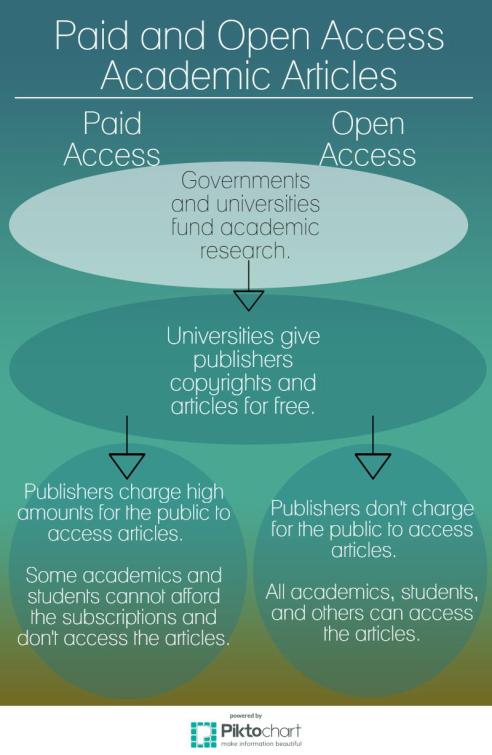
Advantages and Disadvantages for Content Producers Making their Materials Freely Available Online

When knowledge is shared freely and without most licensing restrictions, it constitutes as open access.  As a student, I often wish more articles are open access! Paid and open access academic articles work in different ways, my Piktochart image shows this: Video X advocates for open access in academia, stating: “students’ educations literally depend on access to the journal literature… professors can only teach what they have access to”. Continue reading →

Open Access

For many years, getting access to exclusive scientific research was an expensive and difficult thing to do. Not only was it expensive, but once you paid that outrageous price, whether it was relevant or not was also an issue. With the the ever-improving and developing technology, open access has become a popular way to easily publish your work. Open access is scientific and technological information that is available to all. Continue reading →

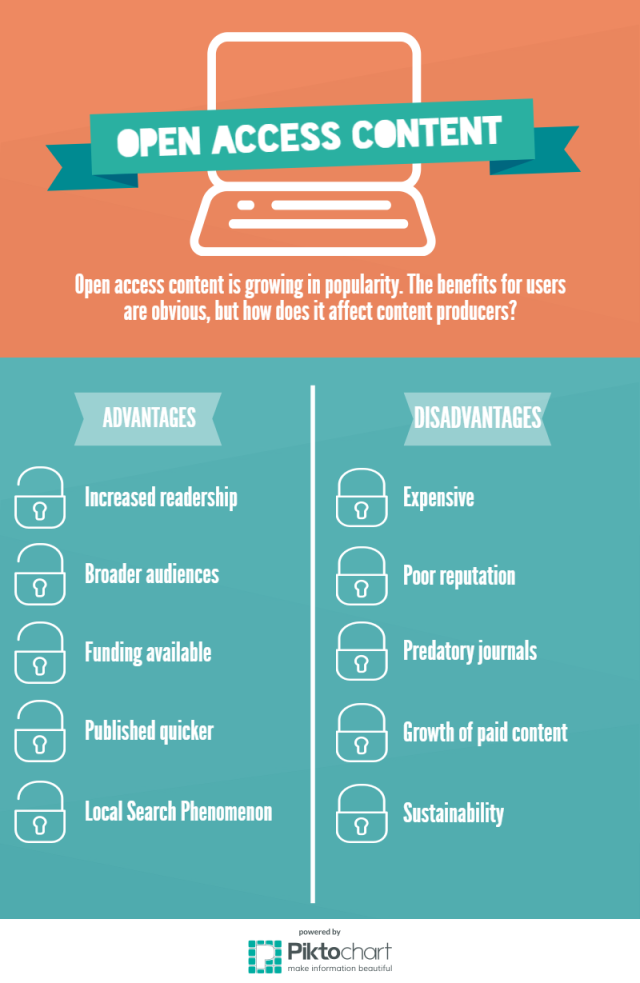
The advantages and disadvantages to a content producer of making their materials freely available online.

    Once again, a very relevant and current subject matter. Particularly for people who fall under the category of education and research. Although this topic can be argued either way, I personally believe that content producers should make their materials freely available online. However, I will also discuss the disadvantages of this. Continue reading →

Topic 4 Reflection

This week’s topic looked at ethical issues & social media. With such a wide range of responses this really opened my eyes to the unethical practices of some businesses. Haley’s post raised an important issue of misleading advertising to increase sales & gain more recognition. As Ellie also admits, many people will read reviews before they buy things or look to people who recommend products, but this becomes an issue when it is fake or paid advertising. Continue reading →

Topic 4: Reflections

This week, we were given the task of exploring the ethical issues that arise through business or educational use of social media. This topic triggered a broad range of topics to be discussed by fellow #UOSM2008 students, however my post focused on the issue of digital footprints that accumulate from using social media in education. I thoroughly enjoyed researching this topic and reading the different perspectives that everyone had explored. Continue reading →

Topic 4: Reflections

This week, we were given the task of exploring the ethical issues that arise through business or educational use of social media. This topic triggered a broad range of topics to be discussed by fellow #UOSM2008 students, however my post focused on the issue of digital footprints that accumulate from using social media in education. I thoroughly enjoyed researching this topic and reading the different perspectives that everyone had explored. Continue reading →

Topic 4: Summary

In the choice of topic this week, I chose to write a blog post on the digital divide. This is an important topic for me that I feel is a very important issue today. As I mentioned, the digital divide describes the difference in access or use of the Internet; such as phycsial access disparity between countries, or the difference in ability to effectively use the resources to complete a goal. Continue reading →