Currently browsing category

2016, Page 14

Topic 2: Is holding multiple identities the way to achieve anonymity?

With contrasting opinions on whether individuals should adopt multiple online identities, Facebook and 4Chan have created social media platforms that differ in the extent to which an individual can achieve anonymity. Whilst 4Chan users don’t even need to register an account to use the site, Facebook has constantly searched for ways to improve the authenticity of its users and the recent acquisition of Instagram highlights this (Krotoski 2012). Continue reading →

Should I Build Another ‘Me’ Online?

Your identity is the main way you represent yourself when interacting with others, and it is what make you unique. However, there is a difference between your real-life identity and an online identity you might have.   Firstly, let’s just clarify what online identity actually is. Your online identity, also known as Internet identity (IID), is the group of characteristics and social identity that a user creates when interacting with online communities. Continue reading →

You Are What You Share

As a marketing student I learn first hand the importance of a single online identity. Paid advertising relies on consumers to show behaviours in order to raise profits from their advertising space. When multiple online identities are formed this becomes difficult and results in unsuccessful marketing investments (Vronay, 2014). Zuckerberg has a rather fascist view on identities. His brainchild contractually binds you into having just one in their terms of service under clause 4. Continue reading →

Multiple Online Identities: who are you really?

Whilst some individuals are wary of revealing merely one online identity, there is much debate over having multiple. Many (including Facebook creators) believe that authenticity, which describes the genuine nature of one’s online persona, is greatly important in online networking. Others believe that individuals are multifaceted; which is creatively reflected when anonymity is maintained, and allows people to explore avenues when not restricted by their names or “real” identities. Continue reading →

Reflection on Topic 1

Since posting my summary on Digital Visitors and Digital Residents, I have read the views presented on the blogs of others and been presented with things I had not considered before. The most interesting to me was the statement on Agnieszka’s blog that one’s position on the visitor/resident spectrum is likely to change at different stages in one’s lifetime. My current position being closer towards the resident end is due to my current situation. Continue reading →

Reflecting on Topic 1

Looking back at topic 1, I have developed my understanding of what digital residents and visitors are, how they can be identified and whether there are any other contrastingly concepts or theories, such as Prensky, which can deepen our understanding of how we identify ourselves whilst online. I see myself as definitely more of a resident, rather than visitor. Continue reading →

Topic One: My reflections

The first topic on this course prompted us to contextualise the terms “Digital Migrants” and “Digital Residents.” These terms had evolved from Prensky’s (2001) “Digital Natives” and “Digital Immigrants” however these original definitions appeared quite outdated and quite generalised. White and Cornu (2011) therefore developed Prensky’s original terms and highlighted that online activity is not determined by age, contrary to his beliefs. Continue reading →

Reflecting on Digital Visitors and Residents

Topic 1, ‘Digital Visitors and Residents’, allowed me to broaden my knowledge of this subject through my own research and blog post. I thought I had read extensively and taken into account a range of opinions until I started to engage with others and read their work. I hadn’t even began to realise that there is so much more to the concept of digital visitors and residents than it first seems. Continue reading →

Reflecting on Topic 1

One of the key points that I have learnt from topic 1 is that the distinction between the two categories boils down to individuals engaging with the internet differently. Holly’s post likened digital visitor’s use of the internet as a vacation and residents use to a world traveller which is a good metaphor for the distinction between the groups. Continue reading →

Topic One: Reflection

With the task of writing just a few hundred words around such a topic as this, it was a pleasant surprise to see the variation in how people approached the topic of digital visitors and residents. Through the initial research I did in preparation for writing my blog post on the topic and then reading my peers’ posts, I learned a lot more about the topic. Continue reading →

Topic 1: Reflective Summary

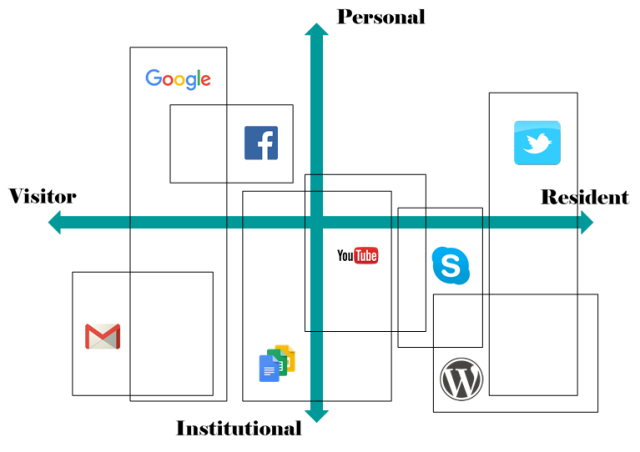
Following from Agnieszka’s example, I realised that it would be very helpful to put together a figure on my own web usage on the visitor/resident and personal/institutional spectrums. This was something I would never have thought of doing it was a really helpful visual tool for understanding where on the spectrum I lie. For the most part, it confirmed what I guessed which was that where my behaviour lies on the spectrum varies depending on the context in which I am acting. Continue reading →