Currently browsing

2016, Page 18

Topic 1: Reflection

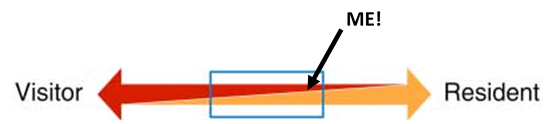
Although Topic 1 was about us dipping our toes into the blogging water, it had a great impact on me. At first I was more focused on creating a clear image of what “digital residents” and “digital visitors” are. I read through Prensky’s, Le Cornu, and White’s papers so I could understand their theories. What I came to realise was that the hard part was not the research, but the self-evaluation. Applying the theories you read about, to yourself and seeing how you fit the picture. Continue reading →

Finishing off Topic 1

Hi everyone Don’t forget that your two comments should be posted by close of play Wednesday (17th) and your reflective summaries are due by end of Sunday (21st). You will then get individual feedback on Topic 1 as a whole by end of play on Tuesday 23rd. Don’t forget that you need to give your posts a Category of “Topic 1″ in order for them to display in the right section of the module blog. If you can’t see your work coming through to it, please check this issue out. Continue reading →

Digital Residents and Digital Visitors

Prensky (2001) formulated the original theory surrounding the different digital competency levels people can have, sparking theoretical development of this topic.  He used observational methods on his students to formulate his theory about from when digital technology rapidly developed and was introduced to the general public.  The Digital Natives grew up within a technological culture and naturally learnt about digital technology alongside other skills like playing with manual toys. Continue reading →

Digital ‘Visitors’ and ‘Residents.’

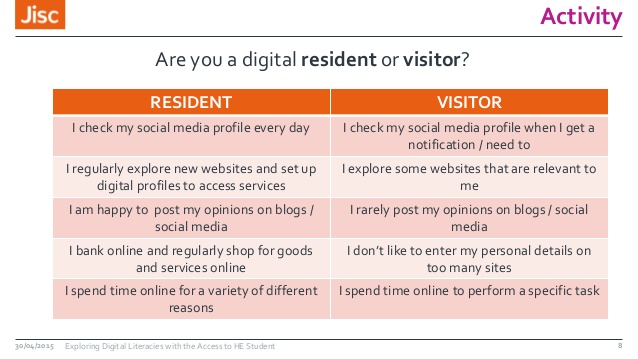
The terms ‘Digital Visitors’ and ‘Digital residents’ may sound alien to the majority of people however everyone who uses the internet will fall into one category. Let’s start off with a basic definition of both, as explained by White, D. S., & Cornu, A. L. (2011): Photo Credits Visitors: This describes an individual who will only use the internet when they need it such as a basic google search for information, to make online bookings, or to do general research. Continue reading →

Digital Visitors & Digital Residents

Prensky (2001) illustrates the difference between what he sees as two distinct types of tech and Web users: digital natives, and digital immigrants. Those who fall into the former category are people young enough to have grown up in a period when modern technology and the Web are already pervasive and established aspects of life; in fact they are so familiar with it, it is almost as if they have learned its use as instinctively as they learned their primary language. Continue reading →

Are you a digital resident or a digital visitor?

Prensky’s theory Prensky’s theory classifies individuals as digital natives and digital immigrants. Digital natives are defined as young people who are experts at using technology due to growing up in the digital world; whereas, a digital immigrant is defined as an older person who struggles with modern technology. This theory purely classifies people in terms of their age and background and does not consider other determining factors of an individual’s technological expertise. Continue reading →

Digital Visitors and Residents

Are you a digital visitor or resident? Before researching this topic I didn’t even know what a digital visitor or resident was, let alone which category I fitted into. Our use of the internet and the growth of a digital society has made way for many theories about computer competency. Prensky’s theory proposes two distinct digital groups: natives and immigrants. Digital Natives are those who have grown up in a digital age and are native speakers of the digital language. Continue reading →

Hi, do you live in Digital Town?

We live in a place today where digital technology has become a norm and is simply integrated into our lives without much thinking about it. From the first moment we wake up, instead of having an alarm clock, our smartphone greets us with endless scrolling through Instagram, before realising we are going to be late for whatever we have planned. However, within society for some this norm is not natural to them. This is where the divide between the types of users of technology is created. Continue reading →

Topic 1. ‘Visitors’ v ‘Residents’

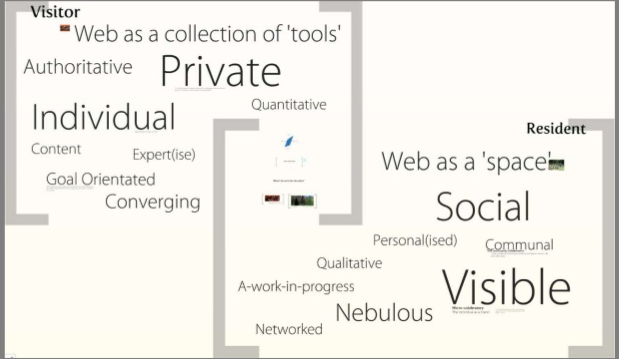
The White and Cornu’s (2011) ‘visitors and residents’ typology is based on different styles of using the Internet, the Web in particular, by individuals. The authors of the article conceptualised the Web using the metaphores of ‘tool’ and ‘place’. The Web as a ‘tool’ means using online resources to achieve a goal, whether is it shopping, searching for jobs or watching YouTube videos. Continue reading →

Topic 1: Digital ‘Visitors’ and Digital ‘Residents’

Prensky’s (2001) ‘immigrant’ and ‘natives’ theory likened the use of technology to a language, where if you grew up with it you were ‘native’ and if you didn’t, you were labelled an ‘immigrant’ as the way you would interact with technology would mirror a second language. In contrast, White and Le Cornu’s (2011) ‘Visitors’ and ‘Residents’ concept does not make assumptions based on age or technical skill, but only an individual’s motivation to engage online. Continue reading →

Are we simply residents or visitors?

We have already made a start to 2016 and are continuously seeing the steady growth of internet users, however, we aren’t always aware of the reasoning behind these uses. Sometimes we assume that people are simply living on the internet, but in some cases are focus on finding information. White (2008), outline 2 distinct categories of internet users. Continue reading →

Topic 1: Digital Visitors and Digital Residents

Prensky (2001) defined digital natives as those who grew up with technology and intuitively have an ability to efficiently utilise technology and the internet. This is in contrast with digital immigrants, people from an older generation that are just now learning how to use technology and as a result, cannot skilfully utilise it. After reading about the digital immigrant definition, I instantly thought about my IT illiterate parents. Continue reading →

The Move to Digital Residents and Visitors

Topic 1 of UOSM2008 focuses on the idea of digital ‘visitors’ and ‘residents’ – a framework I’d never actually come across until this week. Digital Natives and Immigrants to Residents and Visitors The development of the new terms ‘digital residents’ and ‘digital visitors’ to replace the outdated ‘digital natives’ and ‘digital immigrants’ has definitely become necessary to create a better understanding of the way individuals engage with the web. Continue reading →

Silver Surfers and Digital Babies

Until now the idea of a new generation of native digital speakers (White and Alison Le Cornu, 2011) was not far fetched from what I’ve experienced. My grandfather’s collection of encyclopaedias is the idea of ancient history for many 90’s kids, to which Google was their first word. The younger generations innate ability to use digital means was introduced by Prensky (White, 2014) as a ‘native’. Continue reading →