
Currently browsing

2016, Page 16

Reflecting on Topic 1

Looking back at topic 1, I have developed my understanding of what digital residents and visitors are, how they can be identified and whether there are any other contrastingly concepts or theories, such as Prensky, which can deepen our understanding of how we identify ourselves whilst online. I see myself as definitely more of a resident, rather than visitor. Continue reading →

Topic One: My reflections

The first topic on this course prompted us to contextualise the terms “Digital Migrants” and “Digital Residents.” These terms had evolved from Prensky’s (2001) “Digital Natives” and “Digital Immigrants” however these original definitions appeared quite outdated and quite generalised. White and Cornu (2011) therefore developed Prensky’s original terms and highlighted that online activity is not determined by age, contrary to his beliefs. Continue reading →

Reflecting on Digital Visitors and Residents

Topic 1, ‘Digital Visitors and Residents’, allowed me to broaden my knowledge of this subject through my own research and blog post. I thought I had read extensively and taken into account a range of opinions until I started to engage with others and read their work. I hadn’t even began to realise that there is so much more to the concept of digital visitors and residents than it first seems. Continue reading →

Reflecting on Topic 1

One of the key points that I have learnt from topic 1 is that the distinction between the two categories boils down to individuals engaging with the internet differently. Holly’s post likened digital visitor’s use of the internet as a vacation and residents use to a world traveller which is a good metaphor for the distinction between the groups. Continue reading →

Reflecting on Topic 1

One of the key points that I have learnt from topic 1 is that the distinction between the two categories boils down to individuals engaging with the internet differently. Holly’s post likened digital visitor’s use of the internet as a vacation and residents use to a world traveller which is a good metaphor for the distinction between the groups. Continue reading →

Topic One: Reflection

With the task of writing just a few hundred words around such a topic as this, it was a pleasant surprise to see the variation in how people approached the topic of digital visitors and residents. Through the initial research I did in preparation for writing my blog post on the topic and then reading my peers’ posts, I learned a lot more about the topic. Continue reading →

Topic 1: Reflective Summary

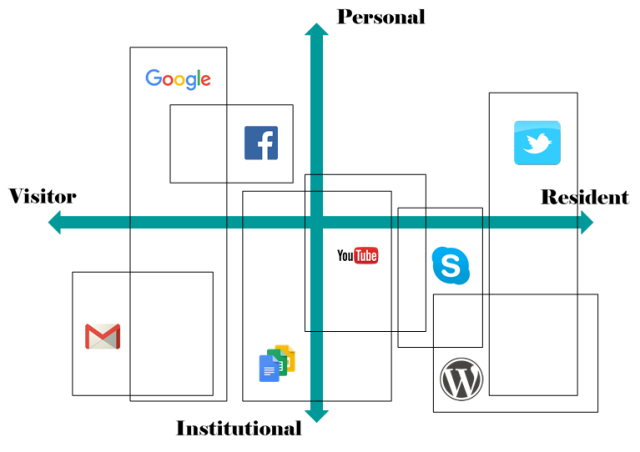
Following from Agnieszka’s example, I realised that it would be very helpful to put together a figure on my own web usage on the visitor/resident and personal/institutional spectrums. This was something I would never have thought of doing it was a really helpful visual tool for understanding where on the spectrum I lie. For the most part, it confirmed what I guessed which was that where my behaviour lies on the spectrum varies depending on the context in which I am acting. Continue reading →

Topic 1: Reflections

For this week’s topic, we were given the task of explaining the concepts Digital ‘visitors’ and ‘residents’. These terms originally seemed new to me until I realized that they were developments which had been made to the infamous terms of Digital ‘natives’ and ‘immigrants’ popularized by Prensky. Continue reading →

Topic 1: Reflections

For this week’s topic, we were given the task of explaining the concepts Digital ‘visitors’ and ‘residents’. These terms originally seemed new to me until I realized that they were developments which had been made to the infamous terms of Digital ‘natives’ and ‘immigrants’ popularized by Prensky. Continue reading →

Topic 1: Reflective Account

Topic 1 has come to an end. Initially I agreed with the definition of digital natives and immigrants outlined by Prensky (2001), using my parents as examples of digital immigrants. However through further reading and debate, I have accepted White and Conru’s (2011) visitor and resident analogy. My colleague, Clayton has a lot of experience with the internet through his course, in comparison to my lack of experience, I would define him as a clear digital resident. Continue reading →

Digital Residents and Visitors: Reflection

Last week I wrote a post about Digital Residents and Visitors which was a new concept to me and I found it interesting to learn about. After reading some more blogs on the topic and replying to some comments on my own, I’ve learnt a little more on the topic. Firstly, Clayton brought up an interesting point about teachers may find it hard to teach a generation of children who “speak a different language”. Continue reading →

Topic 1: Reflection

Originally, I thought I had grasped the concept of visitors and residents perfectly. Little did I know there would be more to learn from reading the blog posts of my peers. Although we were given the same task, the nature of online education and personal learning networks ensured that all of our content was different! Ellies’ post incorporated the idea of digital ‘lurkers’ who are present online but do not post or engage. Continue reading →

Topic 1: Reflection

When I wrote my blog post for this topic, I believed that I had a pretty solid grasp on the idea of “Digital Visitors” and “Digital Residents”, and how these had been created following on from Prensky’s ideas of “Digital Natives” and “Digital Immigrants”. However, during the two weeks that have passed during this topic, and collaboration that has occurred with my peers, my understanding has been altered. I received three very insightful comments on my blog post. Continue reading →

TOPIC 1: Reflection

  I must admit, I never really thought it was necessary to have such a framework as ‘Digital Visitors and Residents’, however after researching myself but particularly after reading  other students blogs on the topic, I’ve changed my mind. For me, it was really interesting to see how ‘Digital Visitors and Residents’ affects employers, social media but above all learning techniques on the web. Continue reading →

Reflecting back on Topic 1 (UOSM2008)

Topic 1 drew upon a new framework for Web engagement proposed by White and Cornu – the use of the terms digital ‘residents’ and ‘visitors’. This acts as a replacement for Prensky’s original idea of digital ‘natives’ and ‘immigrants’ which based the categorisation of Web users primarily on their age, suggesting younger people are the ‘natives’ of the digital world. Continue reading →

Reflective post 1

At the beginning of the 21st century, Mark Prensky found that internet users can be identified either as digital native, which represent all the 90’s kids and younger generation that were born into the digital world, or digital immigrants, which would not possess all the natural abilities of the younger generation for using internet. Continue reading →

Reflecting on Digital Visitors and Residents

I’ve discussed the differences in digital competencies of family and friends before, but never knew that there were theories surrounding this until this module.  I’ve since found myself analysing my friends’ online behaviour more, and classifying them as either Digital Residents or Digital Visitors (White and Cornu).  I also looked at my own past online behaviour, mainly through looking at my Facebook timeline, and classified myself as a Digital Resident. Continue reading →

Reflecting on Digital Visitors and Residents

I’ve discussed the differences in digital competencies of family and friends before, but never knew that there were theories surrounding this until this module.  I’ve since found myself analysing my friends’ online behaviour more, and classifying them as either Digital Residents or Digital Visitors (White and Cornu).  I also looked at my own past online behaviour, mainly through looking at my Facebook timeline, and classified myself as a Digital Resident. Continue reading →