Art, Matter and Making

PIRG-image_NSB

Noriko Suzuki-Bosco

07 March 2016

The reading material selected for this PIRG session, ‘New Bachelards?: Reveries, Elements and Twenty-First Century Materialism’ by James L. Smith, looked to understand some of the cross resonance between the philosophy of Gaston Bachelard and the materialism of the twenty-first century. Smith brought together Bachelard’s philosophy on the interpretation of elements, the poetics of reverie and material imagination with Vibrant Matter: A Political Ecology of Things by Jane Bennett (2010) and Elemental Philosophy: Earth, Air, Fire and Water as Elemental Ideas by David Macauley (2010). The investigation into a new Bachelard emerging from the synthesis of ideas that engaged with a more ‘diffuse, more complex, network of images, an ecological awareness and an ethic of conservation’ (Smith 2012, 165) provided an engaging backdrop for our discussions around material, making and thinking.

According to the emerging trend of new materialists thought, matter is no longer considered to be inert but to hold transformative qualities to be ‘agentive, indeterminate, constantly forming and reforming in unexpected ways.’ (Hickey-Moody and Page 2016, 2). Bennett’s theory of ‘vibrant materialism’ also reinforces the idea that matter as ‘passive stuff, as raw, brute or inert’ is no longer applicable but instead ‘an ability to feel the vitality of the object, be it with the reason or the body, gives the option of a political engagement with the world that avoids deadening or flattening objects or reducing nature to utility.’ (Smith 2012, 158)

The power of matter to exert influence over the human subject makes us reconsider the agential properties of elements. Bennett argues for a world of ‘intimate liveliness and distributed agency’ where human interaction with matter that has ‘affect, bahaviour, vitality and agency’ questions the human-centric theories of action (ibid, 158). In a world such as this, agency is not solely the province of humans but as something that emerge through the configuration of human and non-human forces.

Theoretical physicist and professor of feminist studies Karan Barad’s theory of ‘agential realism’ also echoes the idea of distributed agency. According to Barad, ‘agency is about possibilities for worldly re-configurings’. Agency, therefore, ‘is not something possessed by humans or non-humans but is an ‘enactment’’ (Dolphijn and van der Tuin 2012, 56). Agency, for Barad, is something that emerges through the process of ‘intra-acting’, a term introduced by Barad to conceptualize the action between matters and to propose a new way of thinking causality.

The ‘object-oriented’ philosophy, where matter has power to hold and shape how humans perceive and interact with the world provided context for lively discussion to take place and during the session, we touched on other areas of theory such as Deleuze and Guttari’s idea of ‘whatness and thingness’ (‘A Thousand Plateaus’), the affect theory, Merleau-Ponty’s theory of affordance, Heidegger’s notion of ‘handling’ and ‘understanding’ (‘The Questions Concerning Technology’) as well as feminist theories, namely that of Julia Kristeva and Elizabeth Grosz (‘Volatile Bodies’). Furthermore, contemporary geographical studies were mentioned as reference points to reflect on how our environmental perceptions (how we connected with the world of material stuff) may also be affected by the ways we interact with the material matters of the world.

The discussion developed into thoughts around embodied learning through material pedagogy and ‘material thinking’ (to borrow Paul Carter’s term). According to Hickey-Moody and Page, material pedagogy and materials thinking do not look at learning as a passive process of simply acquiring information but instead conceives learning to be a ‘relational process where theory is entangled with everyday practice’ (Hickey-Moody and Page 2016, 13). Learning through material thinking points to a process of ‘becoming’ through the relational interaction of body and matter, which is different from understanding using cognitive faculties.

As research artists, the idea that materials are not just passive objects to be used instrumentally by artists, but rather the materials and processes of production have their own intelligence that come into play to interact with the artists’ creativity, resonated with all of us and the session concluded with a small collaged postcard-art making workshop in an attempt to ‘join the hand, mind and eye’ (Carter 2004, xiii).

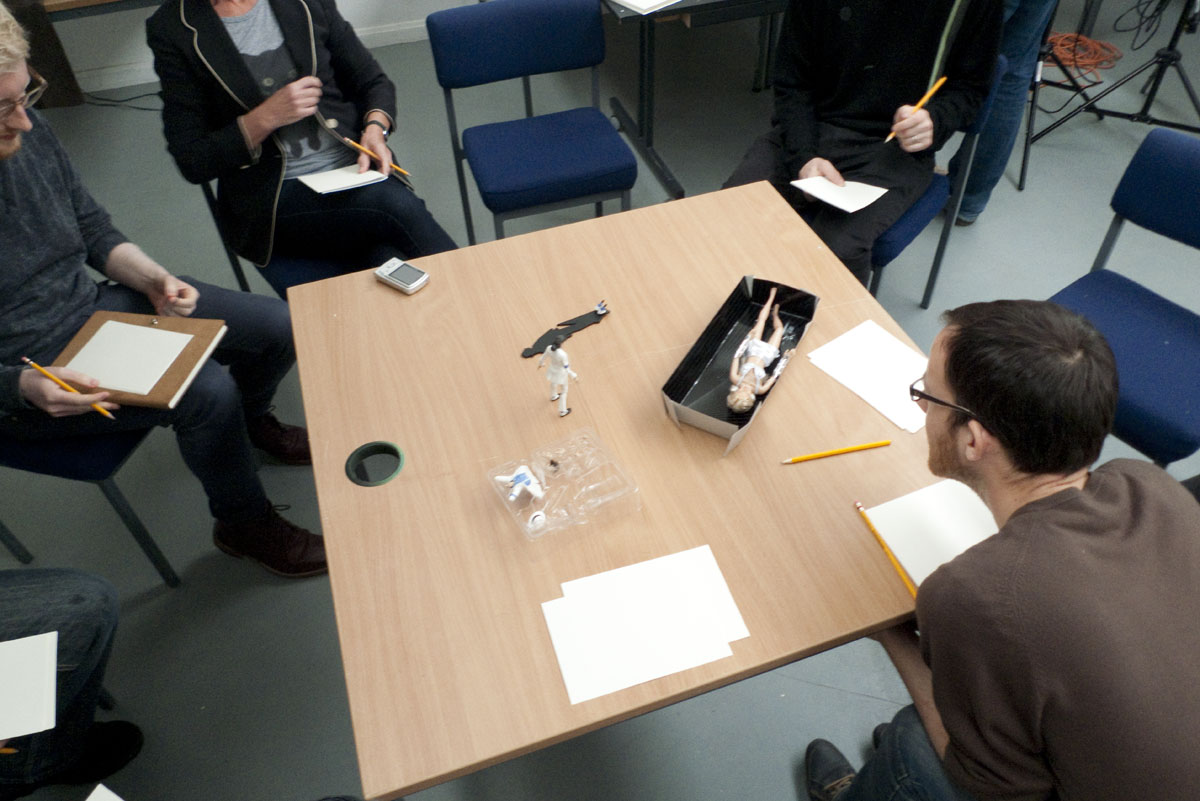
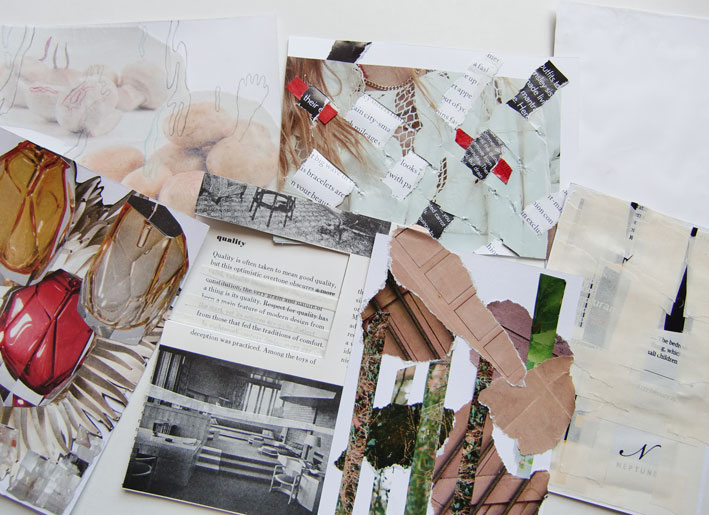
Whilst choosing the materials for the collage, everyone was asked to be conscious about the way they chose the images and handled the materials. We spent around twenty minutes to create the small artworks which was followed by a presentation of the works around the table and a short discussion. The presentation revealed interesting insights into how the artist’s mind worked during the process of making. Intuition seemed to be backed up with certain habitual characteristics for choosing colours and textures of the materials as well as how they were physically handled.

Studies around new materialism and material thinking offer rich grounds to think about our relationship with the material world around us. As we learn more about the world that surrounds us, we proceed to learn how to better correspond with it. As Tim Ingold emphasizes, ‘the mind is very much connected with the body where the thinking corresponds to what is happening to the material.’ (Ingold 2013, 7). The potentials of relational interaction between human and non-human matter that new materialists draw out are exciting perspective to broaden and transform our sense of Being in the world.

References (including materials mentioned during the meeting)

Barad, K. Meeting the Universe Halfway: Quantum Physics and the Entanglement of Matter and Meaning, Durham: Duke University Press, 2007.

Berberich, C., Campbell, N. and Hudson, R. (eds), Affective Landscapes in Literature, Art and Everyday Life: Memory, Place and the Senses, Burlington, VT: Ashgate, 2015.

Best, S. Visualizing Feeling: Affect and the Feminine Avant-garde, London: I.B. Tauris, 2011.

Carter, P. Material Thinking: The Theory and Practice of Creative Research, Melbourne: Melbourne University Press, 2004.

Crouch, D. Flirting with Space: Journeys with Creativity, Burlington: Ashgate, 2010.

Deleuze, G. and Guttari, F. A Thousand Plateaus: Capitalism and Schizophrenia, London: Althorne Press, 1988.

Dolphijn, R. and van der Tuin, I. New Materialism: Interviews and Cartographies, Ann Arbor: Open Humanities Press, 2012.

Gauntlett, D. Making is Connecting: The Social Meaning of Creativity from DIY and Knitting to YouTube and Web 2.0, Cambridge: Polity Press, 2011.

Grosz, E. Volatile Bodies, Bloomington: Indiana University Press, 1994.

Hawkins, H. For Creative Geographies: Geography, Visual Arts and the Making of Worlds, London: Routledge, 2014.

Hawkins, H. Geographical Aesthetics: Imagining Space, Staging Encounters, London: Routledge, 2015.

Heidegger, M. The Question Concerning Technology and Other Essays, London: Harper and Row, 1977.

Hickey-Moody, A. and Page, T. Arts, Pedagogy and Cultural Resistance: New Materialism, 2016.

Ingold, T. Making: Anthropology, Archaeology, Art and Architecture, 2013.

Macleod, K. and Holdridge, L. ‘The Enactment of Thinking: The Creative Practice Ph.D’ in Journal of Visual Art Practice vol. 4 no. 2 and 3, 2005.

Preston, J. Performing Matter: Interior Surface and Feminist Actions, Baunach, Germany: Spurbuch Verlag, 2014.

Smith, J. ‘New Bachelards?: Reveries, Elements and Twenty-First Century Materialism’ in Altre Modernità (Other Modernities), Numero Speciale Bachelard e la Plasticità della Materia, 2012, pp.156-167.


Plastic Surgery

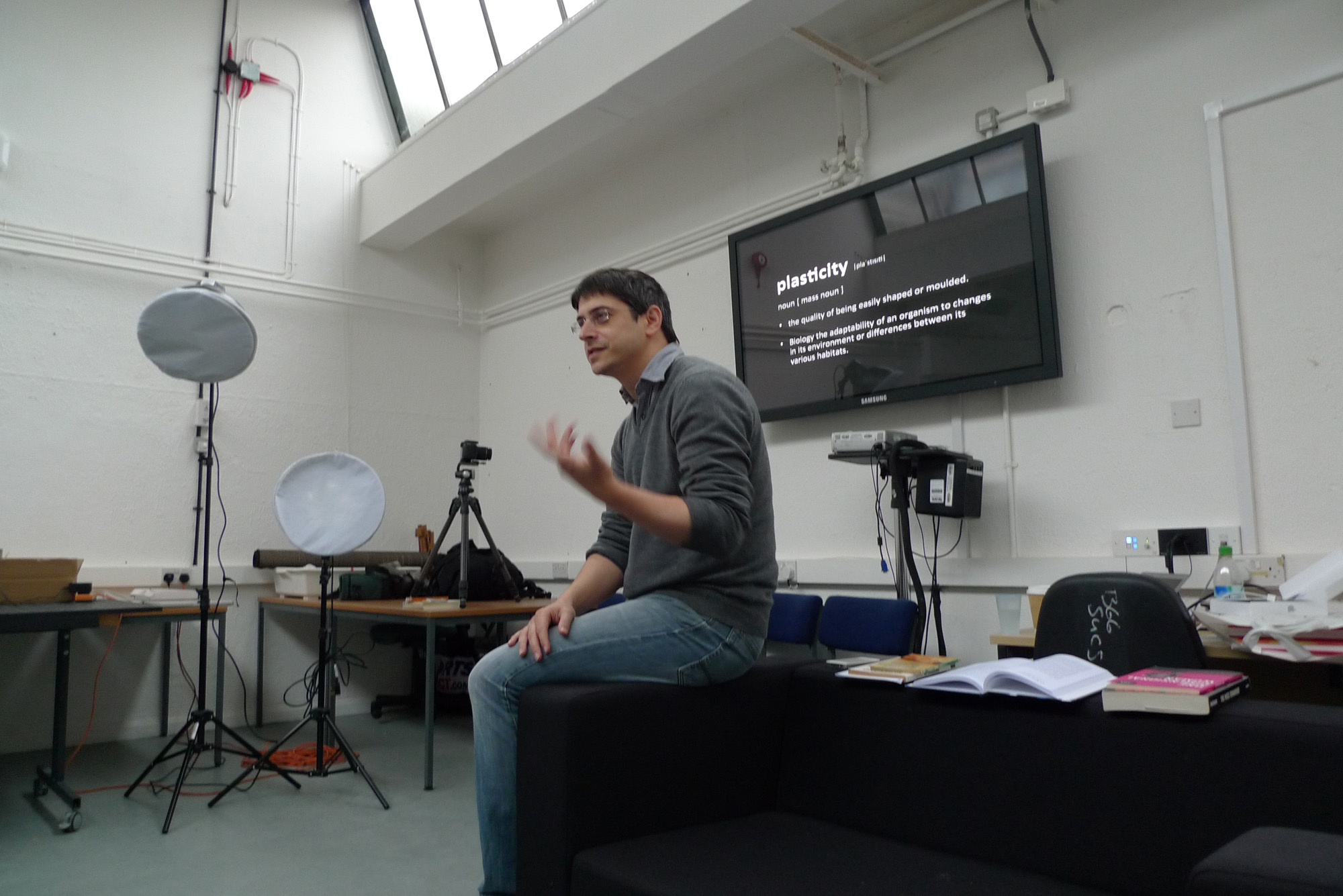
3D printing is now commonplace, and frequently referred to in popular discourse. Controversies arise with the 3D printing of illegal items, such as a working model of a gun, or utopian visions unfold with ideas of 3D printing buildings and aircraft. It is also the case that 3D printing is now increasingly affordable and accessible. However, unless you have had first hand experience of the production of 3D printing there remain many questions and quandaries. The second of the Re: Making seminars, under the title of Plastic Surgery, sought to address this knowledge gap. The two day seminar was primarily led by Ian Dawson (who has many years of experience as a sculptor) and Chris Carter (who regularly teaches many sculptural techniques, including the use of 3D printing). But it was also a collaboration with Sunil Manghani, who introduced the two days and offered a specific ‘prompt’, bringing in plastic toys of Michael Jackson and Kylie Minogue.

The choice of these two figures was on the one hand simply for their associations as icons of ‘plastic pop’. Manghani began by discussing notions of plasticity as it is used in the arts. The term ‘plastic arts’ is perhaps less used now. It refers of course to 3D art, typically as sculpture or bas-relief, that is characterised by three dimensional modelling. However, as a plural term, it was often used to refer also to visual art (as painting, sculpture, or film), and especially as a means to distinguish from ‘written’ art forms (as poetry or music). However, the relationship of plasticity and writing was asserted in the seminar through reference to Roland Barthes’ classic text Mythologies. Originally published in 1957, the book offers short essays on the newly emerging consumer culture, which, postwar, is beginning to grow rapidly, and not least due to new, modernist technologies and processes including plastic. Indeed, one of the entry by Barthes is prompted by a plastics exhibition fair.

Despite having names of Greek shepherds (Polystyrene, Polyvinyl, Polyethylene), plastic … is in essence the stuff of alchemy. […] more than a substance, plastic is the very idea of its infinite transformation; as its everyday name indicates, it is ubiquity made visible. And it is this, in fact, which makes it a miraculous substance: a miracle is always a sudden transformation of nature. Plastic remains impregnated throughout with this wonder: it is less a thing than the trace of movement. […] In the hierarchy of the major poetic substances, it figures as a disgraced material … it embodies none of the genuine produce of the mineral world: foam, fibres, strata. It is a ‘shaped’ substance: whatever its final state, plastic keeps a flocculent appearance, something opaque, creamy and curdled, something powerless ever to achieve the triumphant smoothness of Nature. But what best reveals it for what it is is the sound it gives, at one hallow and flat; its noise is its undoing, as are its colours, for it seems capable of retaining only the most chemical-looking ones. […] Plastic is wholly swallowed up in the fact of being used: ultimately, objects will be invented for the sole pleasure of using them. The hierarchy of substances is abolished: a single one replaces them all: the whole world can be plasticised, and even life itself since, we are told, they are beginning to make plastic aortas. (Roland Barthes, ‘Plastic’ in Mythologies).

It is not just the emergence of plastic as a new material technology that is significant. Mythologies is a key text for the emergence and popularity of Semiology, or the science of the sign. Barthes’ innovation is to lift a concept related to language and linguistic and apply it not only to literature, but also popular culture. Everything is a ‘myth’ and ‘sign’ according to Barthes. As a cultural theory, semiotics, and later the notion of the Text (and intertextuality) thus opens up a whole new ‘plasticity’ of ‘reading’ culture and making meaning within it.

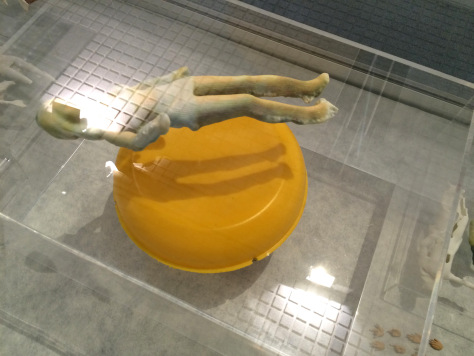
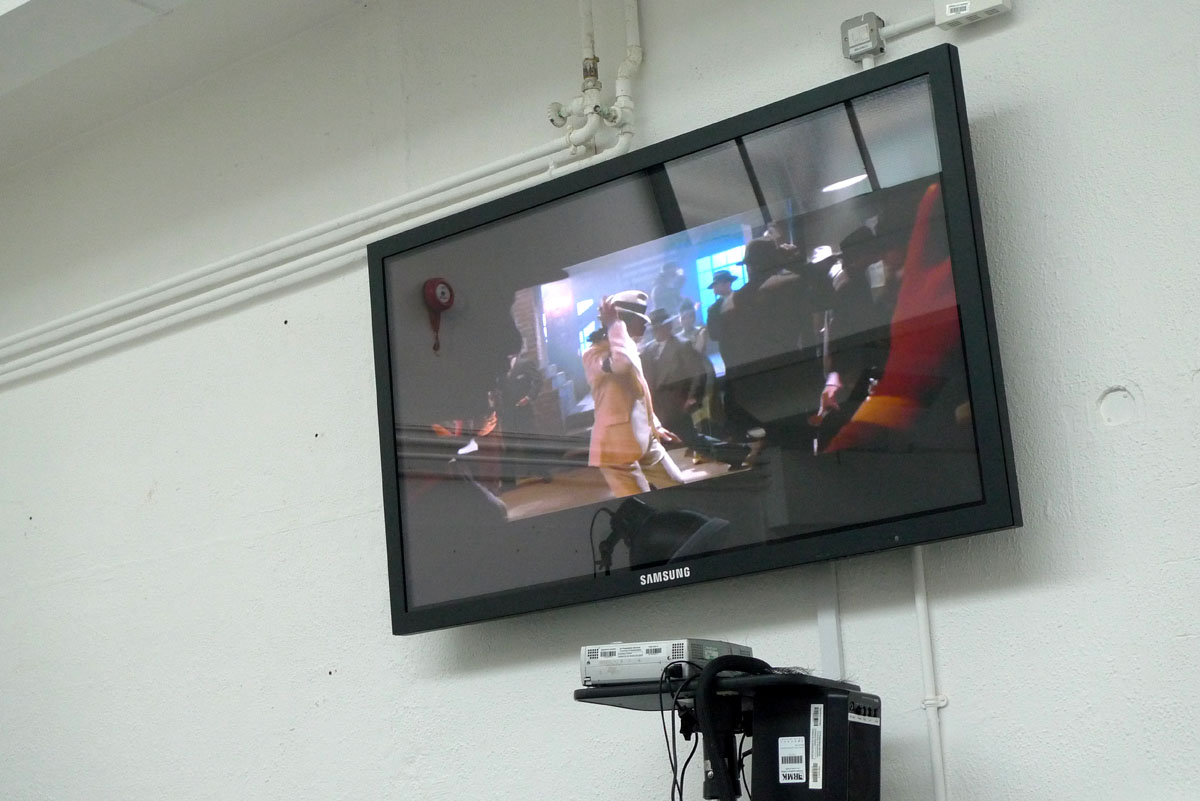
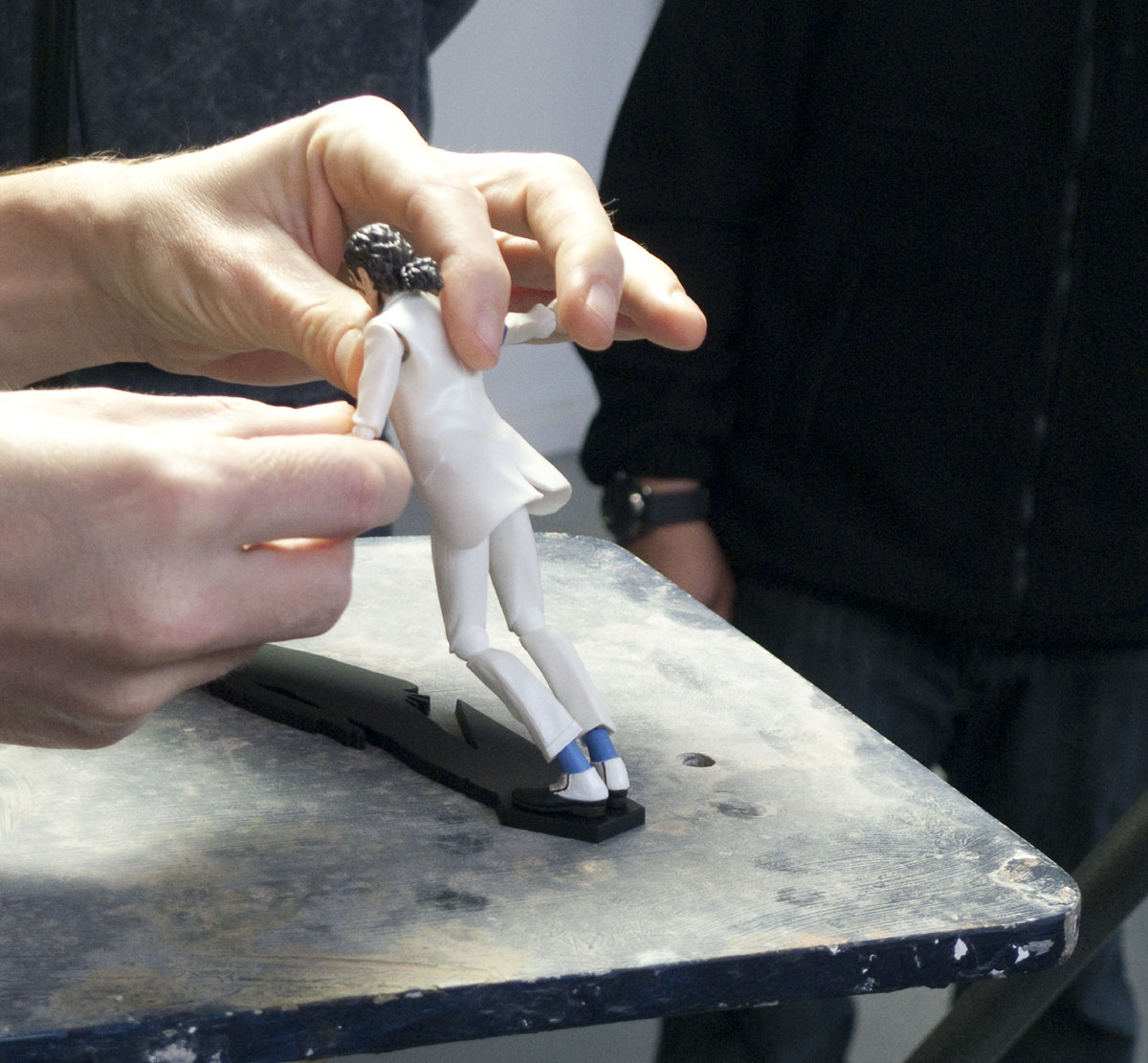
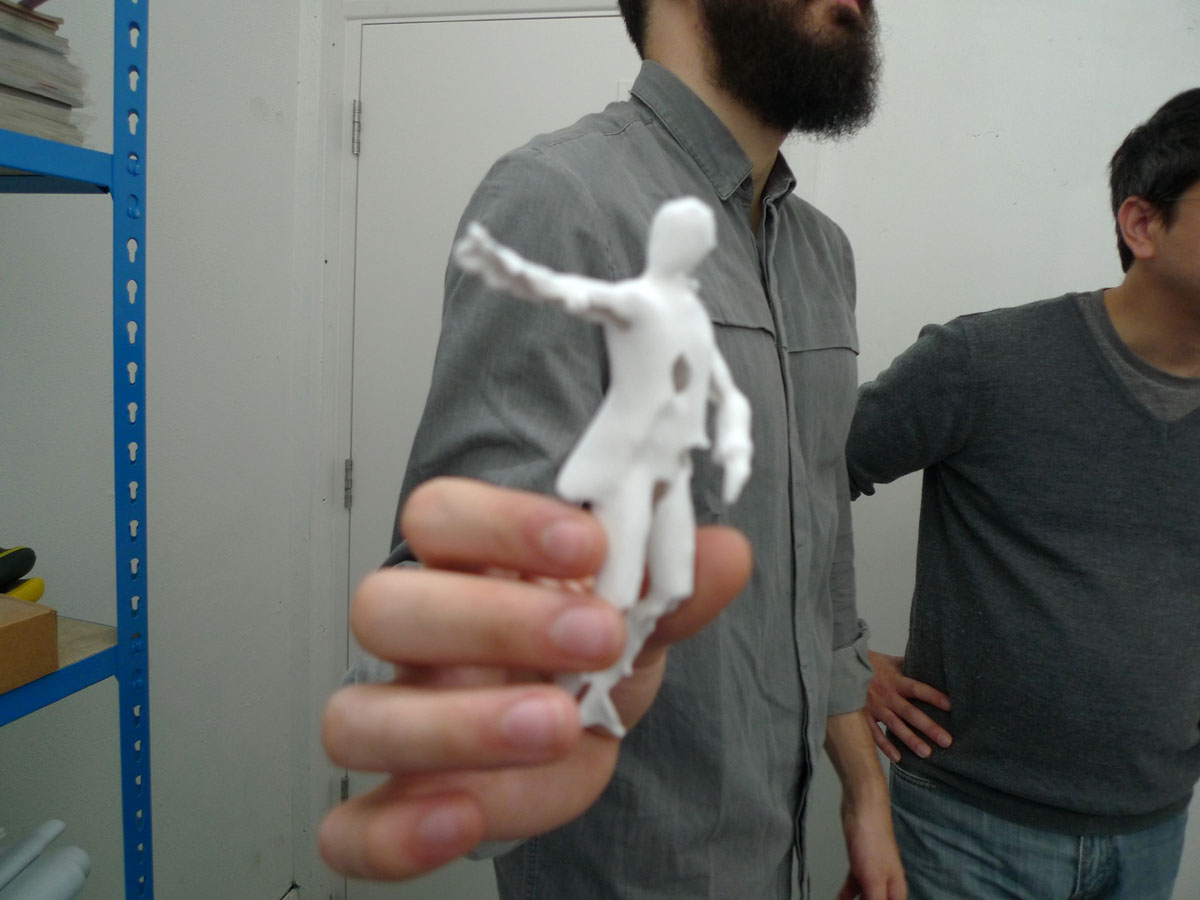
The choice of Michael Jackson and Kylie Minogue is undoubtedly a playful one, but of course connects immediately with the both the ‘trace of movement’ and the hallow and the flat that Barthes refers to with plastic. Jackson was certainly much discussed for this ‘plastic surgery’ (including of course the controversial debate about his skin tone). However, also, his music offers a means for his body to movement in ways that were not seen before (at least not in popular forms). His mooonwalking is the most obvious example, but more generally, his body is a highly fluid and yet sharp ‘medium’ through which he performed. As part of the seminar the video for his Smooth Criminal was screened, which includes a dramatic sequence in which he appears to lean forward beyond the realms of ordinary physics. The plastic model used for the seminar represents Michael Jackson from this video, and even comes complete with various re-attachable hands and feet and a ‘shadow’ stand that allows the figure to lean impossibly forward. The hard plastic of the figure offers a precision rendering of Jackson from his video, which in turn leant itself well to its reproduction through 3D scanning and clay moulding.

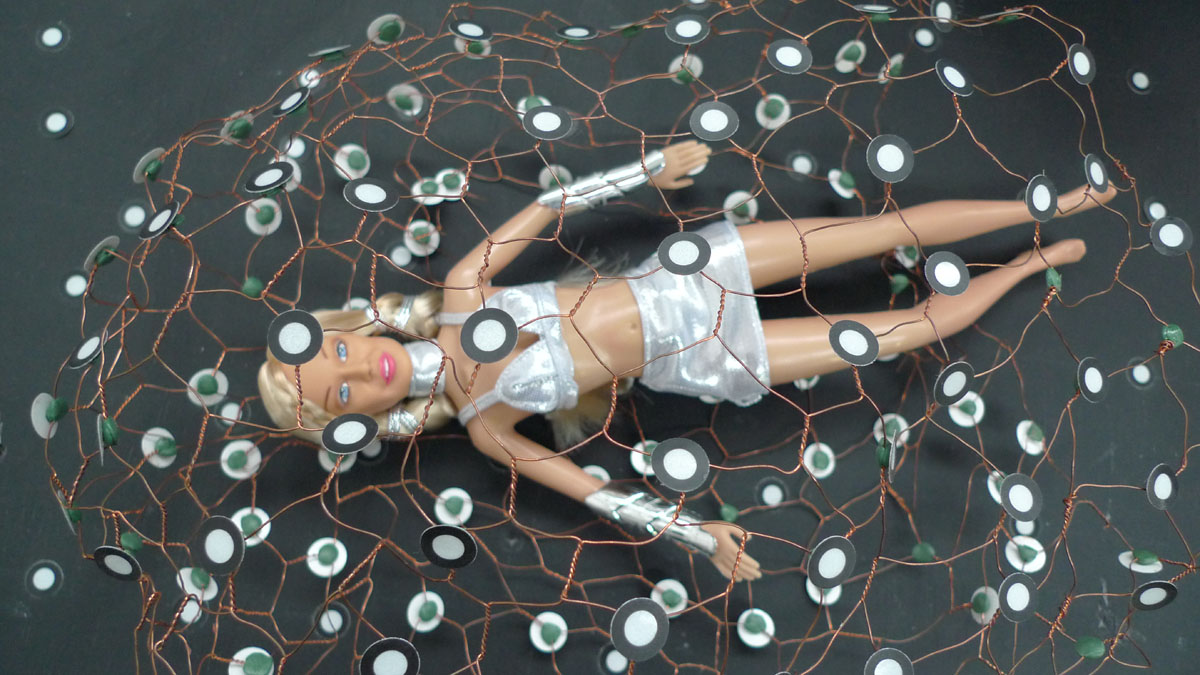
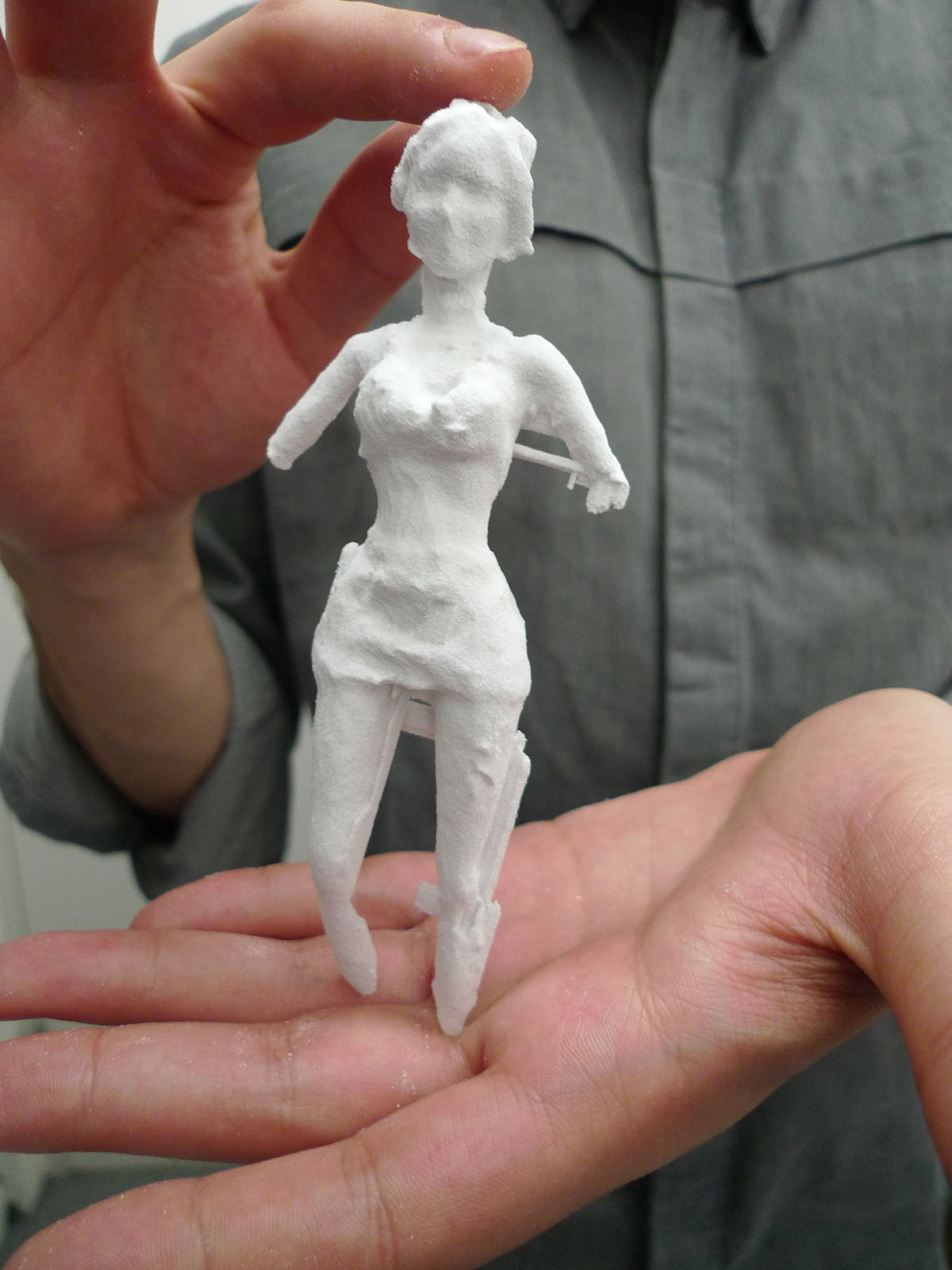
By contrast, a more rubbery doll of Kylie Minogue provided a fairly poor reproduction of her image. Which, in this case, was meant to recall her look c.2001, much associated with her worldwide hit ‘Can’t Get You Out Of My Head‘. The music critic Paul Morley has written a whole book around this video, Words and Music, which begins by making a bold connection between Minogue and Alvin Lucier’s 1969 work ‘I’m Sitting in a Room‘. Morley fascination with Kylie is of a virtual and near-alien creature. In  ‘Can’t Get You Out Of My Head’, she drives effortlessly towards a Ballardian cityscape, the epitome of postmodern pop. During the seminar, a connection was also made to Allen Jones’ pop art, and particularly some of his drawings which develop his play of both bodies and clothes (and genders). Kylie Minogue perhaps represents the other side of digital pop music, with Michael Jackson representing last days of analogue music making. They become intro and outro of form of pop music that is ‘perfected’ by the late 1990s, to the point of sounding hallow and flat.  An additional reason for the reference to Kylie Minogue came through Manghani’s drawing that was originally exhibited at the Practices of Research exhibition, and which was directly related to an entry he contributed to a book reimagining Roland Barthes’ Mythologies (see more). Thus, taken together, the kitsch dolls of Michael Jackson and Kylie Minogue were adopted as ‘models’ to explore simultaneously both physical 3D rendering processes and conceptual understandings of plasticity as evoked by the fine arts and cultural critique.

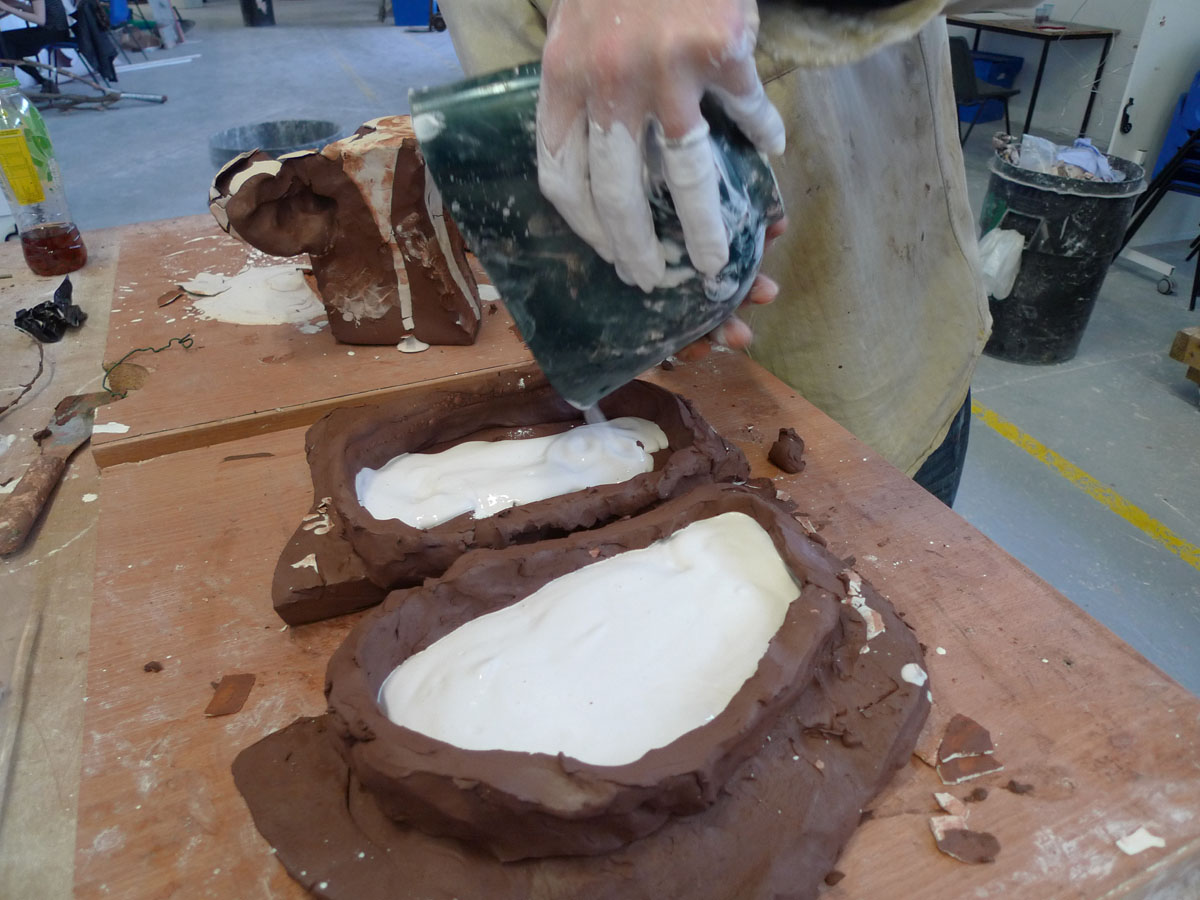
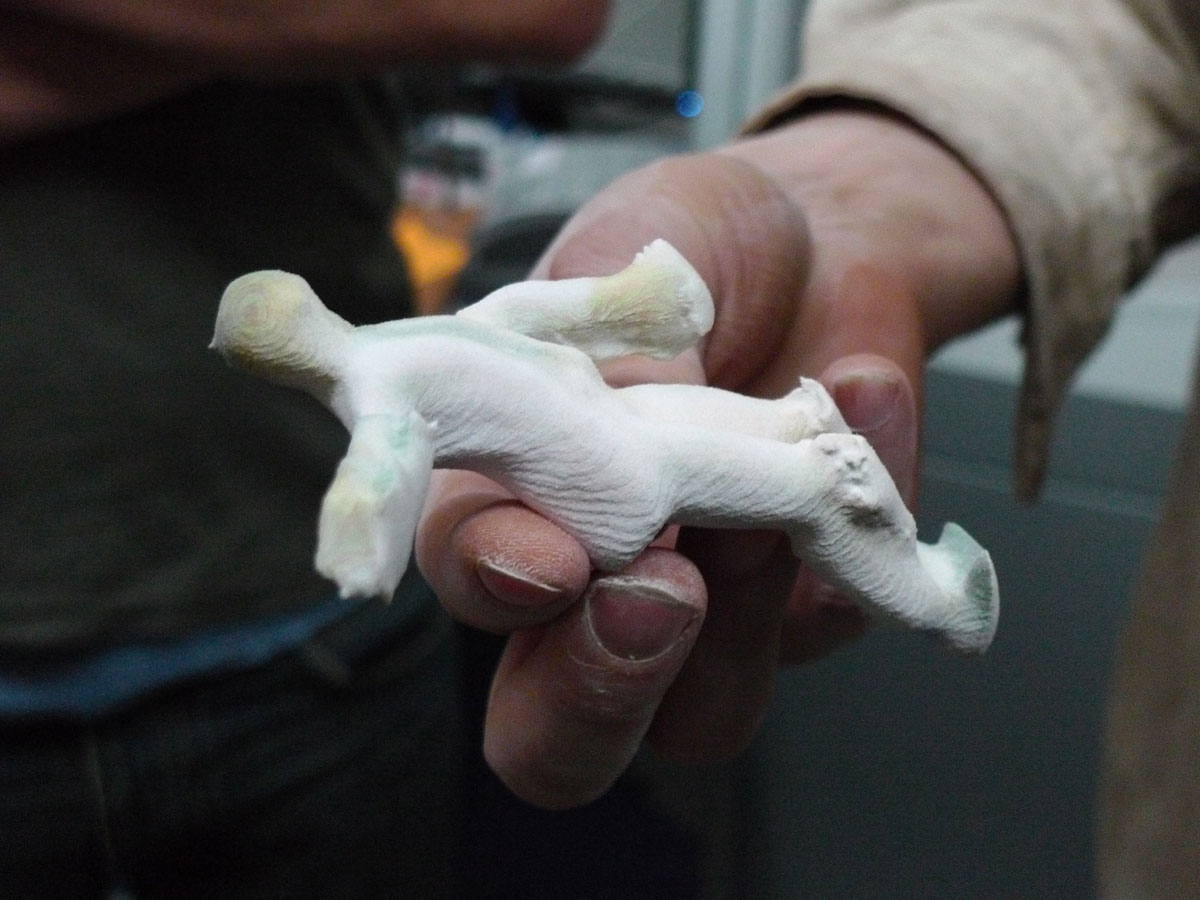
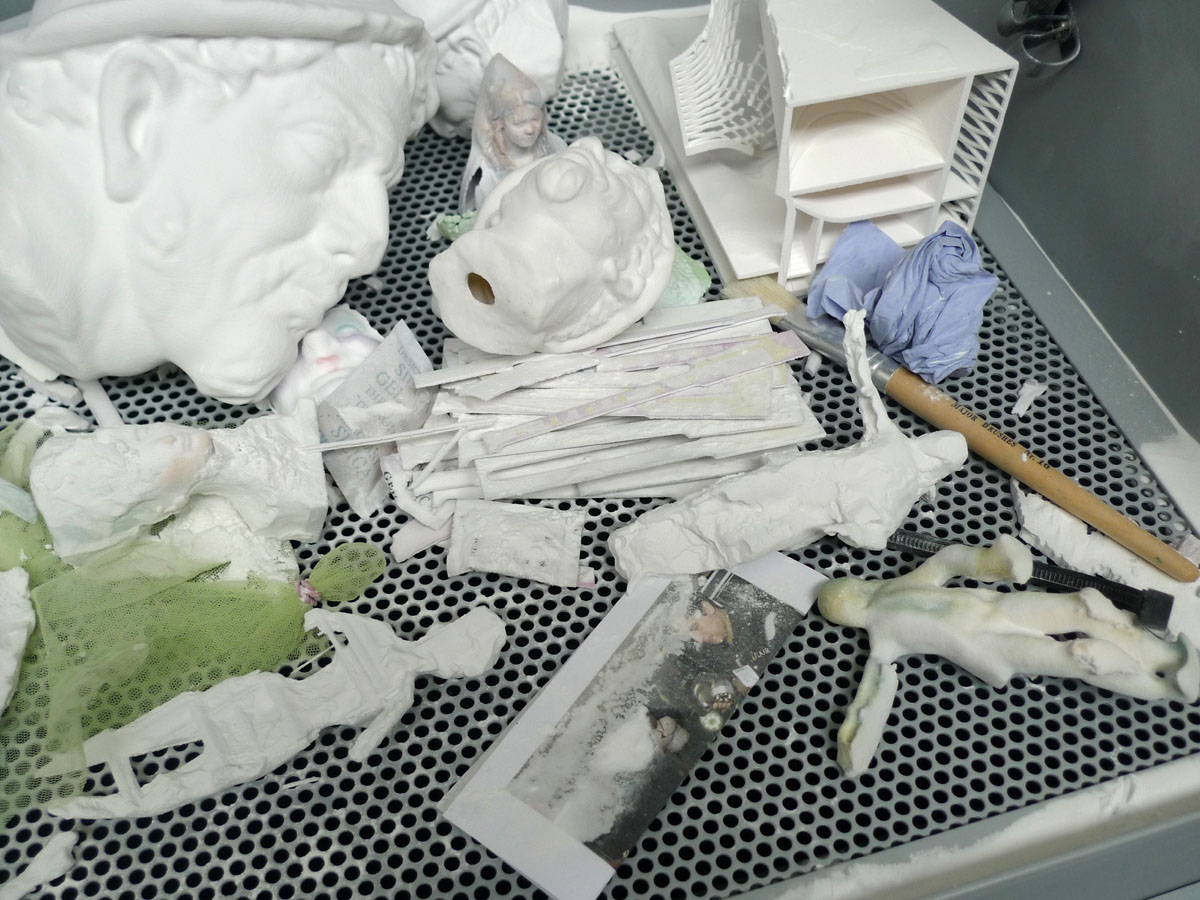
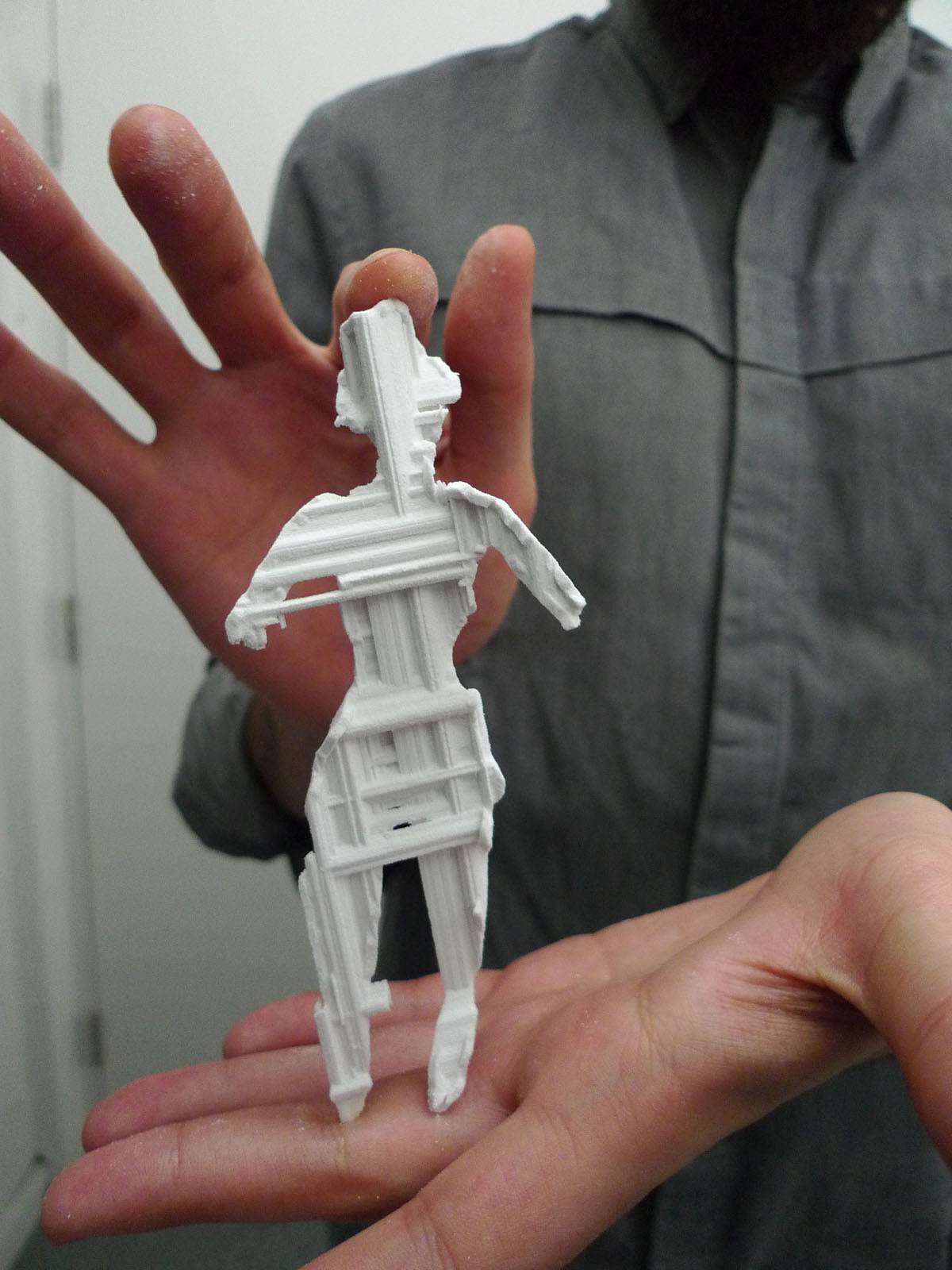
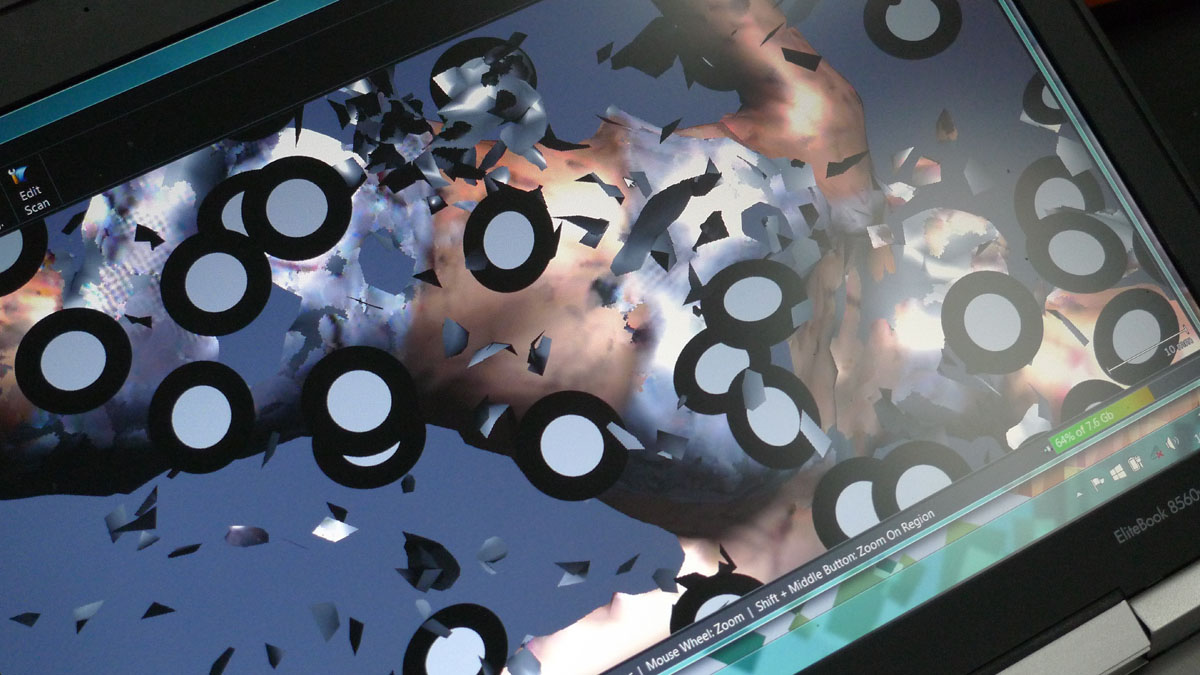
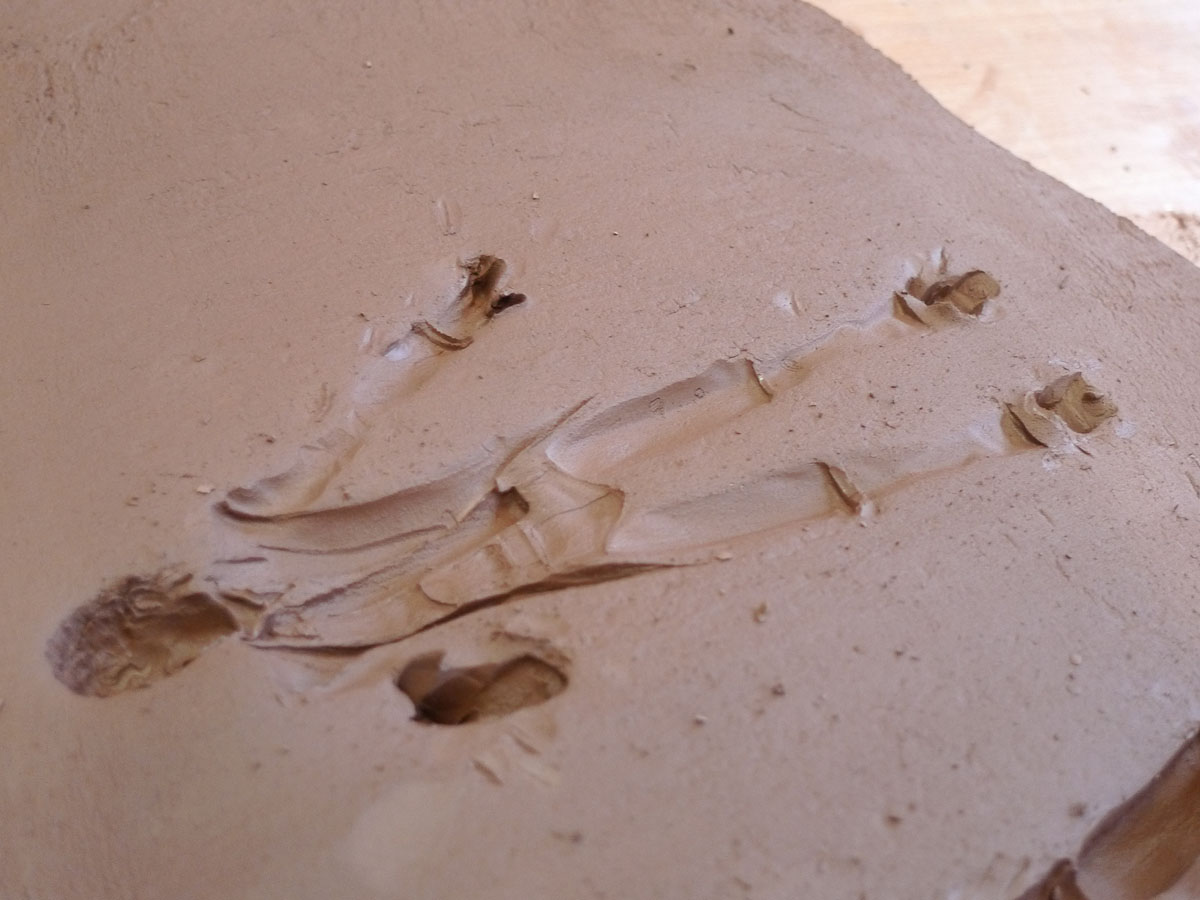
As can be seen with the images included in this post, the seminar worked through a series of different techniques. It began with recording the figures through photographic and digital means for processing in 3D printing softwares. This was a lengthy process, but requiring relatively straightforward and even imprecise means to gain ‘data’ for the softwares to crunch. There is certainly an element of ‘blackbox’ as to how the softwares treat the various inputs to render a three-dimensional figure. However, the process of looking carefully at the models, experimenting with the cameras, lighting and angles prompted lots of discussion and speculation. Working with a sculptor, it was also possibly to think way beyond the narratives that can be played with the two iconic figures and rather consider material processes. It was soon agreed that we need not only to experiment with 3D digital technologies, but also more traditional clay and plastic moulding apparatus. Two very prominent ‘outcomes’ of the seminar were as follows:

an ability to ‘think’ through process and material. Ian Dawson’s insights into the various processes and possibilities soon eclipsed the initial theoretical consideration of the figures. While their was certainly a confluence of ideas, the need to keep making – to operate through iteration, as a means of critical consideration – meant that the figures (and the processes we applied to them) became the real force within our collaborative thinking. It became necessary to try out different techniques and to have the opportunity to bring the various result together as quickly as possibly, which in turn prompted further ideas. The speed with which you can mock-up objects through 3D printing is of course a boon to the sculptor’s methodology.

a material consistency of time and space, or even time-space. From an intuitive way of turning the figures around in your hand to wonder about them, it soon becomes apparent how all of the various techniques for re-making and testing these figures operate through the means of rotation. The video at the top of this post shows the Kylie figure held (on the left) in the rotational moulder, which is a metal set of frames to allow rotation on all axis. On the right, she is shown rendered through 3D software, which again immediately provides the means to rotate in all directions. When a scan is first placed in the software there is no reverse to the image. We are familiar with a sheet of paper having both a front and back. In 3D software the image scan begins with no reverse. As you spin the object it simply disappears. In order to prepare for 3D printing it is necessarily build up the reverse. In a similar way when a mould is placed in the rotating metal frames the ‘object’ has no surface, it is merely outlines by the mould. Liquid plastic is poured in and rotated to gain a even coating, which then effectively gives the object its outside and inside. While all very simple to comprehend the two days of the seminar repeatedly foregrounded this principle and its consistency through many different processes.


Return to Re: Making

Writing as Making

For a final seminar of the autumn semester 2015, Writing as Making, we gathered for two days to work as a community of writers. Picking up from the Practices of Research exhibition that was held in 2014, which presented work of 16 PhD students and two members of staff, the idea for this seminar was again to acknowledge the diversity of research practices but also the fact that a written component must be submitted for all examined research, whether practice-based or not. As the rationale for Practices of Research put it:

Studio-based researchers in art and design work alongside those engaged in humanities and social science research, covering areas of art history, critical theory and curatorial practice, as well as the management and marketing of advertising, design, media, fashion, textiles and luxury branding. All researchers at the School are engaged in the critical making of new knowledge: each moving in and out of complex and disciplined modes of activity. Whether it is reading, writing, looking, making, coding, speaking, recording, and much else besides, each are forms of imaginative and critical engagement, developed and extended within the context of a collaborative and inter-disciplinary research community.

As a form of writing retreat, the primary aim of Writing as Making was to provide dedicated time to write, but also to share in the act of writing, and as such to reflect critically on various strategies. There were three main interventions. Firstly, all participants were asked to consider how at sentence level they pursue a form of critical writing. A simple technique used in schools known as PEA or PEE (Point, Evidence, Analysis, or Explanation) was put before everyone, in effect as a provocation, to question how both arguments and analysis are drawn out from the materials we are citing and synthesising. Like the writing through a stick of rock, are the points we wish to make working their way through each and every sentence. Is there an underlying coherence to our work?

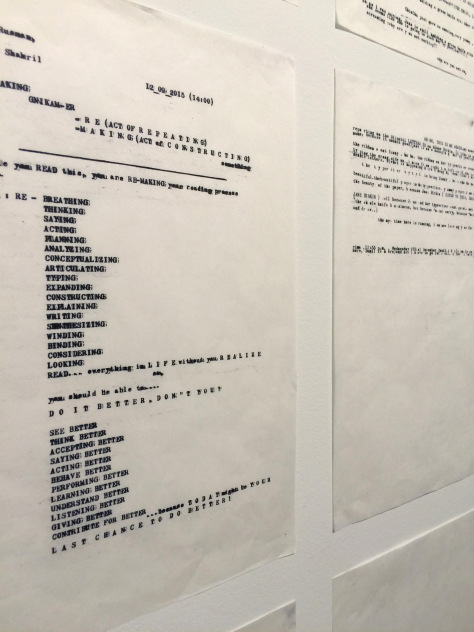
A second intervention was a typewriter. This was placed in the room on its own desk, with all participants encourage to take ‘time-out’ from their own work to experiment with this now defunct tool for writing and printing. As Friedrich Kittler suggests, ‘[r]eading functions as hallucinating a meaning between letters and lines’, and as corollary to which the medium through which we write effects how we think (or ‘hallucinate’). According to Kittler, when philosopher Friedrich Nietzsche turned to using the typewriter his prose ‘changed from arguments to aphorisms, from thoughts to puns, from rhetoric to telegram style’. Part of the change in style reflects the practicalities of using the device. As Emden suggests, Nietzsche found using the typewriter ‘more difficult than the piano, and long sentences were not much of an option’. With Nietzsche’s eyesight failing, the ability to ‘feel’ his way through writing was appealing, but arguably the technology then has a profound impact on the status and nature of his philosophising. As Kittler writes:

Neitzsche’s reasons for purchasing a typewriter were very different from those of his colleagues who wrote for entertainment purposes, such as Twain, Lindau, Amytor, Hart, Nansen, and so on. They all counted on increased speed and textual mass production; the half-blind, by contrast, turned from philosophy to literature, from rereasing to a pure, blind, and intransitive act of writing.

Quite aside from any romance we might now associate with the typewriter – as a signifier of a golden age of modernist writing and criticism – the clatter of the machine proved too much for some of the seminar participants. While individuals became quite engrossed in typing, the thud thud of the device meant others buried themselves in their headphones to listen privately to music as they worked.

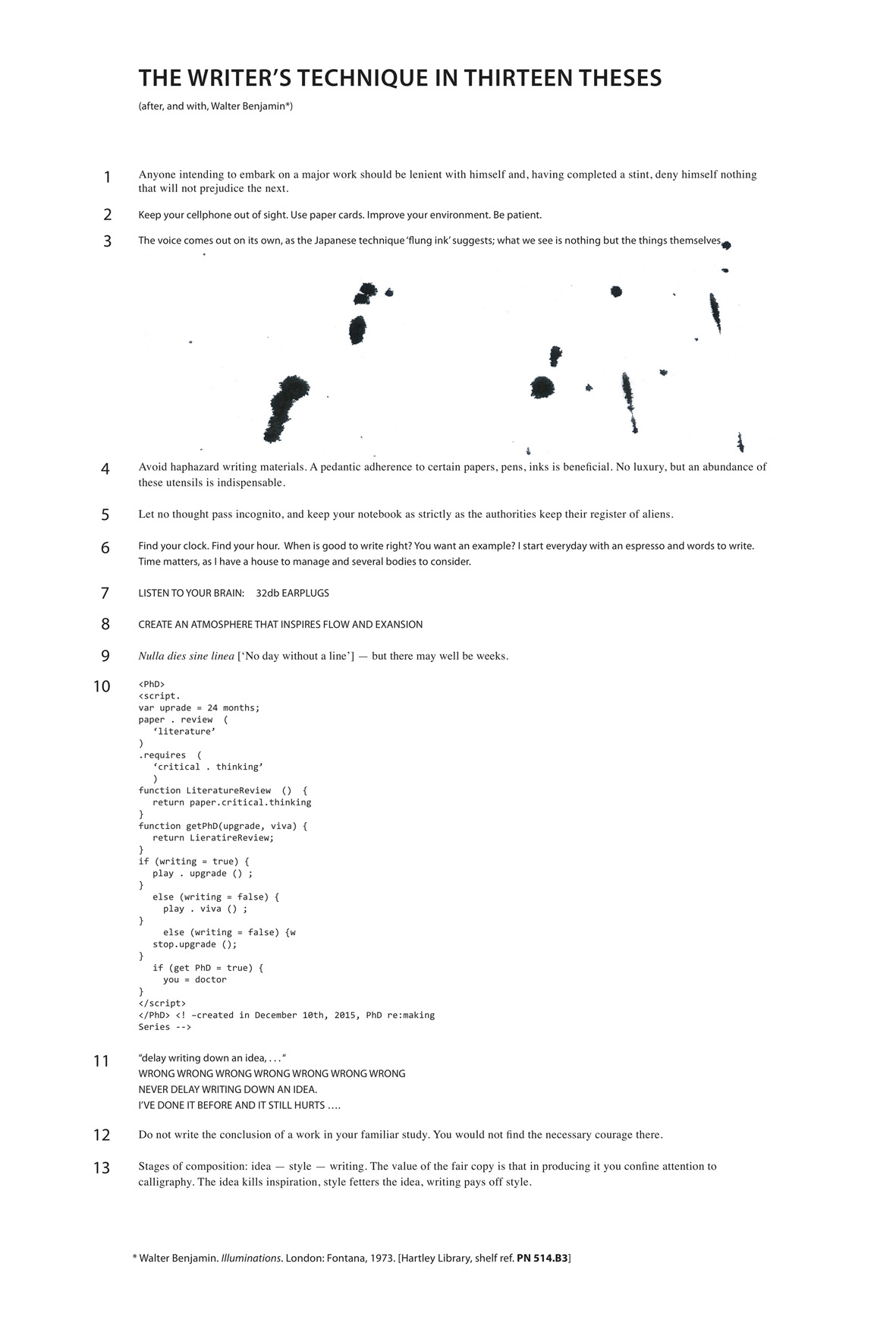
The ambivalence of the typewriter in the room (and the wild sheets of paper that came out of it) relates well to the writer, Walter Benjamin, who became the third intervention for the seminar. In his One Way Street, published in 1928, Benjamin argues, in a section titled ‘Teaching Aid’, that the typewriter ‘will alienate the hand of the man of letters from the pen only when the precision of typographic forms has directly entered the conception of his books. One might suppose that new systems with more variable typefaces would then be needed. They will replace the pliancy of the hand with the innervation of commanding fingers.’ However, it is in the section shortly after this, ‘Post No Bills’, that gave impetus for a collaborative outcome of the seminar. In this section, Benjamin offers ‘The Writer’s Technique in Thirteen Theses’. All participants were invited to contribute an entry for a new version, or re-making of this text. What emerged was a highly eclectic set of thoughts and missives. Of course, unlike the authoritative (even pompous) voice of single author, as in the case of Benjamin, the new text presents a much more heterogenous and fragmentary set of voices. It is also a much more immediate text, like a diary digest of the two day seminar marked out as concrete poetry, and which in fact we did choose (against Benjamin’s wishes?) to display as a bill poster for the Re: Making exhibition. Click on the image image to download a PDF version of the wall poster. As a document it quickly reveals writing as practice, as a working and re-working of texts in pursuit of new thoughts, images and confluences


References

Benjamin, W (1997) One-Way Street, trans. by Edmund Jephcott and Kingsley Shorter. Verso.

Emden, C. (2005) Nietzsche On Language, Consciousness, And The Body. University of Illinois Press.

Kittler, F. A. (1999) Gramophone, Film, Typewriter trans. by Geoffrey Winthrop-Young and Michael Wutz. Standford University Press


Return to Re: Making

Re: Making

Re: Making
L4 Gallery, Southampton
13 February to 8 March, 2016

‘…what of the artists, the makers, how do they make decisions? …now an artist is as likely to atomise or extrude or draw, print, wear or perform with objects as part of an adaptable practice. And since art has been transformed into aesthetic communication it is no longer traditions but messages that count…’ – Ian Dawson, Making Contemporary Sculpture, 2012, p.9

‘I don’t think it makes sense to untangle the picture (as material) from the image (as immaterial). […] Somehow we get snagged by a desire, an objet petit ‘an’, to theorise the image as a singularity, rather than reimagining and enacting theory around its multiplicity.’ – Sunil Manghani, ‘Images: An Imaginary Problem’, 2011, p.228.

This exhibition documents three PhD seminars that each ran between 2-3 days at Winchester School of Art, University of Southampton. Underlying Re:Making is a consideration of what it means to make and re-make ideas, objects and processes. Each seminar centred around key prompts or challenges for collaborative engagement, but without necessarily stipulating required outcomes. Instead the sessions were intended as a open spaces to explore and experiment. Working together we can observe and draw upon the range of decisions we each seem to make intuitively as we approach the ‘research’ in hand. In part a response to Ian Dawson’s suggestion from a previous seminar, the aim was to work together, and intensively, to question what it is we do and think when making, writing and researching. Taken as a whole, Re: Making asserts we might need to make before we think as much as we think before we make.

Prompts were provided to explore different modalities of making as follows:

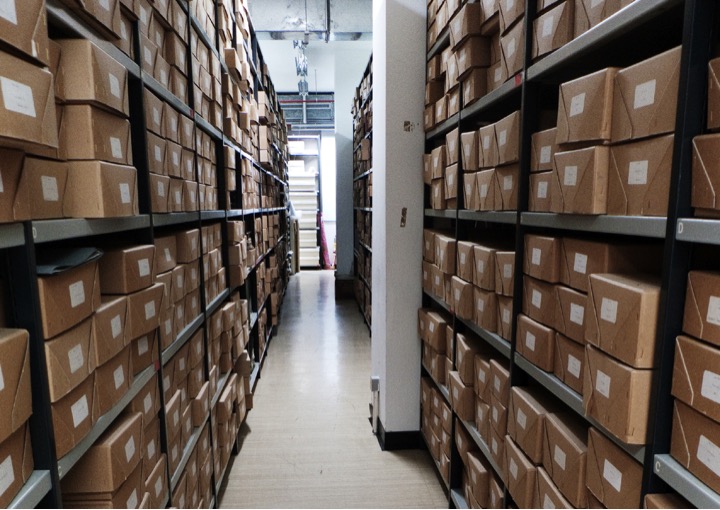
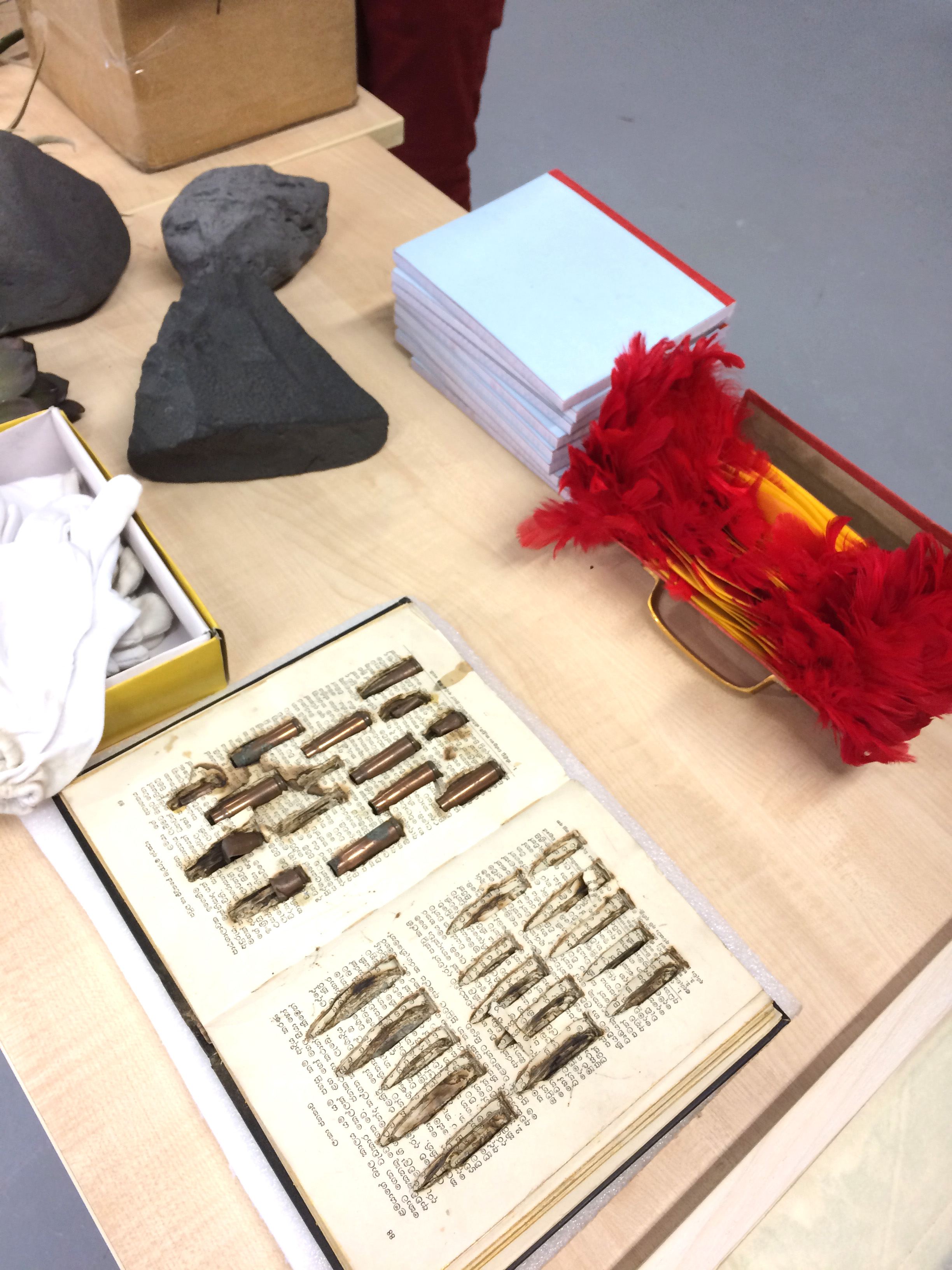
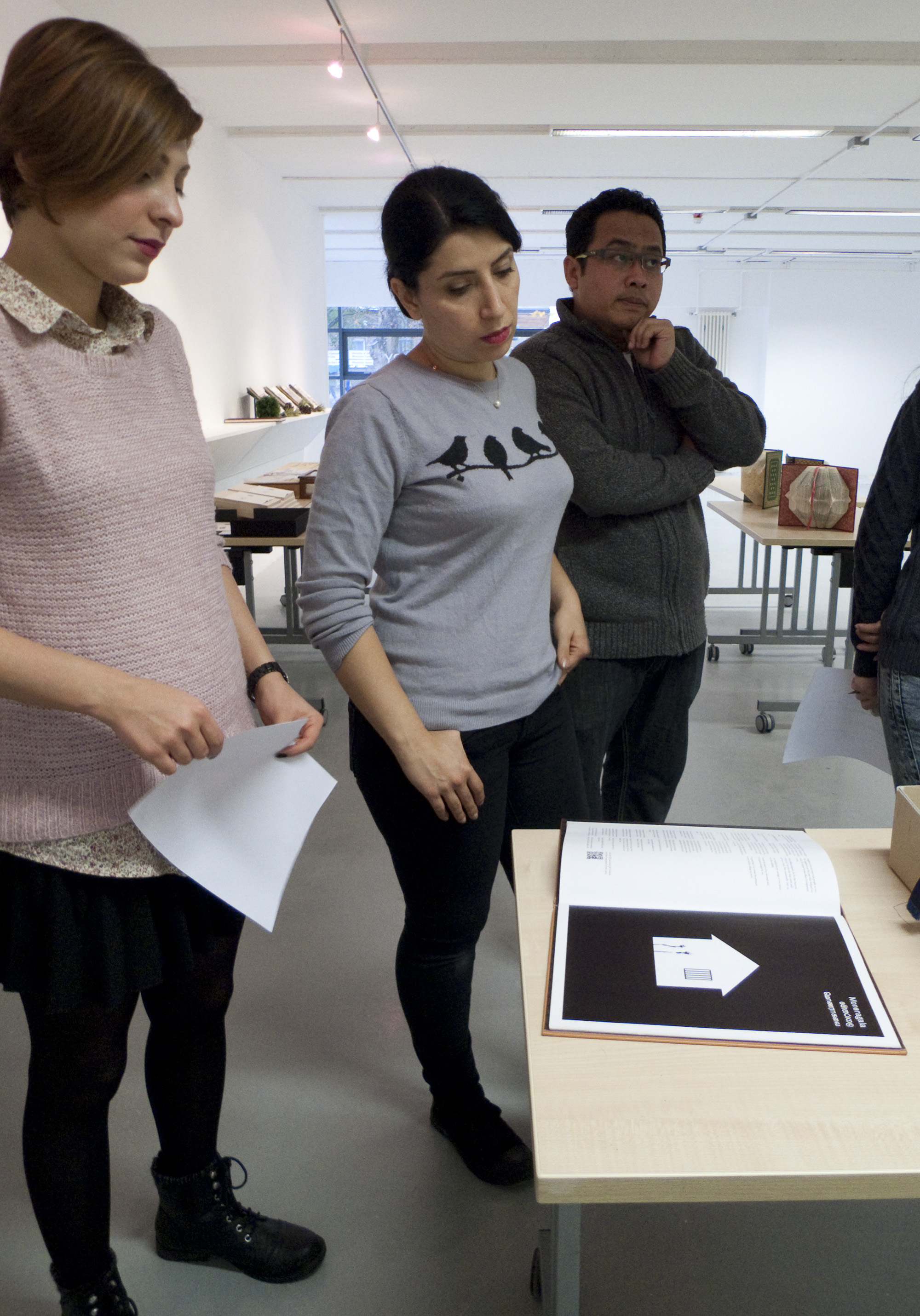
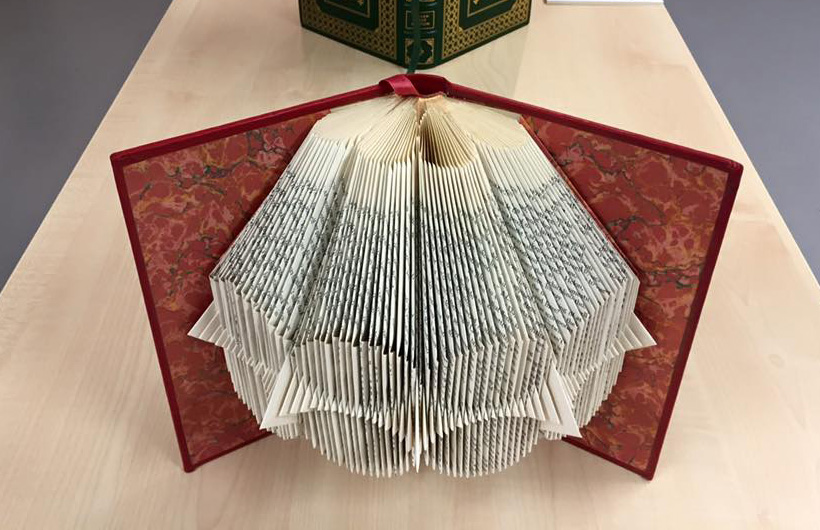
  • Reading Room was the re-creation of an exhibition of artists’ books that had originally shown in India. The artworks were brought into dialogue with the School’s own collection so reframing and re-tracing thoughts, beliefs and emotions within the boundaries of a book and the cultures in which they circulate. In this case a 3-day seminar ran between Wednesday 28 and Friday 30 October 2015, with the Private View of the exhibition held in the evening of the final day. See more…
  • Plastic Surgery (held on Tuesday 10 and Wednesday 11 November 2015) took two icons of ‘plastic pop’, Michael Jackson and Kylie Minogue, as ‘models’ to explore simultaneously both physical 3D rendering processes and conceptual understandings of plasticity as evoked by the fine arts and cultural critique. Taken together, Re: Making asserts we might need to make before we think as much as we think before we make. See more…
  • Writing as Making was a study retreat for dedicated time to write, to share in the act of writing, and to reflect critically on various strategies. The seminar was held on Wednesday 9 and Thursday 10 December 2015. One outcome was a re-making of Walter Benajmin’s ‘The Writer’s Technique in Thirteen Theses’, which quickly reveals writing as practice, as a working and re-working of texts in pursuit of new thoughts, images and confluences. See more…

Of related interest, see also:

  • Drawing Together  – a participatory outdoor drawing event, co-orangised by Cheng-Chu Weng and Sunil Manghani. The event was held on Saturday 17 October 2015, 11am – 1pm at the Discovery Centre, in Winchester and was part of the wider programming for 10 Days, Winchester’s  biennial, interdisciplinary, arts festival. Through the medium of chalk and shadows Drawing Together sought to bring people together in a shared act of drawing. Visitors to the Discovery Centre were invited to draw together as a means to draw each other together if only fleetingly, just as our shadows are mere fleeting images of ourselves. See More…
  • Practices of Research – as a precursor to the Re: Making seminars, a collaborative exhibition, Image-Text-Object: Practices of Research, was held at the L4 Gallery in early 2014. The exhibition presented the work of 16 PhD students and two members of staff from Winchester School of Art (WSA). Taken together the works offered a series of images, texts and objects, helping to think about different ways of seeing, thinking, writing and making. See More…

Inner Colonization

Abelardo G. Fournier is a PhD candidate at Winchester School of Art. His practice-based research speculates with the notion of a digital colonization of the visual, both by machine vision systems and the industrial coating of visible surfaces. In this post he reviews “Inner Colonization”, the project developed during a 6-week residency in Matadero Center of Art in Madrid and the resulting exhibition with the rest of the selected artists from Spain, Korea and Japan.

In a large old industrial slaughterhouse area transformed into a cultural center, last November I participated as an artist in residence in the program El Ranchito, supported by Matadero Center of Arts and AECID. There, eight artists and collectives from Spain, Korea and Japan, selected from an open call, shared studio space to elaborate our projects and to prepare a collective exhibition of the results.

Inner Colonization, a project belonging to the practice-based research I’m elaborating at WSA, has dealt with the operations of the Spanish National Institute of Colonization during the 1939-1973 years as part of Franco’s dictatorship reforms. During three decades, this institution transformed enormous extensions of Spanish land in search of productivity, demographic growth as well as ideological control. Linked to the so-called “Green Revolution”, it involved the engineering of large-scale water infrastructures, big movements of population and a centralized management of the information gathered in the continuous monitoring of the process. This inner colonization, as it was called by the Administration, has been one of the most ambitious reforms in the recent economic history of Spain, and completely changed, as a result, the face of its rural landscape.

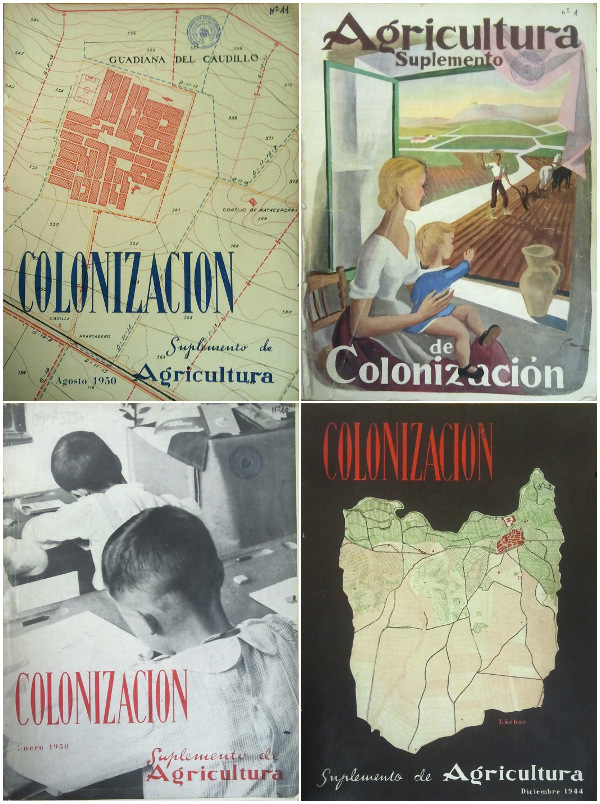
Frontpages of an annual publication devoted to the colonization

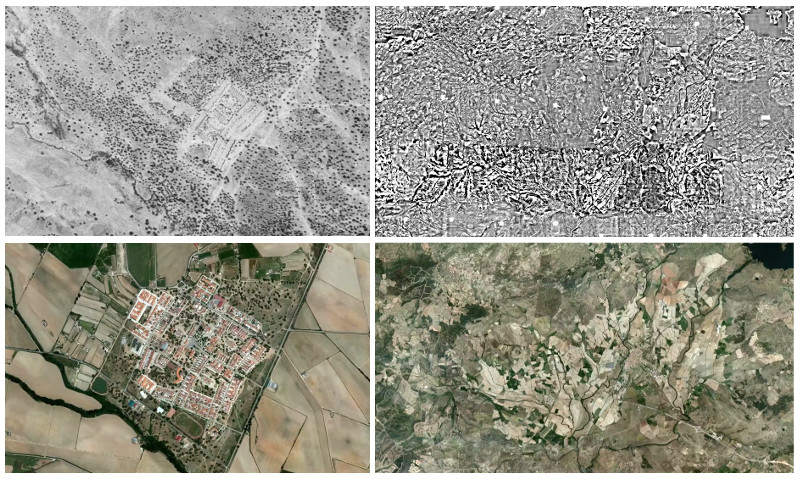
Interestingly, this technification, exploitation and population of large extensions of land coincided with the first series of aerial orthophotographic pictures mapping the whole Spanish territory. The same land that, on the one hand, was being measured and parceled, was on the other hand being photographed frame by frame by fleets of aircrafts. Although the resulting images where not used as widely as contemporary satellite ones nowadays, the aerial point of view pervaded the illustrated documents and the audiovisual films that publicised the reform. Seen from above, any of these transformed territories appears today as a huge green stain surrounded by wasteland: its industrial scale becomes visible, once the workers, their tools and homes have been made imperceptible. It is a vertical perspective, using Hito Steyerl words, complementary to the engineering of the soil, that completes the assimilation of land into the circuits of abstract economy.

Aerial photography, 1956 and 2014. Left: Vegaviana, a settlers’ town founded in 1955; right: colonization at the Borbollón dam (software reconstruction). Source of the image tiles: Spanish National Geographic Institute (IGN).

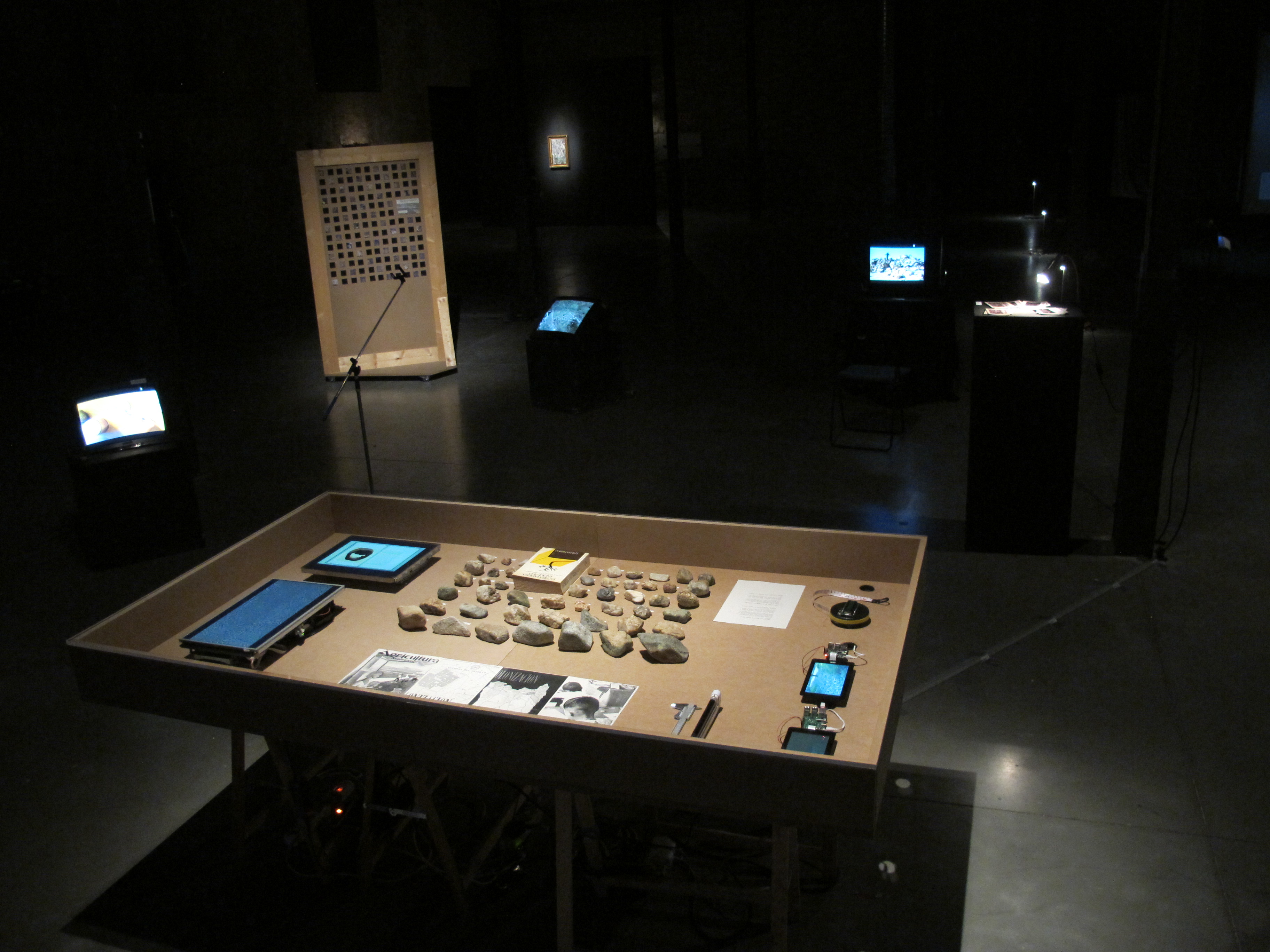
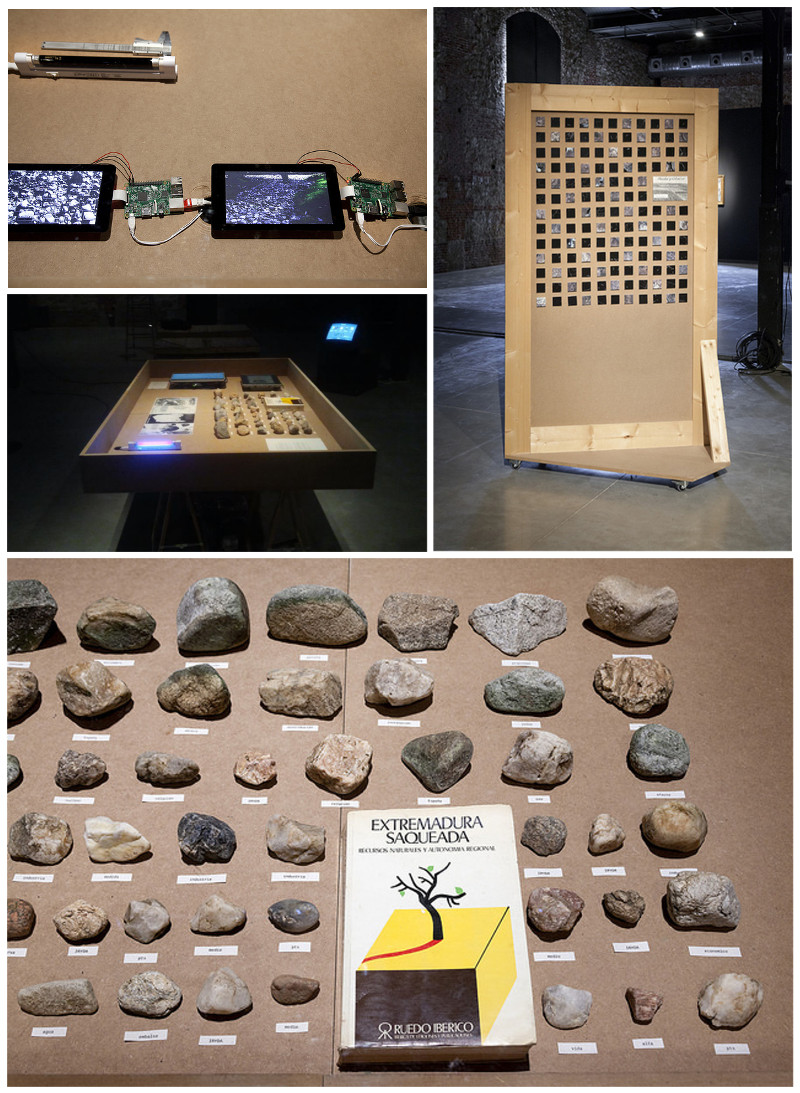
During the residency in El Ranchito, I’ve proposed a speculative parallelism between the actions of the Institute of Colonization and the transformations operated by the digital industries nowadays. Under the gaze of machine vision systems, land was populated by settlers with a “Terms of Service” type of contract and tightly controlled by State officials, just as social media networks are, today, populated by TOS regulated users and monitored by corporate databases. As two processes that have transformed the ways we relate to the surfaces of the world, the project has emphasized in particular the extractive relation with the terrain itself they also share: the soil, its variability and its becoming something to be pictured and measured in order to be capitalized. To do this, I have developed a set of specific measuring devices designed to approach those terrains as media to be read or, more accurately, decoded. Lengths, frequencies and computer vision techniques, together with a deciphering algorithm, have been put together to playfully establish a relation between stones and words, between any particular terrain and any chosen book.

Details of the installation

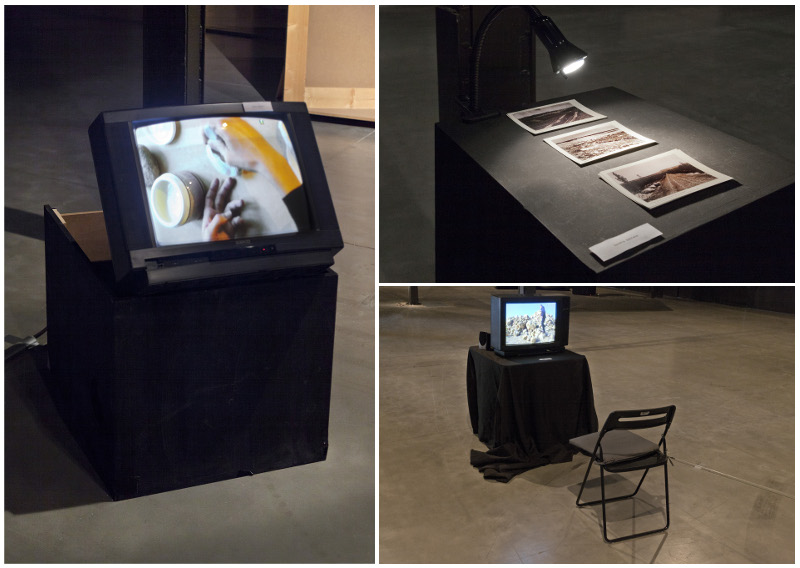
“But it is not an alphabet, it is a pattern without a message” (Caillois, 1985, p.70). A sequence of selected pages of Roger Caillois’ book The Writing of Stones is shown in a screen inside a display cabinet table, together with the measuring instruments, the stones and other documents and videos. The cabinet is surrounded by other displays -several screen monitors, a vertical panel and a plinth- containing other pieces that have been elaborated for the project.

In the exhibition space, the installation unfolds as a still lab, an aggregation of pieces and fragments documenting a process of research and conversation. Three of them, additionally, have been elaborated by three different artists invited to contribute with a specific work: José OteroSandra Santana and María Andueza. The nature of the actions of the Institute, its archives together with the nuances of the name given by the Government to the process, inner colonization, suggested and stimulated a collective approach, open to a variety of voices and actions.

Pieces by María Andueza, Sandra Santana and José Otero, specifically produced as contributions to the project

The exhibition was open to the public in Matadero until the 10th of January. It also included work produced by Gun-hee Kim and Part-Time Suite from Korea; Nobuaki Itoh and Maiko Jinushi from Japan; and Helena Grande, Jonathan Notario and Alejandra Pombo from Spain.

Top image courtesy of José Otero.


References

Hito Steyerl, In free fall: A Thought Experiment on Vertical Perspective http://www.e-flux.com/journal/in-free-fall-a-thought-experiment-on-vertical-perspective/ . Accessed: 20-12-2015

Roger Caillois (1985) The Writing of Stones. University Press of Virginia.

Analogue Audience/Digital Interfaces

Shwetal A. Patel is a PhD student at Winchester School of Art and a founding member of Kochi-Muziris Biennale. As a founding member of KMB, Patel took a wide ranging role, which involved  research and national and international advocacy duties, including a key initiative between Google Art Project and KMB to bring the biennial experience to internet audiences globally. In this post, Shwetal provides an overview of ‘Analogue Audiences / Digital Interfaces’, a symposium he organised for WSA examining contemporary audiences in the context of galleries and museums. The symposium was held on the 24th November 2015, at the Royal Institute of British Architects in London.

*
On an overcast drizzly Tuesday afternoon, high up in the Wren Room of the RIBA building in central London, a group of scholars, artists and experts gathered to participate in a symposium titled ‘Analogue Audience / Digital Interfaces‘ in an attempt to better understand our current digitally driven age. Our world today is increasingly one of hyper digital interaction in every conceivable sphere of society. We use our phones, our computers, our tablets, for almost all activities, and technology has become an intractable part of our daily lives. Projections for the numbers of people online are set to grow almost exponentially in the coming decade and there are even plans afoot to provide internet access to the most rural and improvised parts of the globe.
 
The effect that this might have on art, its production and its appreciation, is something we are only beginning to understand. In order to examine these issue more closely, faculty from Winchester School of Art (WSA) and I gathered some of the most accomplished thinkers and practitioners in this area. Participating WSA faculty included Head of Research, Professor Ryan Bishop, Head of School, Dr. Robert D’Souza, Reader in Critical and Cultural Theory, Dr. Sunil Manghani and the school’s Winchester Gallery curator, August Davis. Invited participants included curator, Hannah Redler, Head of Programmes and Operations at Sedition, Ashley Wong, Programme Manager at Google Cultural Institute, James Davis, artist and poet Robert Montgomery and Tate Modern Director, Chris Dercon.

‘Analogue Audience/Digital Interfaces’ was an attempt by us to discover something of the nature of the consumption, appreciation and understanding of artworks and how this is changed when a digital interface is interposed between artwork and viewer. Our collective intention was to explore the notion of the ever increasing digitisation and dissemination of art in the internet era, and also to explore philosophical and ideological issues and use this as the beginning for a larger discussion of our age. The selection of the speakers and moderators was made so as not to distil pre conceived notions or provide neat  ‘take aways’, but rather to gather a diverse range of voices that could set up important questions and examples of what was going on in the field. Following a brief introduction by myself, Ryan Bishop lay some of the theoretical groundwork for the symposium including the notion that interfaces can be simultaneously productive, alienating and liberating and that machines were increasingly speaking directly to other machines in the current phase of technological advancement. 

The first speaker in the symposium was Hannah Redler, an independent curator talked about a recent project curated by Lucy Dusgate for which Hannah selected key works as one of 5 guest curators. The show, titled Right Here Right Now, is an exhibition of contemporary art engaged in digital culture (Right Here Right Now is open at the Lowry until February 2016). Hannah is also the Open Data Institute Associate Curator, and a consultant art curator for the Institute of Physics where she recently co-curated an events series for Tate Modern titled ‘Light and Dark Matters’, with Tate and IOP programming teams Hannah brought a wealth of experience of working with artists who are using technology and digital strategies in interesting and unique ways.
 
Ashley Wong, Head of Programmes and Operations at Sedition – a leading online platform for artists to distribute work as digital limited editions for digital TV’s, smartphones, screens & tablets – discussed Sedition as a commercial platform for emerging and established artists. Artists Sedition currently offer on their platform include blue chip figures Bill Viola, Tracy Emin, Damien Hirst, Elmgreen & Dragset, Jake & Dinos Chapman and filmmaker Wim Wenders amongst nearly 100 others. During her presentation she explored several examples of artist practices who are engaging audiences in different ways with technology in their work whilst also discussing the interdependent relationship between the digital and physical in the post-digital age.
 
Robert Montgomery is a London-based, Scottish artist. He occupies a precarious space between street art and academia. His simple, graphic poems have been plastered, often illegally, over advertisements and billboards internationally, as well as being available (copyright free) over the internet. Montgomery was initially inspired by the graffiti artists of East London, the poetry of Philip Larkin, the philosophy of Guy Debord, and the French student protesters of May 1968. Montgomery became interested in the Situationist tradition while following the writing of Roland Barthes and Jean Baudrillard during his time at Edinburgh College of Art in the early 1990’s.
 
During his presentation Montgomery gave an example of a 22-year-old from Culver City who tattooed one of his poems on her arms and later emailed him the image through social media. His studio has since followed how the poems he writes get posted by people on Twitter /Facebook/ Pintrest/ Instagram etc and how his poem ‘The People You Love Become Ghosts Inside Of You And Like This You Keep Them Alive’ travels out into various communities of people beyond the contemporary art audience and gets used in sometimes unusual and expected ways. Montgomery also challenged the Benjaminian notion that the aura of an art work is diminished upon reproduction. Rather the artist felt that the internet was liberating his poetry and allowed him to disseminate his work to previously inaccessible audiences and engage in a dialogue with the public, suggesting that the internet was ‘like a democratic postcard’.
 
James Davis, Programme Manager at Google Cultural Institute presented Google’s ground breaking non-profit initiative, Google Art Project, as an online platform through which the public can access high-resolution images of artworks housed in partner museums and institutions, which currently number over 900 internationally. The fast expanding platform enables users to virtually tour partner museums’ galleries, explore physical space and monuments and research contextual information about artworks, and compile their own virtual collections as well as visit historical and archaeological wonders of the world. By using an internet connected webpage, he showed the audience the “walk-through” feature of the project which uses Google’s Street View and Gigapixel technology. Davis largely repeated the stated Google’s position/s and heralded the technology and platform as one that essentially provides “access to art and culture to anyone with an internet connection”. Google is one of the worlds most sophisticated and influential technology companies whose primary mission is to “organise the worlds information” though Google strongly believes in the potential of universal access to cultural production. 
 
To close the symposium, Chris Dercon, Director of Tate Modern was in conversation with Ryan Bishop and their free-form discussion expanded on some of the Tate’s Digital initiatives as well as personal insights into running a museum the size of Tate Modern in the digital age. Tate believes that digital media is an important channel for inspiring, challenging and engaging with local, national and international audiences. A useful insight garnered from Tate’s own research showed that 42% of visitors stated that they came to Tate to experience ‘encounters’, this was an interesting learning which illustrated how people are seemingly desirous of experiences and encounters which public spaces can provide in the digital age. Interestingly, 47% of visitors to the Tate website sited ‘research’ purposes as a reason for visiting the site. Dercon also mentioned that although their current Alexander Calder exhibition had received rave reviews from the art and mainstream press and that social media activity had been extremely high, the opening week attendance had been unusually low. This went against the idea that popularity on the web leads to greater footfall at exhibitions and he stated that Tate were currently analysing this phenomenon further to understand why. Despite substantial digital investment Dercon felt that it was still not possible to effectively translate theatre and museum experiences online.
 
As a result of the symposium there is now a platform of views and ideas to build upon, and a chance to open the discussion to audiences and scholars through the internet. The entire event is being transcribed from 3hrs and 42 mins of audio (links to be provided soon). This, it is hoped, will lead to new questions and possibly some conclusions emerging in the future. After the event, I said, ‘I feel this area is very fast moving and we are kind of guinea pigs of the digital revolution. Tech companies, artists, institutions and audiences are still feeling their way through the many changes and opportunities and it will take some time for the ground to settle and for concrete conclusions to be drawn. The lens of time and history will help.’ I hope many more people can join this discussion over the coming months as the topic broadens.
 
 
See also: Analogue Audience / Digital Interfaces [Programme Notes]

Image:
The Portrait of Sakıp Sabancı (2014) by Kütlag Ataman at the Sabanci Museum. Photo: Shwetal A. Patel.


While in Tokyo…

Stephen Cornford is a PhD candidate at Winchester School of Art. His fine art practice-based research explores the materialities of residual media. In this blog post he reports on a recent commission for the Ftarri Festival in Tokyo, along with a further installation, Migration, and a CD, Kinetic Sculptures.

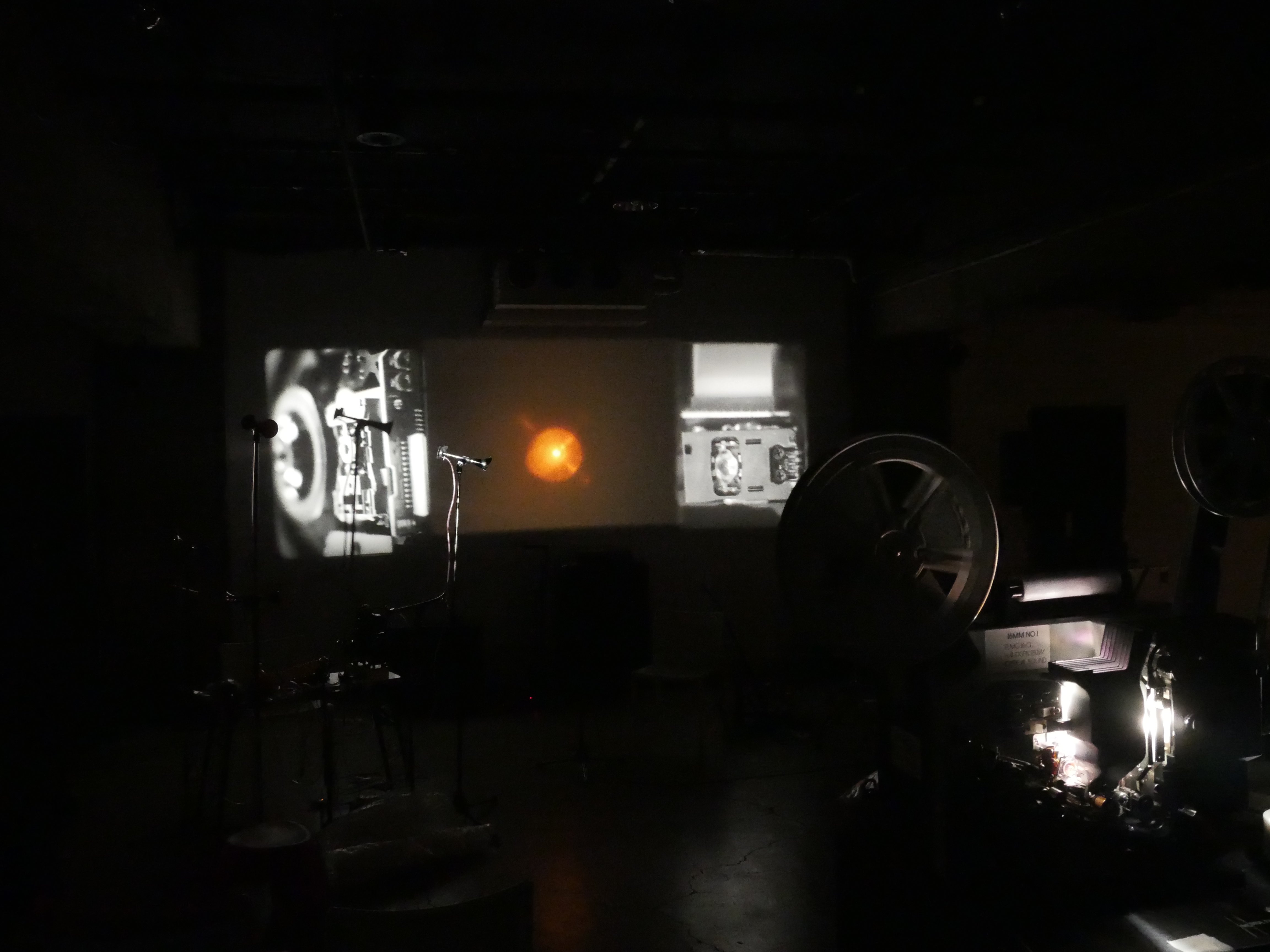
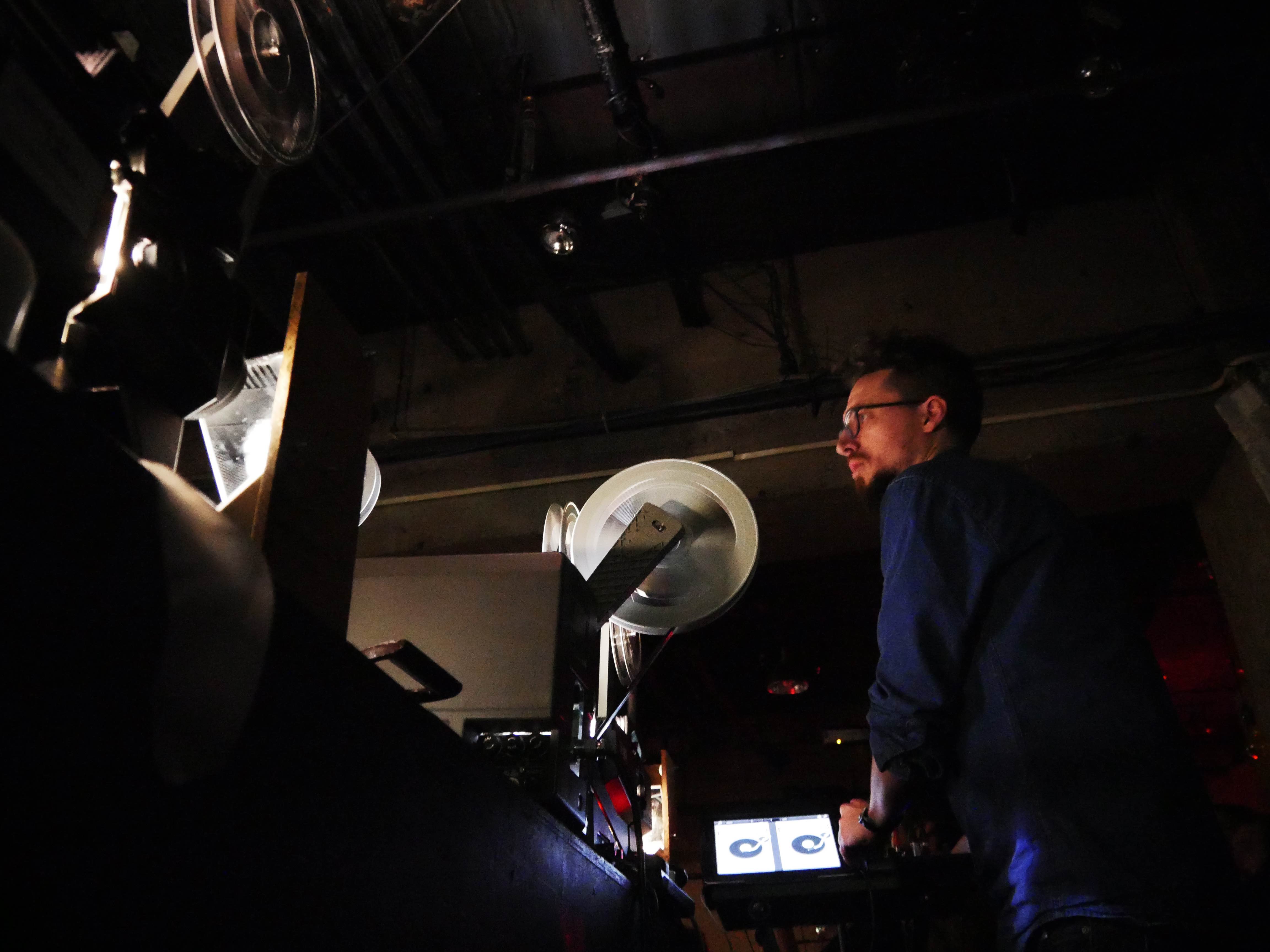
For the 2015 Ftarri Festival in Tokyo I was commissioned to make a new work to be performed by myself, long-term collaborator Patrick Farmer and a Japanese musician Madoka Kuono. My response to the commission was to produce a three-screen 16mm performance titled Digital Audio Film. The central concept of the work was the exposure of analogue film to the laser of a CD player – film emulsion being sensitive to radiation wavelengths far beyond the abilities of human sight. The work brings a technology for the reproduction of digital audio into dialogue with a moving image technology, allowing them to re-interpret one another. A machine intended to reproduce sound becomes a producer of images. This work was performed at SuperDeluxe on Sunday November 22nd with the help of Japanese filmmaker Shinkan Tamaki who leant me his projectors and provided technical support throughout the day.


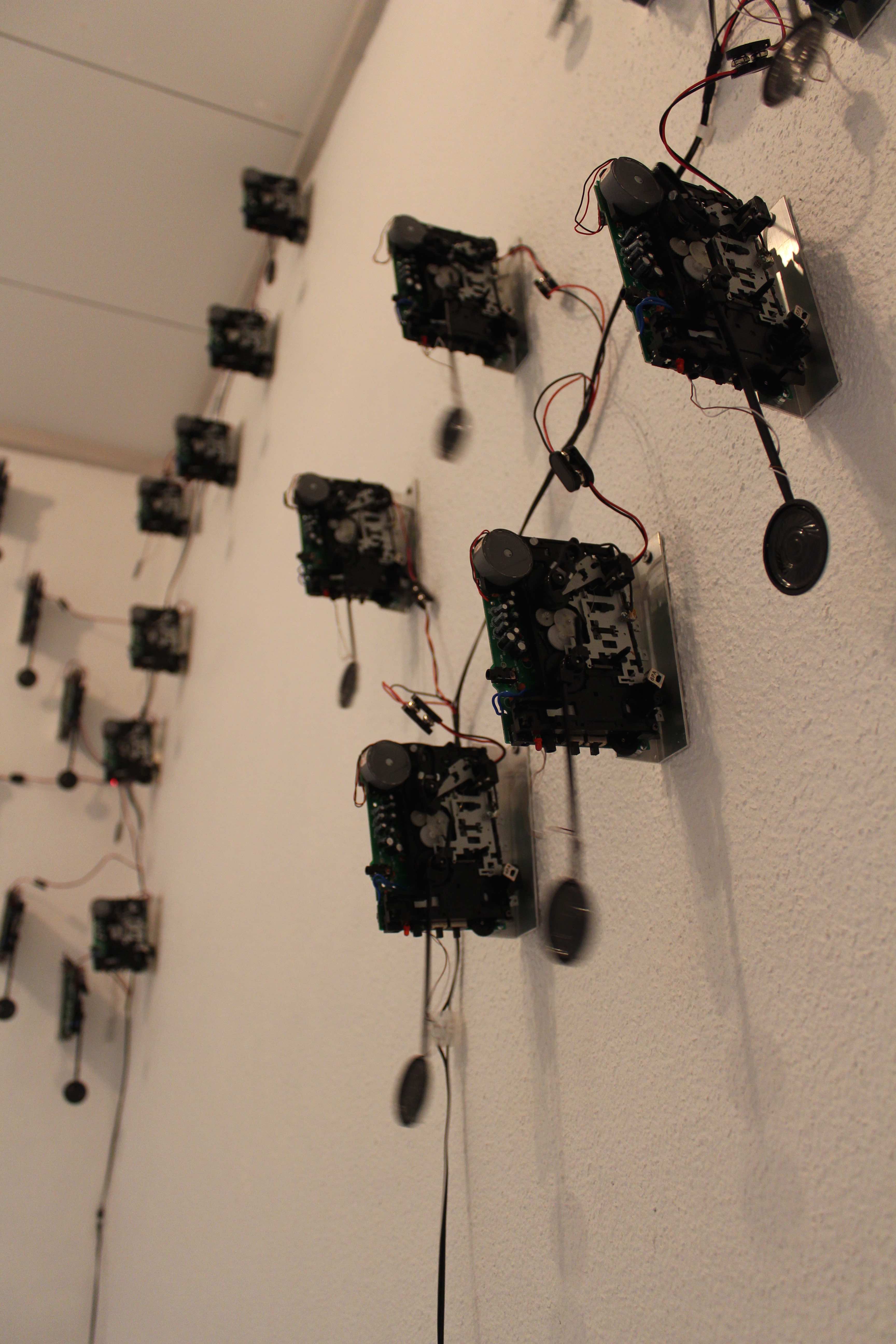
After receiving the invitation I also managed to arrange an exhibition at a small independent art space, Gallery 20202 run by Yukari Fujimoto ex-promoter of Off Site, a performance space for experimental music now considered instrumental in the emergence of Onkyô. The work exhibited here titled Migration, is an installation for numerous factory-second dictaphones which modifies their mechanics and electronics to produce an audio-visual effect reminiscent of the massed migrations of birds or insects. In doing so the work draws a parallel between this organic seasonal process and the global shipping of electronics as they move through our economy from production to their inevitable end as pollutants.

Coinciding with this exhibition was the release of a new CD titled Kinetic Sculptures on the vlzprodukt label. This CD collects together works from 2006 to 2010 the majority of which were made during my MA at Dartington College of Arts.

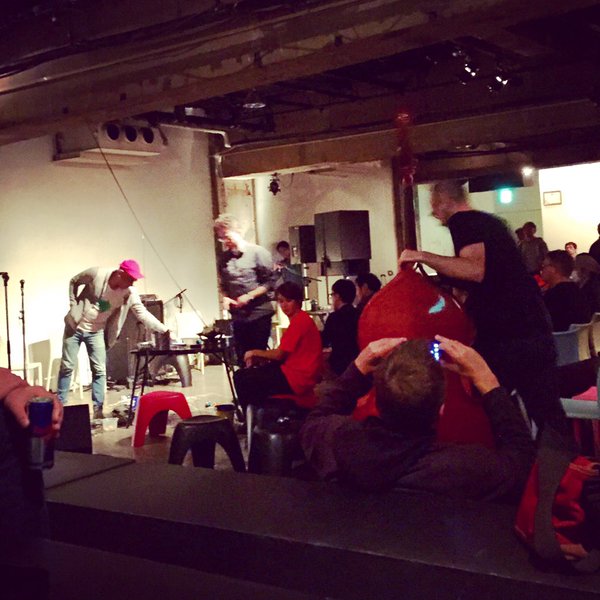
While in Tokyo I also performed twice in collaboration with other musicians invited to the festival. On Saturday 21st I played a trio with Makoto Oshiro and Matija Schellander which took and saw us placing sound objects all over the venue in a performance which deliberately dispersed the traditional focus of attention on the stage space. I worked with 10 modified Dictaphones and a turntable placing these chirruping devices among the audience, at the bar and on the PA, while Matija walked in circles around his double bass, plucking a rod inserted between its strings and Makoto placed home-made vibrating devices and alarm clocks throughout the space and then preceded to set off firecrackers in the toilets. Finally on the Monday after the festival I performed a duo with British harpist Rhodri Davies at a local record store.

Throughout the week I was taken aback by the generosity and hospitality of the Japanese. During the installation of the exhibition and following the opening I was treated to several traditional Japanese meals at local restaurants, including one evening meal of almost a dozen small courses, each served on its own specific crockery. A wonderful week and I very much look forward to returning to Tokyo in the not-too-distant future.


To see more of Stephen Cornford’s work visit: http://www.scrawn.co.uk

Art, Work, and Archives: Performativity and the Techniques of Production

Jane Birkin is a former doctoral candidate at Winchester School of Art, completing her practice-based PhD in June 2015.  Her essay ‘Art, Work, and Archives: Performativity and the Techniques of Production’ was recently published in Archive Journal.


This essay attempts to address the significance of my longstanding working connection with image collections and archives. It explains how aspects of archival thinking permeate the practices of various artists (including my own), notably through the application of performative working methods that position their work within an established genre of indexing and categorisation.

Performativity is defined here as a two-step procedure: firstly the making of an instruction, and secondly the following of that instruction. This is at odds with the early designation by J.L. Austin, in How to Do Things with Words, where the ‘saying’ and the ‘doing’ are one and the same thing. It also avoids the theatrical aspects that are often associated with performance art.

The call for papers was on the theme of ‘Radical Archives’, and asked what this well-used term really means. The ‘radical’ that is so often perceived in relation to the archive in terms of radical content (punk archives and so on) is here differently defined through archival cataloguing techniques of ordering, description and listing. In the way of the ‘readymade’, these institutional techniques become radicalised through their passage into art practice. The use of archival description in relation to the photographic image (the subject of my PhD thesis) constitutes a radical form of writing and reading the image, at odds with traditional hermeneutical analysis. It is an indexical rather than a representational approach, consistent with the recent material turn in photographic studies that is becoming a critical methodology in theory, practice and education, and frequently with reference to the ‘archived’ image.

Read the essay here:

Art, Work, and Archives: Performativity and the Techniques of Production


Re-Making an Exhibition

The exhibition, Reading Room: Leaves, Threads and Traces (November 2015), exhibited book art originally shown in Delhi and at the Colombo Art Biennale, Sri Lanka (2014) and Kochi-Muziris Biennale, India (2014). Working in collaboration with Blueprint 12, these shows were curated by Amit Jain, joined staff and students at Winchester School of Art for the seminar and the installation of works. The original shows of ‘Reading Room’ featured works by fifteen artists from across the world. Many of these works were shipped over for a new iteration of the show, and which were brought into dialogue with a selection from the Artists’ Books Collection held at the Winchester School of Art Library, which comprises book art from the 1960s to the present day. The seminar will be co-convened by Sunil Manghani, Amit Jain, August Davis, and Linda Newington.

As the final wall text produced for the show explains:

In placing items from the School’s own collection alongside the visiting collection of book art from South Asia, the themes of leaves, threads and traces are explored. It brings to the fore both the physicality of books – their material properties and relationship to material culture – and an imagination of books. This edition of Reading Room opens up how we interleave, draw together and re-trace thoughts, beliefs and emotions within the boundaries of a book and the cultures in which they circulate.

Preliminary curatorial decisions, such as the objects to be made available for display, had already been made in lead up to the installation of the show. However, the all-important positioning of the objects, the handling of the space, and the ‘journey(s)’ laid out for the viewer – the exhibition making as a practice – was to be carried out by the postgraduate research group in just three days. Amit Jain, who had curated the two previous exhibitions and brought the books over from India, purposely played little part in the decision-making processes. He was interested to see how his exhibitions would be re-made, and how he would himself learn from the process. Amit made it clear from the start that the final exhibition, whatever shape it was to take, could never be perceived as a failure in either curatorial or pedagogic terms, but that the processes of making and juxtaposition, and the subsequent viewing by the public, would serve as a practical site of learning. Like all the events in the re:making series, this was designed as a collaborative and experimental task for PhD students; it was to be an intensive project that would thoroughly test the proposition of thinking through making that is key to this seminar series.

Day2_12-26

The book is a mini exhibition space in itself: it has content and it has a physicality and a three dimensional space through which to navigate this content. Reading Room could be perceived then as an exhibition of interrelating exhibitions—a difficult and interesting curatorial notion to begin with. As we all know, the navigation of both books and exhibitions is not always linear, it is a complex back and forth interaction, often with multiple visits to certain parts. In this limited time, a coherent exhibition had to be installed that would expose commonality and create a dialogue between the two different collections, yet would still allow an openness of conditions so that the visitor/reader would be able to traverse the display in their own way and to make their own connections.

As with all exhibitions, logistics around the objects and the space in which they are to be displayed play a large part in the decision-making around display. The extremely delicate nature of a number of the objects meant that they could not be truly navigated at all, but were displayed as static objects that denied the visitor the haptic interface usually associated with the book. Happily, some objects could be touched and used as books; indeed they actively required handling in order to explore their methodology and message. Other objects were not books as we commonly experience them at all, but book-related artworks in different forms. These were conceptual pieces, some of a highly political nature, with temporal qualities (usually experienced through page turning) here embodied and understood through the varying and openly exhibited processes of their making.

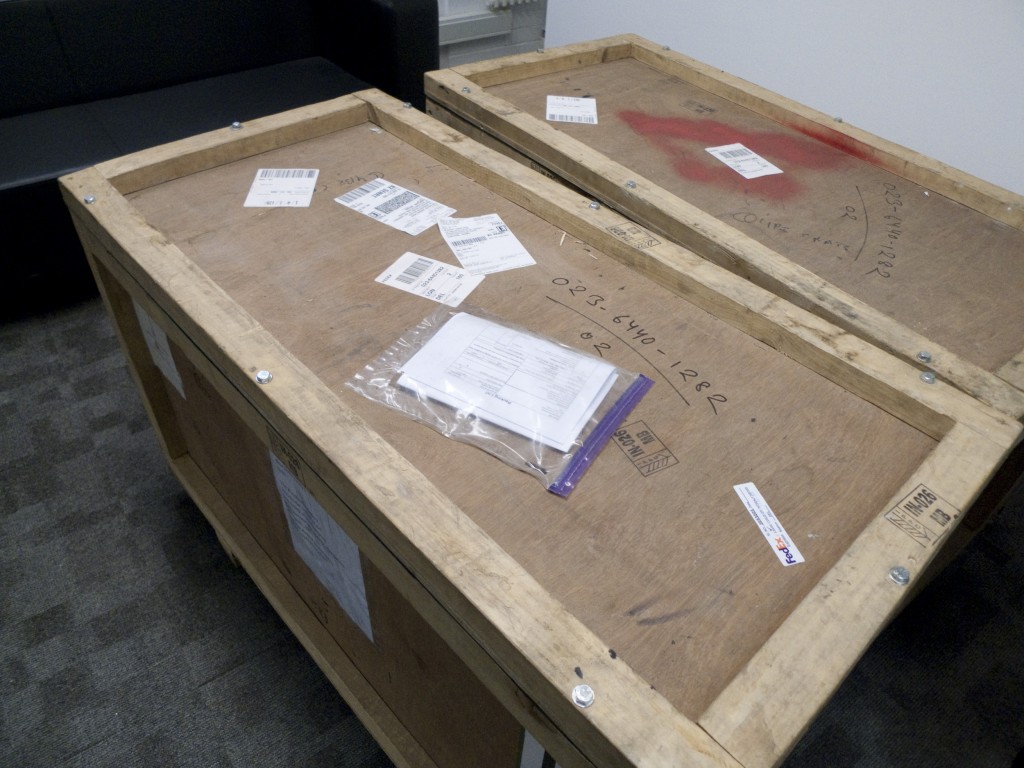
RR19-2Before the books were even unpacked, systems of good practice had to be formulated that would ensure the safe handling of the objects, and some background information on the objects had to be relayed and considered. It was late on Day One before the fascinatingly inaccessible packing cases were opened and the books from India were uncovered and laid out. For the group this was at the same time a contemplative act of revealing and an abrupt realisation of the task ahead.

The three days of installation were peppered with periods of notional inactivity, weariness and even boredom. But these lulls were actually active times of information processing (such times play an important part in all making projects) and they undoubtedly played a significant part in the successful, intelligent and articulate final installation of the show. The act of unpacking that was so physically experienced by the group could be viewed metaphorically as a critical part of the thinking through making process.

Day1_14-26


Drawing Together

Cheng-Chu Weng is a PhD candidate at Winchester School of Art, undertaking studio-based research concerned with shadows, the body and space. In this post she recounts her undertaking of an outdoor participatory drawing event, Drawing Together, which was part of 10 Days 2015 CHALK, Winchester’s biennial, interdisciplinary, arts festival.

Drawing Together was devised as a participatory outdoor drawing event. Co-orangised by Cheng-Chu Weng and Sunil Manghani, the event was held on Saturday 17 October 2015, 11am – 1pm at the Discovery Centre, in Winchester. The event was part of the wider programming for 10 Days, Winchester’s  biennial, interdisciplinary, arts festival. The event was advertised as follows:

Through the medium of chalk and shadows Drawing Together brings people together in a shared act of drawing. Visitors to the Discovery Centre are invited to draw together as a means to draw ourselves together if only fleetingly, just as our shadows are mere fleeting images of ourselves. This act of drawing upon the ground of the city in which we live and work is intended to mark a temporary reflection of ourselves as individuals and as a community.

The theme of the biennale was ‘chalk’. Thus, Drawing Together sought to make explicit use of chalk as its medium, along with shadows. The drawing of shadows, which are fleeting, ephemeral phenomena also relate to the ethereal mists of Winchester, borne of its chalk geology.

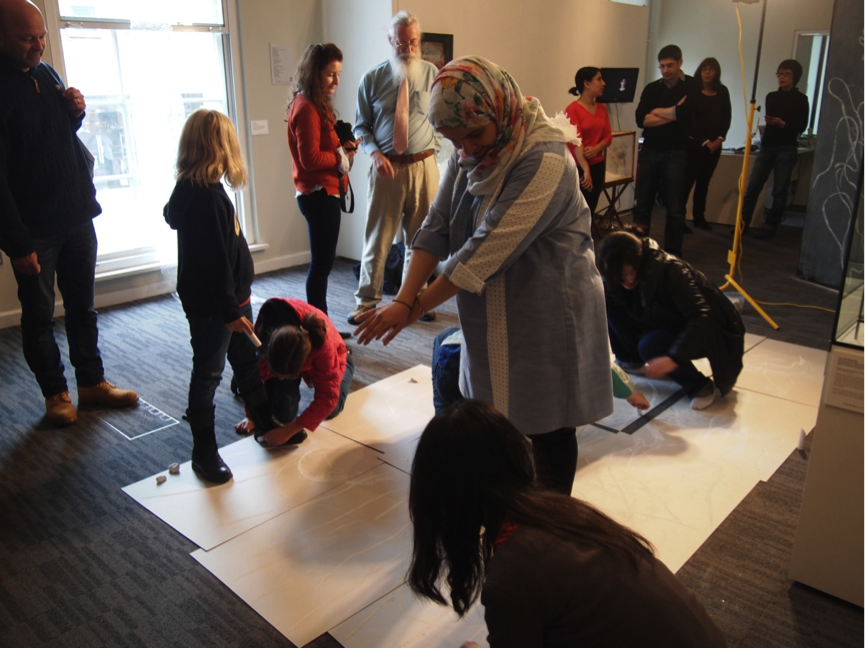
As an artist living in Winchester city, my aim was to engage with local people, beyond my studio at the School. My fine art practice begins in painting, but has now developed through installation works. I explore phenomenological readings of vision as embodied space: How people look, feel, and experience not just things, but emotions and memories. The phenomenon of the shadow is central to my practice, as it evokes questions about how we define the boundaries of our bodies and identities. What, for example, do we claim to be inside and outside of an outline? In Drawing Together, my aim was to  invite, demonstrate and direct people to mark out their shadows with chalk. This act of drawing upon the ‘ground’ of the city itself in which we live was intended to mark a temporary reflection of ourselves as individuals and as a community. (The plan was hold the event on the paved area immediately in front of the Centre’s entrance, but the weather was in fact quite poor, particularly the light levels on the day, which hampered the aim to draw shadows from natural light. We managed a short period outside, but in the main we had to move inside the Discovery Centre and work with artificial lighting).

Photograph: Ruby Chan

The process of engaging with local people through using chalks, lights and shadows prompted the action of tracing shadows. The following rubric was provided:

  1. Use chalk provided to trace the outline of the shadows of people around you as they form on the paved area outside of the Discovery Centre. Feel free to trace as many shadows as you like and do not worry about lines overlapping.
  2. Provide your name and address to the event organizers if you wish to receive a postcard of the finished work.
  3. Please feel free to post your own photos and videos of the drawing as it develops. Use hashtag #chalkshadows for Twitter and Instagram and/or post comments to the Facebook

Projects and artworks with a social dimension at their core have become increasingly common. However, any social artwork reveals not just collaborative efforts, but also what it means to be individual within a group. Drawing Together similarly played with the boundary between individual and collective. However, as a convenor of the project, what was particularly revealing was how the process of persuading visitors to draw shadow and make marks is not an easy job. It requires a good deal of skill in communication. This was a challenge for me. I am used to producing works individually, working in the studio environment which is tailored to making. In this environment there is a form of internal dialogue. It is a matter of experiencing objects as a form of non-verbal communication. Thus, aside from the event happening on the day, the underlying challenge to running a social community-orientated project – even one that on the surface seems very simple – is the lengthy process of organising and communicating with collaborators and the festival organisers. As a maker, I realise this is equally a part of making the ‘work’. However, it is really the participants on the day who bring the work into being. Once people have been invited to act, the situation changes; everyone can become an artist, as befits Joseph Beuys’ concept of Social sculpture. In this case, it was interesting to note, when comparing the two drawing surfaces, the pavement (outside of the Discovery Centre) and the boards (inside of the Discovery Centre), people found it much easier to be persuaded to draw on the pavement. There is a practical reason perhaps, since they do not need to take off shoes and need not worry about making a mess. To mark a person’s shadow on the pavement is more straightforward, and may even draw upon the participant’s memories of playing on the pavement, such as marking out hopscotch in a school playground etc.

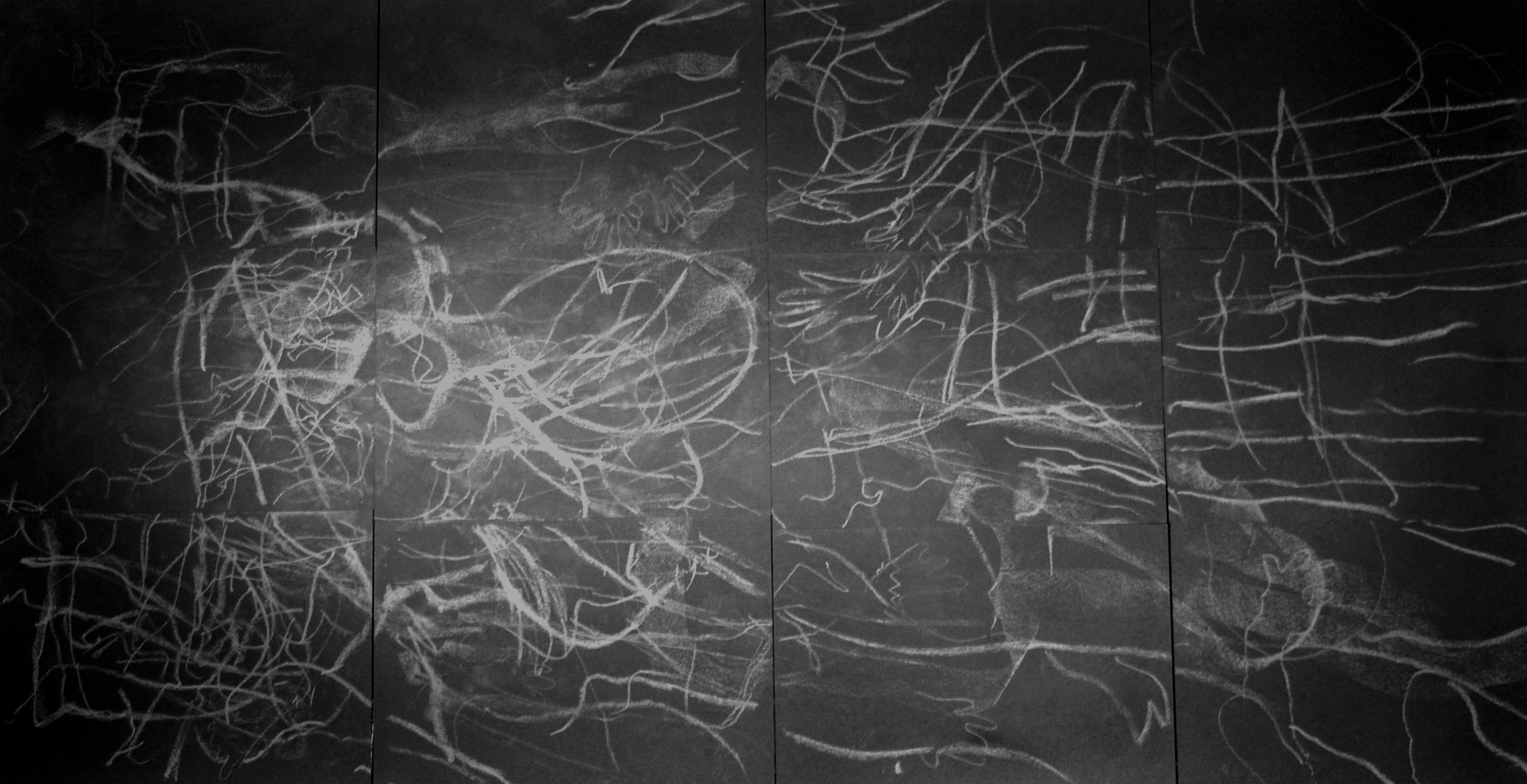
The use of social media was suggested to participants, to allow the project to engage not just materially but also virtually. Images circulated on the day, and the final collaborative ‘drawing’ from the day was photographed and printed in a limited set of postcards (and sent out to all those who participated). However, the relationship between the participants, object (chalk) and surface or support (the ground, drawing boards) was the real ‘event’ of the project. Here we might think of Martin Heidegger’s concept of intentionality, the idea of the object within the subject intention, as Joel Smith explains: ‘Equipment is ready-to-hand, and this means that it is ready to usehandy, or available. The readiness-to-hand of equipment is its manipulability in our dealings with it’ (Internet Encyclopedia of Philosophy).

Drawing Together, in the end, was about the experience of the body – and indeed bodies – in using chalk as a means to trace our shadows. Ultimately this is an impossible task, but one we feel is nonetheless ‘ready to hand’. It was heartening to see people spent time to engage with the project. I am grateful to my collaborator, Sunil Manghani, and the Biennale organisers, Sophie and Jane, for helping to make Drawing Together happen. A big thanks also to Elham, Sarvenaz, Ruby and James for helping out on the day.

See also Re: Making