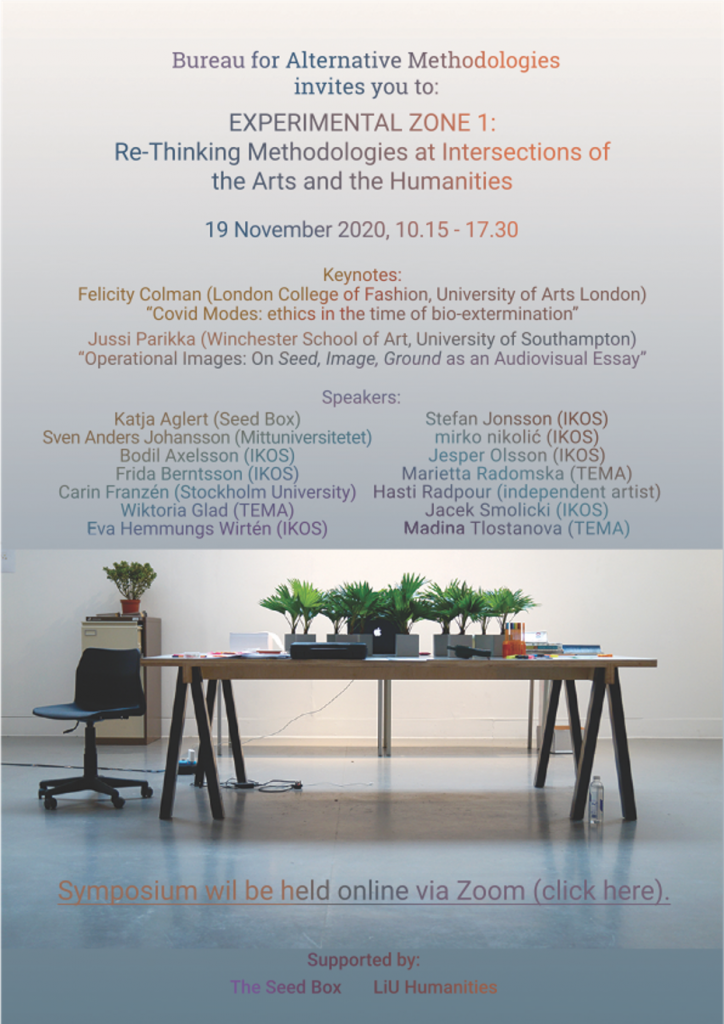
EXPERIMENTAL ZONE 1: Re-thinking Methodologies at Intersections of the Arts and the Humanities is the first of a series of planned events organised by a group of scholars and artists at Linköping University (Linköping, Sweden) under the tentative and temporary heading: Bureau for Alternative Methodologies (BAM). The following report on the event was kindly provided by Ana Čavić, a current WSA PhD candidate.
One thing the pandemic revealed was the strong sense of community amongst WSA’s staff and PGRs. Below, Noriko Suzuki-Basco (then a PhD candidate and now an alumna) reflects on her Covid-19 project with Lesia Tkacz (currently a PhD candidate), The Lockdown Larder Cookbook Challenge.
Boundary2’s online journal recently published a special issue, edited by WSA’s Ryan Bishop, on “Frictionless Sovereignty”. The special issue can be accessed from the journal’s website. Here, Ryan talks about the collaborations and research interests from which the special issue grew.
Liminoid Encounters, at Akademie Schloss Solitude (2020; the Akademie kindly gave permission for the use of this image)
Berit Fischer (http://www.beritfischer.org), a recent WSA PhD graduate, is curating an exciting three-day live online event (10-12 Dec 2020), Liminal Encounters. Details are below; registration and full details of the programme are at this link.
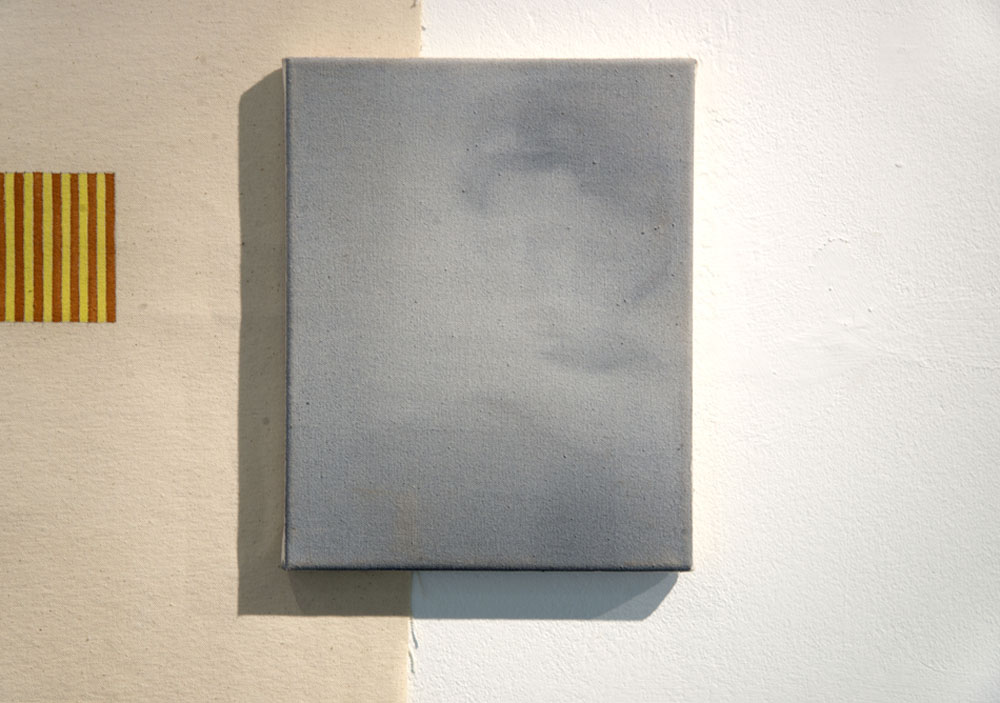
‘Rules that order the reading of clouds’ (2016) solo exhibition at Intermission Museum of Art entitled ‘Translation’, 1-30 September 2020
Ana Čavić, currently a WSA PhD student, below discusses her artwork, ‘Rules that order the reading of clouds’, exhibited by the Intermission Museum of Art.
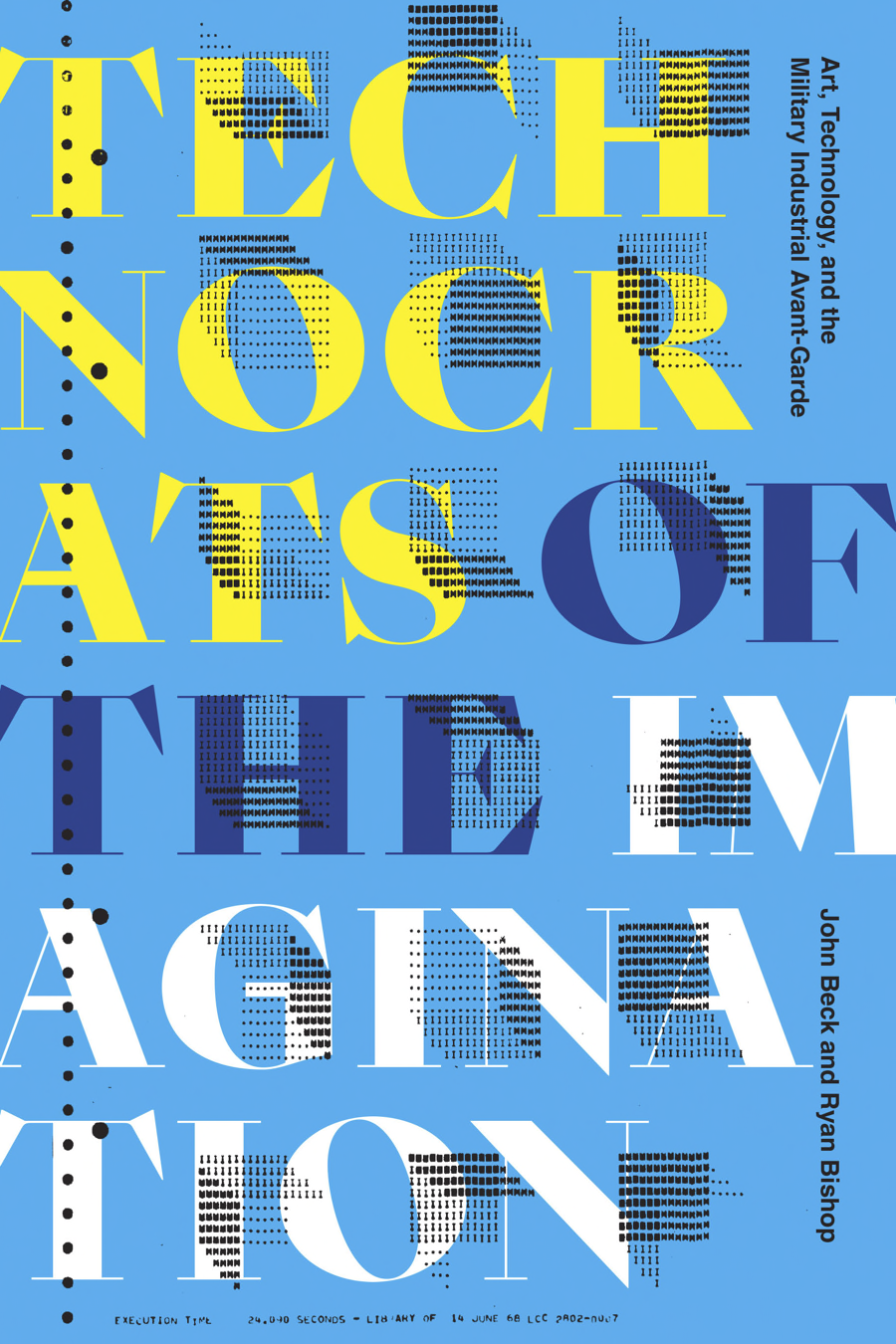
John Beck & Ryan Bishop Technocrats of the Imagination, recently published by Duke University Press, is about a particularly striking form of interdisciplinarity: the Cold War cooperation between the military-industrial complex and avant-garde art. Below, Ryan shares some of the background related to how he came to co-author the book, the experience of writing the book and the continued necessity of understanding the Cold War.
The right to look is not about seeing. It begins at a personal level with the look into someone else’s eyes to express friendship, solidarity, or love. That look must be mutual, each person inventing the other, or it fails … It is the claim to a subjectivity that has the autonomy to arrange the relations of the visible and the sayable. The right to look confronts the police who say to us, ‘Move on, there’s nothing to see here.’ Only there is, and we know it and so do they.1
Winchester School of Art became an Associate of Tate Exchangein 2017 and staged its first main event,Building an Art Biennale, in May 2018. The second,Itinerant Objects, took place in April 2019. A podcast project, Nothing to See Here, was due to be the School’s third project. It was being developed in response to Tate Exchange’s annual theme of power for 2020, but was one of many events cancelled due to the COVID-19 pandemic. In lieu of this project an dialogue was held between Nicholas Mirzoeff (who has been a scheduled guest) and Sunil Manghani, and is posted as a ‘Research Feature’ on the Tate website.
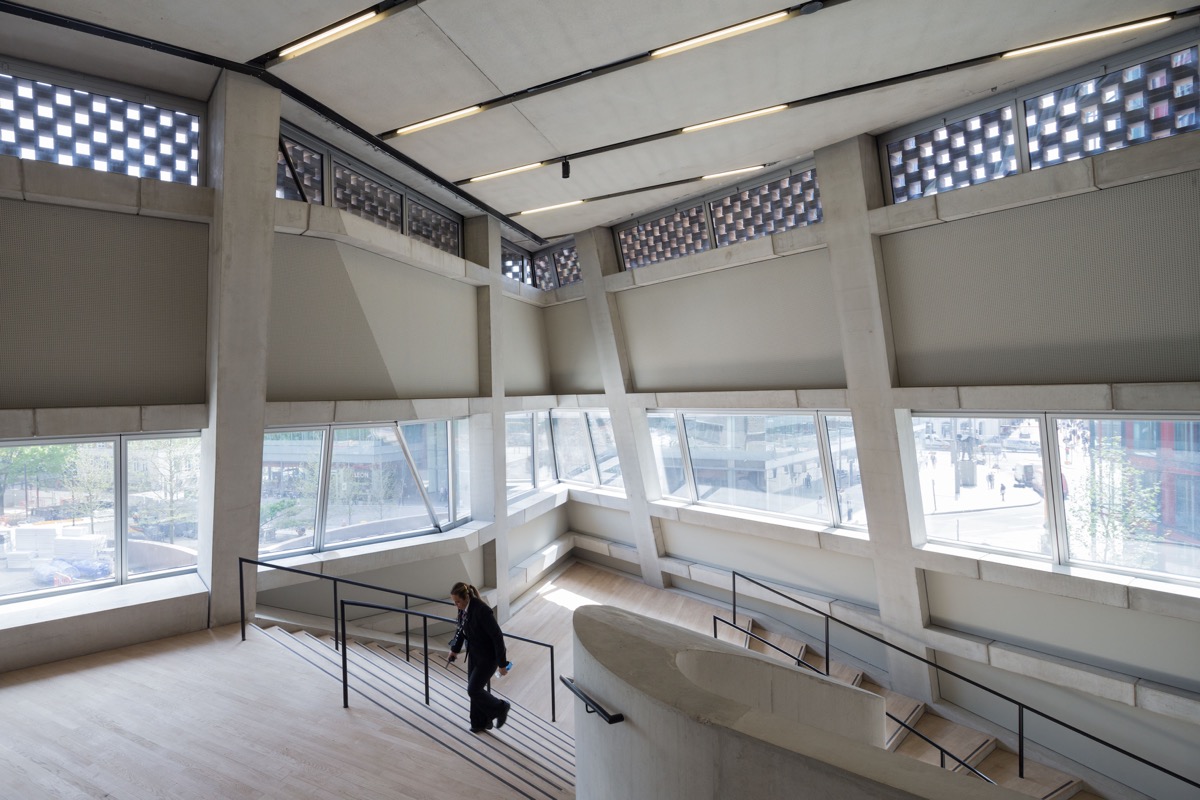
Tate Exchange at Tate Modern opened in 2016 and describes itself as an open experiment exploring the role of art in society. It offers a unique platform that combines curation, education and social participation. In doing so, it brings together the work of international artists, members of the public and contributions from over sixty ‘Associates’ who represent an array of organisations, large and small, from diverse fields within and beyond the arts, including education, youth engagement, health and wellbeing, and community advocacy. Crucially, Tate Exchange has afforded its Associates a great deal of freedom to devise and curate their own contributions for an annual themed programme, allowing for an entire floor of Tate Modern’s new building to be dedicated to participatory artworks, workshops, activities and debates.
As a collaboration between two Associates, Winchester School of Art and Stance Podcast, the project, Nothing to See Here, had sought to foster social proximity with three other Tate Exchange Associates – Valleys Kids, People Empowering People, and John Hansard Gallery – each of which work in highly creative ways, deep within local communities (way outside of the ‘art world’ bubble), often working through very live issues of social and economic hardships. Everyone involved was due to join together to produce a podcast series, which would explore the value of art and creativity as it actually takes places within the local circumstances of the collaborating Associates. The series was to be launched at a special event at Tate Modern at which the audio would provide an invisible soundscape across the entire floor of Tate Exchange, which would otherwise be completely ‘empty’ (‘nothing to see there’). A dedicated forum had been planned, inviting the collaborating Associates and their communities, guest speakers and members of the public, to engage in critical dialogue about the ‘values’ of art and creativity, about the voices that are allowed to be heard, and the right for us to look.
One such guest speaker was Nicholas Mirzoeff, Professor of Media, Culture and Communication at New York University, and author and editor of key texts on visual culture, including An Introduction to Visual Culture (1999), Diaspora and Visual Culture: Representing Africans and Jews (2000), Watching Babylon: The War in Iraq and Global Visual Culture (2005), The Right to Look: A Counter-History of Visuality (2011) and How to See the World (2015). Mirzoeff had been a key inspiration for the project concept, not least due to his use of the phrase ‘nothing to see here’. As it turned out, however, there really was going to be nothing to see.
The COVID-19 health crisis swept across the globe just as the project was finding its footing; just as the collaborators were working out when and where they could meet, among their other pressing activities and duties. There was a great deal of good will, excitement and anticipation for what this ‘open brief’ project was going to bring. Yet, as country after country went into lockdown, social distancing rules were being enforced precisely when the project collaborators were working towards proximity and exchange. As a form of observing the ‘passing’ of this event, to acknowledge the fact that nothing can now be shown for its endeavour, and yet that this very precarity of our right to be seen was always at the heart of the project, the following interview with Nicholas Mirzoeff explores some of the conceptual concerns, which also, inevitably, come to be framed within this unprecedented global event.
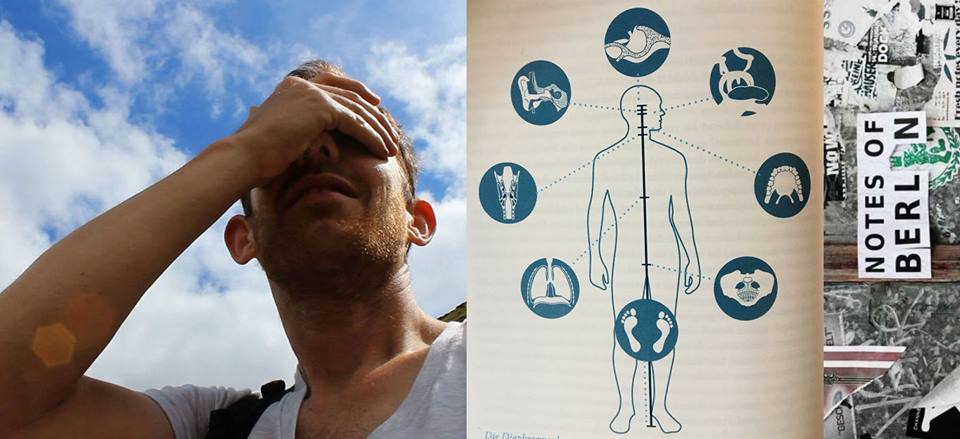
Dave Ball, currently pursuing a practice-based PhD at Winchester School of Art, presented ‘Absurdity, Absurdity, and Absurdity‘ as part of Conversas series at Schillerpalais, Berlin, 29 Nov 2017. The following are his reflections on the event.
Conversas is a regular series of thematically diverse talks held with the aim of creating discussion and dialogue, where audience members are encouraged to interrupt and ask questions, and presenters are warned against preparing “too tightly”. I decided, therefore, not to give a conventionally coherent presentation of my work or my PhD research, but instead treat the event as a public testing-ground for some of the more speculative elements emerging out of my research into absurdity.
The plan was to present a series of examples of what I’d identified as eight variants of absurdity observable in works of contemporary art. Since those categorisations were, to a degree, based on my own intuitive assertions about what would or wouldn’t constitute “absurdity”, I was very keen to test them out publicly.
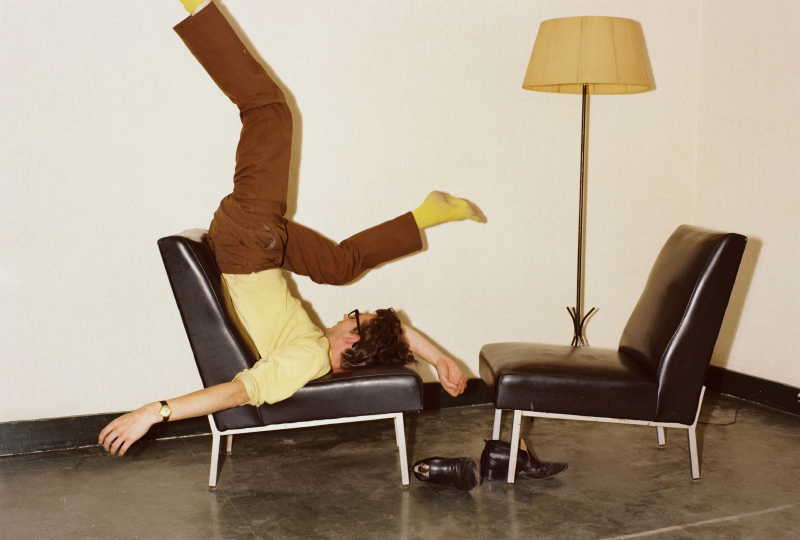
The talk began with a short screening of one of my own video works, which was greeted appreciatively, followed by a brief introduction to my research. As soon as the presentation turned to the work of other artists, however, the atmosphere in the room became unexpectedly heated. In fact, the very first slide shown (a photo by Thomas Ruff of a man inelegantly attempting a handstand on a leather chair, legs flailing in the air) received an immediate rebuttal that “Why shouldn’t we do handstands on chairs? Why is that absurd? That’s so conservative!”
In fact, almost every slide I showed initiated some tirade or other on what various audience members seemed to consider an affront to their intelligence, their outlook on life, or at least their conception of art. My gentle conceptual enquiry into whether or not the works could be considered absurd was frequently met with an impassioned and resounding “no!” Whist some of these protestations could easily be dealt with through reasoned argumentation or clarification of concepts, others unearthed genuinely fertile grounds for further investigation. But what took me completely by surprise was the level of passion, conviction, and emotion with which the audience responded to the topic. Absurdity, as was repeatedly made clear, really matters – and not just to this particular PhD researcher…
Jason Kass recenlty completed his PhD at Winchester School of Art. The title of his thesis is ‘Cognitive Aspects of Pictorial Address and Seriality in Art: A Practice-led Investigation’. In this post he offers an overview of the nature and scope of his research.
My doctoral research explored the perceptual and cognitive processes that underlie spectatorship of pictorial artworks and incorporated insights into the production of new works of art. The fundamental premise of my research was that artworks exist as part of the visual world and are subject to the same visual processes as ordinary scenes and objects. Applying existing empirical findings from cognitive psychology to spectatorship of works of art allows for a more complete understanding of pictorial address.
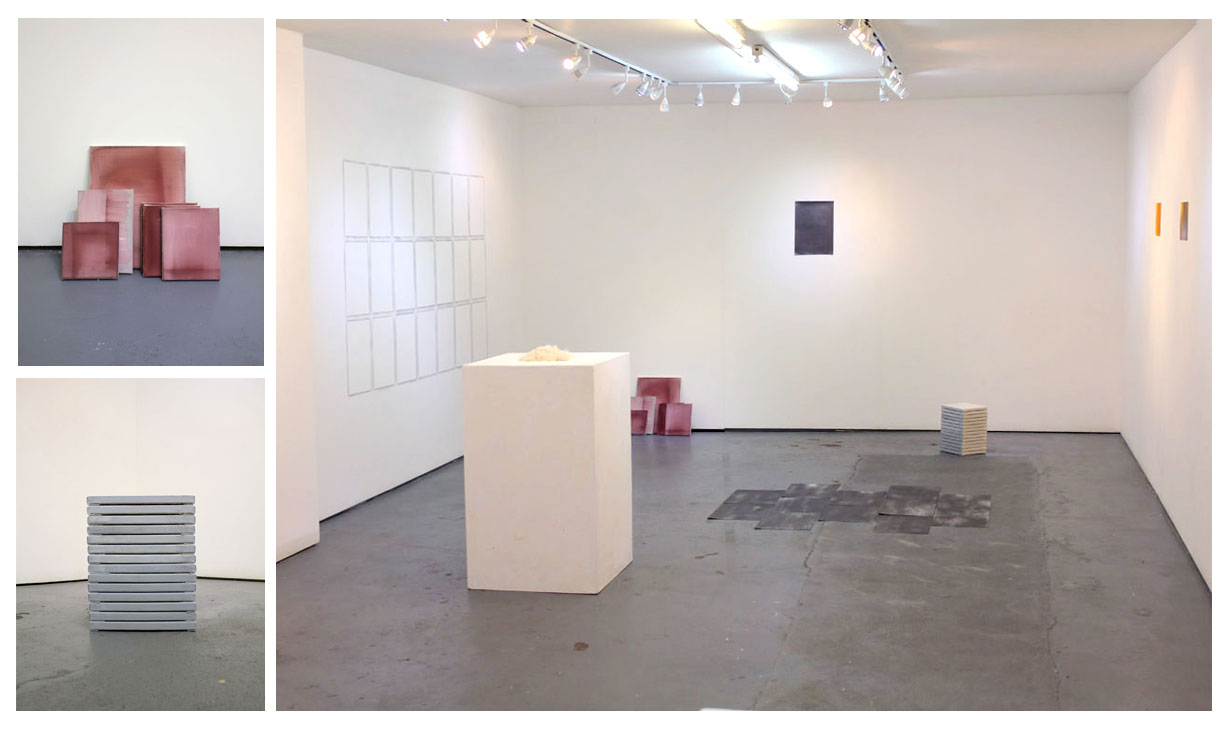
Using theories and methods from psychology to understand the experience of artworks is not in itself novel. The field of empirical aesthetics boasts a wide literature comprising experiments around aesthetic preference and art appreciation. My research differs based on my position as a visual artist rather than a scientist and my emphasis on relating psychological findings to existing art theory and art historical narratives. The incorporation of practice-based research in the form of producing new works of art (Fig. 2) also brings a different perspective to an established yet often divisive discipline.
Figure 1. Installation shot from PhD exhibition.
Within the thesis, I focused on seriality as an aesthetic strategy and the mode of address offered by serial works of art. Serial artworks have previously been theorised, in particular by Coplans (1968), who established a distinction between serial artworks that comprise multiple discrete but related instances and pictures produced along the masterpiece model. Fer (2004) has said about seriality, “It brings with it a whole set of assumptions about the nature of aesthetic experience as direct and spontaneous” (p.4).
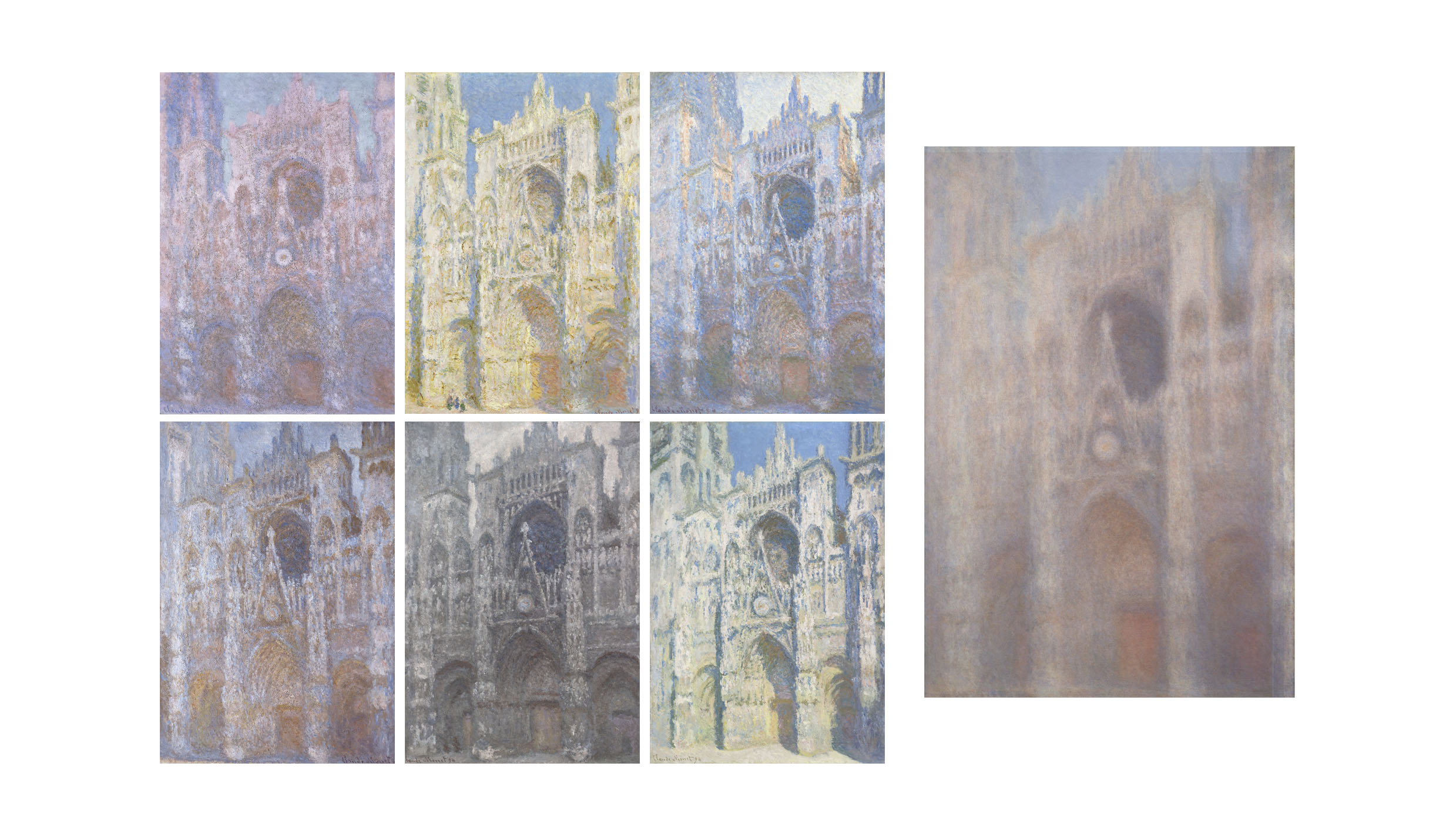
My research sought to reveal the direct impact of seriality on the experience of the viewer by way of cognitive and perceptual processes. In the first instance I considered Monet’s painted series of the Rouen Cathedral. A proto-serial artwork, Monet understood the importance of exhibiting the nearly thirty paintings depicting different light and weather conditions being exhibited together.
I consulted theories of concept formation and face recognition that speak to the ability to form a stable mental concept from a set of varied instances: a feature essential to navigating a complex visual world. Findings within the study of face recognition indicate that the process may involve retaining invariant information across instances while eliminating extraneous superficial details; a process akin to averaging (Young & Bruce, 2011).
Figure 2. A subset of nearly thirty paintings by Monet of the façade of the Rouen Cathedral (left) and an averaged composite of a subset of the paintings created in Photoshop (right).
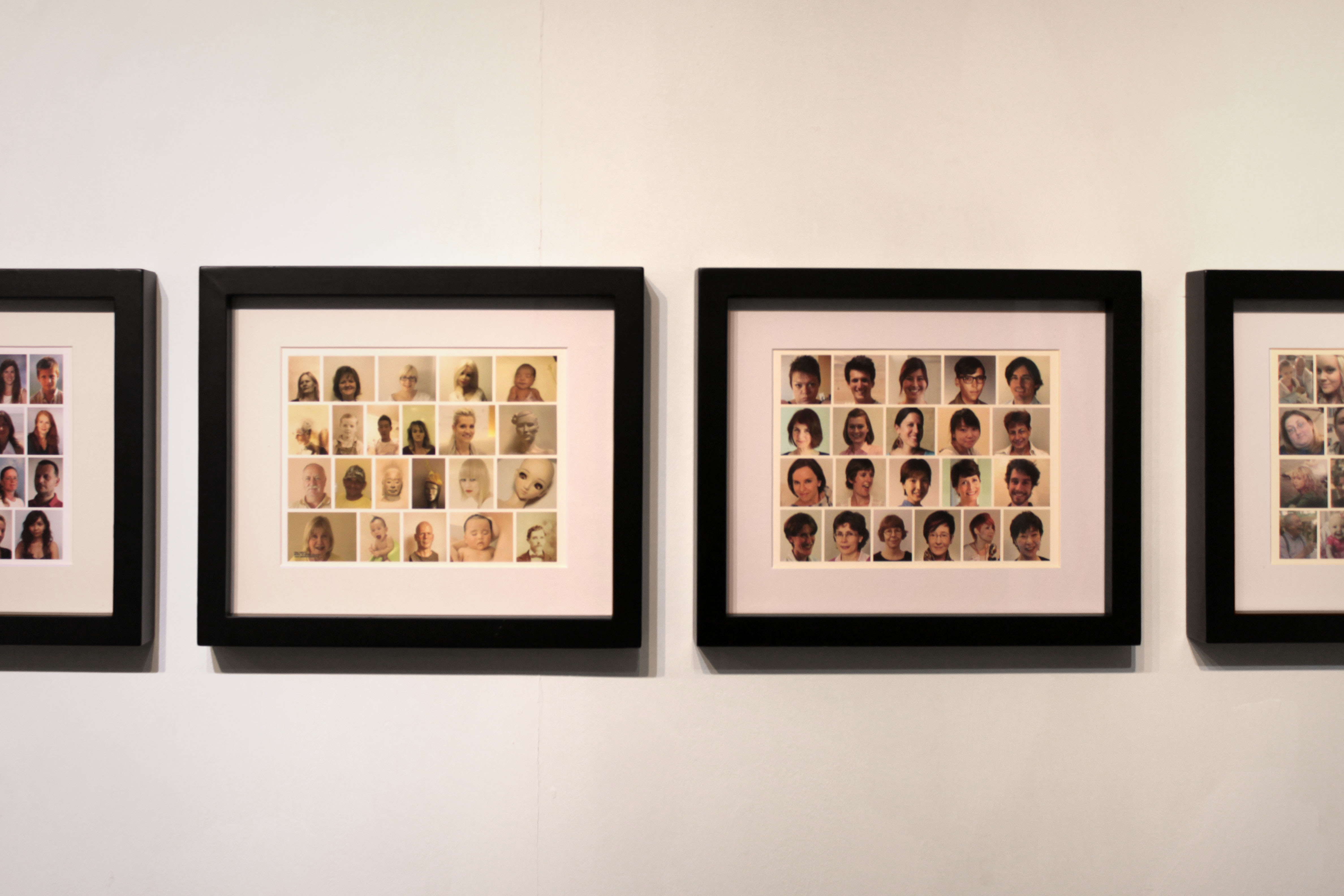
Applying this same premise to Monet’s cathedrals it is possible to infer that the variation in colour and luminosity across the paintings prompts the viewer to form a stable mental concept that lasts long after the in situ viewing (Fig. 2). With regard to art historical narratives, this implies that Monet’s series are as much conceptual as they are perceptual in nature, which runs counter to Duchamp’s well-known exclamation of Impressionist artworks as purely retinal in nature (Krauss, 1990; de Duve, 1996). I explored these findings through photography, drawing and found images (Fig. 3).
Figure 3. Series arrived at by dropping a portrait of my mother into Google’s ‘search by image’ function. The work responded to ideas of concept formation and Barthes’ writings in Camera Lucida (1981).
The second case study examined Warhol’s use of serial repetition in works from his Death and Disaster series that repeat a gruesome image multiple times across a single canvas. Warhol said, “when you see a gruesome picture over and over again it doesn’t really have any effect” (quoted in Goldsmith, 2004, p.19). He presumed that repeated exposure to an distressing image results in a ‘deactivating’ of the negative affect.
Employing existing psychological findings regarding repeated exposure (Zajonc, 1968) it is possible to infer that viewing artworks from the series ultimately leads to an increase in negative affect for the viewer, despite an initial increase in positive affect as a result of repetition. This is due to increased access to the negative semantic content, also a result of repeated exposure (Reber et al., 2004). Related ideas were explored through practice-based research responding to Hunter’s (1973) ”aesthetics of boredom” (Fig. 4).
Figure 4. Installation shot of interim PhD exhibition.
Through future research I hope to build on my dissertation as a model for the exchange of ideas between experimental psychology, art theory and art practice. Although within the dissertation I did not conduct original empirical research I believe there is scope to expand on the theoretical frameworks that I developed through experimentation. I am also keen to further disseminate my findings through practice-based research resulting in creative outcomes that can be publically exhibited.
List of References
Barthes, R. (1981). Camera lucida: Reflections on photography. New York: Farrar, Straus, and Giroux.
Coplans, J. (1968). Serial imagery. Pasadena: Pasadena Art Museum.
De Duve, T. (1996). Resonances of Duchamps Visit to Munich. In R. Kuenzli & F.M. Naumann, Marcel Duchamp: Artist of the Century. Cambridge and London: The MIT Press.
Fer, B. (2004). The infinite line: Re-making art after Modernism. Hartford: Yale University Press.
Goldsmith, K. (2004). I’ll be your mirror: The selected Andy Warhol interviews 1962-1987. New York: Caroll & Graf Publishers.
Hunter, S. (1973). The Aesthetics of Boredom. In S. Hunter and J. Jacobus eds. American Art of the 20th Century: Painting, Sculpture, Architecture. New York: Simon and Schuster.
Krauss, R.E. (1990). The story of the eye. New Literary History, 21(2), 283-298.
Reber, R., Schwarz, N. & Winkielman, P. (2004) Processing fluency and aesthetic pleasure: is beauty in the perceiver’s processing experience? Personality and Social Psychology Review, 8(4), 364–82.
Sagner-Duchting, K. (2002). Monet and Modernism. Munich and London: Prestel.
Young, A. W., & Bruce, V. (2011). Understanding person perception. British Journal of Psychology, 102, 959–74.
Zajonc, R. B. (1968). Attitudinal effects of mere exposure. Journal of Personality and Social Psychology, 9(2), 1–27.
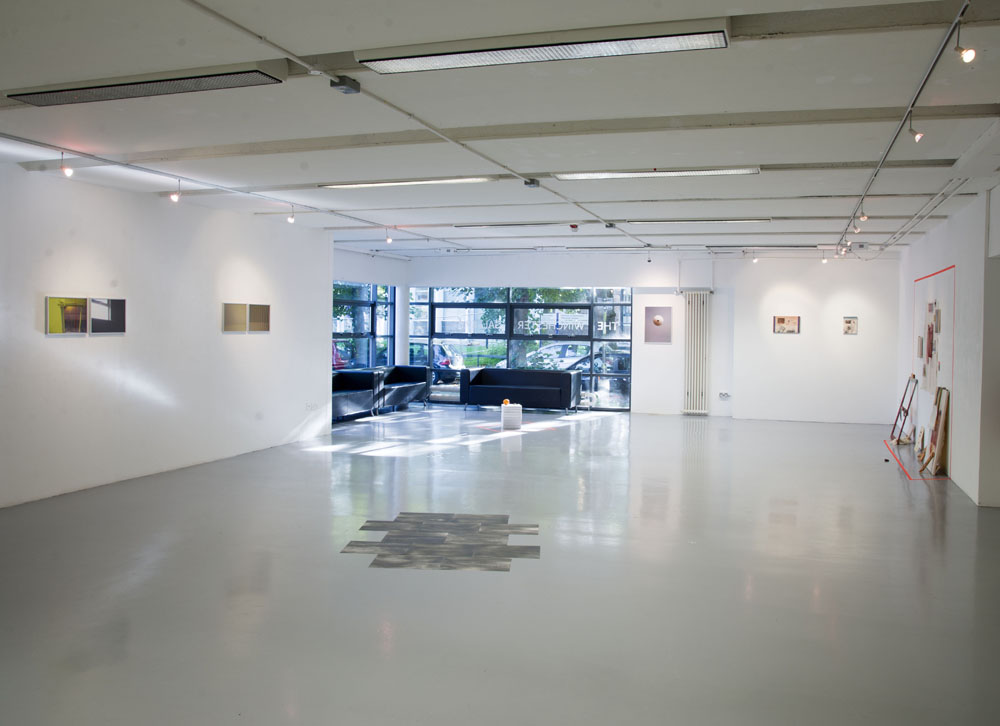
PhD Researcher Abelardo Gil-Fournier has contributed work to an exhibition, Cartographic Operations, at the University’s L4 Gallery space. His work appears alongside that of WSA Staff, Ian Dawson, Sunil Manghani and Jane Birkin.
Cartographic Operations L4 Gallery, February – March 2017
In Bernhard Siegert’s ‘The map is the territory’, he refers to the idea of ‘cartographic operations’. The suggestion is that our way of seeing the world is not simply represented in maps, but that map-making is itself a play of competing signs and discourses producing our subjecthood. These are the coordinates we come to live by, which in turn influence the marks and signs at our disposal when we seek to make and share representations of the world. This exhibition brings together three alternative cartographic operations with the work of Jane Birkin, Abelardo Gil-Fournier and Sunil Manghani and Ian Dawson (see ‘Exhibited Works’ below). The exhibition was devised to complement Beyond Cartography: Safeguarding Historic Maps and Plans, an exhibition in the Special Collections Gallery that showcases maps from the University of Southampton Library’s Special Collections, illustrating the challenges that these objects bring to conservators before conservation or long-term preservation takes place.
Cartographic Operations runs from 20 February to 20 March and sits alongside the exhibition in the Special Collections Gallery, Beyond Cartography: Safeguarding Historic Maps and Plans. Private View: Tuesday 28 February, 5pm to 8pm. [Sign up via Facebook]
Exhibited Works
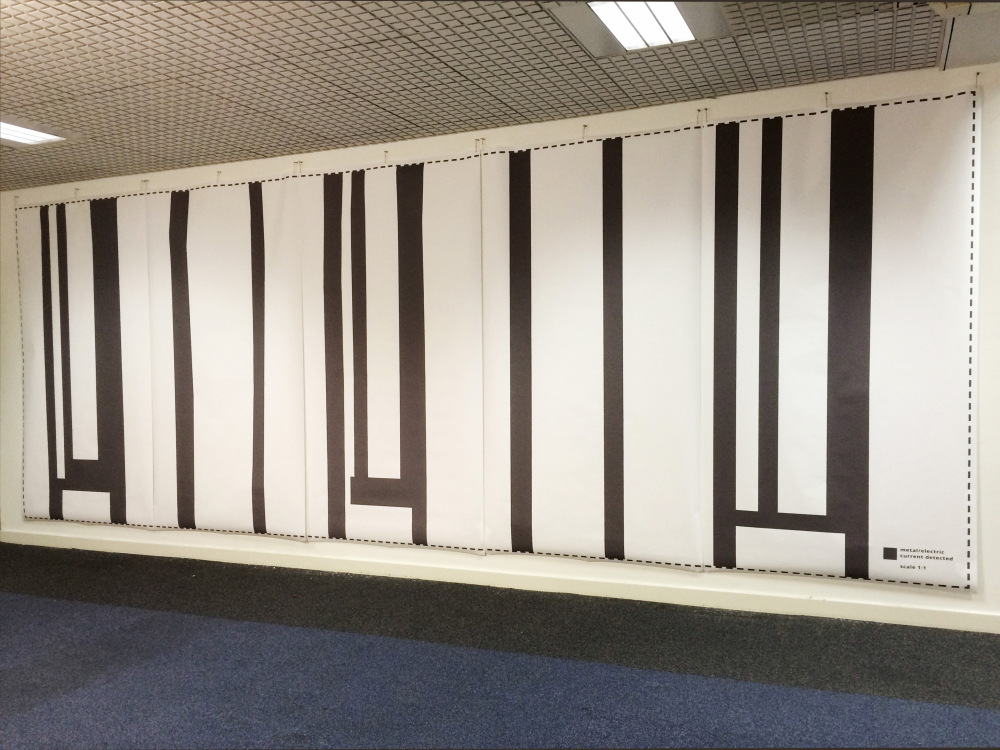
Jane Birkin, 1:1 (2017)
Jane Birkin, 1:1 (2017) [detail]Jane Birkin, 1:1 (2017) [detail]Jane Birkin’s1:1 is a direct mapping of infrastructure behind the white space of display. It is a piece produced by performative procedure: a regulated operation where authorial control is established at the outset and rules are strictly followed. Electric current and metal are plotted using a DIY store metal/voltage detector and the information transferred simply to print.
There are literary precedents for mapping at this scale. In Jorge Luis Borges’s short story On Exactitude in Science cartography became exactingly precise, producing a map that has the same scale as its territory. And, in Lewis Carroll’s Sylvie and Bruno Concluded, a German professor tells how map-makers experimented with the use of ever larger maps, until they finally produced a map of the scale of 1:1. ‘It has never been spread out, yet’, said the professor. ‘The farmers objected: they said it would cover the whole country, and shut out the sunlight!’ In this case, the gallery wall is covered, shut off from light and eyes. Although 1:1 is an impassive engagement with the rule-based activity of cartography, it simultaneously performs an affective act of display.
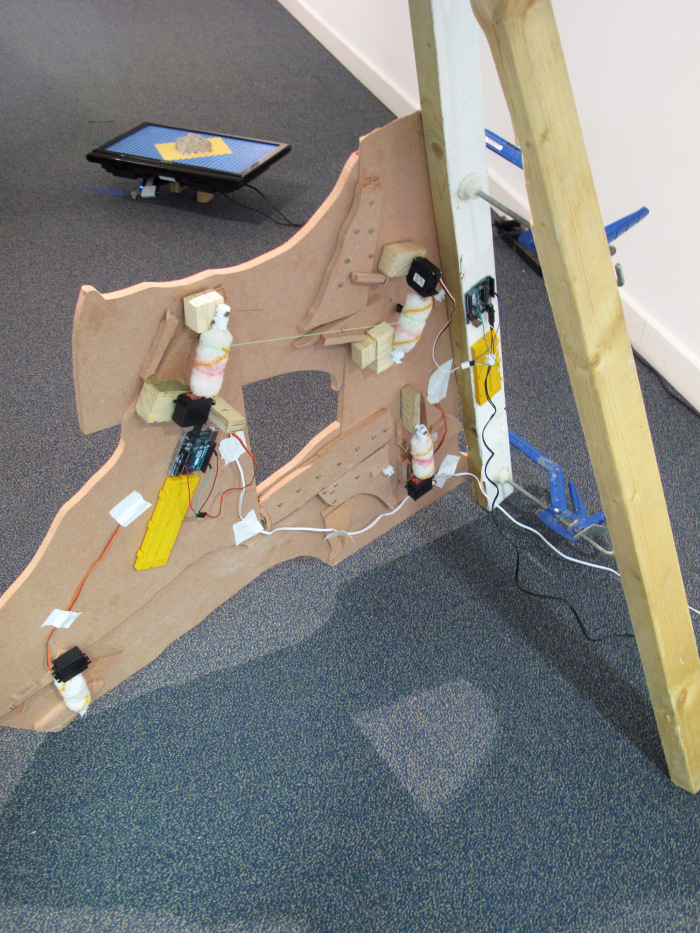
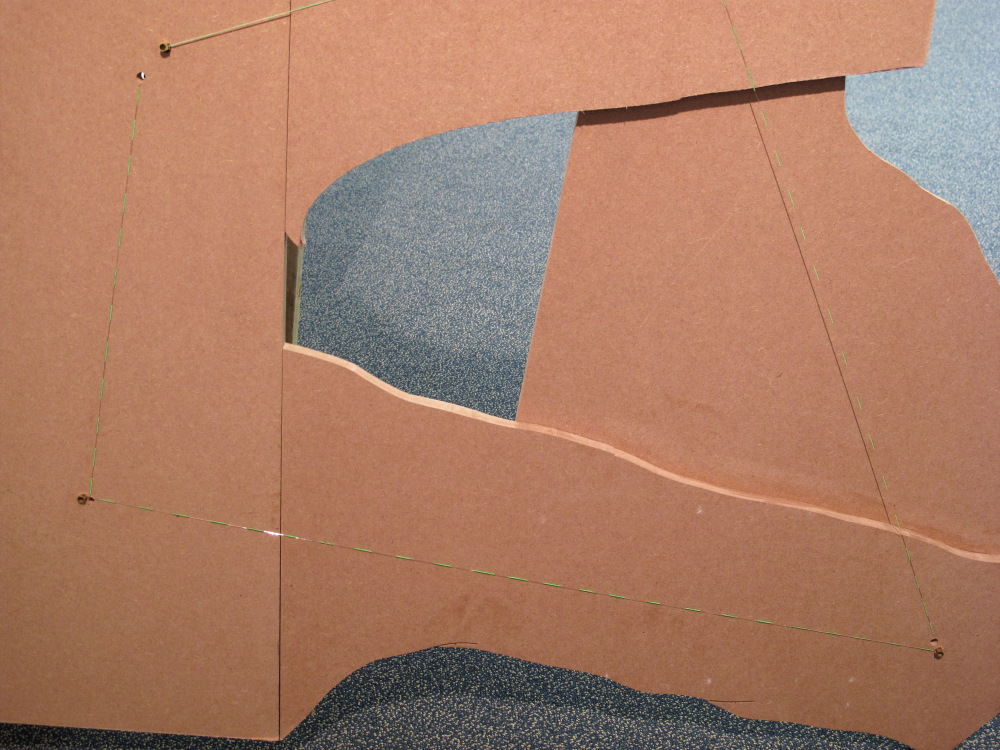
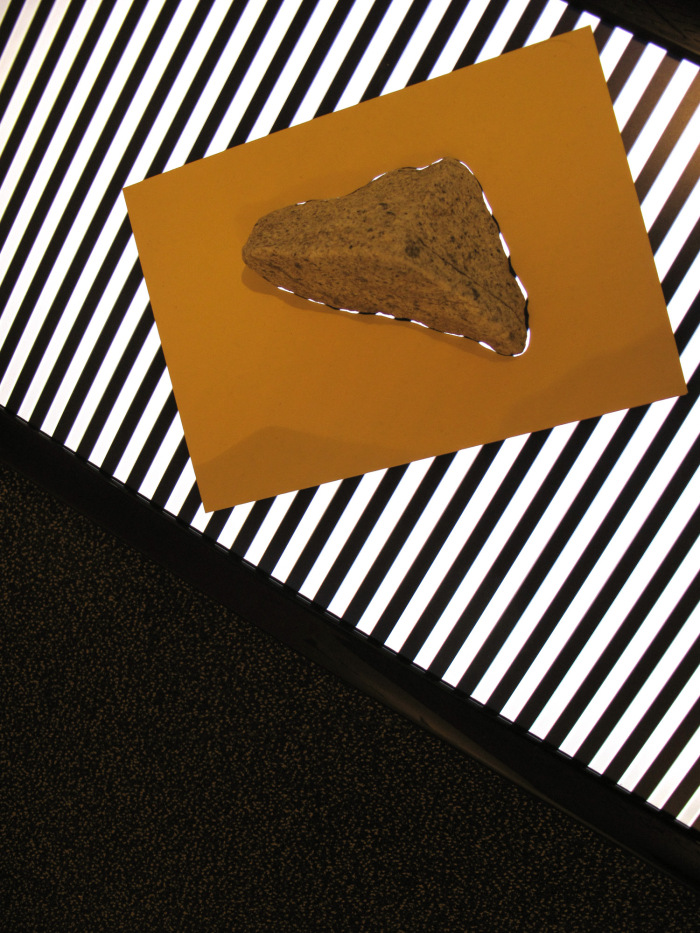
Abelardo Gil-Fournier, Marching Ants (2017)Abelardo Gil-Fournier, Marching Ants (2017)Abelardo Gil-Fournier, Marching Ants (2017)
Abelardo Gil-Fournier’sMarching Ants draws upon historical photographic sources of landscape transformations driven by the building of large water irrigation infrastructures as part of 20th century Spanish land reforms. The work is a reminder of the use of forced labor to transform the lines of maps and diagrams into tunnels and channels in the earth. An economic exploitation of political repression that took place during more that 20 years within Penal Colonies that have been since then removed and forgotten.
The marching ants effect, also known as marquee selection, is the animated border of dashed lines often used in computer graphics programs where the dashes seem to move slowly sideways and up and down, as ants marching in line. It is the visible sign of a potentially immediate transformation within the surface of the screened image. Considered from the point of view of an aerial landscape, operations such as gridding, ordering or leveling land, the marching ants are a form of cultural technique, the tracing of an interaction between imaging technologies, environment, geography and governmental knowledge
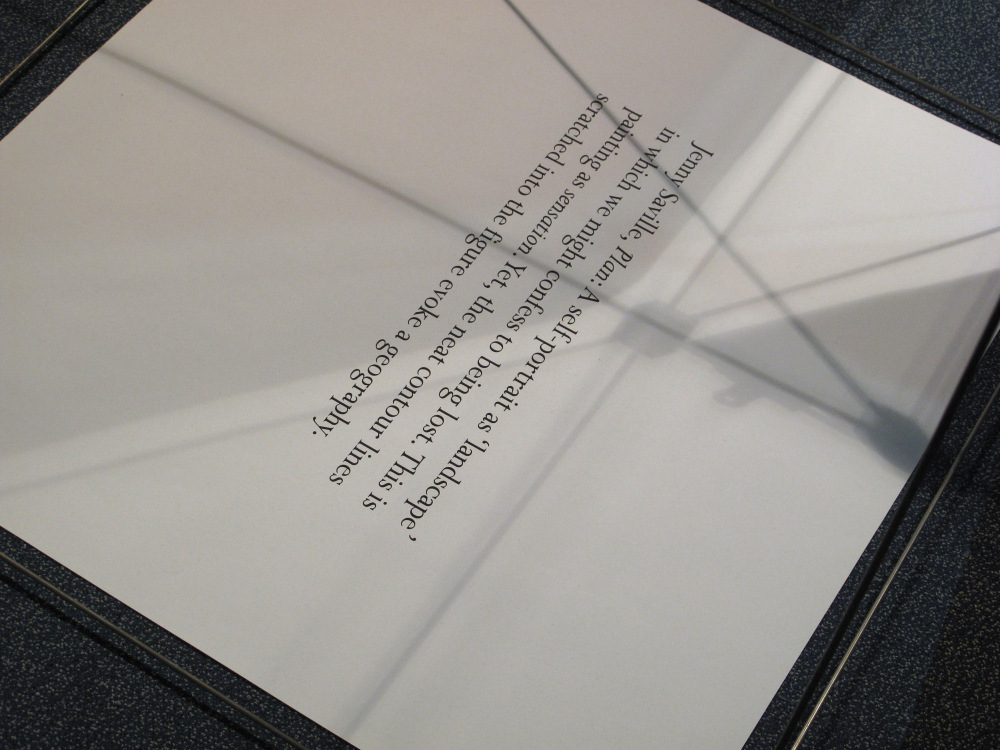
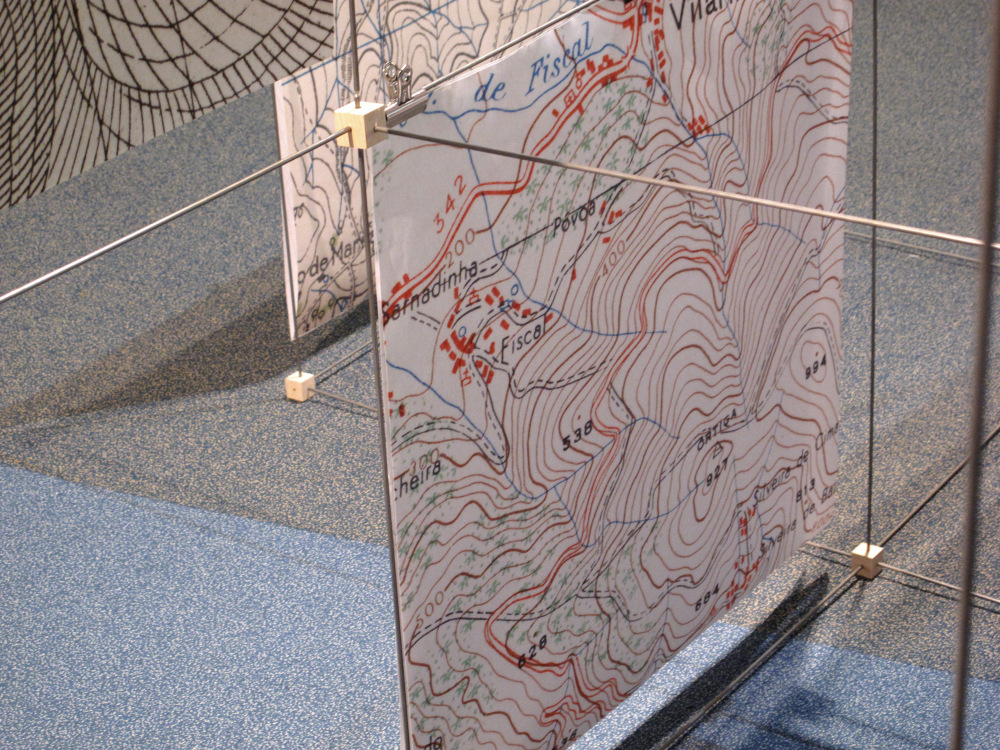
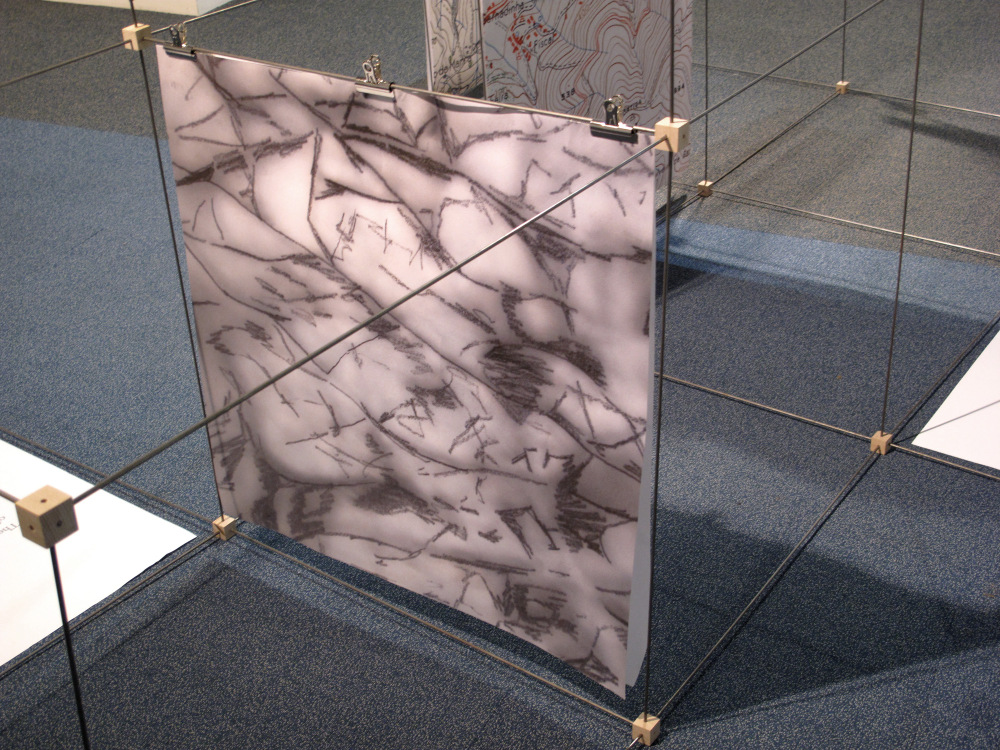
Sunil Manghani and Ian Dawson, Not on the Map (2017)Sunil Manghani and Ian Dawson, Not on the Map (2017)Sunil Manghani and Ian Dawson, Not on the Map (2017)
Sunil Manghani and Ian Dawson’sNot on the Map is an image-text installation built into the gallery space. It draws upon maps held in the University’s Special Collections, picking out details from a volume of Spanish maps from the Ward Collection and military maps of Portugal taken from the Bremner Collection. These details are placed in dialogue with tracings from early and recent figurative works by Jenny Saville – the noted contemporary British artist associated with the Young British Artists of the 1990s and well-known for her large-scale female nudes. The rendering of her work here offers a play on the distinctions between perception/sensations and geography/landscape, which combined with details from real maps only blurs and disorientates our ways of reading lines, sites and points of view. In recent work, Saville shows bodies together, such as an infant wrestling in a mother’s arms, couples embracing, a fight, and children playing in the sand. Such scenes take us into uncharted territories, which we might liken to the enigmatic inks of long forgotten maps. Unlike the spectacle of the body in Saville’s early work, the configuration of images staged here pose as private, idiosyncratic landscapes made up of no single definite lines.


![Jane Birkin, 1:1 (2017) [detail]](http://blog.soton.ac.uk/wsapgr/files/2017/02/jane21.jpg)
![Jane Birkin, 1:1 (2017) [detail]](http://blog.soton.ac.uk/wsapgr/files/2017/02/jane31.jpg)