Living Under the Tourist Gaze

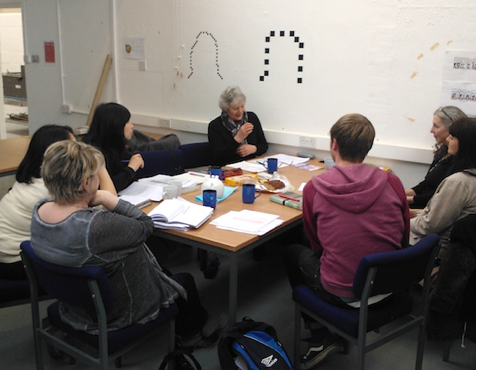
The Phenomenology and Imagination Research Group held a seminar on 19 January 2015, led by Bevis Fenner, with the title ‘Living under the tourist gaze: AirBnB, dwelling and the reflexive negotiation of environmental meaning under the conditions of late capitalism’. The session expanded the previous session’s exploration of what constitutes ‘dwelling’ and ‘home’, led by Patti Gaal-Holmes, to take on notions of ‘existential authenticity’ and performativity in ‘dwelling’. This article provides notes and commentaries drawn from the seminar by the participants, Patti Gaal-Holmes, Noriko Suzuki-Bosco, Yvonne Jones, Yonat Nitzan-Green, Jane Bennett, Cheng-Chu Weng, Simiao Wang.

Texts for Seminar:

  • Ning Wang – Rethinking Authenticity in Tourism Experience (pp. 359-366)
  • Dean MacCannell – Staged Authenticity: Arrangements of Social Space in Tourist Settings (pp. 591-598)
  • Tim Edensor – Performing Tourism, Staging Tourism (pp. 71-79)

Following on from Patti’s seminar on dwelling and making yourself  ‘at home in the world,’ Bevis opened up a discussion about the extent to which we can open out to external influences in order to disrupt ‘habitual ways of being’ without loosing our sense of ‘home’ in ourselves. Vilém Flusser’s provocative suggestion that we need to move away from the encased individualism of houses and build for a collective future, is extremely inspiring. Yet to what extent is it possible to share our private spaces of dwelling – opening our houses and minds to others? Moreover, what are the challenges for cultures in which ‘bricks and mortar’ notions of dwelling and Cartesian relations to the world have become habits for dwelling? For Heidegger, dwelling ‘remains for man’s everyday experience that which is from the outset “habitual” – we inhabit it’ (Heidegger, 1978: 247).

The seminar was based around a draft chapter for Bevis’ thesis document, which explores the idea of ontological authenticity or that which Wang (1999) terms ‘existential authenticity’ in tourism performance. Specifically, he used auto-ethnographic perspectives and observations as a former AirBnB host to explore some of the ways in which tourist performance and ‘staged’ social relations might impact upon ontological authenticity in everyday life.
Bevis Fenner: It turned out to be a very exciting and engaging seminar in which we debated both the nature of authenticity in tourism and everyday life, and the distinctions between host / guest, tourist / non-tourist, which perhaps led us to question both the status of the art object and the need to assert the intention of the artwork in order to govern its reception. One of the key issues that came up was the notion of performance both as a way of directing the self and as a means representation for others – what does playing the tour guide ‘do’ from an ontological perspective? This also brought into play the issue of authenticity in performance and how as tourists we seek ‘the real’ in other peoples, places and things. Yet, as Patti pointed out, this highlights the fragile nature of ontological authenticity, as the ‘authentic’ settings of host communities force us to question whether we are tourists or travellers, friends with hosts or simply their customers. Indeed, as both Cheng-Chu and Yonat pointed out when I said that I wanted to “get under the skin of tourism”, tourists are often thought of as shallow, depthless with nothing under the skin – they are caricatures like Duane Hanson’s sculptures!

As the conversation unfolded, we began to realise the complexities of authenticity in tourism. Ontological or ‘existential tourism’ was discussed in relation to the post-human. Yvonne got us to consider whether or not she authenticity was based on experience rather than the veracity of objects by stating that she had ‘fake’ lenses in her eyes. After reflecting on the way that technology distorts or changes notions of authenticity, Simiao pointed out that just as one might visit a ‘fake’ place like a theme park but experience it in an authentic human way, so too is it Yvonne’s ability make use of or appropriate the lenses in multi-sensory experience that makes her relationship with them ontologically authentic. Yet, as Yvonne noted, even seemingly authentic objects can be inauthentic. She argued that there is something inauthentic about Venice, in that it is left in a crumbling state, very few people actually live there, and there is a sense in which the peeling paintwork and opulently acetic candlelit settings would not exist in the ‘outside world’! We touched upon the notion of ‘staged authenticity’ as the maintenance of aura, which brings to mind, on the one hand Baudrillard’s simulacra, and on the other Benjamin’s notion of the ‘aura’ of the art object. However, what became apparent was that performance and ritual were a necessary to social relations and that tourism often offers strict boundaries for this – ‘habitual ways of being’ a tourist which offer ontological security (Edensor, 2001). We also discussed role the objects that we bring away with us as ‘pieces of home’ and Jane suggested that these were perhaps a kind of reproduced private space – our backstage whilst on tour!

The discussion then moved on to debate the notion of the public and private self in relation to the home and how it differs from culture to culture. Noriko pointed out that the performative roles were a strong part of Japanese culture and there is a respecting of these boundaries in which no-one visiting someone’s home or a public inn would expect to look behind the scenes. Likewise, Simiao explained the ritualised socio-spatial boundaries of traditional Chinese home and how these reflected social and religious hierarchy and reverence within the family structure. This brought about a fruitful fork in our conversation in which, we firstly discussed ideas of the self and the home in relation to both individualism and collectivism, and secondly the role of performative ritual and ceremony in cultural representations – a Benjamin inspired notion linking the ‘host space’ of tourism with the art gallery, and the rituals of representation lost in an age of mechanical reproduction. Indeed, as Cheng-Chu suggests ‘[w]here is the sense of focusing? Do people’s action embodied with a space?’.

We then considered the effects of de-traditionalisation both in the East and the West as bringing about the rise of individualism and its compounding of Cartesian divisions between inside and outside, self and world. The rise of counter culture in the 1960s seems to have perpetuated notions of self against society, in which one’s own future more important than that of one’s family. Indeed, Yvonne, gave a personal anecdote in which she described moving as far away from her parents’ home and the responsibility of family. She talked about refusing to return home when she was 21 and engaged to be married, despite being offered a car! She explained that they were disappointment as they considered she belonged to them, should be guided by them and do as she was told. Interestingly, in the ethics of individualism the home seems to become on the one hand, a refuge from ideologically contaminating ‘outside’, and on the other, a publicly-private space – a shop front for the self – through which is an express of identity to others. Here, the home becomes a contestable space of representational negotiation and hybridity, in which self and ‘home’, are perhaps, interchangeable. Interestingly, I began the seminar with a quote from Richard Sennett about the rise of the protestant ethic in the West and its affect on spatial structures. He argues that the protestant ethic, is at the heart of individualism, which is, in turn, the foundation of capitalism. For Sennett, ‘[o]bsessive inner struggle may imply a deep hostility toward the needs of other people, a resentment of their very presence. Other’s interfere; to get in control of oneself, nothing “out there” can count’ (Sennett, 1990: 45).

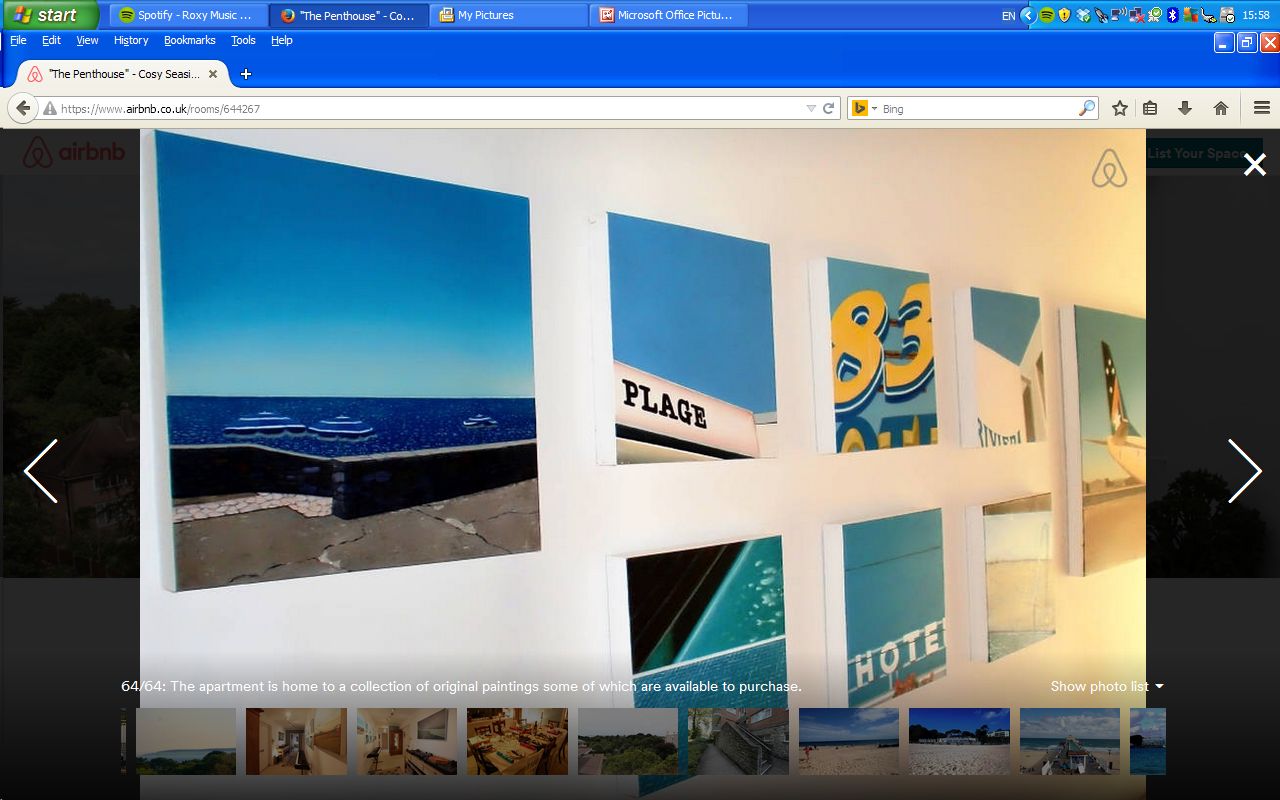
At this point the nature of my own practice was brought into question, which as Yonat pointed out becomes a form of performance in which the status of the artwork is negated but the aura is retained and reused in negotiation of representation both for and by others. In different settings my paintings are ‘read’ in different ways by different people, and the contexts take into account this multi-accentuality. These discussions allowed us to question the enlightenment notion of tourism as a negative form of behaviour in which we demand to see or have, that which we desire in our minds to the exclusion of the objective world, as it is as opposed to how we think it ought to be. Instead, we considered both art and tourism as exploring a gentle politics of Being – as both an openness to the world and a letting things be.

Cheng-Chu Weng: It is a lovely seminar again; I wish, I am able to hold a seminar as this in the future. The question of what is the authenticity did open up the glory discussion. I am impressed in the way your practice set up to adjust the issue, for instance the elements of practice: painting, AirBnB and tourists.

I remember in the seminar the question Yonat asked about, how do you put your position with your painting? This is the question I want to ask as well. I assumed your answer will be evoked the issue of gallery or Benjamin, W.’s aura. The answer from you seems much more complex; due to it intervene the specific viewers. I do feel the relationship between you and your painting is cold. As a painter, I do feel painting is part of me, presenting works as I am naked in front of people. For you the paintings are empty? Painting is working in specific environment? At the page 13, you said “[…] the white walls and spotlights of the hall space…. However, this is not a gallery we can dwell in.” I do agree the form of painting is hard to demonstrate in different environments, especially the light. Whilst paintings take out from the studios the light do change the aura. Furthermore, I do agree the idea of painting should not be understood or view by the specific people and place, which is the reservation for Dadaism and Pop art. On the other hand, I do find moderns’ visions have been disturbed by the technology seriously. Where is the sense of focusing? Do people’s action embodied with a space? As you argue that the idea of performing. However, I think ‘formal’ galleries do pervade the phenomenon of concentrating, and ceremony. A few months before, I visit Richard Serra’s exhibition at Gagosian Gallery. The securities look like come from movie “Men in Black”, they seems had been chosen, model size with black suits. Viewers seem to also respond to the phenomenon the artist created. Both of they are performing.

While reading the text, I do find the position of the host as a the shadow/ illusion maker in Plato’s cave story. Tourists are searching for the exotic experience, yet actually they are in the shadow of the cave. In the end of the seminar, I think from the group desecration did answer my doubt that why do not present the issue as Duane Hanson’s tourists serious? Although the narrative of the tourists’ feedback/ commit of the AirBnB or painting are general ideas for me, the responds from they are providing the holes of the research. This holes create the link between practice and theory.

Thanks, Bevis and the phenomenology & Imagination Reading Group. I do not only find learning the theories from yours, but also find enjoy of sharing the ideas. The idea of sharing is the treasury. From Noriko, Patti, to Bevis seminars are provides different text from phenomenology, yet gives the same sense of being-in-the-world. I like to conclude the idea by quote Merleau-Ponty’s theory:

 […]; we have found underneath the objective and detached knowledge of the body that outher knowledge which we have of it in virtue of its always being with us and of the fact that we are our body. In the same way we shall need to reawaken our experience of the world as it appears to us in so far as we are in the world through our body, and in so far as we perceive the world with our body. But by thus remaking contact with the body and with the world, we shall also rediscover ourself, since, perceiving as we do with our body, the body is a natural self and, as it were, the subject of perception(1945:239).

Following the discussion of family, identity and the being-in-the world do reminds me John’s seminar The Big Night: Into the Ultacity, the idea of escape. Could we imagine the society as the movie The Road? Moreover refer to the idea of family, peak up the memory of the lovely film from German filmmaker Doris Dorrie’s Cherry Blossoms. It is interesting that in the end link to Patti’s. As well as the lovely collection book in WSA library John Bently’s The Old House.

Yvonne Jones: Ontological authenticity, using the notion of authentic within existential philosophy and a definition of ontology, we are speaking of being, becoming, an existence and reality that is genuine, made in the traditional or original way, not a copy.

Within the session my attention was attracted to the over riding concept of AirBnB as a means to achieving authentic experiences of place and people.

Moravec claims that our future is one of very little original experience, and that the senses have no future (1997). While this sounds extreme (to me) the sources of our daily experiences have already altered at a fast rate with the developments in technology. We ‘see’ events across mediated information, witnessing from a distance, via film, TV, the internet and social media to name a few. How often do we see the world (once removed) through glass, be it the window of our house or the windows of the vehicles in which we travel? From Patti’s session, Flusser (Building Houses) writes of walls and the holes of windows and doors where the window becomes an instrument, allowing that ‘one could peer outside without getting wet’; he is describing a distancing of direct experience. He refers us to a Greek term theoria meaning, knowledge without danger or direct experience. Moravec’s belief moves along the spectrum of indirect experience to where there will be a time, he claims, when the vast majority of our knowledge will be sourced from one gigantic computer out in the universe, revealing to us all we would wish to know, with very few moments of original (authentic?) direct experience. He used this model to include ‘all the wonders of the world’, being made known to us. This notion is an evolution and extension of Flusser’s model of holes in walls that allow us to avoid direct experience, to a model where we cease to experience anything directly or through the senses; no direct experiences, but seemingly ‘avoiding danger (and direct experience)’. Where would we be dwelling at that point, how authentic a human would we be, would we all be tourists of the inauthentic?

In his work, Bevis is exploring ontological authenticity. The session was stimulating. That people are today seeking out the backstage in order to have authentic experiences of authentic people and places, is itself exciting. It holds the potential of instigating a discussion and debate that offers a choice for our future, rather than now and future living beings becoming subsumed into a literal posthuman existence without challenging it. While the notion (of literal posthuman existence) appears at first sight to be extreme, there is an evolving path, that, without discourse could lead to such a goal.

Authentic also means made in a way that faithfully resembles an original. Moravec believes a bio material machine can be created in the future, one that ‘me’ can be transferred into, out from ‘my’ old or injured born-corporeal body, leaving the original behind and discarded. Would this faithful resemblance be authentic, would it be characterised by the existential understanding of authentic with the capacity of being, becoming, would this faithful resemblance have an existence and reality that is genuine? It would not have been made in the traditional or original way, via sexual reproduction, but it would be the same genetic construct as the “me’ who was transferred. This is after all only extending idea of incorporating an artificial limb or a natural lens being destroyed and replaced by an artificial lens. In the scenario of such a literal posthuman would, as Simiao says, the ability of ‘me’ to appropriate the bio-material machine make it ontologically authentic?

That ontological authenticity is being sought out, suggests there is already an awareness of our reductive capacity for genuine experience. The emptiness expressed in Bevis’s practice, his paintings, offers an experience for the viewer that questions our experience of existence.

Thank you Bevis for your session and all who participated. The sharing of information and the open talk within this supportive group (PIRG) is productive, a place of real learning and advancement of thought. The group is innovative in its methodology it stimulates and encourages authentic thoughts, responses and comments.
Yonat Nitzan-Green: Bevis wrote: ‘I would like to open a discussion on the extent to which we open out to external influences in order to disrupt “habitual ways of being” without loosing our sense of “home” in ourselves.’

I was interested to see how a discussion will be opened up within the academic environment (Winchester School of Art), bearing in mind HIRG/PIRG moment of transition; not only in term of location (moving from Southampton University café to the PGR seminar room) but also in term of method and methodology. I was aware that Bevis’ opening statement reflects, un-intentionally perhaps, this moment of transition. At the beginning of the session I mentioned very briefly the method of conversation which was used at all previous meetings and the method of presentation which is used in academic seminars. I suggested that a synthesis between the two methods may be a base for PIRG methodology. In line with the topic of this seminar, Bevis’ presentation hosted the method of conversation perfectly, thus, I, and I believe, the others, felt at home.

I go back to the question: what is it to feel ‘at home’?

Bevis writes: ‘For Heidegger, dwelling “remains for man’s everyday experience that which is from the outset ‘habitual’ – we inhabit it” (Heidegger, 1978:247)’.

I looked at the etymological meaning of the word ‘habitual’ in Hebrew and found that it shares the same root as ‘leg’ הרגל, רגל . This is close to the Aborigines’ nomadic way of dwelling (Michael Jackson’s At Home in the World, introduced by Patti Gaal-Holmes). There is an ancient word in Judaism – ‘holidays’ – רגלים which also shares the same root as ‘leg’. It refers to the tradition of walking from all parts of the country to the temple in Jerusalem on special, sacred days. Thus, the word ‘habitual’ maintains a dialectical meaning: the everyday habit, on the one hand, and a special occasion, on the other hand. It also preserves a connection with the body; it is through and with the body that we dwell. I mentioned the kibbutz childhood system of children groups moving house every two years; another daily routine (not mentioned at our meeting) was walking from the ‘children’s house’ to the ‘parents room’ to visit one’s parents every evening for about 3 hours; then walking back to sleep at the ‘children’s house’. No wonder I feel empathy and find in me some sense of familiarity with the Aborigines way of life.

Bevis introduced two concepts ‘auto-ethnography’ and ‘existential authenticity’. I think it is a good idea to put here something about each of these concepts.

‘Autoethnography is a form of self-reflection and writing that explores the researcher’s personal experience and connects this autobiographical story to wider cultural, political, and social meanings and understandings. It differs from ethnography —a qualitative research method in which a researcher uses participant observation and interviews in order to gain a deeper understanding of a group’s culture— in that autoethnography focuses on the writer’s subjective experience rather than, or in interaction with, the beliefs and practices of others. As a form of self-reflective writing, autoethnography is widely used in performance studies, as a method in living educational research and English.’ (From Wiki: http://en.wikipedia.org/wiki/Autoethnography)

I looked at ‘existential authenticity’ as it is explained in Carol J. Steiner and Yvette Reisinger, ‘Understanding Existential Authenticity’ (see link: http://www.osea-cite.org/tourismworkshop/resources/Existential_Authenticity.pdf)

‘Heidegger uses the term “authenticity” to indicate that someone is being themselves existentially (1996:247-277). This is deeper than being oneself behaviorally or psychologically. To be oneself existentially means to exist according to one’s nature or essence, which transcends day-to-day behavior or activities or thinking about self. Because existential authenticity is experience-oriented, the existential self is transient, not enduring, and not conforming to a type. It changes from moment to moment. As a result, a person is not authentic or inauthentic all the time. There is no authentic self.’ (Carol J. Steiner and Yvette Reisinger, ‘Understanding Existential Authenticity’, p. 303).

This made me wonder about the kind of authenticity that emerged in people who lived communally during their early, formative years of personal development.

Another point that interests me is Bevis’ choice of positioning his paintings within this presentation. I have noticed that the images seem to be like any other standard tourists accommodation; the paintings appear in all but one of them, always at an angle and surrounded by other domestic objects, which emphasize their objectness.

In his analysis, Bevis’ intention is made clearer. He termed ‘everyday tourism’ as ‘a work in progress’. In that context, the paintings (his paintings) are in a space/role of mediation. He writes: ‘… the aura of the artwork is never destroyed by mediation but is always in negotiation with context, through which hybrid meanings are produced’. I sense that for Bevis AirBnB was not only a financial necessity, but a performative act in a performative space where questions about existential authenticity could be explored.

To further understand representation in relation to mediation Bevis writes:

‘In discussion of web aesthetics as a reframing of the mediated nature of representational practices, Manghani suggests that re-mediation or the framing-of-framing is an aesthetic of hypermediacy, “which represents our… desire to foreground the act of mediation” (Manghani, 2013: 163)’.

Now, placing mediation at the foreground, Bevis’ paintings ‘are not simply commodities but actors within a commoditized performance space. They play emotional role …prospective visitors … through… suspension of disbelief, envisage ways in which the space could become a temporary home’ (Bevis’ text). Heidegger writes: ‘dwelling itself is always a staying with things’ (Heidegger, 1978b:247). Bevis suggests that ‘perhaps in their ambiguity and obtuseness the paintings allow such dwelling?’

Although not in Bevis’ text, I am reminded of Bachelard’s meditation of home and reverie. Bachelard writes:

‘… the house is one of the greatest powers of integration for the thoughts, memories and dreams of mankind. The binding principle in this integration is the daydream. Past, present and future give the house different dynamisms, which often interfere, at times opposing, at others, stimulating one another. In the life of a man, the house thrusts aside contingencies, its councils of continuity are unceasing. Without it, man would be a dispersed being.’ (Gaston Bachelard, The Poetics of Space, pp. 6-7).

Reinforcing Bevis’ suggestion, I would add that the paintings accommodate the tourist’s gaze; housing their daydreaming.

Noriko Suzuki-Bosco: I have been looking into the area of Human Geography recently to try and understand ‘where’ and ‘what’ a place is.

In the book ‘The Lure of the Local’, art critic and writer Lucy Lippard gives definition of ‘local places’ as an ‘existing hybridity’ and that ‘each time we enter a new place, we become one of the ingredients of the existing hybridity’. She suggests that ‘by entering the hybrid, we change it; and in each situation we play a different role’. (Lippard 1997, p.6)

Lippard notes, ‘Place is latitudinal ad longitudinal within the map of a person’s life. It is temporal and spatial, personal and political. A layered location replete with human histories and memories, place has width as well as depth. It is about connections, what surrounds it, what formed it, what happened there, what will happen there.’ (Lippard 1997, p.7)

I thought about the definition Lippard gives of a place in relation to the host –guest situation of a BnB. If a home is opened up to accommodate others, does that allow for more of this ‘hybridity’ to enter into the so-called personal space? How does this affect one’s relationship with their home?

Your question, ‘ ‘How much can we disrupt our habitual ways of being without losing our sense of home?’ and the two further points raised during the discussion, ‘what are we losing (by opening up our homes to guests)’ and ‘what are we protecting’ seemed ever more prevalent when contemplating this potential shift of home from a personal, sacred place to something more open, hybrid and fluid. From this understanding, is it correct to say that a home opened up to others are never complete, finished or bounded but are always becoming – in process? Maybe a fixed notion of a ‘home’ only exists in our nostalgic, rose tinted ideal?

Furthermore, Lippard suggest that the ‘pull of a place’ continues to operate in all of us as the ‘geographical component of the psychological need to belong somewhere, one antidote to a prevailing alienation’ (Lippard 1997, p.7). Is this why people seek ‘home from home’ experiences when choosing a ‘cosy’ BnB, the desire to be in a home?

I have been pondering over the last question we ended your session with, ‘When you break your “rootedness”, what do you replace it with to call a “home”? ‘

I wonder what this ‘home’ is.

Jane Bennett: It was interesting to note your guests’ comments about being amongst “real” art; perhaps part of what they seek in their search for the back-region is gained from the reflected aura of the art object. The performative function of your paintings in this situation brought to mind Jacques Derrida’s ideas about framing (The Truth in Painting, 1987): the tourist’s performance is in a framed setting, a part of which are your paintings. But the effect of the paintings themselves extends beyond their own frame and their work is additional to their function as an object in a number of ways. Firstly, in the authentic aura of a hand-made object with direct connection to a person that reinforces the back-region illusion; they allow the guest to project themselves into this new world they desire to experience. Secondly, as you state, in their critique of the whole tourist experience in the emptiness of their subject matter and the way in which you have painted them. Just as the frame of the painting sets it aside from the outside world, so the frame (or stage) of tourist experience separates it from our everyday lives.

A further thought about the objects we carry around on our travels – perhaps these become the lifeline to our authentic selves, or ‘home’, which may be necessary lest we become too deeply embedded in our daydream as tourist and forget where reality lies.

Patti Gaal-Holmes: This was such a rich session with a lot to think about and some unexpected connections I found myself making. Since the January session I have stayed in airBnB again (this time in the UK – Taunton) and my experience there made me acutely aware of this ‘act’ of being and entering into the intimacy of someone’s home. Bevis had already raised the ideas for his presentation so it was good to be more aware of the ‘role-playing’ involved. I have previously stayed in AirBnB in Copenhagen (twice) and somehow feel that for traveling abroad it is a better option than a hotel/B&B. Perhaps this is also because the cultural negotiations are also eased by being hosted by a local person who can give tips and ideas about places to visit off the ‘tourist’ radar; and one gains entry into the culture more ‘authentically’ perhaps? Or perhaps a myth?

The idea of cultural difference and how we negotiate this is of immense interest to me and your citations from Lippard, Noriko, are very interesting: in how ‘we become one of the ingredients of the existing hybridity’. She suggests that ‘by entering the hybrid, we change it; and in each situation we play a different role’. (Lippard 1997, p.6). Perhaps by staying in an ‘authentic’ home (AirBnB) we take on the hybridity in cultural difference more readily than when staying in ‘homogenized’ hotels which could be anywhere?

I was also interested in how Bevis discussed his artworks and their role in providing the ‘right’ décor with reference to tourist brochures and which guests felt was so important as being authentic ‘real’ art. Cheng Chu’s point about the ‘cold’ relationship to the work was interesting but perhaps this is also due to the content as these are not angst-ridden expressive works which would be more difficult perhaps for ‘exposing’ oneself; which one already does as a AirBnB host by opening up the personal space of the home.

Our discussion about the cultural differences in traditional Eastern collectively orientated families as opposed to Western individualism was interesting and it was invaluable to hear Cheng-Chu and Simiao’s contributions too. Perhaps as tourists we want somehow to also gain some understanding of how other cultural systems work as we can only really very tentatively step into them: unless we live elsewhere (as opposed to a brief trip/holiday).
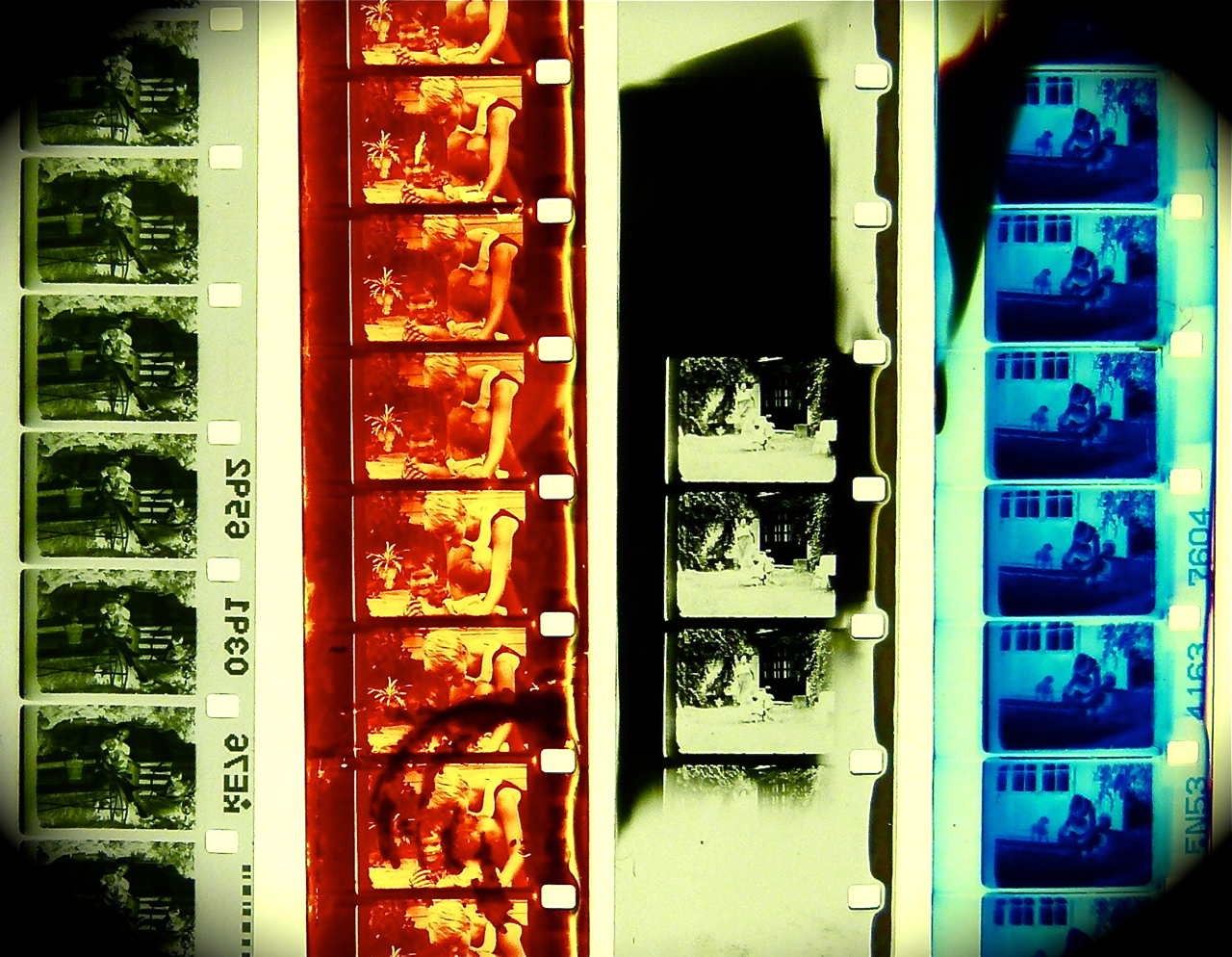
 

Excavations in Film, Fragments Lost in the Ether and Being At ‘Home’ in the World

The Phenomenology and Imagination Research Group held a seminar on 19 January 2015, led by Patti Gaal-Holmes, with the title ‘Excavations in Film, Fragments Lost in the Ether and Being At ‘Home’ in the World’. This article provides notes drawn from the seminar and commentaries from the participants, Noriko Suzuki-Bosco, Yvonne Jones, Yonat Nitzan-Green, Jane Bennett, Cheng-Chu Weng, Bevis Fenner, Xiaoyang Xi.

Seminar Reading:

  • 2 page extract from Michael Jackson’s At Home in the World (2000)
  • Short essay ‘Building Houses’ by Vilém Flusser

Additional Reading:

  • Patti Gaal-Holmes, ‘(Re)calling ‘Home’: An Artist’s Negotiation and (Re)negotiation between Memory, Geography, History and Language’ in Crossings: Journal of Migration and Culture, Intellect, 2012, Vol 3 Issue 2, pp. 210-212.

Patti Gaal-Holmes: The idea with this seminar was not to offer a didactic explanation for the set texts but rather to lay out some materials for conversations to evolve….which they indeed did with valuable contributions from all: many thanks! Three essays provided fuel for discussions and a context for concluding with an illustrated talk about my work-in-progress film project, Liliesleaf Farm: Mayibuye; provoking further discussions.

After a brief introduction we looked more closely at Heidegger’s ‘Building Dwelling Thinking’ essay with a number of valuable digressions, thoughts and counter-thoughts [my brief notes for ‘Building Dwelling Thinking’ attached]. My preoccupations with the notion of ‘home’ have centered on attempting to ascertain what ‘home’ means from a cross-cultural/geographical and multi-lingual perspective (I am half-German, half-Hungarian, born in South Africa, a Belgian national and reside in the UK). Are familiarities/affiliations with being ‘at home in the world’ related to land and landscape, as Michael Jackson’s research with the Walpiri Aboriginal tribe in his book At Home in the World reveals? Or is ‘home’ very much fixed in a Western construct of ‘bricks and mortar’ as the site/building as Heidegger discusses in ‘Building Dwelling Thinking’. For both (J and H) the notion of kin/kinship and belonging seemed to be central. At one point some interesting discussions on Heidegger’s religious position (Catholic) were brought to the table – and the evident biblical influences in this text – and further onto the church as a ‘house of God’ therefore requiring such large proportions, with steeple to sky (the divinities mentioned in H’s essay). On my way home after the seminar I had the ‘good fortune’ of just missing my train and having to wait an hour … so took a walk to Winchester Cathedral with these thoughts in mind: about scale and man and God and a building for thinking and being in … not the ‘cosy’ protectiveness of a human space for dwelling in … a different kind of thinking … collective communion/communication? But cold and vast too…I was much more observant of the huge doors and windows and the sky of the ceiling.

The issue of ‘walls’ came up too: with inside and outside walls offering protection from enemies without and enclosure within; although in Flusser’s ‘Building Houses’ essay he says that our modern homes are full of perforations – like Swiss cheese – with the outside world continually penetrating through the wires and conduits of technology. So discussions moved on to the necessary ‘space’ of silence required to just ‘be’, particularly for the distillation of ideas/noise into (art/written) works. Flusser writes of the need for habit/the habitual to make sense of the noise of experience. Discussion followed on to the invaluable connection which technology brings but equally (I think) sometimes a disconnected ‘unreal’ connection; and also these continued conduits making it difficult to escape from the ‘noise’ of the outside world. Bevis discussed his project where he has invited strangers into his home, opening up some thoughts on privacy, space, etc.

Discussions on the material differences of what home meant from Western perspectives (Heidegger/Flusser) to Jackson’s understanding of home from an Aboriginal perspective [as an experiential anthropologist acquired through living with the Walpiri tribe in Australia] in communion with land and markers in the landscape (rocks, trees, rivers, etc). Heidegger writes of the bridge (the structure not as dwelling place) which provides connecting markers in the landscape, making me think of Western necessity to forge these marks more ‘concretely’, whereas these are already exist as imagined by the Walpiri as connecting markers.

We moved on to my work-in-progress film/photography project, Liliesleaf Farm Mayibuye, with the rich contributions from the seminar providing further contextual basis for discussion. And in mind for this project I thought of John R. Stilgoe’s question in his Introduction to Gaston Bachelard’s Poetics of Space (1958), framing this project: ‘how accurately must one hear in order to hear the geometry of echoes in an old, peculiarly experienced house?’ Liliesleaf, the farm of the title, has particular historical significance, as it was the headquarters of the military wing of the African National Congress (South Africa) in the early 1960s (and is now a key museum forming part of heritage history of the ‘liberation struggle’). A police raid on the farm took place in 1963, with the notorious Rivonia Trial (1964) resulting in the lifetime imprisonment of anti-apartheid activists like Nelson Mandela. Ideas for the project originated with the discovery of 8mm film footage and photographs of my immigrant family at Liliesleaf as this was our home in the late 1960s.

I showed a few slides related to this project and a 3 minute dual-screen film in which I had refilmed the 8mm ‘home-movie’ footage onto 16mm through a laborious – but very valuable ‘slow’ process for thinking – on an Optical printer. The film was hand-processed, digitised and edited. Experimentation with the materiality and content of film and photography lies at the heart of the Liliesleaf Farm: Mayibuye project. The idea is to bring intersecting histories to the fore, opening up a space for reflection on the house, Liliesleaf Farm, as a palimpsest layered by the spectres of history. The film reflects on the lived experiences intersecting in a given space and time and explores, as friend and cultural historian/critic, Saër Maty Bâ, succinctly put it: ‘it seems to me that the ‘Liliesleaf Farm’ project is also a crucial undertaking in the sense that it does not so much explore why we are part of histories but, instead, how we have come to enter those histories and how that mode of entry might enrich the surface and depth of what it means to be human’. I have yet to explore all these possibilities within the project.

The film is intended as a montage of interconnected image and sound, opening up spaces for poetic engagement rather than being a didactic, linear narrative attempting to present a plot. In this way it also poses questions about ‘home’ as a (contested) site where events unfold, where individuals unfold these events and where these individuals, allegedly free of affiliations to nationhood, inadvertently find themselves caught within the residue of turbulent historical moments.

I much appreciated the feedback received on the film, as questions on the use of soundtrack (the film is currently silent), issues of narcissism in working with autobiographical material and the ‘problem of nostalgia’ are foremost in mind with this project.

Comments

Chen-Chu Weng: It is surprising that the idea of home able to extend to values of issues. The term of skin, “I live in my house as I live inside my skin” from Jackson, remind me a film call “The Skin I Live In”. This does not refer to Jackson’s words, I think Jackson’s term of skin may able to explain as the experiences of space. How the body experience the space. I remember whilst I was a little girl, I love to play hide- and- seek at my parents’ house. My body seems already familiar and memories the space, and then a few years before we moved to the new house, the star is much bigger than the old house. I feel odd while I climbed the stairs.

The other interesting term for me is original term of ‘home’ comes from the form of munition, which is quite violent, in Chinese word of home is a house live with pigs. Due to pig is part of property in Chinese ancient culture.

I think the text of Building Dwelling Thinking is able to connect writing Merleau-Ponty’s chapter “Space” in “Phenomenology of Perception”, for instance Heidegger said “The axiomatic proposition and founding representation is cogito sum, I think, I am, ich denke, ich bin. Bin, like the English be, stems from the Indo-Germanic bheu, as does the Latin fui (I have been) and the Greek phuō (I come to light, grow, engender), But these words also give rise to the German word bauen, to build” (PP344-345).

In the similar way Merleau-Ponty said:

The true cogito is not the intimate communing of though with the thought of that thought: they meet only on passing through the world. The consciousness of the world is not based on self-consciousness: they are strictly contemporary. There is a world for me because I am not unaware of myself; and I am not concealed from myself because I have a world. This pre-reflective cogito(1945:345)

I do feel reading the essay and the references is able to help me understand Merleau-Ponty’s theory. Thanks you, Patti!! And thank you, all the members in HIGR, Bevis and Xia I had a good day.

By the way, in the earlier the seminar, I mention the inside and outside of outline, the book name On Not Being Able to Paint by Marion Milner. Although this may refer to subject of painting more than the other subject, it may worth to extend to the topics we discourse, like refuge and out of the refuge, home and homeless, language and outside of language.

Noriko Suzuki-Bosco: I find it interesting thinking about the role of memory in connection to one’s understanding of a place. I used to think that the sense of place was stronger if it only exists in memory. ‘Nostalgia’ plays a big part in it too. You can long for something more if you can’t or don’t have it any longer.

I have been questioning in my own mind about the definition of ‘home’ and sense of belonging, more so since coming back to Winchester.  Where does geographical ‘place’ and brick and mortar ‘house/home’ sit in relation to how I try to make sense of who and where I am now? Where is the role of memory as I try to define my connection with Winchester?

Social anthropologist Tim Ingold makes an interesting differentiation between ‘interaction’ and ‘correspondence’, which somehow resonated with me. According to Ingold, ‘interaction’ is ‘detemporalising, cutting across the path of movement and becoming’. Where as correspondence is where ‘lines wrap around one another’ or simply ‘joining along’. To correspond to the world, as Ingold notes, ‘is not to describe it, or to represent it, but to answer to it…it is to mix the movement of one’s own sentinent awareness with the flows and currents of animate life’.

I reflect on your film shown during the presentation and wonder whether it was this element of  ‘correspondence’ you had with you father through the making of the film, looking through the view finder as your father did, seeing thought his eyes, together with the tactile experience of the slow, hand-process of putting together the film that enabled you to connect with your past, the memories and histories of the place and the house in a far more poignant way than merely remembering or shifting through memory. This, I feel, resulted in a film that was powerful and beautiful without the dangers of ‘nostalgia’ coating personal memory with sugar dust. It was beautiful and I look forward to seeing the finished product.

Jane Bennett: Thank you very much for introducing us to Heidegger and shedding some light on a dense piece of writing.  To introduce the Jackson piece as a counter-view was inspirational;  it really highlighted how embedded in western thinking the other definition of “home” is, with its focus on buildings and fixed boundaries/walls.  I think we merely touched on what “home” actually meant to each of us, but sufficient to indicate that, with the varied life experiences in even our small group, a wide range of differing meaning – perhaps more to discuss here?

Thank you too for sharing with us your work-in-progress – it is such an interesting subject.  The two films bounced off each other, raising questions about how and if such different lived scenarios leave their trace upon the bricks and mortar of the building, or hang in the air within, so to speak.  (We questioned whether the confusion about black/white skin that arose from the use of negative film was intentional?)  However, what I found most moving was that you were looking where your father looked when you edited the family film.  This must have been such a moving experience for you, to have this tangible and material link to your father.  To be in the place that he was visually – to look where he looked.  And this lead me to wonder whether this sense of material connection could be extended to the building itself, that has now gone on to have a different life and remains and endures, despite our transitory human histories.  It is the building that the is site of these experiences.

Perhaps the latter part of the Heidegger document that we didn’t reach that refers to “location” and “space” leads to some answers.

Yonat Nitzan-Green: I would like to create a link between Patti’s presentation and Gaston Bachelard’s thoughts about home and material imagination. What follow are some notes. This text needs to be further developed.

Patti writes: ‘The meaning of ‘home’ is considered in relation to space/place and time as the fragmentary transmutations occurring periodically enable a sense of momentary personal cohesion.’

Transmutation – transformation; scientific word describing a real change in material.

I ask: what the meaning of ‘fragmentary transmutations’?

Gaston Bachelard makes a distinction between ‘formal imagination’ and ‘material imagination’. Both are present in nature and in human consciousness. In nature, formal imagination manifests in a form of beauty in flowers for example. In our mind, formal imagination, according to Bachelard, likes ‘novelty, picturesqueness, variety and unexpectedness’ (Bachelard, The Poetics of Space, p. xiii.). On the other hand, the material imagination ‘aims at producing that which, in being, is both primitive and eternal. … the material imagination is attracted by the elements of permanency present in things’ (ibid).

The itinerant (traveler)/migrant’s position is between places as she/he moves from place to place. S/he is mobile and in direct contrast with elements of permanency.

I wonder what nourishes the itinerant’s imagination. Is it the formal imagination as one encounters new things in one’s daily experience or is being between places and fragmented actually stimulates a thirst to be in touch with elements of permanence fundamental to the material imagination (hence Patti’s interest in both the nomadic perception and the ‘brick and mortar’ perception)?

How does being between places stimulate the imagination and memory?

S/he negotiates her/his sense of ‘self’ through memory/reminiscence between geographical place/s: the geographical place ‘where home is located’ now, and other place/s (significant place/s) that she/he remembers from his/her past.

How does this negotiation as an artist take place? Considering body memory, re-enactment – as Patti, while filming, found herself looking from the same point as her father did – and material imagination.

In thinking about memory and the imagination the following may be helpful.

Bachelard writes: ‘Memories of the outside world will never have the same tonality as those of home and, by recalling these memories, we add to our store of dreams’. (GB, The Poetics of Space, p. 6). Bachelard writes about ‘a community of memory and image’, a ‘solidarity of memory and imagination’. (There, pp. 5-6).

Patti opens up two different perceptions of home and dwelling. First, is the anthropologist Michael Jackson research of nomadic Aboriginal Australian. According to this perception, home is the land, including markings such as a large stone, a tree or a well, that signify places with enhanced importance. Home has no connection to a building. Second, is a western perception of home, discussed profoundly by Martin Heidegger in his essay (as above). In this perception, home and dwelling are connected with building and thinking.

I would like to suggest Bachelard’s meditation of home (mostly in his book, The Poetics of Space, but in other writings too) as a ‘bridge’ between the two perceptions mentioned above, as it includes building, thinking and day-dreaming. It may also be interesting to read about the Australian aborigines and their relationship with dreaming.

It is not the place to elaborate. However, I would like to briefly discuss a few points to do with language.

Heidegger dedicates a large section in his essay to language and meaning, where he expose old connections in language between building, dwelling, neighbor, preserving, nurturing and soil. It led me to look at my own language – Hebrew – and find similar and other connections as follow.

The words ‘schuna’ (neighborhood), ‘shikun’ (building), and ‘shachen’ (neighbor) שכונה, שיכון, שכן share the same root as ‘to dwell’. These words have a connection with a word from the Jewish world: ‘schina’ שכינה which is another word for God, or the Divine Presence and also share the same root as ‘to dwell’. It conveys the idea that God is here, amongst people and things, rather than a distant God in the blue palace of sky.

The Hebrew words ‘building’, ‘to build’, ‘builder’ and ‘built’ are close to the words ‘stone’ and ‘understanding’.

ו’אבן’. ‘בנה’, ‘לבנות’, ‘בניין’, ‘בנאי’ ‘הבנה’

The words ‘son’ and ‘daughter’ also close to the word ‘to build’ and ‘home’.

‘בית’ – ‘בת’ ‘בנה’ – ‘בן’

In examining home and dwelling, we find a material connection: building, constructing and stone; and a cultural connection: to understand.

Heidegger opened a door to look at language which stimulated my imagination and thought. But it is Bachelard who suggests that dwelling is connected with building and daydreaming: ‘the sheltered being gives perceptible limits to his shelter. He experiences the house in its reality and in its virtuality, by means of thought and dreams.’ (GB, The Poetics of Space, p. 5).

Patti proposes to revisit a specific building in a specific place which has a specific history, both personal and political, in order to excavate ‘in film, fragments lost in the ether and being at ‘home’ in the world’. On the one hand there is a sense of loss, as the idea of excavating ‘fragments lost in the ether’ suggests. On the other hand, there is a sense of hope in the possibility of ‘being at ‘home’ in the world’.

I am curious about Patti’s thoughts, as a film maker, regarding materiality.

Is film-making a way to daydream?

Is reading, writing and making a film a way of ‘being at ‘home’ in the world’?

Patti asks ‘where the residues of memory might remain?’ and ‘what might reside within the bricks and mortar of this house…?’ She wonders about the accuracy of hearing the past. In Bachelard’s words, ‘the geometry of echoes in an old, peculiarly experienced house’. ‘Bachelard writes of hearing by imagination…’ (John R. Stilgoe’s introduction in Bachelard, The Poetics of Space, p. ix). [My emphasis].

Patti writes: ‘As a very young child I lived in the house of the title, learning to crawl and walk… Reflecting back and without any recollections of living there…’.

I wonder about the actions of crawling and learning to walk chosen by her. What about eating, playing and learning to talk? I also wonder about ‘body memory’.

How are film, film making and body (the artist’ body) relate? If the question is asked about a residue of memory within the ‘bricks and mortar’, would Bachelard’s term, material imagination, be applicable? How is material being translated in the medium of film? How does material imagination sustain Patti’s imagery?

Bevis Fenner: The seminar opened up some very interesting ideas about the relationship between making and dwelling. On the one hand, the idea that we have to build in order to dwell and on the other, the possibility that dwelling and sense of place has more to do with memory and social relations. For me, the two things are not mutually exclusive as our interactions with both objects and landscape seem to provide us with a kind of ontological authenticity – an embodied and experiential connectedness with the world via the path of narrative and memory. Human Geographer David Crouch argues that it is only through ‘embodiment’ that we can begin to enact the ‘primal social practices of shared space, that [can] be imbued with mythologies and images of ownership’ (Crouch, 1998: 168). In other words, in embodying spaces we generate our own mythologies through visual and experiential memories of place; and this, in turn, produces representational spaces as we revisit spaces and rejuvenate them with our own narratives.

The interesting thing about Patti’s film piece is that it allows for an emergent connectedness by enabling the conjunction a kind of personal-universal consciousness with historical narrative; it creates a feeling of being there and draws a presence out of narratives of absence. Yet, it does this without embodiment, which suggests we might be connecting through the imagination and a kind of embodied vision – through Patti’s father’s eyes. But where is the ‘bricks and mortar’ materiality in this mode of dwelling? There seems to me some attempt to keep the indexical materiality of the image in the use of Super 8 footage – connecting directly to the moment the footage was recorded – but does this alone account for the object’s capacity to activate our mind-traveling? John Berger suggests that the camera substitutes the ontological function of memory, which is to preserve ‘an event from being covered and therefore hidden by the events that come after it’ (Berger, 2013: 51). He also makes an interesting distinction between what he terms ‘public’ and ‘private’ photography. He argues that the public photograph has a generic quality, which objectifies people’s lives, describing how a ‘public photograph’ shouts ‘look’, at a moment which has been ripped from context and from its temporal connectedness with the lives of those involved. In contrast, he also seems to imply that the ‘private photograph’ is a kind of material base for the preservation of the moment (of dwelling, of Being) – drawing a line of ‘continuity which is parallel to the continuity from which the photograph was originally taken (Berger, 2013: 52)’. In other words, he’s suggesting that the private photograph has a kind of meta life – inscribing or mapping a line from what Husserl terms ‘primal-impressional’ consciousness to our mode of preservation or ‘protection’. This mode is material in the case of the photograph or of landscape, however Berger seems to imply that the materiality is simply an aide d’mémoire. Yet, as Patti pointed out, her work is not merely autobiographical or nostalgic. If her work is personal, then this manifests as a personal connected to the historical – it is not her memories that are being preserved by the work but the interconnectedness of her memory with place, and as a means, not of preserving but of drawing out and protecting the essence of dwelling, which for Heidegger is the basic character of Being’ (Heidegger, 1978b: 254). All this seems quite confusing. A paradox appears as: how can we have dwelling without materiality, memory without indexicality, being without Being? It would seem, however, that all these elements are present in Patti’s piece but not in a causal or linear kind of way. There seems to be a simultaneity in which being emerges as an inchoate substance; as a residue of synchronic traces, from both the material and from non-linear historical and dramatic human narrative. In other words, the work characterises an altogether more complex and subtle art of memory. Berger expands:

There is never a single approach to something remembered. The remembered is not like a terminus at the end of a line. Numerous approaches or stimuli converge upon it and lead to it. Words, comparisons, signs need to create a context for a printed photograph in a comparable way; that is to say, they must mark and leave open diverse approaches. A radial system has to be constructed around the photograph so that it may be seen in terms which are simultaneously personal, political, economic, dramatic, everyday and historic (Berger, 2013: 55).

Xiao-yang Li: I believe it was during a discussion over the ‘dwelling in human space’ I mentioned ‘experiencing of one’s own silence’. This comes from something I’ve been reading – Agamben’s new book, in which he talked about the ancient Eleusinian rite that’s often associated with the idea of the ‘unspeakable’. According to thus one could gain ‘supreme philosophical wisdom’ by fully experiencing the power of God and one is not allowed to put this mythical vision into words – that is the silence itself. I think it is a ‘silence’ in a very metaphorical sense, it doesn’t mean ‘without sound’. It perhaps indicate that experiences come as higher than words, the instinctual(or the contemplation) comes higher than the didactic…. and so this is the mystery itself…

In terms of the idea of ‘home’ – in a cross-regional multi-lingual aspect/generation – I personally believe it is the place where one finds one’s own mind at peace, where one finds ease and contentment in everything one does.

I once met a Neapolitan who is so proud of Napoli and would remember every lofty old tree in the centre of every town square – in a way similar to how we’d remember an old friend affectionately. So the cutting down of one of these oldest trees would hurt him so much that he’d call it less of a home now…The trees are not mere ‘trees’ anymore for him, they must have served a metaphorical/psychological function for defining a ‘home’ for him, so is every other little element associated to the place, every persona every bit of history – Caravaggio might have rested under the tree and Giordano Bruno might have drunk the water from the square before his shadowy wandering…a collective ideaology will be necessary, in part I believe this is why Athens thrived, because in comparison to our contemporary cities (even the smallest ones) Athens those day was small with a even smaller population – but these people shared a strong ideaology perhaps similar to what the Neapolitan had felt about his city – but on a much smaller concentrated scale and with a very active political life, upon all this greatest thinkers and statesmen emerged…

PhD by Design Conference

PhD by Design is a conference that explores the messiness that!is practice- based research. Walter van Rijn, who is soon due to complete his PhD in Fine Art at WSA, provides a review of the conference held in November 2014. 

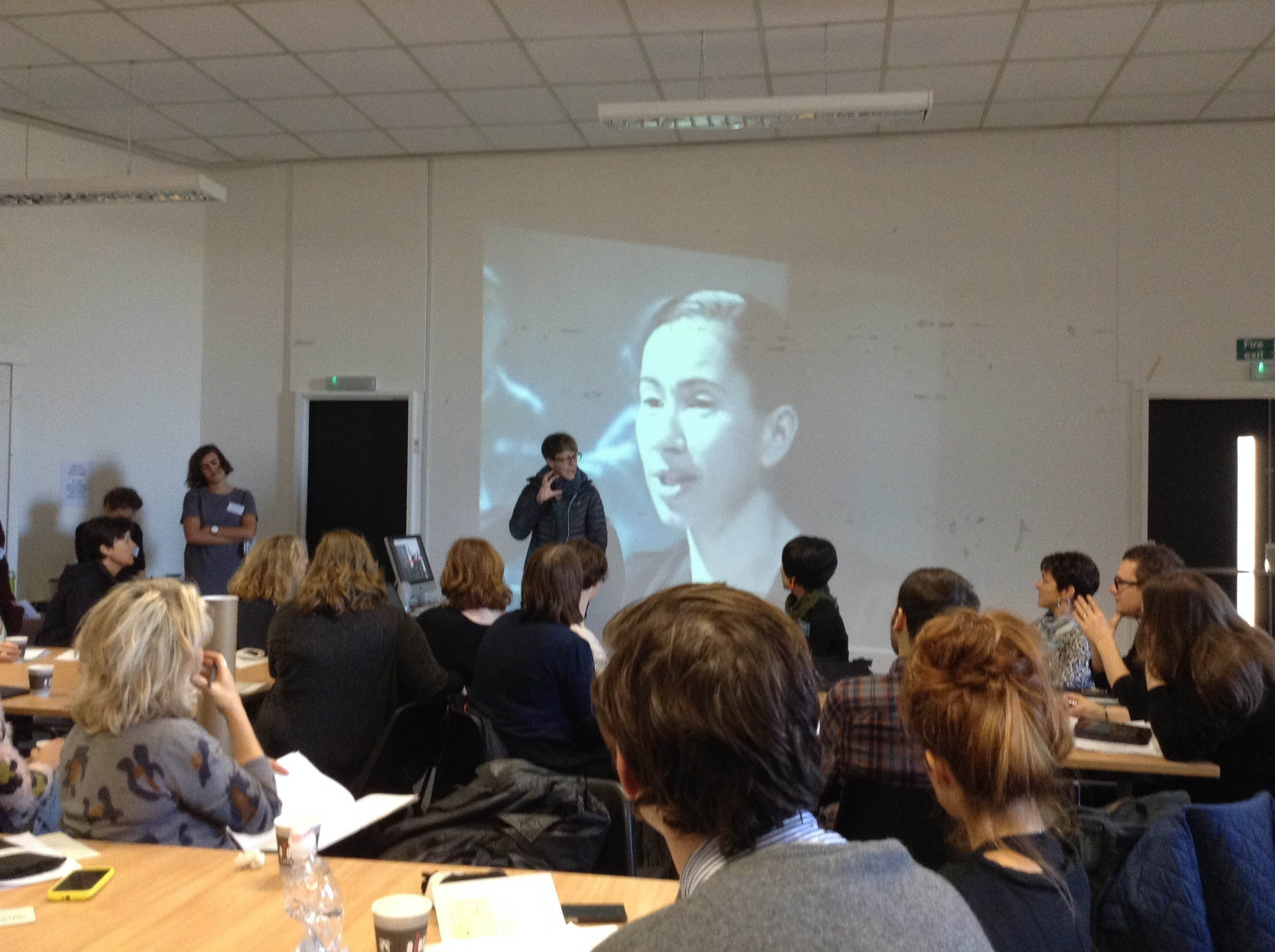
On 6 and 7 November 2014 I attended and presented at the PhD by Design Conference organised by students of the Department of Design, Goldsmiths, London. The main reason I wanted to take part was to see if my research, which has an artistic research methodology, could also apply to the design world. As I will show below my work has an overlap with design but I approach it from a dierent direction, and I hoped that by discussing my points of view I could work out in what way my research might be relevant for the design discipline, that is, outside the fine art discipline.

The conference was introduced by Jules Sprake who introduced Andrea Fraser’s famous ‘welcome’ as a way to perform her critique of institutions. Sparke was basically saying we, as phd researchers in this conference and through our work, are here to do exactly that. The critical intention was already part of the set-up of the conference, as the organisers explained in the pre-conference info, the conference itself was structured around questions and discussions by the participants. Over the two days we were going to “discuss and work through many of the topical issues of conducting a practice-based PhD in Design” (http://phdbydesign.com). On the basis of the questions, we the participants provided with our registration, the organisers placed everyone in discussion groups. The group sessions were focussed on a particular question, and they started with a couple of short presentations which were then intensively discussed and commented upon. I go into some detail here about the conference itself because the way it was organised was exactly fitting for the subject we are dealing with: ‘the messiness’ of our practice and research, also called practice-based or practice-led research. As became clear at the end of the conference, everyone really appreciated the conference structure facilitating an intense two days, somewhere between a workshop and conference. And of course thanks to hard work of the brilliant organisers Alison Thomson, Maria Portugal and Bianca Elzenbaumer! By the way the conference sessions were very alike the discussions and seminars of our own Postgraduate Research at the Winchester school of Art, organised by Sunil Manghani.

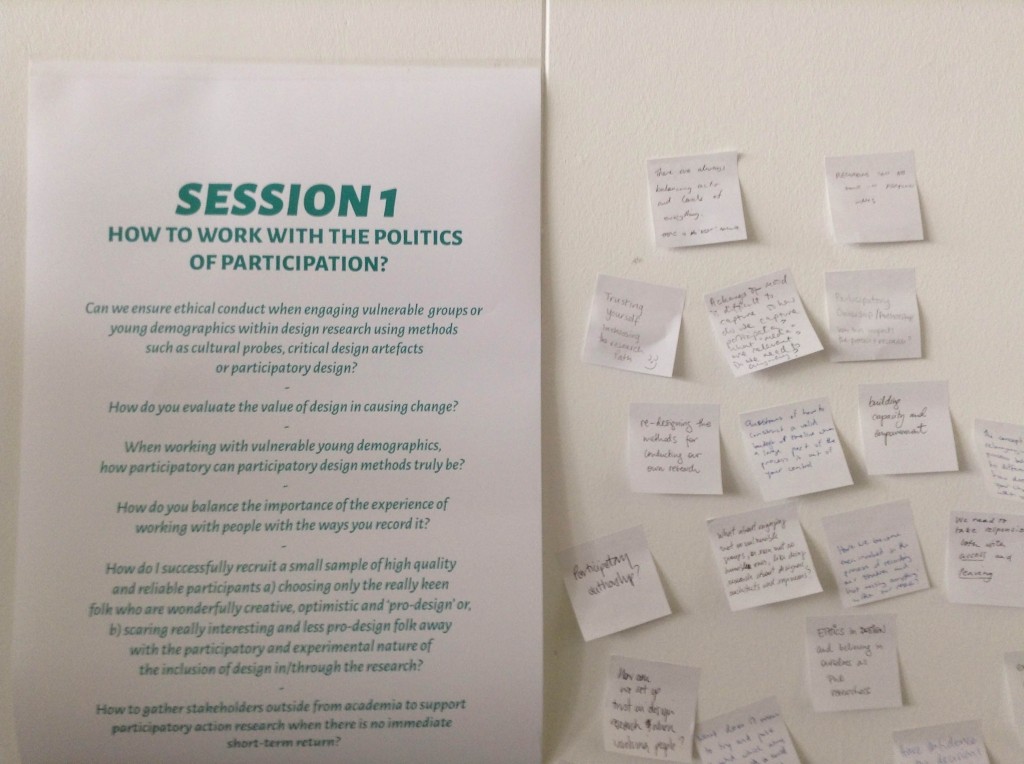
The questions for the different sessions tell their own story:

Session 1: doing/ making/ planning
What about interdisciplinarty? How to connect with actors beyond academia?
How to work with the politics of participation?
How to wrestle with the gap between practice and theory?
Exploring methods of making and recording?

Session 2: output/ dissemination/ use
How can we reach non-academic audiences?
How to represent research practice in inventive ways?
How can we evaluate the impact of design research?
How to deal with co-produced research outputs?
How can we disseminate practice-based research beyond the academic article?

Session 3: open discussion
What does design research look like?
How to decide on my approach and format of submission?
How to value the knowledge and eects produced through design research?
How to integrate design research with other fields?
How to consider the impact success and sustainability of design research?
I hope the organisers will manage somehow to create a record of what happened in all the discussions I could not take part in, because there were many I would have liked to be in. A pdf version of the participants’ abstracts will be available on the conference website.

I presented my research in session 2, How can we reach non-academic audiences? See the presentation A Dispersal Alongside … on my website: http://www.symbiotext.net/tag/public-address-2/

It argues for a dierent critical approach. One that moves away from a focus on products and target audiences, and instead uses a strategy of embedding and giving access. The discussion afterwards turned towards the questions: What is the role then of the designer/artist? Are we to provide a service, a product or critically engage with a particular context as a whole? Besides a general sense of what a designer/artist is or does, we seem to seek to answer that question individually. Our research is a great opportunity to do that. Some of us work through a sense of gender, mapping human/site interaction, user interaction, dispersal practice etc.

Besides our discussion sessions there where also keynote speakers. Bill Gaver, Jennifer Gabrys, Jane Harris, Jon Rogers and Teal Triggs. Bill Gaver talked us through one of his design studio’s projects, the Energy Babble project, and interspersed it with answering more general questions that came up at the conference. The Energy Babble project was a great example because it showed success and failure, and how he arrived at this evaluation. Hearing his methodology I realised that in design research too, the practice-led methodology works out as a methodology that follows where the practice goes, that is, it evolves and entails that what is needed to be able to “reflect on the results to precisely articulate the insights gained”. Besides the researcher has to “realise that many possible perspectives can be taken on the work” so that the research is not a closed off thing that is assuming a “stable ground truth”. The fact that the research takes place does change the situation.

Jennifer Gabrys, Jane Harris, Jon Rogers and Teal Triggs had their presentation at the end of the conference and focused each in their own way on the application of our research in the real world. Jennifer Gabrys presented Citizen Sensing and Environmental Practice, which resonated with my own work for its do it yourself strategies and critical view on all the actors (human and non-human) implicated in a particular situation. Jane Harris put it very strongly that we have to look beyond our usual field of applications, and to follow our instincts and that what drives us, diversify as much a possible. Or to quote Jon Rogers “How do you bring you into the PhD? Through your practice.” Teal Triggs also came up with lots of questions we have to keep asking ourselves during the research: When is it over? What is opened/closed through the research? What is for the future? What has it uncovered? What fields does it contribute to? Questions to articulate the messiness of what we do, and, she stressed, we need to keep asking these questions after the phd to pursue research in our fields. The importance of extending research in our fields….

The conference ended with a collective debriefing, and launching ideas about what’s next. What ever happens next everyone agreed that the format of the conference was hugely successful and hopefully will be continued in some form. Then it was off to the pub, head buzzing, you might have guessed, we had a great time.


Islamic & Arab Heritage and Global Creativity

Najla Binhalail’s doctoral research examines the practicalities and politics of the museum display of Saudi clothing, with particular consideration of the Unification of the Kingdom Hall in the National Museum in the Kingdom of Saudi Arabia. In this article she considers the relationship between Islamic and Arab heritage and forces of ‘global’ creativity.

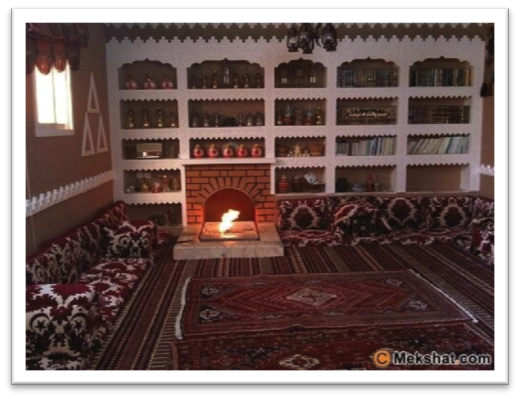
Islamic and Arab heritage is considered to be a great treasure. Most of its motifs are inspired by the rich nature of the surrounding environment and geography. Flowers, birds, and geometric designs feature in most of the motifs, embroidery, furniture and fashion of the Arab nations.

An example of flowers, birds, and geometric designs featured in traditional Saudi furniture, Mekshat.com

As a Muslim from an Arab nation, and also as someone whose field is textile and clothing history, I am always curious about the link between our cultural heritage and our identity. Hence, I have a fear of losing what is beautiful in our heritage if we continue to ignore or give less attention to the inspirational roots and provenance of our designs and motifs.

In my opinion, global cultural literacy, and the subsequent sustainability of our Islamic and Arabic heritage in particular, do not always receive the required attention from a number of Arab designers who fail to recognize the inspirational roots of our heritage; while others limit their research and knowledge of our Islamic and Arabic civilization throughout the ages. As a result, there is a danger that some Arab consumers will tend to ignore their own domestic textiles and fashion products, and instead support European styles – styles that are often more attractively presented and advanced in their marketing methods.

Zuhal Yorgancıoğlu has worked as a fashion designer for 67 years, creating clothing for Turkish women inspired by Anatolian and Ottoman culture. She argues that ‘There have been successful fashion designers in Turkey in recent years but I can’t call them Turkish designers. They imitate Europeans; I can’t see that they have a Turkish style’ (Hurriyetdailynews.com, 2012). Herein lies the problematic: both designers and consumers are not only demonstrating a limitation in their understanding of global cultural literacy, but also more specifically they are appearing to fail in their appreciation of Islamic and Arabic culture. As Polistina points out:

[cultural literacy is] a fundamental skill required by learners in their development of sustainability literacy. The role of educator itself demands a high level of cultural literacy to ensure that education provides chances for critical reflection on culture from multiple perspectives, rather than being confined to limited imperialist views of other cultures. Reflection on our own culture and other cultural systems can help reveal the complex social, environmental and economic relationships that need to be changed to make a successful shift towards sustainability. (Polistina, n.d., p.5)

Based on the evidence I have seen, the textile and fashion industry appears to be an essential component of most developed countries. However, many Arab designers in the textile and fashion world, whose avowed objective is to reach a global audience, are operating only within the borders of the Arab region. They are not, in my view, meeting their objective; they are not moving beyond those borders into the wider world, either in terms of the manufacturing or marketing of their designs and products. As far I am aware, there is no major Arabic fashion house, on a level with such names as Coco Chanel and Christian Dior, that functions beyond the confines of the Islamic and Arabic world. My interest in European textiles and fashion is twofold: first, I admire their ideas and creativity; second, observations that I make will improve the skills I need for my research and work, as a faculty member of the Designs and Arts College, in the Princess Nora bint Abdul Rahman University in Saudi Arabia.

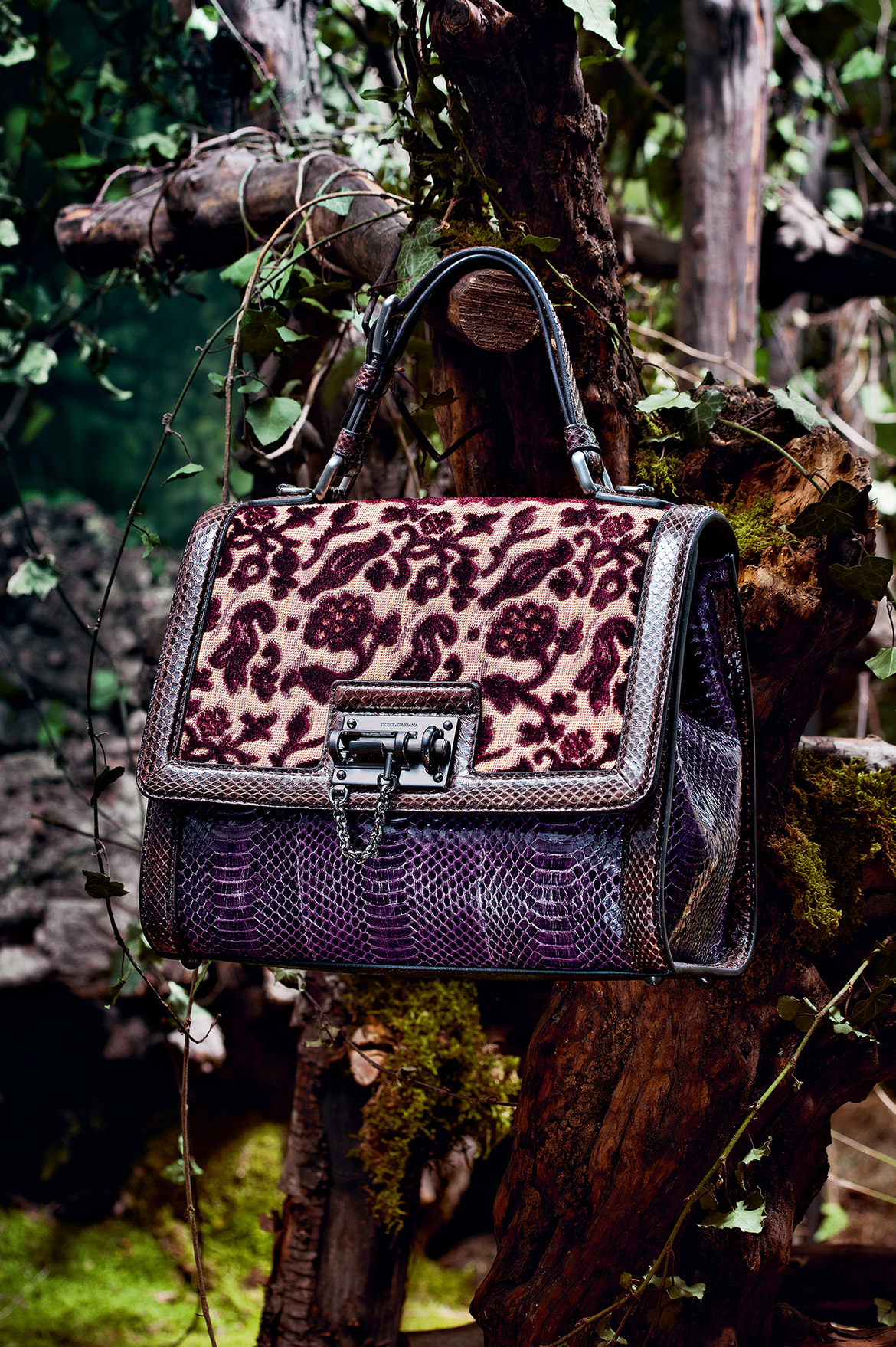
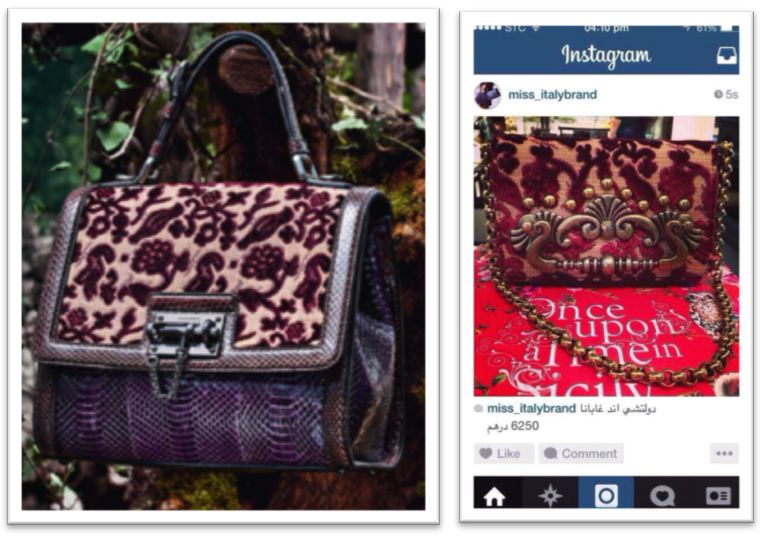
The 2015 showcase of the Dolce and Gabbana Accessories Collection drew my attention to the crucial issue concerning the inspirational roots of a people’s heritage, and how a people’s identity becomes visible and revealed through the fabric, clothing and accessories that people wear and use. This collection includes a textile design for handbags, which appears to me to be inspired by one of the most famous upholstery fabrics used by Saudi people in their traditional furniture.

A textile design for two handbags, 2015 showcase of the Dolce and Gabbana Accessories Collection & Instagram: miss italybrand.

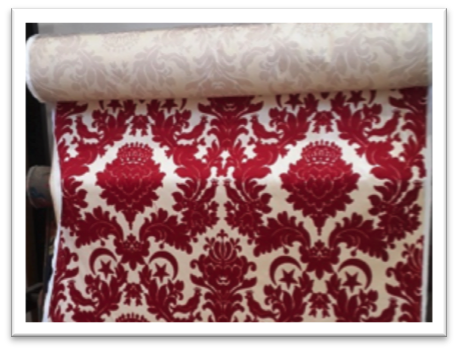
The name of the fabric is ‘abo taer’, meaning ‘father of the bird’. The fabric includes the shape of birds and usually comes from Morocco, a Middle Eastern country, rich in Islamic and Arabic heritage.

‘abo taer’ fabric, one of the most famous upholstery fabrics used by Saudi people in their traditional furniture, the fabric usually comes from Morocco.

This example leads me to make two assumptions: first, it is possible, although in my view unlikely, that the textile design used for these handbags does not have its roots in ‘abo taer’. However, it is more probable that this ‘new’ design was inspired by ‘abo taer’- it has the same popular colours of maroon and beige, and possesses a design showing birds and flowers. Second, if the Dolce and Gabbana fabric for these handbags was actually inspired by ‘abo taer’, and this I would personally appreciate and welcome, then it is surely evidence of a limitation by the Islamic and Arabic fashion industry in their understanding of ‘global cultural literacy’. An increased awareness and global understanding would, in my view, enable the Islamic and Arabic industry to communicate internationally more effectively the message of their cultural roots and heritage. If the industry is enabled to move beyond its own borders, then researchers and designers from other cultures will more readily recognize the provenance and importance of the Arabic source. This collection of Dolce and Gabbana could be an effective way of marketing their product, thus making it more attractive for a wide range of consumers, including a large segment of the Arab population.

From my understanding of the British educational system, it is paramount to recognize the inspirational roots for any design in the creative arts. According to Eckert (1997, p.1) sources of inspiration ‘play a powerful role at the beginning of the design process, in research and strategic collection planning. They also play an essential role in the communication of design ideas, both among designers, and between designers and managers and buyers.’

‘Where does the fashion designer get ideas and inspiration for new styles? The answer is everywhere and everything. Anything visual and tactile, in fact sensual, can be a source of inspiration for a garment.’ (Fatma Mete, 2006,pp.282-283).

This collection raises for me a number of questions: Is there an alarm bell ringing in the ears of Arab designers? Are these designers being challenged to recognize that the Islamic and Arabic heritage is ‘rich, astonishing and fabulous’? Are they taking into account that the inspiration for their creativity is linked to and an essential part of their heritage and identity as Arabs? And if this inherent Arabic heritage keeps dancing to the tune on a global scale orchestrated by western designers, then is it in danger in time of losing its identity of origin? Or could this be the beginning of a path towards global creativity and recognition? And does this mean that the echo of our rich Islamic and Arabic heritage will be heard globally in the international forums and connections of domestic and foreign consumption?

‘Any thing visual can be a source of inspiration. Sources of inspiration are employed throughout the design process. Initially other garments allow the designers to develop a feel for the coming fashion and provide a source for design features which can be adapted into the designers own garments’. (Claudia Eckert, 1997, p.12)

From my point of view, current domestic textiles and fashions in the local market of some Islamic and Arabic countries do not compare favourably with the versatility and accuracy of European textiles and fashions. I hope that this issue receives attention from Muslim and Arab specialists in the field of textile and fashion design, and that a careful attempt is made by them to create eastern fashion lines – lines inspired by a superb heritage, in contemporary, accurate, brilliant, and attractive styles that speak eloquently of their Islamic and Arabic origin. This is a key issue that needs to be addressed in our postmodern world. It is important not only for the cultural education of Arabs, but also for the education of designers and customers globally. Indeed, it could be a way, perhaps the most crucial way, of creating a new generation and style in the universal world of textile and fashion design.


References:

Eckert, C. (1997). Design inspiration and design performance. 78th World Conference of the Textile Institute, pp.1, 12. Available at: http://00b7d52c186c2769bb000000-3.pdf [Accessed 21 Oct. 2014].

Hurriyetdailynews.com, (2012). FASHION – Designer promotes Ottoman motifs to the world. [online] Available at: http://www.hurriyetdailynews.com/designer-promotes-ottoman-motifs-to-the-world.aspx?pageID=238&nID=19607&NewsCatID=376 [Accessed 25 Oct. 2014].

Mete, F. (2006). The creative role of sources of inspiration in clothing design. International Journal of Clothing Science and Technology, [online] 18(4), pp.278 – 293. Available at: http://www.emeraldinsight.com/doi/full/10.1108/09556220610668509 [Accessed 21 Oct. 2014].

Polistina, K. (n.d.). Understanding and Respect for the Cultural Aspects of Sustainability. p.5. Available at: http://arts.brighton.ac.uk/__data/assets/pdf_file/0006/5982/Cultural-Literacy.pdf [Accessed 25 Oct. 2014].


Pictures’ references:

Mekshat.com – http://www.dolcegabbana.com/woman/collection/accessories/

Instagram: miss italybrand – http://img1.haraj.com.sa/userfiles30/2014-06-21/53a5507b1a2c8


Lines of Beauty: Propaganda, the Poster, and the Pictorial Trope

Georgina Williams recently completed her PhD at Winchester School of Art. Here she offers an account of the main research themes and issues.

Propaganda conceived for distribution via a medium such as the pictorial poster creates a body of artwork that can be productively examined from both aesthetic and political perspectives. When this artwork is primarily restricted to conflict propaganda from the second decade of the twentieth century, the temporal and contextual considerations assist in focussing the poster’s role as a functional object, not only within a propaganda campaign but also within the wider visual ecology of an era. These early years of the twentieth century – encompassing as they do the conflict of World War I – witnessed the emergence of the pictorial poster as a useful tool for the state to employ in the distribution of propagandist messaging. Allied with this is how propaganda as a concept was beginning to be considered in the context that we now understand, and both these considerations contribute to why this particular period of history is ripe for a productive analysis of this genre of artwork.

'Step into your Place' - Artist Unknown - 1915.
‘Step into your Place’ – Artist Unknown – 1915.

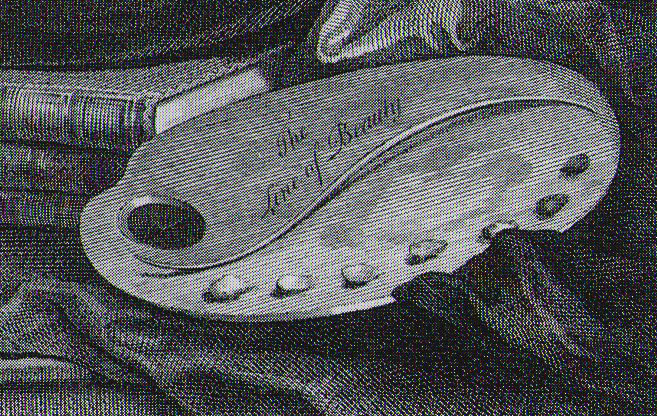
For the pictorial poster to operate as an effective means of propaganda distribution, however, the propagandist requires compositional elements that incorporate constructs considered to be capable of attracting the individual within the mass. If a particular construct is isolated and subsequently utilised in the artwork’s composition, its manifestation demonstrates the potential for its use as a mechanism by which the imagery can be unpacked. The concept of a propagandist promotion of an alternate reality worth striving for as a challenge to a current real – and the prospective movement from one to the other – can be figuratively as well as literally conveyed via an apposite construct’s employment as a pictorial trope. Taking these factors into consideration, therefore, the visual construct deemed to represent “movement” – and not only movement, but movement at its most beautiful, thereby forming a focus for the attraction of the viewer – is the serpentine curve that in 1745 William Hogarth scribed on a paint palette and titled ‘THE LINE OF BEAUTY’ (Hogarth, 1997 p6).

William Hogarth - 'The Line of Beauty' 1745 [Detail]
William Hogarth – ‘The Line of Beauty’ 1745 [Detail]
In concentrating on the poster within the wider genre of early twentieth century visual conflict propaganda, and by creating new associations with both aesthetic and metaphoric concepts pertaining to Hogarth’s chosen “line”, Lines of Beauty: Propaganda, the Poster, and the Pictorial Trope as a body of research attempts to articulate how each contributory element within the artwork’s construction ‘respectively influences the identity and the economies of the other’, thereby providing ‘a model by which to focus and rethink’ these relationships (Ostrow, 2005 p226). In this way, the line of beauty serves as both cause and effect of the process by which the relationships are reconsidered, generating the potential to provoke an innovative discourse as to the prospective impact of the whole upon the visual culture field.


References

Hogarth, W. (1997) The Analysis of Beauty edited by Paulson, R. London: Yale University Press.

Ostrow, S. (2005) ‘Rehearsing Revolution and Life: The Embodiment of Benjamin’s Artwork Essay at the End of the Age of Mechanical Reproduction’ in Benjamin, A. (Ed.) Walter Benjamin and Art London: Continuum 226-247.

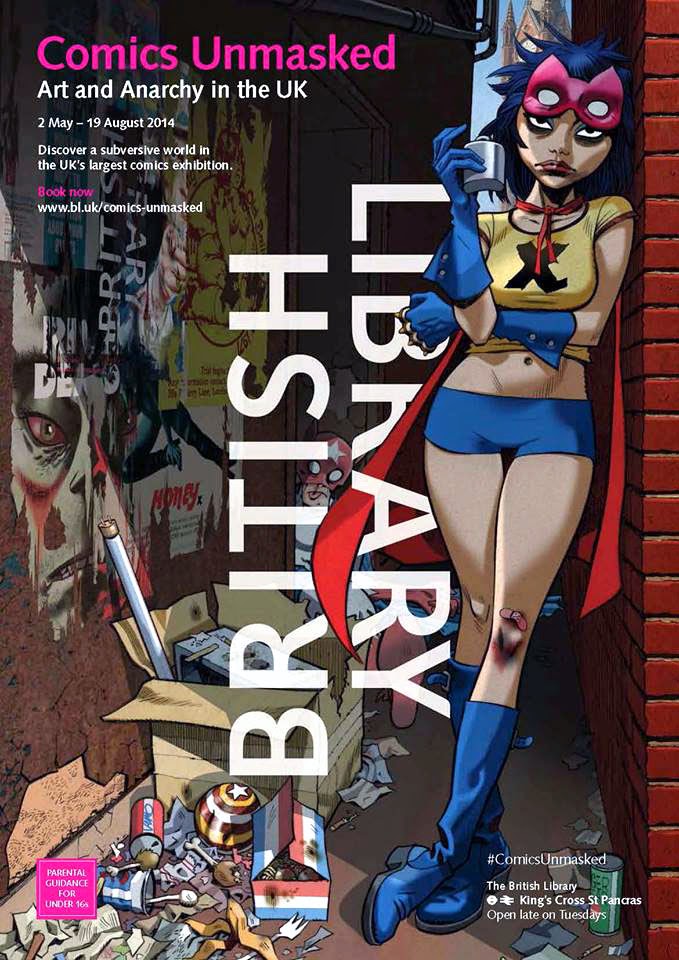
Comics Unmasked

Elham Soleimani’s PhD research is concerned with questions of the veil and the use of female figures in Persian illustrations. Her work centres upon her own practice of illustration, working towards counter-narratives of contemporary Iran. In this article she notes how a trip to the British Library’s ‘Comics Unmasked’ exhibition provided an opportunity to think further about the format and design of her work.

During the summer 2014, I attended an exhibition at the British Library called ‘Comics Unmasked’. This major exhibition at the British Library was a great collection of comic books created by some of the most talented British writers and amazing artists such as Neil Gaiman (Sandman), Alan Moore (Watchmen, V for Vendetta) Grant Morrison (Batman: Arkham Asylum) and Posy Simmonds (Tamara Drewe). However, there is a huge diversity of comics in this exhibition in terms of the creators, themes, content, size and styles and it was indeed fascinating how this show enables the viewers to trace the history of comics from their early days (almost over two centuries ago) to the digital era, highlighting their adaptability throughout the years.

For me, one of the main purposes of visiting this exhibition was to become more familiar with comics and also enhance my knowledge in this area, as my PhD practice has recently taken a new direction towards graphic novels. Although I have designed a number of books over the last few years, designing comics is a completely new and exciting, yet mysterious world to me. However, this exhibition was an excellent opportunity to take a quick journey through the history of comics and be inspired by many inspiring artists.

ES-2

In the show, we came across a very interesting unique comic book, which was created by Libyan-born Muslim Asia Alfasi, that demonstrates the influence of Japanese pop culture on the artist and also her memories of watching anime cartoons in Libya and reading and making manga in Britain. “Asia had grown up watching anime (animation in Japanese) adaptions on Libyan television, and later realized it was not Arab after all but Japanese. She vowed to learn how to make her own manga. She kept her vow by growing up into an award-winning graphic novelist.” (Gravett, 2014: 59).

Apart from the brilliant illustrations in ‘JinNarration’, the layout of this book is fascinating. The overlapping Illustrations in different sizes, the close-ups, movements and wording allow the reader to become completely engaged with the story.

However, the exhibit that made the greatest impression was a giant comic book called “She Lives” by Woodrow Phoenix. Here is the Vimeo link so you can watch a video of Woodrow turning the pages of this very big book:

All of the illustrations in this book are hand-drawn and are in black and white. The book took Phoenix nineteen months to complete. In interview with the British Library he notes:

It was surprisingly physical to work on drawings at that size. I was covering so much paper, I was doing a lot of bending and stretching and I would be exhausted at the end of every day. But I did really enjoy doing something that used all of my body rather than just a bit from my elbow to my fingers. (Britishlibrary.typepad.co.uk, 2014)

One of the most amazing aspects of this book is that the images tell the story, rather than any text, and yet it is still an incredibly powerful story that is communicated effectively without the presence of any text.

Despite the fact that in the last couple of months I have been designing and redesigning my book, I have been struggling over a few issues, namely the relationship between the text (story) and the images, and the theoretical part of my research. Moreover, the question of to what extent I can use ‘narrative art’ in this project has played on my mind. However, seeing this giant book, and discussing its particular layout and style with others, along with how the layout of comics in general enables the book to interact with the readers more effectively, I have begun to think further about the format of my own work. I found the following extract from the book ‘Comics Unmasked’ very inspiring and almost a solution for the issues that I am currently dealing with.

Instead of reducing a problem down to a simplified single image, comics can dig deeper to unpack the fuller story. Particularly rather than passive, comics incite readers to think for themselves by filling in the gaps between the panel and making their own interpretation of what the pictures and words are saying to them. Comics, according to Woodrow Phoenix, work as ‘empathy generator’. No wonder that such an engaging and empowering medium has been used by many groups as a tool for protest, as well as by the establishment to strengthen the status quo. (Gravett, 2014: 88).


References

Gravett, P. and Dunning, J (2014). To See ourselves. Comics Unmasked.

Britishlibrary.typepad.co.uk, (2014). Woodrow Phoenix turns the pages of She Lives at the British Library – Inspired by… blog. [online] Available at: http://britishlibrary.typepad.co.uk/inspiredby/2014/06/woodrow-phoenix-she-lives-british-library.html [Accessed 7 Aug. 2014].

Soft Power: A Sense of India

Soumik Parida is currently studying ‘soft power’ in the context of India for his PhD research. To date there there is little significant research in this area. In the following account Parida outlines the main scope and themes of his work.


India is a cultural melting pot. It has a rich and illustrious history with many different people from the Greeks to the Moghuls and latterly the English, Portuguese and French influencing its traditions that were initially set by the Indo Aryans. India’s classical dances and songs have a strong presence on the world stage. India’s cuisine can be found in all major cities of the world. Yoga has become the new-age mantra for healthy living with millions of people practicing it every day. Bollywood’s (Hindi film industry) reach and effect on the pop culture is becoming more prominent, and some of the Indian film stars are even more popular than Hollywood stars. The country has various other soft attributes that it has contributed to the world, such as dance, food and Yoga. This work will explore the various soft attributes that contribute to communicating India as a soft power. A communication model is proposed that develops the idea of understanding how various people perceive India as a soft power and to overlay this with how these attributes are communicated to individuals. I want to understand India’s great assets locked away in “soft” cultural contexts and why these are not exploited fully.

While there are many positive soft power attributes of India as seen above, the vicarious attributes of India outshine its positive counterpart; at least in the CBI Rankings (2011) and Monocle soft power rankings (2012), where India has been constantly dropping in the ratings. The focus of this research is based on Ying Fan’s nation brand definition. According to Fan “A nation brand is the total sum of the perceptions in the minds of international stakeholders, which may comprise some of the following elements such as people, place, culture, language, history, food, fashion, famous faces (celebrities), global brands, and cinema”. So the focus of this study is to evaluate various cultural factors of India which influence the perception of people around the world”. Factors such as ‘India as a nation’, ‘India’s historical perspective’, ‘cultural perspective’, ‘Indian cuisine’, ‘spiritualism & yoga’ and ‘Bollywood’ will be analysed in detail.

India is a complex set of nation states unified by Bollywood, deep spirituality, food and dance culture so a study in these areas would help to understand the impact that they have outside India’s borders. One could argue that none of the attributes discussed is mutually exclusive as Bollywood for instance can portray dance, food and spirituality in one go. At the same time yoga philosophy and practice also incorporates food principles via Ayurveda. Dance looks at spiritual aspects and history together with music that is often incorporated in Bollywood. The soft issues pervade Indian culture together with a passive acceptance of an often rigid caste system that rarely flares into riots such as those witnessed recently in Egypt. The study therefore needs to reconcile these opposites and the fluid interweaving of softness that comes across internationally and appears to exert such an influence on so many nations. Why does softness create such a popular nation and how does the hardness or vicariousness of the way people and women are treated create imbalances? The research intends to throw light on how a nation can use its soft power attributes to define its status and to move forward in the world. What are the complexities? What makes people stand up and take notice? How does a country change long held views?

I always wondered why a potentially prosperous country like India which has been called a cradle of civilization, and which gave the world Vedic mathematics, principles of non-violence, medicines and surgical expertise and was also a knowledge centre, slowly succumbed to invasion after invasion and finally lost its independence to the British empire. I believe, that India’s answer to success lies in its glorious past. Nevertheless, there has been limited academic research in the field of nation branding and soft power related to India. Little research has been carried out in understanding the role of Indian cinema, Indian cuisine, spiritualism and yoga, India’s historical and cultural heritage in the promotion of the nation. Which factors out of these are the most important ones? Do these factors change according to perceptions in different countries? For example will chicken tikka masala be a more prominent cultural ambassador of India in UK than Bollywood? What are the key factors that straddle most countries and what are the factors that are unique to certain countries?

This research intends to understand how interrelated factors can contribute to a country’s brand as a soft power nation. At the same time it is important to understand what factors are more important than others.

Research Methods Festival

Vanissa Wanick’s doctoral research investigates the design of advergames that could influence and embed cross-cultural consumer behaviour, analysing aspects of pervasive games, HCI and advertising, particularly through the comparison between UK and Brazil. In this post, she presents her recent experience at the first day of the Research Methods Festival and describes the best practices of research that are being used in different academic studies.


Arts, design and social sciences: how to innovate in research methods

This year’s Research Methods Festival (RMF14), organized by ESRC, had intriguing and variable sessions, including talks about Cross-National Research, Visual Methods and Big Data. I had the opportunity to go for the first day of the Festival with the aim to understand better the application of cross-cultural methods and other aspects that could be helpful for my methodology section in my research. Curiously, I had very good surprises, which I hope to share here with you.


Book from the RMF14 and St. Catherine’s College – Oxford (location of the Festival)

Cross-National Research and the challenge of meaningful quantitative data and indicators

For Cross-National Research, the session offered presentations from international organizations, such as UNECE and European Commission. The discussion was mainly situated in quantitative data, international policy frameworks, monitoring tools and comparisons between countries. Basically, from the perspective of my research, the session was helpful in many ways, especially to understand how big international institutions collect their data and publish their reports. Most of the organizations gather data from institutes like World Bank, WHO, ILO and Gallup World View.

The day started with Vitalia Gaucaite, from UNECE, the main aspect presented by her was regarding frameworks like, for example the Millennium Development Goals (MDG) and the concern to make data accessible to the public and to decision-makers. The biggest challenge for most of the presenters was related to data accessibility, data quality, “time lag” (when the data was collected) and the necessity to negotiate the methodology to be applied in their research.

Most of the talks were regarding issues of ageing, unemployment and poverty, which are worldwide issues. For example, Jane Scobie from HelpAge International presented the indicators utilized to build the report “Global Age Watch Index 2013”. In essence, this shows that for any Cross-National Research it’s necessary to have indicators to build comparisons. However, defining indicators is not enough. It’s also essential to understand people’s perceptions in each country. In addition, another important aspect highlighted by the presenters was the concept that the research will always depend on how you look at things. Basically everything could be considered as relative data and it will depend on how we, as researchers, interpret it.

Quantitative data studies and interpretations

Finally, the session ended with Isabelle Maquet-Engsted, from the European Commission with an exciting talk about poverty and challenges of quantitative data. Again, it was mentioned that the perception of poverty could be different across cultures. For example, some countries think that poverty is related to jobless, while other countries believe that it is related to the materially deprived. In essence, the session of Cross-National Research was very helpful in order to understand the impacts of quantitative data and the variables that we should take in account.


Social media and censorship

Notes from Gary King presentation

Still during the day, I had the opportunity to watch the exciting talk from Gary King, about “Reverse Engineering of Chinese Censorship”. Gary introduced a very good background about the use of social media in research, especially regarding the popular Big Data. However the main issue was overlooking the context of the data. After building a program that could analyse this database, it was possible to understand how censorship works in China and what kind of information is not allowed in the country. It was also possible to detect the events that were censored and why. From the research perspective, Gary presented two approaches that he took with his team: observational study and experimental + participant approach. This methodology was very insightful in order to demonstrate the integration of two methods utilizing social media in one country. For this, it was necessary to have a big team with people that could not only understand Chinese as a language, but also as a culture.


Using visual methods in research

Notes from Visual Methods Research session

Lastly, the day ended with Visual Research Methods , which surprised me (in a good way). Visual methods are a new and expanding are of study in research methods, which could also include participatory approaches through visual resources as, for example, photos. Yes! Photos are a moment in time. They could be photo incitation, photographic journalist, annotated photographs and so on. Also, there are other methods that could be included in this category, such as cartoons (scaffolding responses), concept maps, visual organization, animation (as a learning journey), building things with LEGO (model identity) and more. I keep thinking that we could add games into that list too! Also, it’s important to understand that there are at least three types of visual data to be utilized: researcher created, researcher generated and researcher found. Briefly, visual methods can help to start conversations with people and should include confidence, understanding and warrant, making the participant interested and engaged into the study.

Finally, digital arts and social sciences at the same place

And what about adding digital arts and social sciences? That’s a talk that I’ve missed, because it was at the same time of Cross-National Research. However, I had the opportunity to enter into the website of MIDAS and find more about their project. In essence, MIDAS is an interdisciplinary methodology that combines body (physical interactions), digital resources and methods (practices and applications from social sciences). If you are interested, read this paper that explains how they mixed the methods in order to promote the best approach into research.  If you are intrigued, just look at the tweet below. Imagine what we can do!

To conclude, my experience at the RMF14 was fantastic. The lesson that I can take from it it’s that we can and we should innovate as researchers in our studies. It’s possible to be creative and use everything we have now. Why not? There is a lot of work to do. But the best thing is that it was good to see that there is a lot of potential in research through the integration of arts and design into social sciences studies. Time to be creative!


References:

Margolis, E., & Pauwels, L. (Eds.). (2011). The Sage handbook of visual research methods. Sage.

Wall, Kate, Elaine Hall, and Pamela Woolner. “Visual methodology: previously, now and in the future.” International Journal of Research & Method in Education35.3 (2012): 223-226.

King, G., Pan, J., & Roberts, M. E. (2013). How censorship in China allows government criticism but silences collective expression. American Political Science Review107(02), 326-343.

Xambó, A., Jewitt, C. and Price, S. (2014) Towards an integrated methodological framework for understanding embodiment in HCI. In Proceedings of the SIGCHI Conference on Human Factors in Computer Systems. ACM.

Price, S., Jewitt, C., & Brown, B. (Eds.). (2013). The SAGE handbook of digital technology research. Sage.


Visual In-Sights

Jason Kass’ doctoral research is jointly supervised in the schools of art and psychology at the University of Southampton. His research concerns an exploration of aesthetic experience, artistic volition, and spectatorship, approached through an understanding of visual cognition. In this post he reports upon his attendance at the Visual In-Sights conference held in Newcastle over the summer.

At the end of June I attended and presented a paper at the Visual In-Sights Conference at the University of Newcastle . The conference brought together a range of individuals who research the visual and/or work with visual materials and methods. The conference organisers described their goal to “to host an inclusive, cross-sectoral engagement event which create[d] spaces for academic, practical and exhibitive work within the framework of a conference programme”.

From the start, I was particularly interested in this conference for a number of reasons. On the one hand, as a researcher working across disciplines I was keen to present my research in a forum that took into account the difficulties that arise when attempting to breakdown disciplinary boundaries. And as a practice-based researcher I was equally enthusiastic to belong to a space that was inclusive of both traditional academic research outputs alongside the exhibition of practical research outputs.

The conference met its goals in many respects and gathered a truly varied group of presenters. The presentations were divided thematically and grouped into sessions as diverse as Art and Aesthetics, Embodying the Visual, Visualising Identities, Visual Cultures and Geopolitics, and Landscapes of the Visual. My paper titled Abstracting concepts from sets of instances: the case of serial works of art, was included in the Art and Aesthetics session.

Jason Kass, ‘Untitled (The Unique Particular)’, C-print, 2013.

The paper applied theories from visual cognition to an understanding of spectatorship of serial artworks. The work forms part of my PhD thesis and is supported by a practice-led project that responds to an aspect of Roland Barthes’ essay Camera Lucida, in which he describes the experience of remembering his mother through photography. The project is informed by mechanisms of visual memory and face recognition, particularly the model of ‘stability from variation’ whereby essential information is abstracted from discreet but related instances to produce stable concepts. The work generated to date has considered the relationship between exemplars and prototypes and the potential role of averaging in the formation of robust mental representations. Using personal family photographs as a starting point, my practice-based research examines the tension between instances and concepts both in relation to pictorial modes of address and the more private desire to come to terms with the limits of remembering those loved and lost.

In addition to the oral presentation, I had the opportunity to exhibit practical research outputs within the conference space. The available resources did not conform to the traditional white cube model as researchers were each given two, bright-blue pin-up boards in the entrance lobby to one of the Universities venues. This brought up issues that I have dealt with in the past regarding the status of images and artefacts resulting from the research process and to what extent they might be considered and treated as artworks. If anything, my experience at the conference only exacerbated these issues rather than offering any sense of resolution. This is an area that I hope to explore in more detail moving forward as I believe it remains ambiguous within practice-based research in the arts.

One of the highlights of the conference was the exciting plenary speakers. David Campbell spoke candidly about “the changing function of photojournalism in the new media economy” and offered a range of insights in relation to the proliferation of images in contemporary visual culture. Marcus Banks, Professor of Visual Anthropology at Oxford, presented a case for the “banality of crime scene photography”. Both speakers touched upon the changing parameters of visual storytelling in a post-digital environment and current tensions around the authenticity of the image. I found it interesting to hear that many of the same concerns around the status of the image in an art context are shared by researchers working in other areas of visual research.


Image Research & its Futures

Looking at Images, Workshop 2: Image Research & its Futures
Thursday 19 June 2014
Goldsmiths, University of London

Guest Speakers

Sunil Manghani (WSA) – Writing with Images

Verina Gfader (Huddersfield) – Assembly: Corrective Unrest & Image Instruments

Christina Duffy (British Library) – Imaging Science at the British Library

Nora McGregor (British Library) – #BLDigital: 1 Million Image Experiment

Joanna Zylinska (Goldsmiths) – Curating / Open / Images


Image Research and its Futures 
was open to postgraduate and early career researchers working in the areas of image studies, visual culture, media and communications, and art and design. The guest panel offered presentations on a diverse range of image-related research projects and methodologies. The presentations considered institutional, ethical, intellectual and practical matters when devising, conducting and disseminating image-based work. Following which, participants engaged in an open debate about the role of images in research and image-based research a view to helping postgraduate and early career researcher look ahead to the development of research beyond the doctoral thesis. All participants were invited to expand on the debates and ideas explored during the workshop to submit individual contributions for the ‘Researcher’s Guide’ e-book.

Image Research & its Futures was the second of two workshop events for Looking at Images: A Researcher’s Guide, an AHRC-funded project which ran over 2014. The project focused on the development of skills in image-related research, prompting dialogue between and within the subject areas Art & Design and Media & Communication (concerning both practice and non-practice research). It culminated in a launch event, at the British Library, for a collaboratively produced ‘Researcher’s Guide’ e-book. The idea for the overall project grew out of three main influences:

(1) Marquard Smith (editor of the Journal of Visual Culture) offered a key contribution to Winchester School of Art’s Centre for Global Futures in Art, Design and Media, with a presentation about the ‘image’ of research. Subsequent discussion also informed WSA’s Postgraduate Conference 2013, which identified a need in developing deep-level skills pertinent to understanding and handling the image in and as research across a range of areas.

(2) Approaches to thinking critically about images and image practices while simultaneously engaging with image-making processes has been difficult to formulate. Sunil Manghani’s Image Studies (Routledge, 2013) is one key publication that speculates upon specific research tools and approaches for both obtaining and handling images (relating to issues of access, quality, ethics and intellectual property) and critiquing them (including the use of images as a means of critique). The book includes an ‘ecology of images’ diagram as a proposed research tool, with examples of its use to stimulate and enrich image research.

(3) The recently launched Photomediations Machine (a sister project to the online open access journal Culture Machine) has renewed debates about the form of scholarly work. Curated by Prof. Joanna Zylinska (Goldsmiths), it provides an online space where ‘the dynamic relations of mediation as performed in photography and other media can be critically encountered, experienced and engaged’. As a platform for combined theoretical and practical work, it has led us to think further about the future of image-based, open access research in the field of visual culture.

See also: Workshop 1: Picturing Research / Researching Pictures