heurion.com
Overview
What you have to do each week and all the important module deadlines are displayed for you in this one page quickview document.
Continue reading →
Getting started in week 1
This flowchart shows you all the steps you need to take in the first week.
UOSM2008 2018 FlowDiagram
You can also review the slides from the opening lecture.
If you are unclear about what to do or how to do it, why not try asking your classmates on twitter.....
Continue reading →
Welcome!
This is a module unlike most you'll have seen before. You can check out the module introduction video if you'd like to see how it works - but note: this video is a couple of years old and we now only have 3 summative topics (instead of 5).
You should take time to read the study guide in detail, it is a key document.
Continue reading →
Created using Canva
With the number of internet users continuing to grow, considering that just over 3.5 billions people are able to access the internet (internetlivestats.com), there is an increasing pressure to ensure people use the internet ethically.
Within Phil’s blog he focused on how social media generates a ‘lynch mob’ mentality in cases much like Justine Sacco, which we have explored previously.
Continue reading →
Created using Canva
The advent of social networking sites has made all of us more connected and by doing so has allowed others to more easily contact each other. Some of those connections are positive but some are not.
The format of social networking we see today began in the late 90s with ‘Six Degrees’, a social networking site that allowed users to create profiles and connect with others through existing relationships or through mutual interests (Boyd et al. 2007).
Continue reading →
According to Reference, ethical issues bring morality and principles into conflict and are more subjective and open to opinions and interpretation. Social media brings to light numerous ethical issues for example the issue of anonymity and privacy, freedom of speech and fake news. Social media giants (Facebook, Twitter) are slowly being forced to deal with these issues and held liable, rightly or wrongly.
(S.
Continue reading →
According to Reference, ethical issues bring morality and principles into conflict and are more subjective and open to opinions and interpretation. Social media brings to light numerous ethical issues for example the issue of anonymity and privacy, freedom of speech and fake news. Social media giants (Facebook, Twitter) are slowly being forced to deal with these issues and held liable, rightly or wrongly.
(S.
Continue reading →
I enjoyed this week’s topic as it was all about applying the technical learning from Topic 2.
How to build a professional profile in the right way is of interest and importance to me. As a soon-to-be graduate, I often feel (and I know I am not alone in this) more than slightly daunted by the contemporary pressure to join the job market rat race. This topic has helped me to get a calm handle on some of the main things to be aware of online.
Continue reading →
Topic 3 was all about how you can develop a professional profile online. After engaging with other bloggers on my work as well as reading other blogs, I found that being professional online could result in you losing your true identity.
Once discoursing with Cherie on her post and reading this article, it came to my attention that you should not necessarily make all of your social media accounts professional.
Continue reading →
E. Back, Piktochart Presentation, 2017
Above is the summary of Topic 3 and the main points I have learned from it. However, for this topic the majority of my learning has come from peer blogs and my interactions with them. I received many comments on my post and some of them have challenged, developed and introduced me to new ideas.
E.
Continue reading →
Created using Canva
When considering on how to create an authentic professional profile, there are a few basic building blocks that remain relatively similar. However, as your profile begins to be more easily recognisable or even now that you are employed this is where some extra steps are necessary to maintain your profile and retain the image you have created for yourself.
Continue reading →
We have already discussed online identities, but here’s why they are so important professionally. As the days of posting a CV and cover letter are fading into the background, coming to the forefront are the new days of employers using your online identity to judge your employability.
How do we make our persona authentic?
Your professional online persona needs to be multifaceted and should not stand in the way of promotion.
Continue reading →
One of the ways in which people can utilise multiple online identities (discussed in Topic 2), is through a professional personal divide, and last week I asked an important question: does the ability to edit yourself and create partial identities allow for authenticity?
(Infographic 1 created by me)
I find this week’s topic on ‘authentic’ professional identities somewhat problematic as the nature of a professional identity involves editing and ‘selling’...
Continue reading →
Created using Canva
Regardless of whether you are just joining the professional scene or are already a part of it, having something that will make you instantly recognisable and makes you stand out from the crowd is essential. In the digital age, creating a professional online profile and building your ‘personal brand’ is quickly taking job hunting to a new level.
Continue reading →
Throughout the last two weeks, my understanding on the topic of multiple identities has developed. Originally, I only thought of multiple identities in terms of different accounts for different sites, however since researching more about it I have learnt that it is so much more than that.
In writing my initial post, I learnt to consider multiple identities from the perspective of different personas in the form of cosplay.
Continue reading →
During my research into the topic of online identities I realised that this topic has great depth. Online identities are things we can’t help but create if we wish to use the internet as a tool; it’s required by most websites to create a profile. There are many dangers that come with having multiple online identities, as well as the argument for and against anonymity which I was only able to touch on.
Continue reading →
Created using Canva
Before I had written my post for topic 2 I had already assumed that the debate over multiple online identities would come down to security, oh how I was wrong.
A part of the debate can be attributed to a security aspect, wherein hackers may be able to gain access to accounts and private information which can later be used for identity fraud (mentioned in the beginning of the “anonymity vs. identity” conference).
Continue reading →
As Internet use became more and more popular, the number of identities created online also grew. In a previous blog post I mentioned the different ways in which people use the web, and how they would present themselves while using it. While people may choose to utilise the web in either a more personal or professional manner, they will be presenting an online identity to all those who go online.
Continue reading →
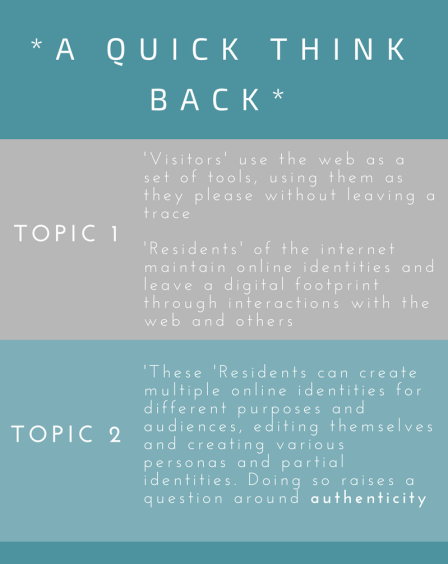
Thinking back to Topic 1’s Digital Resident / Visitor spectrum, your position is likely to affect your understandings of online privacy and identities, the focus of this post.
Increasingly, users of the web, especially those involved in the ‘knowledge economy’ and ‘network societies’, are acknowledging the importance of a digital and professional footprint, online collaboration, and having an identity online. (Costa and Torres, 2011).
Continue reading →
With the online world advancing, the use of the internet is increasing as we find ourselves enveloped in accessible information. We reap the wonderful benefits of this with our abilities to connect with family and friends from around the world, shop online and access endless information. However in doing so we leave behind our own ‘digital identity‘.
Digital Identity: is the information we leave online, the sum of our characteristics.
Continue reading →