Currently browsing

Page 42

LinkedIn as an Enabler of Employability and Professional Identity Development

Having a strong online professional presence is favourable in today’s competitive job market, and in this post I’llĀ focus on the uses and effects ofĀ LinkedIn.   Allison Cheston, founder of a careers advisement firm, says that the first thing she does when assessing candidates is review their LinkedIn profile, and … if they’re an active user. Ā This means contributing to the site, showing your personality, knowledge and opinions to your connections and the public. Continue reading →

Developing an authentic online professional profile

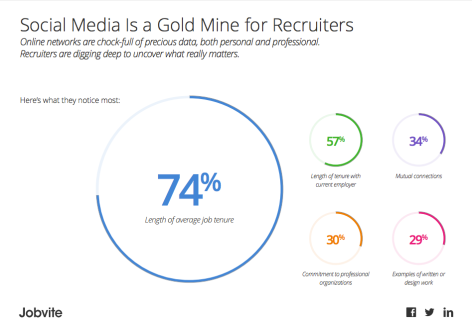
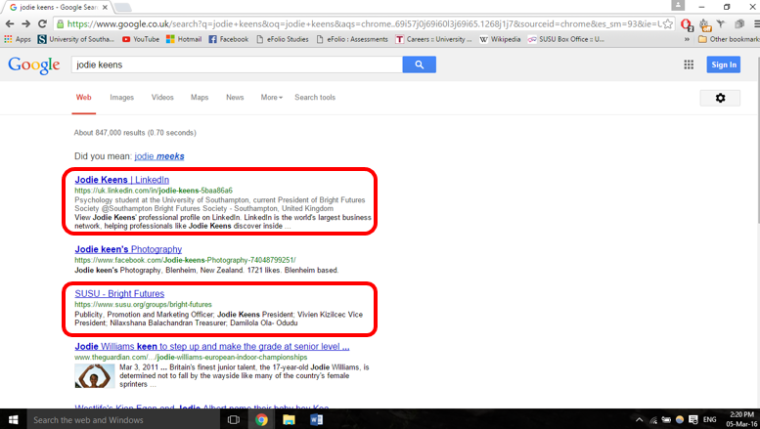
  As social media has become a widespread feature within modern society, it also plays an increasingly important role within the recruitment process as highlighted by the statistics shown in Figure 1 and 2. This makes it quintessential for jobseekers, in particular graduates to keep up-to-date authentic online professional profiles so that all important job opportunities are not being missed. Continue reading →

Review of Topic 3

Whilst I always recognised the importance of my presence online and the role it can play in determining my employment possibilities, attaching a statistic to the seriousness of the issue has completely changed my outlook on the matter. Being aware that 93% of recruiter’s review a candidate’s social media profile before making a hiring decision has made me completely rethink my online professional appearance. Continue reading →

Review of Topic 3

Whilst I always recognised the importance of my presence online and the role it can play in determining my employment possibilities, attaching a statistic to the seriousness of the issue has completely changed my outlook on the matter. Being aware that 93% of recruiter’s review a candidate’s social media profile before making a hiring decision has made me completely rethink my online professional appearance. Continue reading →

Topic 3: How can you develop an authentic online professional profile?

Why is building an authentic online professional profile important? With 73% of recruiters admitting to have hired a candidate through social media and 93% of recruiters admitting that they review a candidate’s social media profile before making a hiring decision, it is evident that there is huge importance placed on your online professional profile (Job Vite 2014). With this in mind, it is crucial that I use my online profiles as an asset that can be used to improve my employability. Continue reading →

Topic 2: Reflections

As a society, we are increasingly putting more information about ourselves online meaning that our online identities plays an important role in our everyday lives. This is particularly the case for those that demonstrate ā€˜digital resident’[1]Ā traits as their increased online activities would cause their online identity to become more valuable. Continue reading →

Topic 2: Reflections

As a society, we are increasingly putting more information about ourselves online meaning that our online identities plays an important role in our everyday lives. This is particularly the case for those that demonstrate ā€˜digital resident’[1]Ā traits as their increased online activities would cause their online identity to become more valuable. Continue reading →

My Reflection about the Perils of Numerous Online Identities

I found this topic really intellectually stimulating because I’ve only thought about it in a black-and-white way before.Ā  Finding readings to evaluate made me more informed, however on a sub-conscious level I probably gravitated towards those I agreed with.Ā  I realised what a valuable learning curve reading others’ blogs to comment on is because it actively challenges my thoughts, especially when those viewpoints are evidenced. Continue reading →

The Perils of Numerous Online Identities

This online identity topic has, much like the digital residents and visitors topic, an element of ambiguity for the different online identities which people can have and the level of anonymity these hold.Ā  An identity refers to what we do and who we are (Internet Society, 2006), so our online identity is an extension of this. Please click on the photo to access the original photo submission. Continue reading →

Topic 2: Is holding multiple online identities advantageous?

With contrasting opinions on whether individuals should adopt multiple online identities, Facebook and 4Chan have created social media platforms that differ in the extent to which an individual can achieve anonymity. Whilst 4Chan users don’t even need to register an account to use the site, Facebook has constantly searched for ways to improve the authenticity of its users and their recent acquisition of Instagram highlights this (Krotoski 2012). Continue reading →

Think you are anonymous? Think again.

As the ā€œdigital residents and visitorsā€ topic taught us, most web-related subjects are not black or white. Similarly, having multiple online identities is not an absolute debate, but rather serves many purposes, given it is employed properly. Ā But what do we mean by multiple online identities? In this context, its not aboutĀ simply using different accounts … Continue reading Think you are anonymous? Think again. Continue reading →

Reflecting on Topic 1

One of the key points that I have learnt from topic 1 is that the distinction between the two categories boils down to individuals engaging with the internet differently. Holly’s post likened digital visitor’s use of the internet as a vacation and residents use to a world traveller which is a good metaphor for the distinction between the groups. Continue reading →

Topic 1: Reflections

For this week’s topic, we were given the task of explaining the concepts Digital ā€˜visitors’ and ‘residents’. These terms originally seemed new to me until I realized that they were developments which had been made to the infamous terms of Digital ā€˜natives’ and ā€˜immigrants’ popularized by Prensky. Continue reading →

Topic 1: Reflections

For this week’s topic, we were given the task of explaining the concepts Digital ā€˜visitors’ and ‘residents’. These terms originally seemed new to me until I realized that they were developments which had been made to the infamous terms of Digital ā€˜natives’ and ā€˜immigrants’ popularized by Prensky. Continue reading →