Currently browsing category

Topic 3, Page 13

Topic 3: If you Searched yourself would you be Happy with the Results?

We have already discussed online identities, but here’s why they are so important professionally. As the days of posting a CV and cover letter are fading into the background, coming to the forefront are the new days of employers using your online identity to judge your employability.   How do we make our persona authentic? Your professional online persona needs to be multifaceted and should not stand in the way of promotion. Continue reading →
Topic 3: Professional online identities

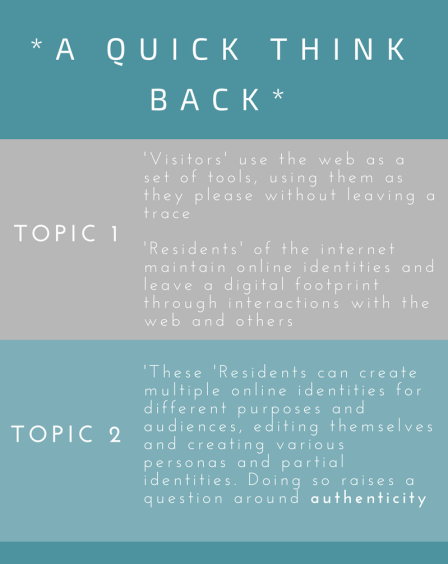
One of the ways in which people can utilise multiple online identities (discussed in Topic 2), is through a professional personal divide, and last week I asked an important question: does the ability to edit yourself and create partial identities allow for authenticity?  (Infographic 1 created by me) I find this week’s topic on ‘authentic’ professional identities somewhat problematic as the nature of a professional identity involves editing and ‘selling’... Continue reading →

Topic 3: Reflections

This week we were given the task of providing tips on how to build an online professional profile. The importance of an online professional profile is constantly mentioned at networking events so I therefore based my post on exploring tips that I have frequently heard as a law student. From completing this topic I have a better understanding as to what my professional online profile should look like, which will come in handy when I (eventually) create my LinkedIn page. Continue reading →

LinkedIn as an Enabler of Employability and Professional Identity Development

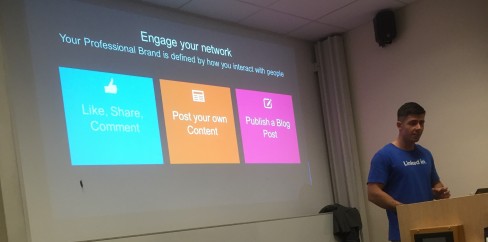
Having a strong online professional presence is favourable in today’s competitive job market, and in this post I’ll focus on the uses and effects of LinkedIn.   Allison Cheston, founder of a careers advisement firm, says that the first thing she does when assessing candidates is review their LinkedIn profile, and … if they’re an active user.  This means contributing to the site, showing your personality, knowledge and opinions to your connections and the public. Continue reading →

Developing an authentic online professional profile

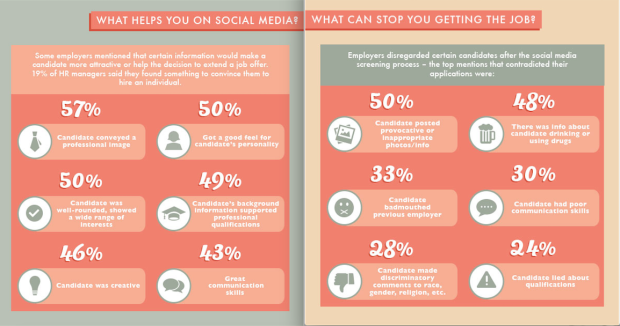
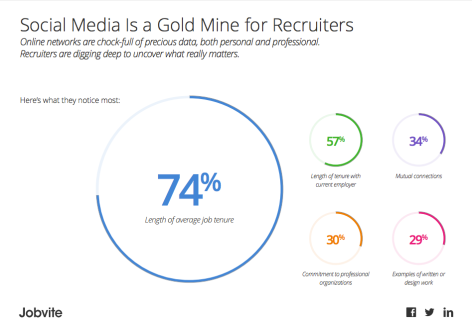
  As social media has become a widespread feature within modern society, it also plays an increasingly important role within the recruitment process as highlighted by the statistics shown in Figure 1 and 2. This makes it quintessential for jobseekers, in particular graduates to keep up-to-date authentic online professional profiles so that all important job opportunities are not being missed. Continue reading →

Review of Topic 3

Whilst I always recognised the importance of my presence online and the role it can play in determining my employment possibilities, attaching a statistic to the seriousness of the issue has completely changed my outlook on the matter. Being aware that 93% of recruiter’s review a candidate’s social media profile before making a hiring decision has made me completely rethink my online professional appearance. Continue reading →

Review of Topic 3

Whilst I always recognised the importance of my presence online and the role it can play in determining my employment possibilities, attaching a statistic to the seriousness of the issue has completely changed my outlook on the matter. Being aware that 93% of recruiter’s review a candidate’s social media profile before making a hiring decision has made me completely rethink my online professional appearance. Continue reading →

Topic 3: How can you develop an authentic online professional profile?

Why is building an authentic online professional profile important? With 73% of recruiters admitting to have hired a candidate through social media and 93% of recruiters admitting that they review a candidate’s social media profile before making a hiring decision, it is evident that there is huge importance placed on your online professional profile (Job Vite 2014). With this in mind, it is crucial that I use my online profiles as an asset that can be used to improve my employability. Continue reading →