Currently browsing category

2017, Page 7

Topic 4: Reflection

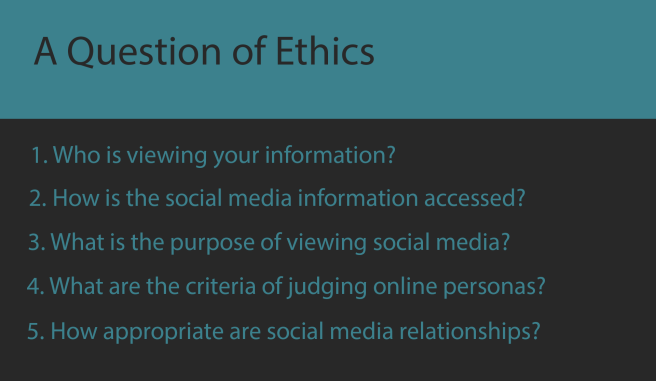
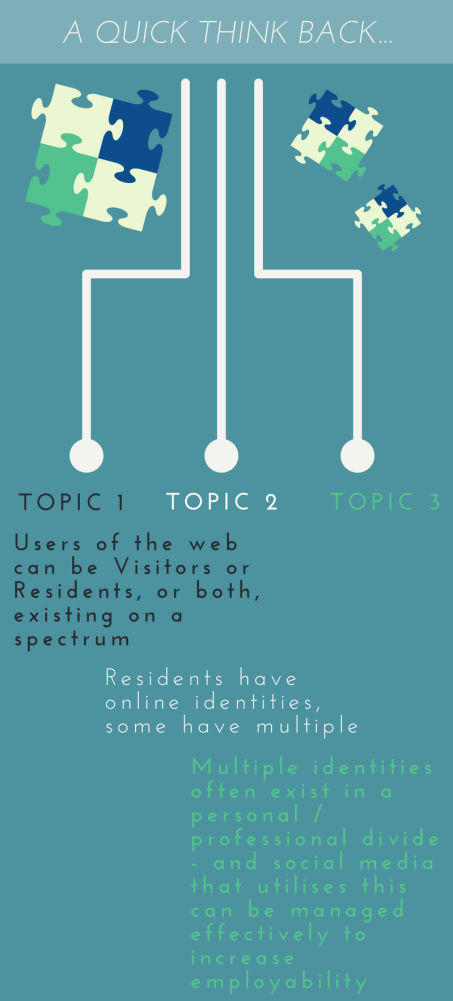
The topic this week was really thought-provoking as it’s such a far-reaching relationship to consider, and especially as I am exposed to these business tactics daily. I tried to take a broader approach at first by highlighting the main ethical challenges, and then specified further by giving examples, and I feel this was useful for my learning, and hopefully for others’ too. Image created by author to illustrate thought process. Continue reading →

Topic 5: Open Access – Free for All?

Figure 1. Definitions of Open Access and Paywall. Created via Canva. Within today’s digital world, Open Access (OA) is being used more frequently as a business model for publishing peer-reviewed journals (Björk et al., 2016). According to Van Noorden (2013), a large proportion of academic journals are behind paywalls, which charge subscription fees for users to access the online material. Continue reading →

Topic 4: Reflections :D

A summary of Topic 4: Figure 1. Displays an infographic of Topic 4 self-assessment The individual interpretation that was required in Topic 4 meant that everyone took a very different approach which was stimulating to read. In my own work, I have seen a great improvement from Topic 1 where I literally regurgitated White (2011)’s findings on digital natives and residents; to now where I have made my own inferences about ethicality within business social media use. Continue reading →

Topic 4: Reflection – The Ethics of Social Media Within Business Companies.

Researching for Topic 4 was a challenging task due to its breadth. Nevertheless, with perseverance, I was able to narrow down and focus on the business perspective of ethics on social media. Additionally, Rachel and Cherie’s posts introduced me to the educational side, pivotal for courses like UoSM2008. As a result, I have included a visual on the ethical issue of cyberbullying, concerning education. Figure 1. Presentation of cyberbullying in education. Self-produced via Canva. Continue reading →

Topic 4: Reflection

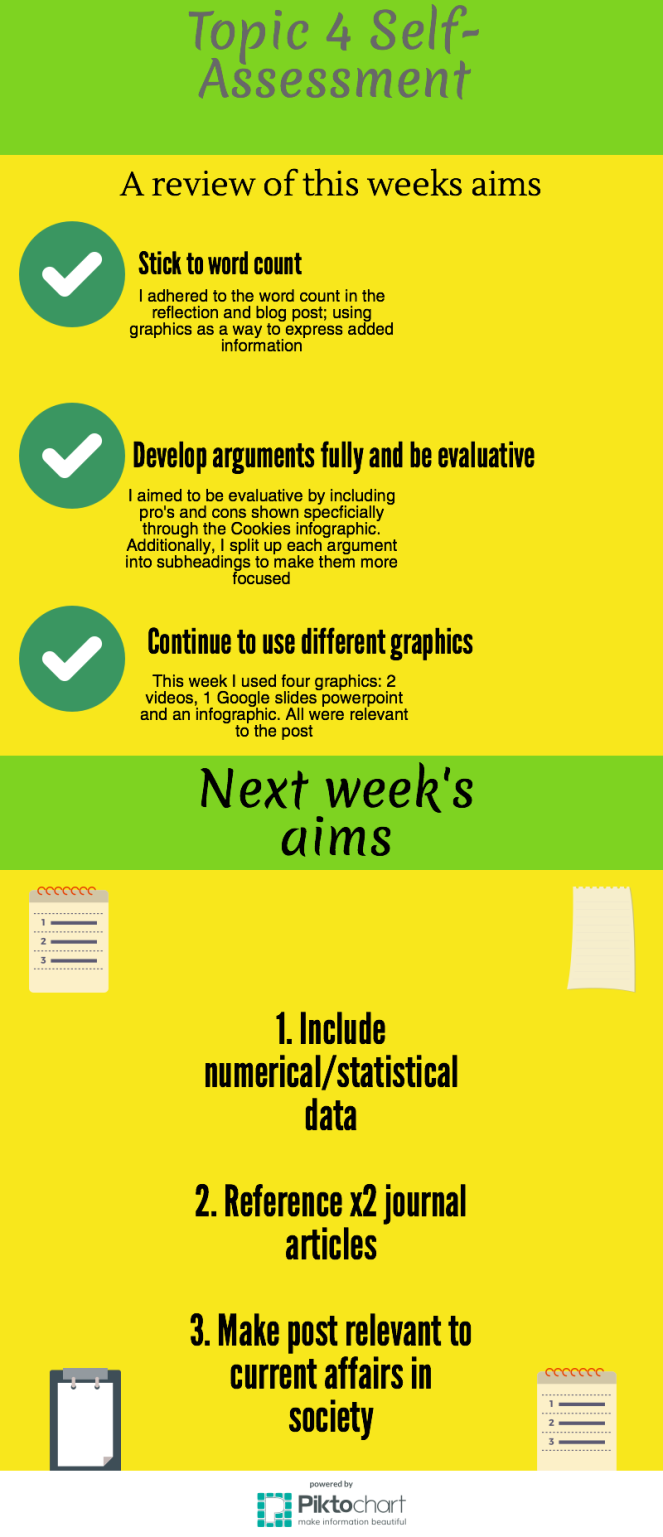
The module is nearing an end and it is really interesting to see how all the other blogs have developed and the different approaches people have taken. Last week, my main reflection was the necessity to develop a more analytical perspective which I focused on with this week’s blog. In the infographic below, I’ve demonstrated how I did or did not achieve my aims. Figure 1: My aims this week, self-produced using canva. Continue reading →

Topic 4: The Ethics of Social Media

In the last topic, I talked about how the rise of the digital age has lent its way to businesses using social media in a more professional way, including branding and recruiting. This is especially useful when the platforms are free to use, but offer paid advertising spaces where businesses can promote their brand (Corcione, 2017). Continue reading →

Topic 4- Has your privacy become ours?

With the web constantly evolving, it is no surprise that the way in which people can share their information online has become easier through the likes of different social networking sites (SNS) like Facebook, Twitter and Snapchat. Most of us use these platforms to connect with our friends and colleagues, however at the same time this same information is being used by businesses to learn more about our preferences and daily life. Continue reading →

Bitter Twitter: when free speech goes wrong

In November last year a woman was brutally killed in Birstall, West Yorkshire. Jo Cox was a respected MP and mother of two children, but her murderer, Thomas Mair was only interested in her political voice, communicated through her professional Twitter account, which he viewed two days prior to the killing (Cobain, 2016). Jo, like most MPs, freely expressed her political opinions online; Mair was reacting against her support for the Remain campaign during the EU referendum . Continue reading →

Social media provider’s ethical data management: regulating content to breach or create privacy?

Many ethical issues relate to business’ social media use: one particularly significant issue are the ways social media providers, the businesses providing services, manage the data users create on platforms. Facebook, Google, Twitter and other providers have corporate interests tied within the large data economies, with fiscal economic value attached(Gerlitz and Helmond, 2013). Continue reading →

Evaluate the ethical issues raised by the educational use of social media

Social Media has become a huge part of our day to day lives which is often associated with being a leisure activity or tool for business. However now there is a growing use of social media as an educational tool. With most of us students using social media in our free time, it is unsurprising that this is the way things have evolved. It sounds like a much more appealing way to learn and interact with teachers and other students than the generic email or meeting. Continue reading →

Promoting What?!

Commercials are everywhere on the Web and the use of social media as an advertising platform has become an integral to marketing strategies. However, late last week Google has seen a boycott by some of the largest corporations and governmental organizations as they pull their ads off of its networks in response to association with controversial content. Continue reading →

Topic 4: Social Media Ethics – The Power of Online Endorsements

The term ethics refers to moral principles that govern behaviour (Oxford Dictionary, 2017). In the context of social media and business, ethics can refer to a company’s duty to engage with online consumers in a way that is appropriate, honest and morally sound (Drushal & German, 2011). Due to my interest marketing, I have chosen to focus on the ethics of social media endorsements. Figure 1. Continue reading →

Topic 4: Social Media Ethics

Created using Canva The advent of social networking sites has made all of us more connected and by doing so has allowed others to more easily contact each other. Some of those connections are positive but some are not. The format of social networking we see today began in the late 90s with ‘Six Degrees’, a social networking site that allowed users to create profiles and connect with others through existing relationships or through mutual interests (Boyd et al. 2007). Continue reading →

Ethical issues of social media

Social media and having a social media account has become the norm in society today, this norm has been reproduced so that school children will now likely have an account of their own on a form of social media. I remember begging my mum to let me have a Facebook account when I was 12, even though the age requirement was 16 at the time. This leads me on to the topic of this week’s blog post, the  issues of social media, and I will be looking particularly at school children. Continue reading →

Internet safety rules

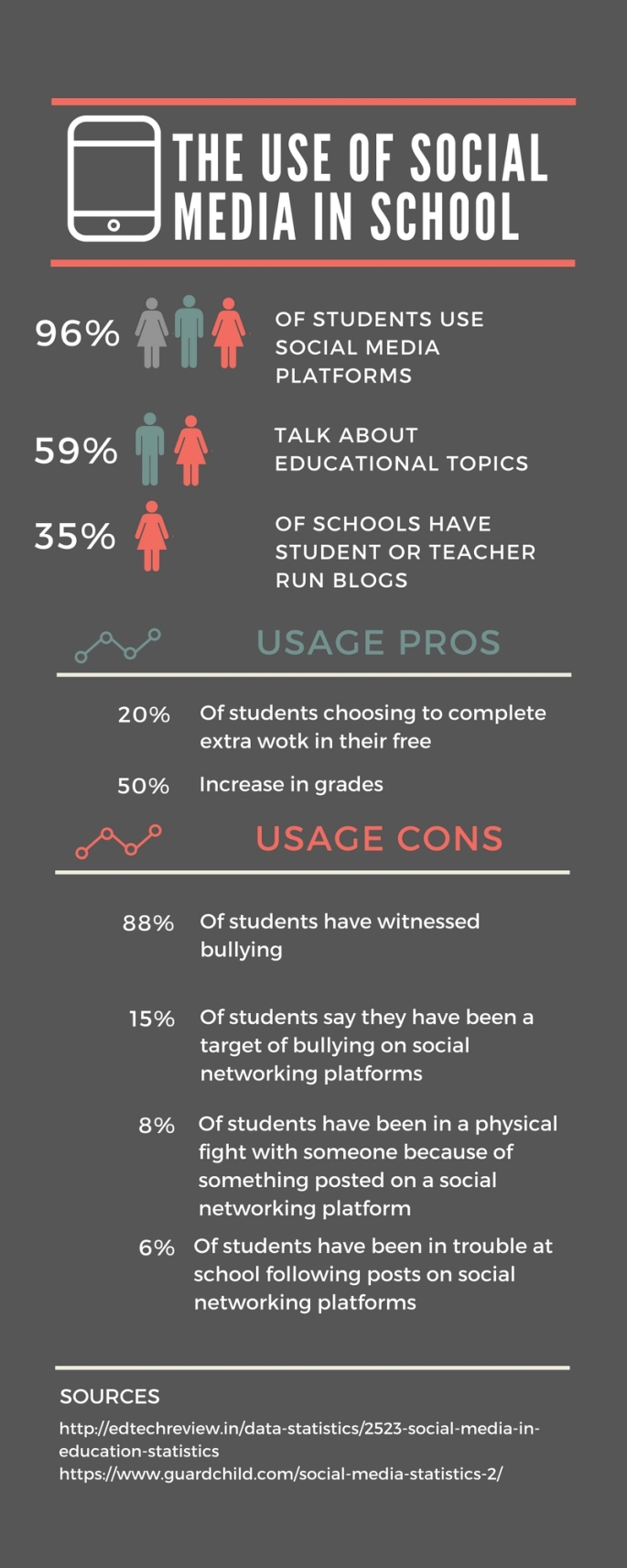
As discussed in Topic 1 the use of the Internet in everyday life is becoming increasingly prevalent thus it was arguably only a matter of time before social media became a part of education (Lauby, 2012). The infographic I have created below using Canva neatly encapsulates these rather pervasive statistics. Continue reading →

Topic 4: Ethics – Businesses & Social Media

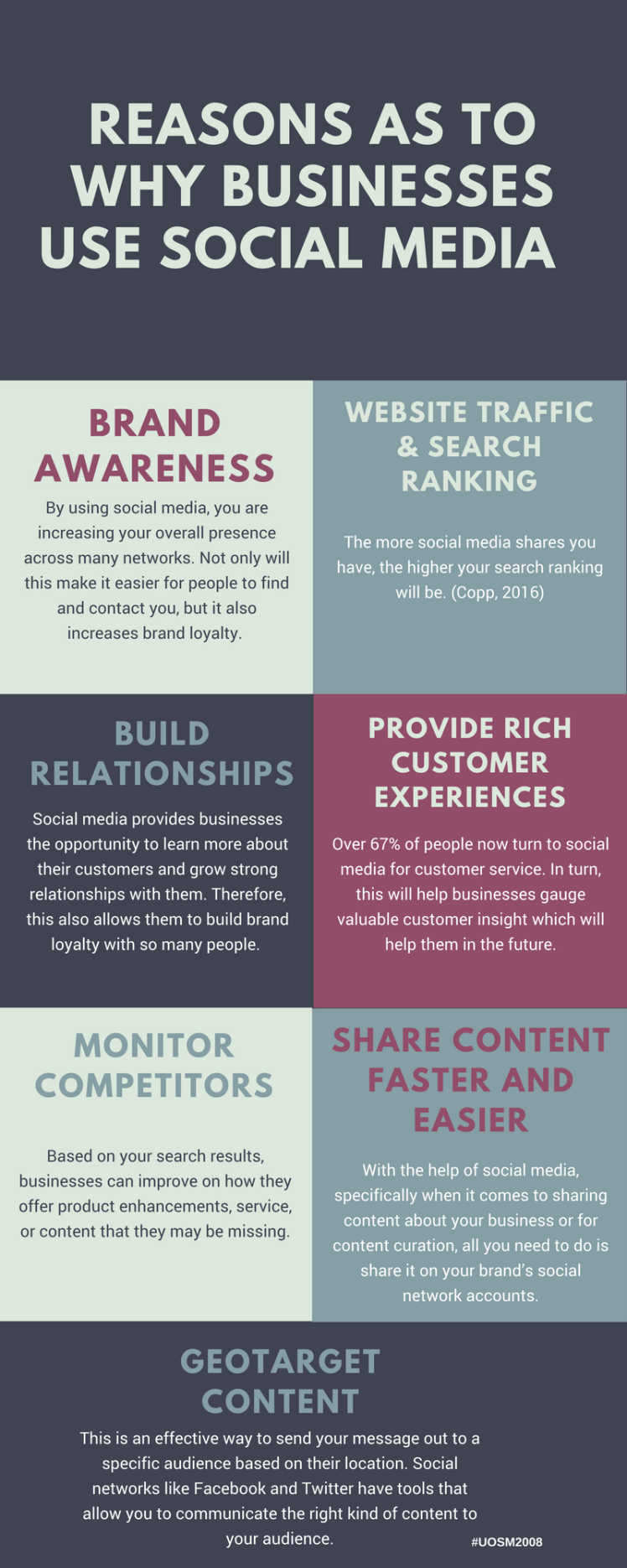
As discussed in my comments and reflection for last weeks topic, the ethical implications of social media use within businesses are far-reaching (Gunkel, 2015), and as the web continues to evolve, so do the associated moral challenges. The line between personal and professional is becoming increasingly blurred, and alongside the many benefits, there are shortcomings associated with the use of social media within businesses. Continue reading →