
Currently browsing author

Page 2

Earn £20 by reading this post!

Did you believe me? Unfortunately, you won’t be getting £20, sorry to disappoint you, but there is definitely a lot of false information and identities online and this is just one example! NEWS People likes to receive news in different forms, the statistic below displays the main source of news for different age groups. It can be seen that online is the most popular source of news. Main source of news by age. (Newman et al. Continue reading →

Can we close the gap?

My knowledge on this topic has widely developed after reading several peers blog posts. The differentiation of personal and macro factors is not something I had previously considered. Mainly macro factors seem to differentiate the digital access between the population in countries of a similar development. I found it quite surprising that some fellow young adults don’t use the internet as frequently, this is not even in relation to their digital access. Continue reading →

Can we close the gap?

My knowledge on this topic has widely developed after reading several peers blog posts. The differentiation of personal and macro factors is not something I had previously considered. Mainly macro factors seem to differentiate the digital access between the population in countries of a similar development. I found it quite surprising that some fellow young adults don’t use the internet as frequently, this is not even in relation to their digital access. Continue reading →

Can we close the gap?

My knowledge on this topic has widely developed after reading several peers blog posts. The differentiation of personal and macro factors is not something I had previously considered. Mainly macro factors seem to differentiate the digital access between the population in countries of a similar development. I found it quite surprising that some fellow young adults don’t use the internet as frequently, this is not even in relation to their digital access. Continue reading →

THE DIVIDE

Digital differences are the way in which individuals or groups of individuals interact with the web in different ways. Some of the factors that influence this difference are age, gender, race, country of residence and economic status. According to an Ofcom report, that analysed adults’ media use and attitudes, non-internet users are more likely than users to be aged 65 or over. Three in five (62%) non-users are in this age bracket, compared to 12% of internet users. Continue reading →

THE DIVIDE

Digital differences are the way in which individuals or groups of individuals interact with the web in different ways. Some of the factors that influence this difference are age, gender, race, country of residence and economic status. According to an Ofcom report, that analysed adults’ media use and attitudes, non-internet users are more likely than users to be aged 65 or over. Three in five (62%) non-users are in this age bracket, compared to 12% of internet users. Continue reading →

THE DIVIDE

Digital differences are the way in which individuals or groups of individuals interact with the web in different ways. Some of the factors that influence this difference are age, gender, race, country of residence and economic status. According to an Ofcom report, that analysed adults’ media use and attitudes, non-internet users are more likely than users to be aged 65 or over. Three in five (62%) non-users are in this age bracket, compared to 12% of internet users. Continue reading →

Digital visitors and residents

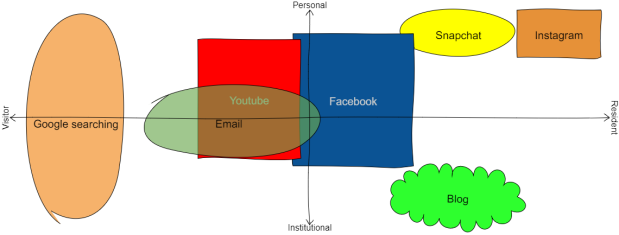
Digital ‘visitors’ are known to use the web only when it is necessary and can help them in achieving certain goals. They like to do most of their thinking offline, so they are users, not members, of the Web and place little value in belonging online (White and Le Cornu, 2011). A common misconception is that the older generation are just visitors, but this is not completely true. Continue reading →