
#UOSM2008 Topic 5 – Explain the advantages and disadvantages to a content producer of making their materials freely available online
Is it a jail ? For many of us, a jail is meant to be the worst place that our democracy system can force us to live in. Indeed it is, because all our freedom and rights are enclosed behind a wall of brick with barbed wire on it. It is there for our safety, for our understanding that we have to regret our criminal actions. As we will see in this article, a comparison of the jail with the freedom of educational knowledge is perhaps a wrong thought to be taken into account. The openness can be seemed as a non-democratic way, but it gives more benefits for people when it is not hidden from the public eyes.
Firstly, as Piled Higher and Deeper (PHD Comics), 2012 pointed out, the human mankind had to find out a way to keep the research which has been done over the time. Every article, containing inspiring and breathtaking concepts needed a place for its conservation. This need gave birth of the journals, which were composed of a series of reviewed articles. Using this method the science grew and progressed in the right way, until recently two factors has started to change this perspective.
On the one hand, the digitization of information and on the other hand, the high cost of the journals, changed the mentality of this old method. The content which in the last century was available only in a few underground libraries by a limited number of people can now be available for 1000 times less than one dollar (David Wiley, Cable Green, and Louis Soares. (2012)). The marginal cost of an online book is nearly zero, because in the online world there is not so much work to be done when a book is online. This can be seen as a big advantage because in the old time a small number of people could afford to spend money on books (250 dollars for a hand-made good or 5 for a printed edition) was small. It is simple why education had no possibilities to reach the majority of people. Even the researches had to buy many journals in order to find their necessary information, sometimes did not find their intended information.
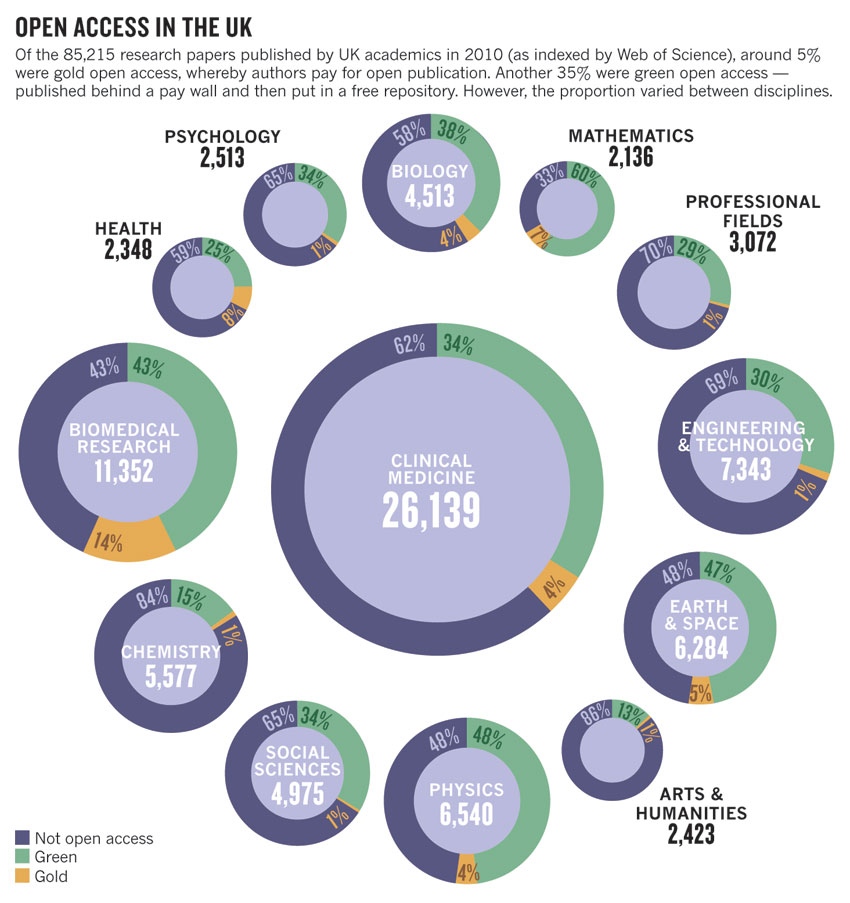 |
| Figure 1 – Open Access in United Kingdom (click on photo) |
Having information in online environment makes it more convenient to be re-used. An algorithm which maps different publications can help the researches to find their needed information quicker and thus to save time. This time can be spent on different activities. The re-use possibility is more valuable and now possible, using the internet.
Not only the scientists can benefit from this openness but all of us. For example, I was spending my time taking a few interesting online MOOCs for free. If I had paid for them, it is clear that I would have not taken them. They were amazing and I have gained a lot of knowledge from them. Being a Computer Science student, I was curious how a course of Informatics is presented at Harvard. This was only possible thought the openness of this university. Not only I saw what and how other students learn at one of the best universities, but I also got a certificate for my work at the end of the course.
In the past the only way to modify an article was a difficult and long-term process. Using erata, the mistakes were detected and send back to the publisher in order to modify the article. The propagation of the new version was very slow, sometimes it was up to two years ( (David Wiley, Cable Green, and Louis Soares. (2012)). Thanks to the Internet, now the articles or books can be easily modified such that the users can have the new version of the publication almost instantaneous.
Of course, the openness can bring issues. One of them is the money which are not paid for the authors of the online content. Presenting free articles or courses online creates a big pressure on the budget of these publishing companies. Coursera, a big online-free courses platform, adopted a very efficient method to solve this problem. All the courses from this website are free and they come with a statement of achievement. In order to get a better certification, people can opt for the certificated version which cost a few tens of dollars. A part of this amount of money (which for MOOCs is significantly greater than the normal courses) is directed to the authors of the courses, thought their universities. The method can be seen as a different way of using pay walls, which will be used in the near future by all the important publications according to STEPHEN LEPITAK. (2013).
Other problem is the big number of online article which will be present on the online medium. Unlike the standard way of publishing, where the articles are re-viewed, here there is no way for the user to know which is good or not. A good approach is that the universities should do this selection and they should filter the articles, but offer them free. The rating system and the comments which can be posted on the articles can serve as reasonable methods for a modern review.
I was personally interested in understanding why the researches are so restrictive regarding the openness of their publication. I have found that the main problem they face with, as Dan Ariely (2008) explained in his book about irrational behavior, is the endowment effect. People tend to over evaluate their own creation and start to ignore the ideas of others. A consequence is, that their work is priceless compared to others, because of the time which was invested. Thus, they do not accept the idea that their work should be freely read. In my opinion, this issue can have a mere solution: the mentality of people should be changed from “not invented here – or to pay for having it” to “proudly borrowed from here” as (David Wiley, Cable Green, and Louis Soares. (2012)) stressed out. After all, it is essential that the content and the ides of the publication are shared with others and not the encapsulation of these notions inside some walls as a jail does. In the end, the research is about spending time to help the science and to improve the quality of life, which is in contrast with the idea of hidden journals.
According to Mark Zuckeberg, the founder of Facebook, we are now living in a information based economy where the possession of knowledge of one individual does not affect others. This is a very different view compared with the standard one, where the power came from the ownership of the resources. One country was richer because it was owning resources on its territories. Today, the more important economical aspect is reached by the way the resources are explored or used rather than the opportunity of having it. Today we can have a world where for example farmers can check the Internet to improve their crop yields. Every student can access Wikipedia as source of their knowledge or they can use social media to improve their communication. The power of free content on the online space is generating creativity and give birth to new innovations from which we can all benefit.
From me to you:
A week ago, I finished successfully the online course regarding irrational behavior offered by Dan Ariely. If you are interested you can check it here: https://www.coursera.org/course/behavioralecon I really recommend it because of the way the teacher found and presented interesting many concepts about irrational behavior
References:
1. Dan Ariely (2008). Predictably Irrational. USA: HarperCollins. 127.
2. David Wiley, Cable Green, and Louis Soares. (2012). Dramatically Bringing Down the Cost of Education with OER. Available: http://files.eric.ed.gov/fulltext/ED535639.pdf. Last accessed 29th Apr 2014.
3. internet.org. (2013). Making the Internet Affordable. Available: https://www.youtube.com/watch?v=AdXwthh-xLQ. Last accessed 29th Apr 2014.
4. Martin Hall. (2014). Why open access should be a key issue for university leaders. Available: http://www.theguardian.com/higher-education-network/blog/2014/feb/18/open-access-key-issue-university-leaders?CMP=twt_gu. Last accessed 4th May 2014.
5. Piled Higher and Deeper (PHD Comics). (2012). Open Access Explained!. Available: https://www.youtube.com/watch?feature=player_embedded&v=L5rVH1KGBCY. Last accessed 28th Apr 2014.
6. STEPHEN LEPITAK . (2013). 90% of online content to be held behind paywalls in three years media company survey suggests. Available: http://www.thedrum.com/news/2013/04/12/90-online-content-be-held-behind-paywalls-three-years-media-company-survey-suggests. Last accessed 3rd May 2014.