
#UOSM2008 Topic 4: Ethical issues raised by educational and business uses of social media
Twenty years ago, when the Internet has came among us, nobody had ever thought its huge number of users can generate a set of ethical problems. But this fact has happened. And it is not an event which has surrounded us today, but it was present there, from the very begging of its existence. A very quick look back on its history, can reveal that the two main domains, in fact the educational and business areas, which had a low influence on our empirical perspective. The absence of human individuals has served as a main cause of its low impact (Figure 1).
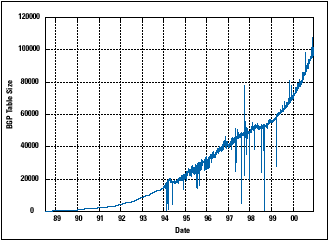 |
| Figure 1 – The amazing grow of Internet users between 1989 and 2009 |
Having a continuous grow of usage over the time, the new ‘universe’ (which, for many of use is not so innovative now), has been started to normally creates its essential human conditions for living. As well as, the planet Mars needs water as a preliminary condition to sustain the living organisms, the Internet, especially the Web, acts in the same way to make possible the share, communication and another human based activities. People believed in the freedom of expression, in the power of changing in better the entire world, by posting, sending messages and hence, generating tones of digital information. One interesting point which can be stressed out here, is represented by the main contributor of this massive communication, which, was not the quantity (nor the quality) of messages, but the incredible pace of being seen and understood by others. A very popular example is the case of #hasJustineLandedYet. As BuzzFeed [1] pointed out, a simple message, but with a truthfully racist content, posted by the PR of a big corporation has demonstrated a fast spread around the word. Given the fact that she was not able to remove it 10 hours, the propagation generated a huge online flood such that the post was a hot subject for a night. Despite the fact that Justine Sacco did not have a lot of followers, she felt the personal effects of her post, being fired from the corporation. In fact, this combination of factors is painting us a picture where the freedom of communication is unobstructed and can be achieve at a non-existent rate until now, by simply using the online social media services. It seems clear to us today, that this world is not perfect, fact which is explained by its symmetrical contruction to the real one, thus it inherits our ethical attitude.
From the educational point of view, the ethical field is playing a very important role. Even now, when I am writing coursework, I am interacting with the ethical rules involved in the process of online education. This course is taking part mainly on Internet being supported by a lot social tools (Twitter, Spoot.it, SlideShare …). Thus, according to Caroline Criado-Perez [2], the course, through its means of expression allowed me to understand more the activity of my colleges and indeed to express my opinion regarding it (using comment, posts on my blog, tweets …). In the same essence, the content of my posts can be seen by other peers, but the quality of them is still remaining a question. Being the author of this blog, I am the only person who can delete them, but do I know that I have to delete them if someone tells me? In addition to this personal experience, a good example of ethical issues can be raised by the biggest online course provider Coursera. This huge platform offers free academic courses from more than 200 universities. I had the honour to take part in many of courses and I succeed to finish a few of them. One of them is called ‘Internet History, Technology, and Security’ (Figure 2). It has a a slightly different format. Notwithstanding to the fact the course provides the video lectures and the weekly assignments, but the teacher (see Video 1) has meeting every week, in a different city with the students who want to personally talk with him. As a result of this, he overcomes the ethical problem of being at distance, by creating these face-to-face conversations.
 |
| Figure 1 – My Coursera diploma of the Internet course |
Video 1 – Charles Severance talks about online education
According to BBC [3], nearly 40% of the whole population of this planet, will have an Internet connection by the end of this year. This fascinating prospect shows us a face of the new online industry. The problems which can be reflected as ethical rules, have a common path with the business area. The case of Justine, may be regarded as a starting point of this discussion. Not only that all the modern companies are now online, but the astonishing outlook generates ethical disorder. It represents the effects of this digital change among with its social media services which emphasize the phenomenon of unemployment. Moreover, as Caroline Criado-Perez [2] has written, Twitter (and other social network services) has the desire to protect its status of a publishing platform. It is our responsibility to report abusing and inappropriate messages. As she described, a very illustrative example of this perspective is represented by a definitive sentence of prison, of 12 and respective 8 weeks for two individuals. They have used the social networks in order to post messages about threatening rape and making death threats. In essence, the government must have a word to say, when the freedom of a person is violated, even if this happens in the online space. A collaboration between the social media services and the officials can be regarded as the best way to solve the problem. Indeed, there should be made a clear distinction between a fake post and a real abuse, but the first step in this process should be the report, which is done by the person in danger.
To sum up, the new online environment, where the social media is taking part, has been started to show us some of its ethical problems. It is our responsibility, as humans, to select and report the content which is not appropriate and hence to find ways to compensate any other issues which can appear.
Words count : 1030 words (with the figure descriptions)
_________________
References:
[1] Alison Vingiano, ‘This Is How A Woman’s Offensive Tweet Became The World’s Top Story‘, BuzzFeed, Online Article, [Published: 21/12/2013, Accessed online on 20/03/2014 at : http://www.buzzfeed.com/alisonvingiano/this-is-how-a-womans-offensive-tweet-became-the-worlds-top-s ]
[2] The Guardian , ‘Twitter abuse: easy on the messenger’, The Guardian, Online Article, [Published: 24/01/2014, Accessed online on 17/03/2014 at http://www.theguardian.com/commentisfree/2014/jan/24/twitter-abuse-abusive-tweets-editorial?CMP=twt_gu ]
[3] Kelion L , ‘UK jumps up internet scoreboard as digital divide grows’, BBC News: Technology, Online Article, [Published: 17/10/2013, Accessed online on 18/03/2014 at :http://www.bbc.co.uk/news/technology-24426739 ]