London Look: Views on Political Aesthetics

On 4 June a PGR trip was arranged into London to visit two very different exhibitions, ‘Defining Beauty’ (British Museum) and ‘The Production Line of Happiness’ (Whitechapel Gallery) followed by a professorial lecture held at Goldsmiths University. The following gives a brief account of the exhibitions, along with thoughts and comments from those attending the trip. 

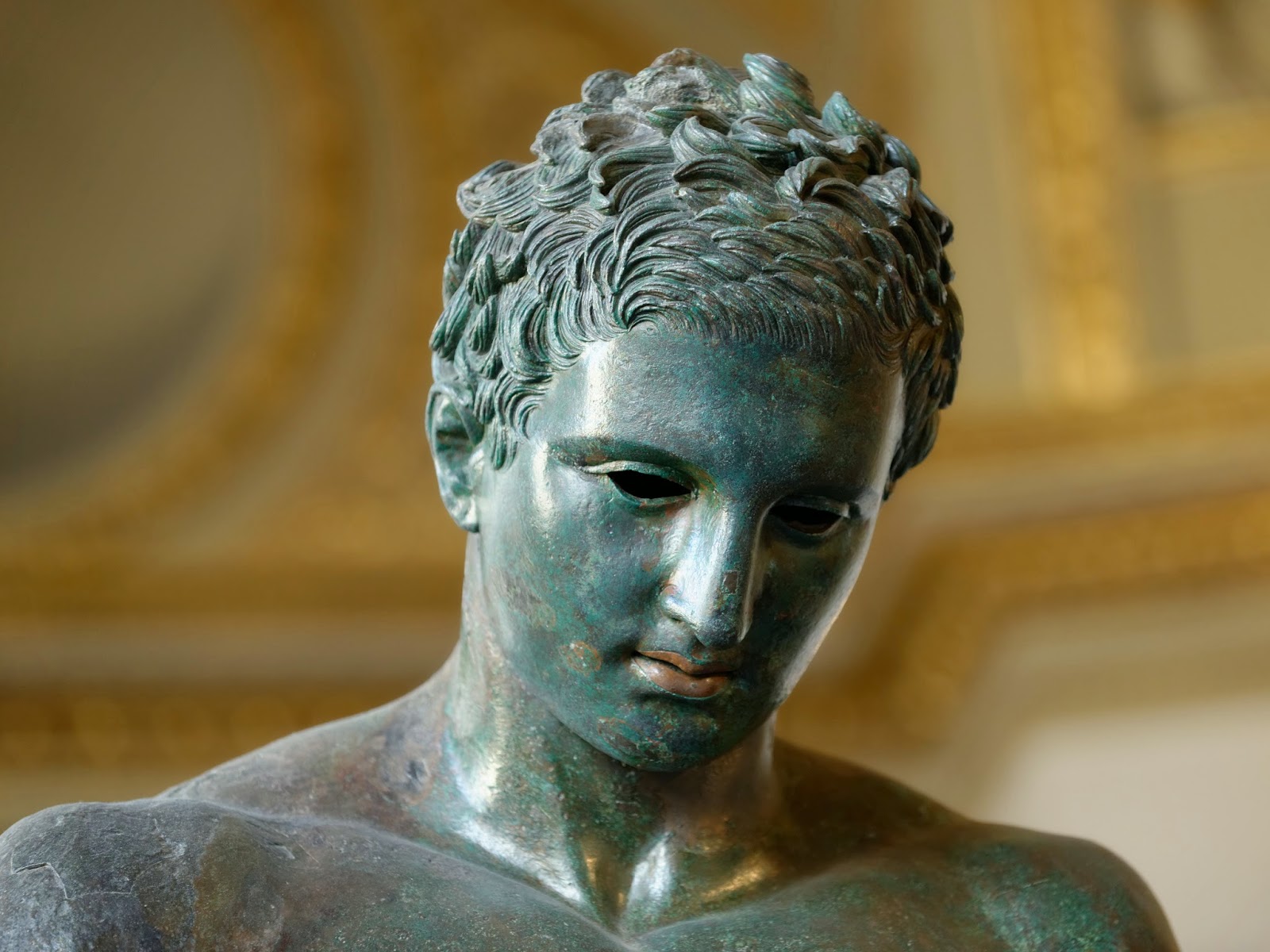
The day began with a visit to the British Museum to see the ‘Defining Beauty‘ exhibition. The focus was on the representation of the human body in ancient Greek art (and Roman remodelling). While Egyptian art had sought to cover the body, the Greek aesthetic was to represent the naked human body as both as an object of beauty and a bearer of meaning. At the opening of the show was a marble statue of a naked Aphrodite crouching as she bathes (a Roman copy of a Greek original, 2nd century AD). The statute is placed such that you arrive to see her from behind, with her finger-tips just hovering over one shoulder as if beckoning, making for a somewhat an erotic image. The wall text at the opening also reminds of the relationship made in the ancient Greek period between the human body and demos or democracy. This opening scene immediately set a theme for the day of the political aesthetic.


After the British Museum, we moved onto the Whitechapel Gallery for Christopher Williams’ ‘The Production Line of Happiness‘. The contrast couldn’t have felt much greater. In the mould of the anti-aesthetic, this exhibition while ostensibly a show of photography, is very deliberately staged to reveal its own sense of display. Elements of the previous exhibition held in the same space are visible, walls are brought in from other exhibitions, and elements of the work shown are placed in the foyer as as well as the designated gallery spaces. All in all the exhibition offers a defamiliarisation of curatorial display. However, while deconstructing the gallery setting, it is arguably an environment that is still inward looking – a critique of and for the few, not the many – unlike the human forms that we encountered in the British Museum (though it ought to be noted, the The Whitechapel exhibition was free entry, while the British Museum charged a high premium for an exhibition that was largely put together based on the Nation’s own collection!).

After visiting these two exhibitions, we ended the day at Goldsmiths to hear a public, professorial lecture given by Prof. Sean Cubitt, in the Media and Communications department. His lecture, with the title of ‘Political Aesthetics: Becoming Human’, began by suggesting a need to shift from the typical ‘political’ image (such as we might associated with the Obama ‘Hope’ poster of his 2008 election campaign). Instead, Cubitt placed attention upon a satellite image, looking out to the planet Saturn. This, Cubitt argued, was a deeply political image. We were told, for example, how the fuel powering this device orbiting the earth to bring us the image came from the uranium mines on aboriginal lands in Australia. As a form of cognitive mapping, whereby we need to reestablish an understanding of how we make meaning (and how all meaning is mediated) Cubitt considered not want that internet does as such, but rather what is made of. How it is powered, how it is transmitted, how it is discarded. In all cases, the contents is borne of political-economic condition that precedes it. In effect, the traditional questions of aesthetics about truth, beauty and the good (as we encountered in the British Museum exhibition, and then challenged at the Whitechapel) were recast in Cubitt’s talk to consider a new materialist and ecological take on both politics and aesthetics. We were asked to consider a new ‘human’, or at least a new set of rights for society that incorporations not just the human body, but the interacting ‘body’ of computers and land.


Thoughts & Commentaries

Jane Birkin: Through a survey of his own work, Christopher Williams references the multiplicity of photographies that can be found across a variety of milieus; this exhibition is not about the status of the single image, but the production and deployment of many. Some pictures have the look of those used in advertising, mainstream publications or commercial catalogues; there are indexically captioned plant typologies; and visually perplexing images that reject categorisation. There are layers and back-stories to these images that we are consistently and purposefully not told. A small document displayed on the upper floor playfully suggests that these images have been found and purchased as a ‘job lot’, bringing us forward to the shifting, authorless, decontextualized state of the photographic image today.

Williams presents us with the techniques of photographic production. An immaculate picture of the technical apparatus itself confronts us at the start: finger on shutter, it is a fitting introduction to a display of perfectly rendered images. But there are imperfections within the pictures, including the noticeable inclusion of photographic equipment, that would normally be lost in cropping or other post-production methods: thus we are not looking at the image itself but rather at its making. In a further technological referencing, the green colour that runs through the exhibition is that of the Fuji film carton. This same green dominates the exhibition catalogue, a beautifully constructed publication that contains none of the images from the exhibition. Why would it when there are important discussions that can be had around this work without its re-production?

In any case the catalogue could never replicate the affect of the installation, and it is this installation that is most immediately striking: the photographs are hung somewhat low on the wall, with the detritus of the previous exhibition becoming an integral part of the exhibition concept. The marks and imperfections on the walls, together with the swathes of Fuji green, interrupt the flow of the already disjointed collection of works and parallel the flaws in the images themselves. The installation presents as much of a deconstructed and voyeuristic view of exhibition making as it does of photographic production.

*

Elham Soleimani: Visiting the exhibition ‘Defining Beauty’ provided me with a space to reflect on my own research and creative practice and, as my work mainly concerns the human body (in particular, the female figure), sexuality and veiling/covering, I believe that all these topics have been greatly explored through ancient Greek art. The human body, specifically its representation and beauty, has indeed received a great deal of attention from all civilizations throughout different eras, however, ancient Greek art explored the representation of the human body not only as an object, but also as a source of meanings. For instance, in one Assyrian scene titled ‘A Chronicle of Cruelty’, nakedness symbolizes failure and dishonor and the sculptures of women’s bodies are covered to represent their modesty and their desire to maintain their reputation.

Despite the wonderful masterpieces in this exhibition, one of the most fascinating features was a booklet with tactile images along with braille text, designed for visually impaired “viewers”. I sat there and simply touched the images. I tried to understand the lines and where they were trying to direct me. In fact, these lines introduced me to a new way of understanding and creating images that I am eager to experiment with, as my own creative practice concentrates on graphic illustration, the effect of lines and the emotions and understanding that one might achieve through them.

*

Cheng-Chu Weng:  The first stop: to view the classical sculptures at the British Museum. Practicing, the Chinese idiom ‘讀萬卷書,行萬里路’ , means ‘in order to attain wisdom, it is not enough merely to read books, you must be well travelled as well’. I have been researching the classical body in art through reading, yet inevitably the visit really helped increased my knowledge. It was magnificent that my own body was able to be around the sculptures, they seem so much more alive than photographs and video. From this point of view did there is a link with Professor Sean Cubitt’s lecture: Becoming human-Political aesthetics, given at Goldsmiths University. Two keywords in my research are pixel and body. At the beginning of the lecture Cubitt offered a critical view of the structure of image in hyper-reality, noting how pixels presented in grids of four via the ubiquitous CCD chip. He believes moderns are dominated by pixel and CCD chip. The images produced by high technology are political, such as an image of a faraway planet in the solar system. The reason that images from science or geology can be political, particularly today, is that we economically we rely on data. What we see or believe is through photography and computer screens, which construct data. This may seem to lack the aesthetic of more obvious political images, yet they are able to ‘enclose’ knowledge; again ‘in order to attain wisdom, it is not enough merely to read books; you must be well travelled as well’. Following Cubitt’s explanation of the human body, which could be analysis three types of the body, flesh (physical body), consuming/ labor body and body as the embodiment with technology, they are in the form of the political. Compare this with the classical body, engaged with myth and human desire; although through their display at the British Museum they become a political body as well. In the end, Cubitt left a fundamental, but challenging question: How should we be human?

*

Oliver Peterson Gilbert: Sean Cubitt’s inaugural lecture, drawing on material archaeologies and the inherent politics of objects, was as alarming as it was insightful. His deconstruction of the eco-political implications of technological matter, from space telescopes to the icons on your computer, demonstrated our total complicity in the destruction of the planet. In particular, Cubitt’s use of Marx’s Grundrisse to reflect upon contemporary post-industrial cognitive-cultural economies and the plight of the digital factory worker was thought provoking and showed the continued relevance of this text in the 21st century.  Despite the ominous nature of his lecture, Cubitt used this public platform as a call-to-arms: presenting the case for a reclassification of the political to include both non-human and human actors, a radical vision which goes someway towards reforming the mankind’s political relationship with the planet.

*

Walter van Rijn: If we consider the art object as that thing created by an artist and presented to us in a particular context, it is clear that the art object is subject to different forces leaving their mark on the object. The sculptures in the ‘Defining Beauty’ exhibition are prime examples of what I would call institutional objects. Objects determined by the institution. The institution determines not only how they look, but also who can see them, where and in which context they are shown, and what their meaning is supposed to be (Defining beauty of the human, or Greek society?). We might say that these sculptures were created by and to function in Greek society, copied and used as status symbol by Roman society, and commercialised and dislocated within British Society.The exhibition ‘The Production Line of Happiness’ by Christopher Williams looks like a completely different exhibition, but there are important similarities. The art objects are again institutional objects, but this time created by our society. Photographs of objects, despite the subject being human, animal, plant or thing. Photographs of objects created initially to function as an ideal representation of a thing in a publication.  Again they are copied or remade and dislocated into this exhibition. This time we are made aware of the dislocation, the procedures of display. The photograph of Buren’s work with green stripes, initially a non-representative, institutional critique work of art in situ, has been used by Williams to determine the green colour and structure of the exhibition space and artist’s book. A green stripe that has become distributed from original to photograph, to context, to artist’s book and art object again. It has become an institutional green, instituted by the artist, validated and consolidated by the art world.
*

Xiao-yang Li: In a metaphoric sense, The British Museum’s exhibition is an event of human bodies confronting the ideals of a different set of human bodies from an era 2000 years apart. We, dwellers of our technology-obsessed time that worships the robotic and prizes the latest touch screen sensations, have come to witness a period with a special people who dared to understand their own body at its fullest, its most natural, most awkward and most beautiful moments! The Classical world did not just arrive out of nothingness, it followed Mycenaean civilization and the dark geometric era, borrowed iconographies and divinities from a mixture of Mesopotamian and ancient Egyptian beliefs, arose from the thousand-fold imperfect and crude Archaic votive figures and with its own gods and rites and Homeric ideologies, come into full blossoming. Here gods and goddesses were sculpted into their monumental splendidness, statues of larger-than-life size bodies were erected against other bodies or attached to an architectural fragment, vivid scenes of brutal killing or mythical rites were depicted on reliefs, and there lies countless broken bodies without an arm or a head or the ‘deep breasted bosom’…
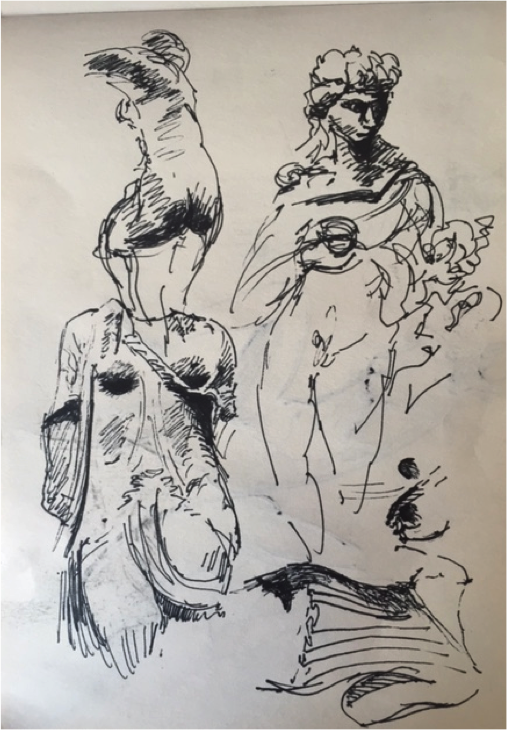
Perhaps the Greeks were the first official ‘realist’ artists, their understanding of the human bodies does not only concern with a higher degree of likeness through a more advanced sculpting technique, it also comes with a sense of human drama and errors. Therefore the divine and the mortals were represented side by side, possessing the same errors and beauties, and we watch this drama unfold before our eyes like the opening pages of an Homeric epic. The full confrontation with nature itself gave rise to meanings in a multi-fold dimension. It grants beauty and grace to all godly abductions, to the scene of the killing, to war, and to the translucently flowing draperies of Artemis’ dress that reveals part of her inner thigh in the most erotic manner. For the Greeks life comes with death and rape, virginity is paired with child-bearing and animal-sacrificing, blessings are peppered with curse and agony, concealment never fully shy away from the sensual exposure of playfulness, the absolute beauty arose from the ugliest castration of the universe, femininity only thrives when in tuned with masculinity. Here it seems the aesthetic reigns above all morality, and the beautiful Olympian gods are still busy entertaining themselves with their outrageous deeds that no mortal could understand. From the body, a sense of the divine is associated with a sense of reality, which reminds us of what we are as human beings, but this divinity is never fully real, for it is too idealized, and partially they are too close to nature they are at once very far away from human conducts. What di the Greeks dream? Was it filled with fantasy and sweet utterings? Or was it darkness of a storming night where all living creatures were erased and destroyed? It is difficult to tell, but we might think the Greeks’ dreams were of a strange set of comic tragedy. Their gods, who maintained in a human body, were so hard to please, it makes one wonder if the reality of human beings that the Greeks discovered was one of catastrophe and inevitably fateful existence. The naturalistically depicted gods and goddesses are the very epitome of this reality, in which humans, with their desperate awe towards nature, confront themselves and find that least human part from within. So what do we make of our current era – an era that slips away from this direct confrontation, are we wise to avoid that sense of the reality, that which could be so real that no human beings can bear anymore?

*

Hazel Atashroo: On being asked, after the event, to respond to Sean Cubitt’s inaugural speech at Goldsmiths last week, I wished that I had had the foresight to take some notes. I foresee that I will have to risk relying on memory, living with my fear that my omissions might outlive me, on a data server, somewhere. A gulf frequently appears between what we initially intend, what actually we do, and the broader consequences.

Sean Cubitt discussed his new research, which returns to the ‘design and materials’ of media technologies and their role in delimiting ‘the political’, how people conceive of and experience ‘politics’ in the digital age.  This points towards the issues that have long occupied the area of the social studies of technology in general: the relationship between the ‘socially constructed’ nature of human productive activities, seen in aspects of material choice and design context, and their intended and unintended broader consequences.

The other fundamental part of this relationship is one of feedback in which the products and processes of human invention in turn re-create the human: changes which may occur ‘below the radar’ of our awareness. Ideologies embodied in everyday technologies- can have enabling, as well as powerfully delimiting effects on human life. Cubitt’s discussion appeared to follow in this critical interest, once indicated in Langdon Winner’s call for a ‘theory of technological politics’.Many years prior to this, Günther Anders wrote of humankind’s ‘Promethean Discrepancy’ – the gulf between human ability to create new technologies and the ability to visualize the consequences. Anders identified the need for a ‘moral imagination’ to avoid the kinds of technological developments that made atrocities like Auschwitz, Hiroshima and Nagasaki possible, and ecological disaster imminent.

In his speech, Cubitt mentioned the centrality of the data spreadsheet, an unassuming technology upon which life or death decisions are made. This impersonal utilitarian vista dominates the daily experience of workers across the globe.  Does the spreadsheet have a ‘moral imagination’?

See also:  Anders, G. Die Antiquiertheit des Menschen [The Obsolesence of Human Beings](1956; 1980). Bijker et. al. (1994) The Social Construction of Technological Systems. New Directions in the Sociology and History of Technology;  Schraube, E. ‘Torturing Things Until They Confess’: Günther Anders’ Critique of Technology (2005);  Van Dijk, P.  Anthropology in the Age of Technology: The Philosophical Contribution of Günther Anders (2000); Winner, L. The Whale and the Reactor. A Search for Limits in an Age of High Technology (1989).

*

Sarvenaz Sohrabi: Although I have read in the past about the art of ancient Greece, the opportunity to look at the works shown at the British Museum while currently engaged in my own practice-based research brought to me new understanding of the works. Artworks, regardless of their aesthetic effects, are carrying messages in different fields and at different time of human thought. Hence they are a type of intermediate cognition of the past and present. Significantly, however, although about half of the human population are women, art history is frequently masculine, with women in second place. The lesser role of women in Greek art is visible. Most of sculptures show  powerful men with strong bodies. Even romantic stories on urns were designed to illustrate the love story of heroes. Visiting the exhibition made me think again about the gender-bias of gods and religions in different art periods.

*

Simiao Wang: The sculptures embody religious functions based on Greek mythology, while its copy represents new politico-religious in Roman context, which emphasis on the duties of human instead of God (contributing to the collapsing of Greek culture). Human beings becomes the city culture identity in Roman empire time rather than God and Goddess, who are no longer enjoy the sacrifice dedicated on the shrine, but transfer from the sexual dimension and lustrous motifs to masculinity of warriors, heroes, and beauty of real human beings, from solemn tradition to a luxury art fashion and assumption of bureaucratic and the wealth.

No matter how eagerly the human beings are striving to replace the position of God in religions, the copy is fake but far more a simple intimation of physicality embodiment of figure but a creative methodology to enfranchise the power of body to a mundane, such as A Roman Lady as Venus (Ny Carlsberg Glyptotek), which has a personalized face with Venus body in order to make it look like a real Venus from Greek, this sophisticated way of engaging Goddess with mundane features to propagate the victor of human beings, in my perspective of view, loses the beauty of original function in aesthetics and religious, even worse, it is a braggadocio of the omnipotent of human beings.

Professor Sean Cubitt points out three virtues of human beings: consideration, wonder and hope. ‘ The hope is hope for a future that is not this one’, he also proposed that we should ‘ refuse the present and open the gate to the future’; if we make the hypotheses that Greek is the past, Roman is the present, and then what is the future? By putting a head on the tradition of beauty’s body could not be the future, for future is a partial denial of the past by respecting the past as what it was, and behind the head and its copied body, the political, economic and easthetic expenditures of celebrating the omnipotent human sculpture can not be ignored, the ceremonies of tradition still carries on with new fashion of wealth consuming. The beauty, decreased in the sense of pure ideological concept for the connections between human and God are vague and unimportant, while the tradition, or the media works as the bridge. In Roman’s case, the media is the sculpture and could also be the expenditures, the warriors, the craftsman and even the public who are getting involved in the ceremony. As Sean said, ‘ the human activities of massive expenditures in ceremonies of wild joy is the anti-aesthetic design to function instead of beauty pleasure.’

In a larger picture, the sculpture and everything behind the scene of sculpture becomes a geology of meditation, a phenomenon of ecological principle, or the fact of human beings become the minimal components of machinery world of celebrating in a shopping experience on ceremony. Quoted from Sean ‘media is not human, it is a thing.’ A thing without judgment on virtues and sins, but ‘can be more trustworthy than human beings’ for things have non-human being character and things knows things, but we, human beings, do not know each other. And in this media world, we lost the human character (it reminds me of robotic in science fiction) for we are volunteering to be part of the media.

Should we accept the fact that we are media instead of human beings? I think it is challenging to answer the question but the pleasure of appreciating the copy of sculpture of Venus is real, even though the original of Venus lost in 300 BC but we can still imagine there is a beauty once exist rather than not.
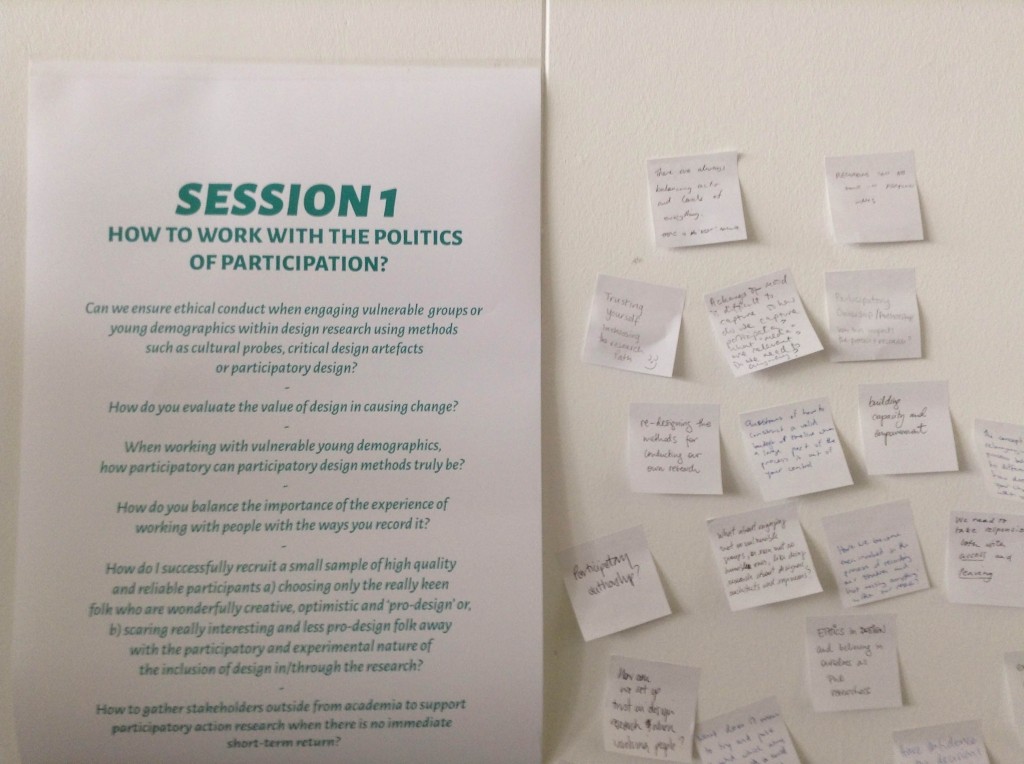


PhD by Design Conference

PhD by Design is a conference that explores the messiness that!is practice- based research. Walter van Rijn, who is soon due to complete his PhD in Fine Art at WSA, provides a review of the conference held in November 2014. 

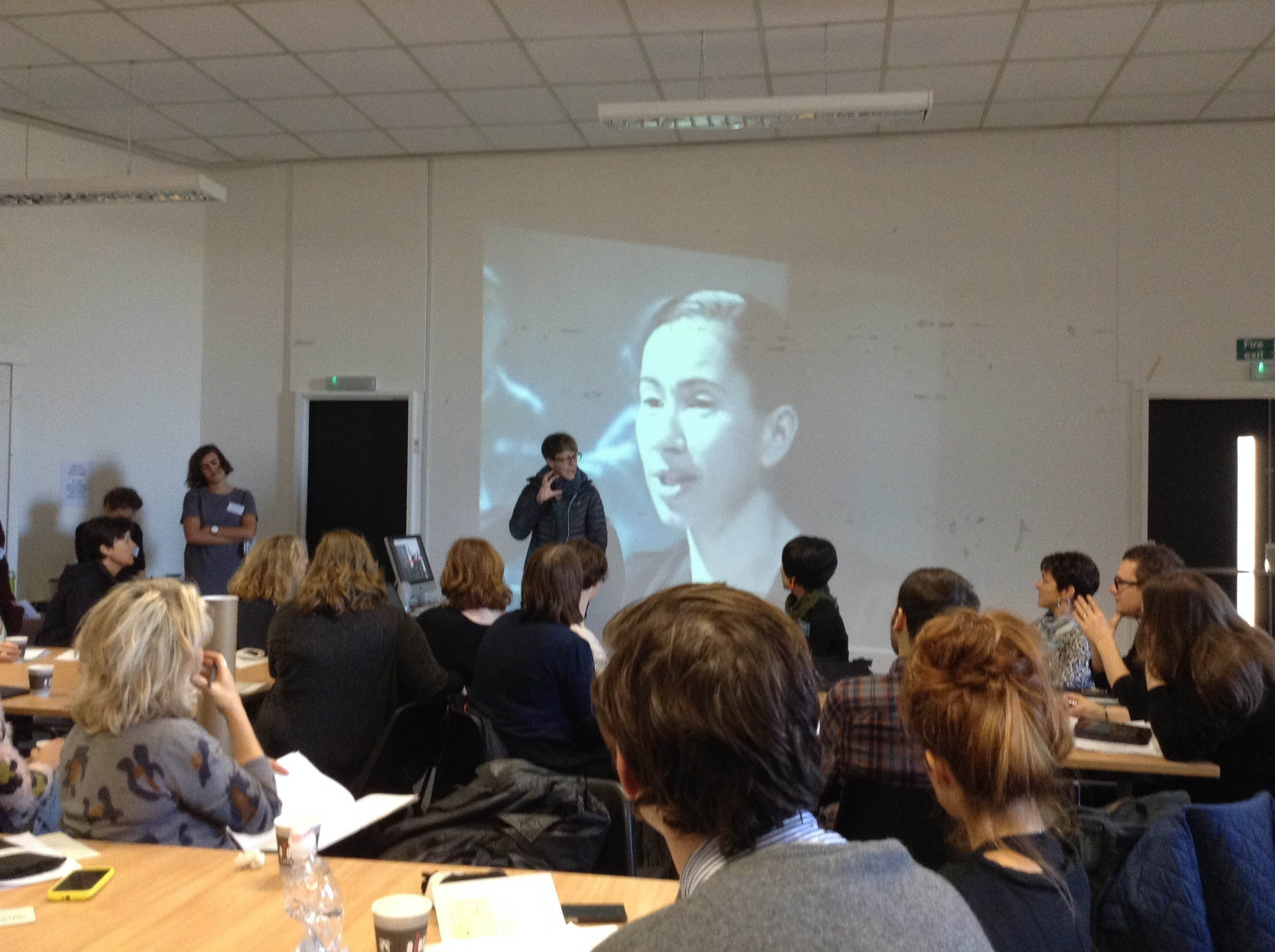
On 6 and 7 November 2014 I attended and presented at the PhD by Design Conference organised by students of the Department of Design, Goldsmiths, London. The main reason I wanted to take part was to see if my research, which has an artistic research methodology, could also apply to the design world. As I will show below my work has an overlap with design but I approach it from a dierent direction, and I hoped that by discussing my points of view I could work out in what way my research might be relevant for the design discipline, that is, outside the fine art discipline.

The conference was introduced by Jules Sprake who introduced Andrea Fraser’s famous ‘welcome’ as a way to perform her critique of institutions. Sparke was basically saying we, as phd researchers in this conference and through our work, are here to do exactly that. The critical intention was already part of the set-up of the conference, as the organisers explained in the pre-conference info, the conference itself was structured around questions and discussions by the participants. Over the two days we were going to “discuss and work through many of the topical issues of conducting a practice-based PhD in Design” (http://phdbydesign.com). On the basis of the questions, we the participants provided with our registration, the organisers placed everyone in discussion groups. The group sessions were focussed on a particular question, and they started with a couple of short presentations which were then intensively discussed and commented upon. I go into some detail here about the conference itself because the way it was organised was exactly fitting for the subject we are dealing with: ‘the messiness’ of our practice and research, also called practice-based or practice-led research. As became clear at the end of the conference, everyone really appreciated the conference structure facilitating an intense two days, somewhere between a workshop and conference. And of course thanks to hard work of the brilliant organisers Alison Thomson, Maria Portugal and Bianca Elzenbaumer! By the way the conference sessions were very alike the discussions and seminars of our own Postgraduate Research at the Winchester school of Art, organised by Sunil Manghani.

The questions for the different sessions tell their own story:

Session 1: doing/ making/ planning
What about interdisciplinarty? How to connect with actors beyond academia?
How to work with the politics of participation?
How to wrestle with the gap between practice and theory?
Exploring methods of making and recording?

Session 2: output/ dissemination/ use
How can we reach non-academic audiences?
How to represent research practice in inventive ways?
How can we evaluate the impact of design research?
How to deal with co-produced research outputs?
How can we disseminate practice-based research beyond the academic article?

Session 3: open discussion
What does design research look like?
How to decide on my approach and format of submission?
How to value the knowledge and eects produced through design research?
How to integrate design research with other fields?
How to consider the impact success and sustainability of design research?
I hope the organisers will manage somehow to create a record of what happened in all the discussions I could not take part in, because there were many I would have liked to be in. A pdf version of the participants’ abstracts will be available on the conference website.

I presented my research in session 2, How can we reach non-academic audiences? See the presentation A Dispersal Alongside … on my website: http://www.symbiotext.net/tag/public-address-2/

It argues for a dierent critical approach. One that moves away from a focus on products and target audiences, and instead uses a strategy of embedding and giving access. The discussion afterwards turned towards the questions: What is the role then of the designer/artist? Are we to provide a service, a product or critically engage with a particular context as a whole? Besides a general sense of what a designer/artist is or does, we seem to seek to answer that question individually. Our research is a great opportunity to do that. Some of us work through a sense of gender, mapping human/site interaction, user interaction, dispersal practice etc.

Besides our discussion sessions there where also keynote speakers. Bill Gaver, Jennifer Gabrys, Jane Harris, Jon Rogers and Teal Triggs. Bill Gaver talked us through one of his design studio’s projects, the Energy Babble project, and interspersed it with answering more general questions that came up at the conference. The Energy Babble project was a great example because it showed success and failure, and how he arrived at this evaluation. Hearing his methodology I realised that in design research too, the practice-led methodology works out as a methodology that follows where the practice goes, that is, it evolves and entails that what is needed to be able to “reflect on the results to precisely articulate the insights gained”. Besides the researcher has to “realise that many possible perspectives can be taken on the work” so that the research is not a closed off thing that is assuming a “stable ground truth”. The fact that the research takes place does change the situation.

Jennifer Gabrys, Jane Harris, Jon Rogers and Teal Triggs had their presentation at the end of the conference and focused each in their own way on the application of our research in the real world. Jennifer Gabrys presented Citizen Sensing and Environmental Practice, which resonated with my own work for its do it yourself strategies and critical view on all the actors (human and non-human) implicated in a particular situation. Jane Harris put it very strongly that we have to look beyond our usual field of applications, and to follow our instincts and that what drives us, diversify as much a possible. Or to quote Jon Rogers “How do you bring you into the PhD? Through your practice.” Teal Triggs also came up with lots of questions we have to keep asking ourselves during the research: When is it over? What is opened/closed through the research? What is for the future? What has it uncovered? What fields does it contribute to? Questions to articulate the messiness of what we do, and, she stressed, we need to keep asking these questions after the phd to pursue research in our fields. The importance of extending research in our fields….

The conference ended with a collective debriefing, and launching ideas about what’s next. What ever happens next everyone agreed that the format of the conference was hugely successful and hopefully will be continued in some form. Then it was off to the pub, head buzzing, you might have guessed, we had a great time.


The Value of Museums

Najla Binhalail’s doctoral research examines the practicalities and politics of the museum display of Saudi clothing, with particular consideration of the Unification of the Kingdom Hall in the National Museum in the Kingdom of Saudi Arabia. Her work prompted the readings for a seminar on the function and ‘value’ of the museum . Her account of the seminar she led connects also with her attendance at the recent conference ‘Taste After Bourdieu’.  


On Wednesday 14 of May, Dr. Sunil Manghani and eight PhD students from different nationalities studying at the Winchester School of Art took part in a seminar to discuss the cultural identity and value of museums. As this topic is relevant to one area of my PhD thesis, I would like to summarise and comment upon our seminar discussion. 
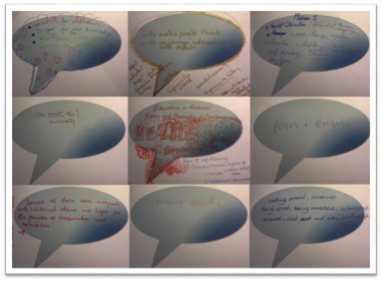
I began the seminar by giving out two papers, each summarising a previous piece of research concerning the core function of museums, and one paper  and pen for the answers to the question I would ask during the discussion.

Fig1. Three sheets of paper and pen provided for the discussion

A definition of the word “museum” was then offered as “a building where many valuable and important objects are kept so that people can go and see them”(Dictionary: Rundell and Fox, 2007, p.985). I asked the question, “What is the function of a museum?”, and the group were asked to write their answers on the paper provided and read them out prior to our discussion.

Fig2. Answers to the question before our discussion

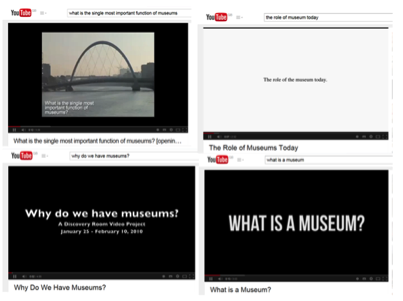
We then watched four YouTube videos (see links below) presenting a varied selection of views and perspectives from both visitors and museum staff in answer to the question I had posed.

museum-blog-3
Fig3. The four YouTube videos concerning the function of a museum

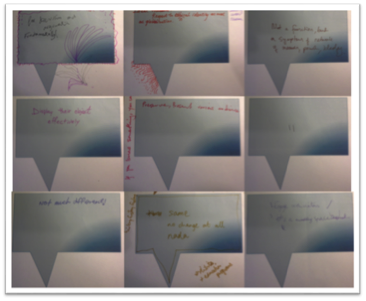
We based our discussion on the videos and the summary I had made of two research papers, “The Museum Values Framework: a Framework for Understanding Organisational Culture in Museums, and Museums, exhibits” and “Visitor Satisfaction: a Study of the Cham Museum, Danang, Vietnam.” After our discussion I asked the same question, “What is the function of a museum?”. Again the group gave their answers on the same sheet paper. The purpose of repeating the question was to observe and compare how opinions had changed as a result of our discussion.

museum-blog-4
Fig4. Answers to the question after our discussion

 In the light of our discussion, I have come to recognize that the word “value” rather than “function” may be more appropriate when describing the aims and purposes of a museum. “Function” tends to imply one overall concept which may or may not be true in any given context, while “value” allows for differences in the economic, political, religious and national needs of each museum, its management, staff, and culture of which it is a part, as well as the wide mix of age, gender, nationality, social and educational background of its audience.

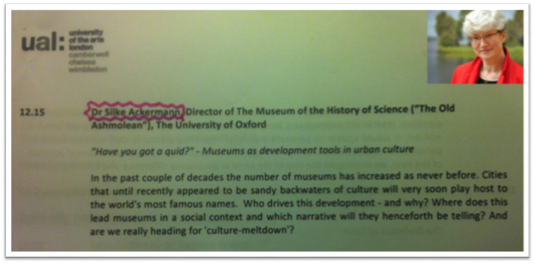
After the seminar I attended the “Taste After Bourdieu” conference at the University of the Arts in London, and as a result I became aware of the relationship between our seminar discussion and a research paper presented by Dr Silke Ackermann, “Have you got a quid?- Museums as development tools in urban culture.”

Fig2. Dr. Silke Ackermann’s abstract

I understand Dr. Ackermann’s concern, because I am from Saudi Arabia and my culture is similar to that of the United Arab Emirates. Her questions were about the value of museums in an urban culture, and in particular she mentioned three new museums in Abu Dhabi as examples of her concern. My opinion is that there appears to be a different value for the museum in some countries of the West compared with some countries of the Gulf.

Some of the Gulf countries have come more recently to recognize the value of museums. They understand that progress and civilization originate from the roots of the past and are attempting to increase an awareness of the importance of museums. These countries tend to link the existence of museums to the interests of their tourists and non-citizens rather than to the needs of their actual residents. As a result, they plan their museums based on the valued experience of some western countries, with many of their new museums designed by foreign experts from a western culture. I am convinced that such experts will not easily understand the real needs of the citizens of the Gulf region.

Museums keep the valuable objects and display the heritage of the nation. Their presentations need to be distinct, effective, and offer the visitor a pleasing and interactive experience. Museums are not merely storerooms or repositories of the past, they are places of the present and the future, places that tell us the human story throughout the ages in an accurate and true fashion, and thus open up and interpret human civilization for succeeding generations to come. My hope is that the majority of citizens in the Gulf countries will come to appreciate the value of museums for the increase of knowledge and communication, and the strengthening of their political and economic standing in the world.

Resources:

Davies, S. M., Paton, R. and O’sullivan, T. J. 2013. The museum values framework: a framework for understanding organisational culture in museums. Museum Management and Curatorship, 28 (4), pp. 345–361.

Rundell, M. (2007). In: English Dictionary for Advanced Learners, 2nd ed. Oxford: Macmillan, pp. 985.

Trinh, T. T. and Ryan, C. 2013. Museums, exhibits and visitor satisfaction: a study of the Cham Museum, Danang, Vietnam. Journal of Tourism and Cultural Change, 11 (4), pp. 239–263.

http://www.youtube.com/watch?v=FL97lJ2rSdI

http://www.youtube.com/watch?v=cjx1F-N3YbQ

http://www.youtube.com/watch?v=ggXFIXglhjs

http://www.youtube.com/watch?v=2_y7n7OGslg

Designerly Ways of Knowing

Bedour Aldakhil’s PhD research, Saudi females, the abaya and everyday life: Towards a Designerly Approach to Consumers Research, prompted the readings for a seminar on ‘Designerly Ways of Knowing’. She offers an account here of some of the elements of the seminar discussion.

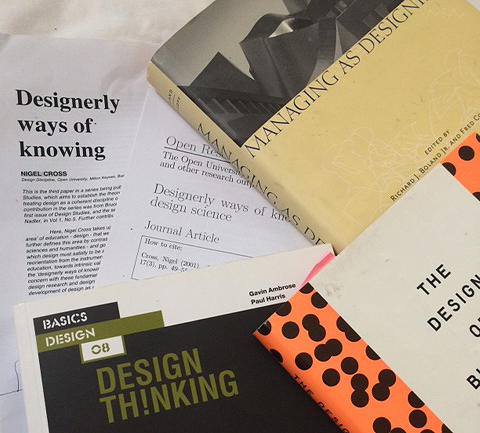
At the start of the seminar, Dr Manghani introduced Noriko Suzuki-Bosco, practicing artist and member of WSA’s alumni, who had joined us for the seminar discussion.  Noriko, whose work is explicitly concerned with material form and processes of making, was able to contribute pertinent insights to our reading of two articles by Nigel Cross, ‘Designerly Ways of Knowing: Design As A Discipline’ (1982) and ‘Designerly Ways of Knowing: Design Discipline versus Design Science’ (2001). As part of preparation for the seminar we also listened to an interview on BBC Radio 4’s The Life Scientific with Professor Mark Andrew Miodownik, the British materials scientist at King’s College London and co-founder of the Materials Library.

In the main, the seminar discussions and arguments centred around the earlier article by Nigel Cross.  The article lays out an argument for and challenges our thinking about a neglected third area of education: Design.  In general, the two dominant cultures of education are the sciences and the arts, broadly defined. Cross’ article published in early 80’s was stimulated by a project on ‘Design in general education’ by Royal College of Arts in the late 70’s, however, it highlights several issues that remain highly relevant to us today.

Cross contrasts between the three cultures science, humanities and design to clarify what he means by design and what is particular about it. As he put it:

The phenomena of study in each culture is

  • In the science: the natural world
  • In the humanities: human experience
  • In design the man made world


The appropriate methods in each culture are

  • In the sciences: controlled experiment, classification, analysis.
  • In the humanities: analogy, metaphor, criticism, evaluation.
  • In design: modelling, pattern-formation, synthesis. 

The values of each culture are:

  • In the science: objectivity, rationality, neutrality and a concern for truth
  • In the humanities subjectivity, imagination, commitment, and a concern for justice
  • In design: practicality, ingenuity, empathy, and a concern for ‘appropriateness’.

We recognise that the boundaries between these three cultures are not concrete but fluid. However, one member of the seminar was sceptical about the idea of design vs. science. He felt the design process that Cross argues for puts science in a tight corner. I think what Cross was trying to do is to explain his own perspective and make the case for design by comparing it to science. The underlying argument is that there are ‘ways of knowing’ embedded in the process of design that are different from  science; which is specifically illustrated with an example between architecture and science. Drawing on observations from Lawson’s study, How designers think (Architectural Press, 1980), Cross explains how postgraduate students of architecture and science show ‘dissimilar problem-solving strategies … The scientists generally adopted a strategy of systematically exploring the possible combinations of blocks, in order to discover the fundamental rule which would allow a permissible combination. The architects were more inclined to propose a series of solutions, and to have these solutions eliminated, until they found an acceptable one’. Lawson elaborates further:

The essential difference between these two strategies is that while the scientists focused their attention on discovering the rule, the architects were obsessed with achieving the desired result. The scientists adopted a generally problem-focused strategy and the  architects a solution-focused strategy. Although it would be quite possible using the architect’s approach to achieve the best solution without actually discovering the complete range of acceptable solutions, in fact most architects discovered something about the  rule governing the allowed combination of blocks.In other words they learn about the nature of the problem largely as a result of trying out solutions, whereas the scientists set out specifically to study the problem. (Lawson, How designers think, 1980)

Thus, for Cross, science relates to a process of a linear analysis to find a solution, while a designerly way of knowing is a process of synthesis and iteration. It unfolds in the future with innovative realisation. The designerly way of knowing is not only embodied in the process of designing but equally the products of design also carry knowledge. The material culture of our world provides knowledge to everyone ”…one does not have to understand mechanics, nor metallurgy, nor the molecular of timber, to know that an axe offers (or ‘explains’) a very effective way of splitting wood”. In a similar vein Professor Mark Miodownik from University College London, in the interview on BBC Radio 4’s The Life Scientific, argued for the importance of our material culture and its sensual aspects. He offers the radical idea of converting public libraries into workshops with laser cutters and 3D printers in place of books.  His point is that we now can access books with little difficulty (and on different formats) but materials and technologies in the context of a workshop are not widely available.  Through making, doing, and experimenting people understand and have more appreciation for materiality and could find new solutions for problem that exist in our world. Materials have there own sensibility different from writing and reading.

Today we can see how people use technology creatively to solve their own problems and help learning from each other. The creative use of hash tags in twitter, or the rise of virtual communities are just a couple of digital examples. Maybe it is appropriate to end with a quote from Victor Papanek, a philosopher of design, from his book Design for the Real World:

“All men [and women] are designers. All that we do, almost all the time, is design, for design is a basic to all human activity. The planning and patterning of any act towards a desired, foreseeable end constitutes the design process and attempting to separate design to make it a thing by itself works counter to the fact that design is the primary underlying matrix of life” (1972: 3).


Read/Write

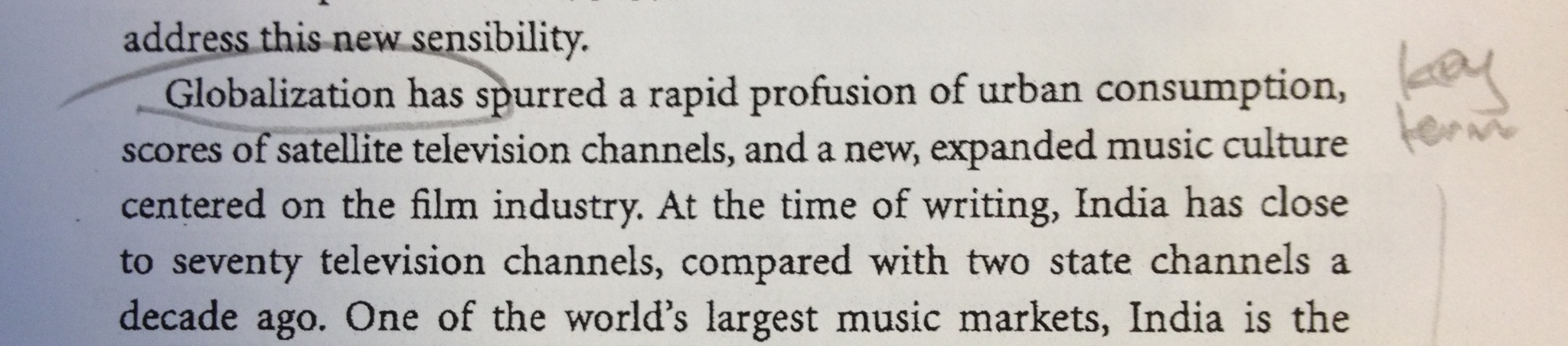
text-globalisation

For the third session of The Seminar, we turned our attention to the role and practice of the ‘literature review’; and more broadly we discussed the practice of reading in academic research and writing. We looked at a couple of examples of literature reviews, published in book and journal article form. Our main focus – in the first half of the session – was the opening chapter of Ranjani Mazumdar’s Bombay Cinema: An Archive of the City (2007). This is a book that is written primarily for a film studies audience, but draws upon literatures of Indian political history and also critical theory, particularly the writings of Walter Benjamin. We didn’t really want to get too involved with the ‘content’ of the book, but rather consider its form as a literature review. The chapter doesn’t list a great many books, but it does demonstrate the way key literatures can be handled to draw out the specific intentions and framings of the author’s own research.

A couple of paragraphs in, Muzumdar offers a dense, comprehensive paragraph that can be said to encapsulate the entire ‘project’ of the book:

Bombay Cinema attempts to enter the complex world of popular cinema by bringing together a range of cinematic practices and the urban experience. My purpose is to engage with the dynamism of popular cinema in the country’s sprawling metropolitan life. The city as a concept remained a crucial absence in much of  Indian nationalism’s history. The nationalists instead invested in the imagination of the village as one of the secure sites of citizenship, reflecting the social base of anti-colonial mobilisation. The interesting feature of Bombay cinema is that it has never been at one with the nationalist prioritization of the village. While cinema also looked at rural life, it is the urban experience that has dominated its landscape. The coming together of cinematic practices and the urban experience offers a useful way of transcending the imaginative limits imposed by nationalist narratives on culture. (Muzumdar)

There are a number of concepts and lines of enquiry that are raised by this single paragraph. We might want to challenge what is meant by the suggestion of an ‘urban experience’ and the ‘city as a concept’, but nonetheless, we can recognise a determined project to examine the screen life of Bombay cinema with a political, historical and sociological reading of India. There is a clear sense of an interdisciplinary approach. The author is concerned not only with ‘cinematic practices’, but also key concepts such as nationalism, citizenship, and colonial history. All of these areas of interest will need to be reflected in the literature review. Partly, as a means to define the key terms of reference. It is notable, later in the chapter, the term ‘globalization’ is used, yet it is not explained. We can infer a general understanding of the term, but it is a complex and loaded term, which ideally in a research project needs to be properly contextualised and argued for. Muzumdar does draw reference to a number of key texts, particularly in relation to the cinema and the city, and Indian nationalism. A number of her references to modernist writers such as Charles Baudelaire and Walter Benjamin are really crucial to a definition of the urban experience, and its collision with the screen. These references are  well worn, not least in film studies. Muzumdar, however, argues the geographic and cultural context of Bombay cinema lends originality to the research. She uses a very neat phrase to get around the problem that her work is both squarely situated in an established (and much researched) area of film studies, yet equally offers its own individual import:

Bombay Cinema is in many ways both a departure from and an addition to the previous work on cinema and the city, while at the same time bringing a perspective from India (Muzumdar)

I would suggest in writing a thesis, this sort of formulation is worth holding onto. It is a line that is clear, confident and carefully contextualised, helping to navigate the need to situate your work in existing scholarship, yet offer something genuinely original. It is perhaps also worth noting how the use of the book title, Bombay Cinema, gives the author further authority; they are presenting you with a project that is articulated in the writing, but also is bound as a book in your hands. A PhD thesis won’t necessarily be able to play off a title like this, but there are ways of characterising your research beyond the stock phrases of ‘in this research’, ‘in my study’, ‘ this dissertation’ etc. Your research is a ‘project’, it has a life beyond being a technical document.

Of course, by making a close reading of Muzumdar’s chapter – particularly in terms of its form – we did highlight a number of potential problems. Indeed, examining anyone’s writing at ‘sentence level’ will reveal all sorts of complexities and issues. Nonetheless, the chapter helped illustrate a point: while academic writing can appear at times to be dense and intense, there is a clear process of drawing together established concepts and ideas, along with new inflections and directions. Muzumdar’s chapter, for example, develops a complex, layered account of India, Indian cinema, urban experience, nationalism, modernism, and globalisation. It goes without saying one has to concentrate when reading this kind of work. To use a phrase from Philip Davis, who recently published Reading and the Reader (2013), we have to engage in a form of reading that is of ‘immersed attention’. It is a very active process.  (You can hear Philip Davis talk about his book on BBC Radio 4’s Start the Week)

The idea of reading as a deliberate and rich process was beautifully developed by Professor Ryan Bishop, who joined us for the second-half of the seminar.  Ryan suggested we think of reading during the PhD (and other research activity) as a means to ‘dwell’; and not least because, as we develop our careers beyond the research degree, we get increasingly get less time to read. We might say, not only should we occupy ourselves with reading, we also need to occupy reading! Yet, Ryan’s point was more nuanced than this, suggesting ‘it is as important to have a text dwell in and with us as it is to dwell in and with a text’; adding that we might at times ‘believe we read the text (and therefore control it), when the converse is also true (texts shape us and we become otherwise)’. Keeping this to mind – and with a brief allusion to slow cooking – Ryan played out a certain ethics of reading, and gave some great tips in maintaining a measured and engaged practice of reading. Here is a brief summary:

  • We are ‘reading’ all the time, whether it is a book, a space, a person, a situation, and that all these instances will provide different readings depending on your point of view, the context, the time etc.
  • Read first kindly, then re-read with a critical eye. In other words, first seek to understand a ‘text’ according to its own terms, before then challenging those terms. This allows you to make sense of a text and its context, which can, for example, aid writing up a literature review where it is useful to show the progression of ideas, even where those ideas are at odds with your own (or those of the texts you are more aligned with).
  • What you don’t read is as important as what you do read! We have to make choices about the books and texts we read and don’t read. It is useful to develop different modes of reading, fast and slow. You can skim a range of texts to understand a broader context, or indeed to satisfy yourself that certain references are not necessary for your work. Conversely you have to commit yourself to reading key materials at a slower pace.
  • Keep track. Reading needs to be an active process, and that includes keeping some records of what you’ve looked at. As your research develops you build an impressive bibliography, which will function both as a simple, technical list of materials, but also as an ‘archive’ of your research.
  • Write your way to thinking… A key line from Ryan’s is that we can all be readers should we wish, but ‘it is impossible to write (at all, not to even write well) without reading. It is through reading at all that we can even start to write’.

The seminar began by examining the literature review as a distinct element of one’s research, but perhaps more importantly what it reminds us of is the intricacy of both reading and writing. Read/Write: Together they form a virtual ‘space’ that opens up thinking. We can know what we want to write and put pen to paper, but our thoughts will be informed by a practice of reading. We can also surprise ourselves in our own thoughts as we write. Again, however, this writing is a product of distilling reading and engaging in an ongoing practice of writing. If you find you can’t get started with  writing, try reading first. And if the reading starts to then feel like it is slowing you down, it might be time to try writing again. And so it goes on…


If you would like to comment on anything from the seminar or wish to offer thoughts on a related topic, please join the Facebook Page:
 WSA PGR Seminar Group

The Practice of Theory

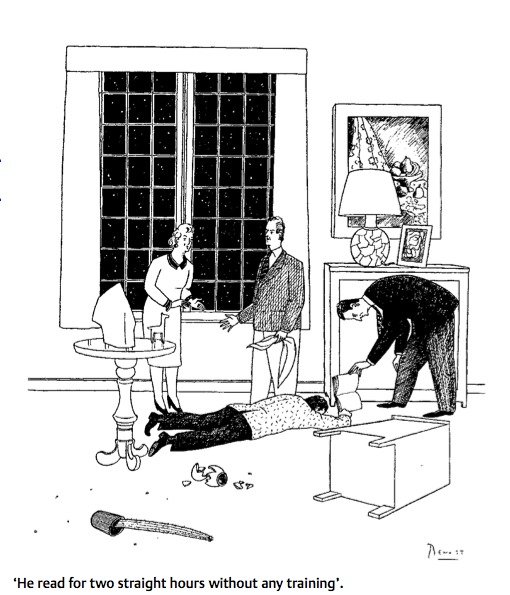
“He read for two hours straight without any training”

For the second session of The Seminar, we discussed two texts. Firstly, the opening chapter of Jonthan Culler’s neat little book Literary Theory: A Very Short Introduction (Routledge, 2000). Secondly, a chapter by Nicholas Davey called ‘Art and theoria’ from Thinking Through Art: Reflections on Art as Research (Routledge, 2006). This volume, edited by Katy Macleod and Lin Holdridge, brings together a wide range of voices to consider what we mean and think we mean by ‘practice-based research’.  Perhaps a little unfairly, I suggested at the start of the seminar the book is an example of what happens when a (seemingly) new concept comes into vogue (as for example with past terms like the cyborg, or visual culture). In that period when no one quite knows what to say about the new terms of reference, what better than to edit a book to draw out some answers? More often than not, however, the result is a further set questions and ambiguities.  Thinking Through Art results in something like this, not least with the concluding chapter by James Elkins’ taking a highly skeptical line about practice being in any way a form of research (you can read Elkins on this topic in more detail from the book Artists with PhDs, much of which is online; a second-edition of the print version is due out soon).

One member of the seminar group suggested that the piece by Jonathan Culler played the role of a guide to the reading by Nicholas Davey, whose chapter draws upon the more unwieldy vocabulary of Kant and Gadamer. We began with Culler then, whose chapter, albeit pointing towards literature, presents a neat, and at times funny account of the term ‘theory’.

In literary and cultural studies these days there is a lot of talk about theory – not theory of literature, mind you: just plain ‘theory’. To anyone outside the field, this usage must seem very odd. ‘Theory of what?’ you want to ask. It’s surprisingly hard to say. It is not the theory of anything in particular, nor a comprehensive theory of things in general. Sometimes theory seems less an account of anything than an activity – something you do or don’t do. You can be involved with theory; you can teach or study theory; you can hate theory or be afraid of it. None of this, though, helps much to understand what theory is. ( Jonathan Culler, p.1)

I think perhaps we went through all these possibilities, discussing the importance of theory in our own research, considering whether we were involved in theory development or applying theory to gain new insights. We also discussed the idea that maybe theory sometimes uses three words when it could just use the one – in other words that theory is unnecessarily opaque. However, for Culler, theory needs to be difficult. Theory signals ‘speculation’ he suggests, yet it is no mere guess-work:

…to count as a theory, not only must an explanation not be obvious; it should involved a certain complexity […] A theory must be more than a hypothesis: it can’t be obvious; it involves complex relations of a systematic kind among a number of factors;  and it is not easily confirmed or disproved. (Jonathan Culler, p.2-3)

The idea that theory should not state the obvious seems on the one hand obvious, yet equally raises the concern that somehow it overly complicates matters. However, as Culler suggests, theory can be defined by its ‘practical effects’, by the fact it can lead to changes in people’s views.  ‘The main effect of theory,’ he writes, ‘is the disputing of ‘common sense’: common- sense views about meaning, writing, literature, experience’. The fact that theory intervenes in common sense thinking is precisely why it cannot be obvious from the outset and it is the reason theory can be treated with suspicion, or see as a destabilising force. Arguably, this is also why theory has no fixed discipline from which  it operates . As part of the practical effects of theory it is also frequently the case that its significance moves across a range of subject areas. Culler gives two specific case-studies, one relating to the work of Michel Foucault and the other regarding  Jacques Derrida’s philosophical writings. During the seminar we discussed Foucault at some length. His ideas about the construction of knowledge/power and discursive regimes (along with his genealogical approach to history) has enabled a great deal of critical and theoretical work to take place across a number of different fields, including law, education, medicine, and management. It is certainly worth re-reading Culler’s brief account and/or reading other overviews to get a grasp of how ‘theory’ is less a set of constructs and much more a mode of enquiry – it is a process rather than a set theory of ‘something’.

The chapter by Nicholas Davey similarly develops this idea of ‘theory as process’, though he does so by tracing our modern conception of theory back to the Greek philosophical terms theoria (contemplation) and theoros (participation). ‘Unlike the modern conception of theory’, he writes, ‘ which stresses the detached observation of a phenomenal event, the ancient notion of theoria emphasises the act of witness which … contributes toward the emergence of the event participated in’. Crucially, Davey is seeking to reawaken the term theoria as a means to step outside of a forced dichotomy of theory/practice. He suggests the term ‘offers a dialogical account of how theory and practice can interact in such a way as to mutually assist in the realisation of an artwork’s subject matter’. He develops his argument in relation to three claims about art: (1) that art addresses us, (2) that it has distinct subject matters as its content, and (3) that the ‘interface between ourselves and art is fundamentally dialogical.’ In this model, the artwork does not possess an intrinsic ‘truth’ claim, but does have a claim upon us – at its simplist, the artwork demands it be considered an artwork, to which the viewer must respond, even if it is to deny it such status. Davey’s account is built upon a close reading of Gadamer’s hermeneutic philosophy, which in turn requires careful study to do justice to the arguments being laid out. In brief, however, the ‘site’ of the artwork in Davey’s account exists in a network of readings or meanings that circulate through language, culture and art processes. A theoretical, or virtual understanding and engagement in this network can both clarify and produce artworks, hence Davey’s belief that the divide between theory and practice is a false one. Theoria, as a practice of contemplation gets us closer to an understanding of how we approach art – as objects and as an activity. As he puts it, ‘the act of aesthetic contemplation is not the artwork but it is an act which facilitates the ‘working’ of the artwork, an act of aesthetic midwifery which allows the work to ‘work”.

As a group we seemed to reach the view that Davey’s account was arguing for something we generally wanted to agree with – i.e. that it is fruitful to get beyond the theory/practice divide and to think of practices of theory and theories of practice as combined and complementary processes. However, there remained some resistance to the terms of Davey’s argument, and even his notion of the artwork, which it was felt ends up a reified object. There is certainly a great deal more to discuss on this topic, and we will surely return to it. In fact, four members of our group, Jane Birkin, Rima Chahrour, Jason Kass, Nina Pancheva-Kirkova, are due to hold a group show at 5th Base Gallery (7-13 November, 2013), which aims to consider the nature of practice within visual arts research. The exhibition asks, for example, ‘if the production and exhibition of artwork becomes repositioned when considered as part of academic enquiry’. An artists’ talk will be held between 4-6pm on Thursday 7 November, to discuss many of the issues raised above, and the  event will be recorded in preparation for the writing of a collaborative article. I want to suggest the event takes the place of our classroom seminar for that week, and that as many of us as possible attend and contribute to the discussion. The talk will be followed by a private viewing and wine reception.

A Preface to the PhD

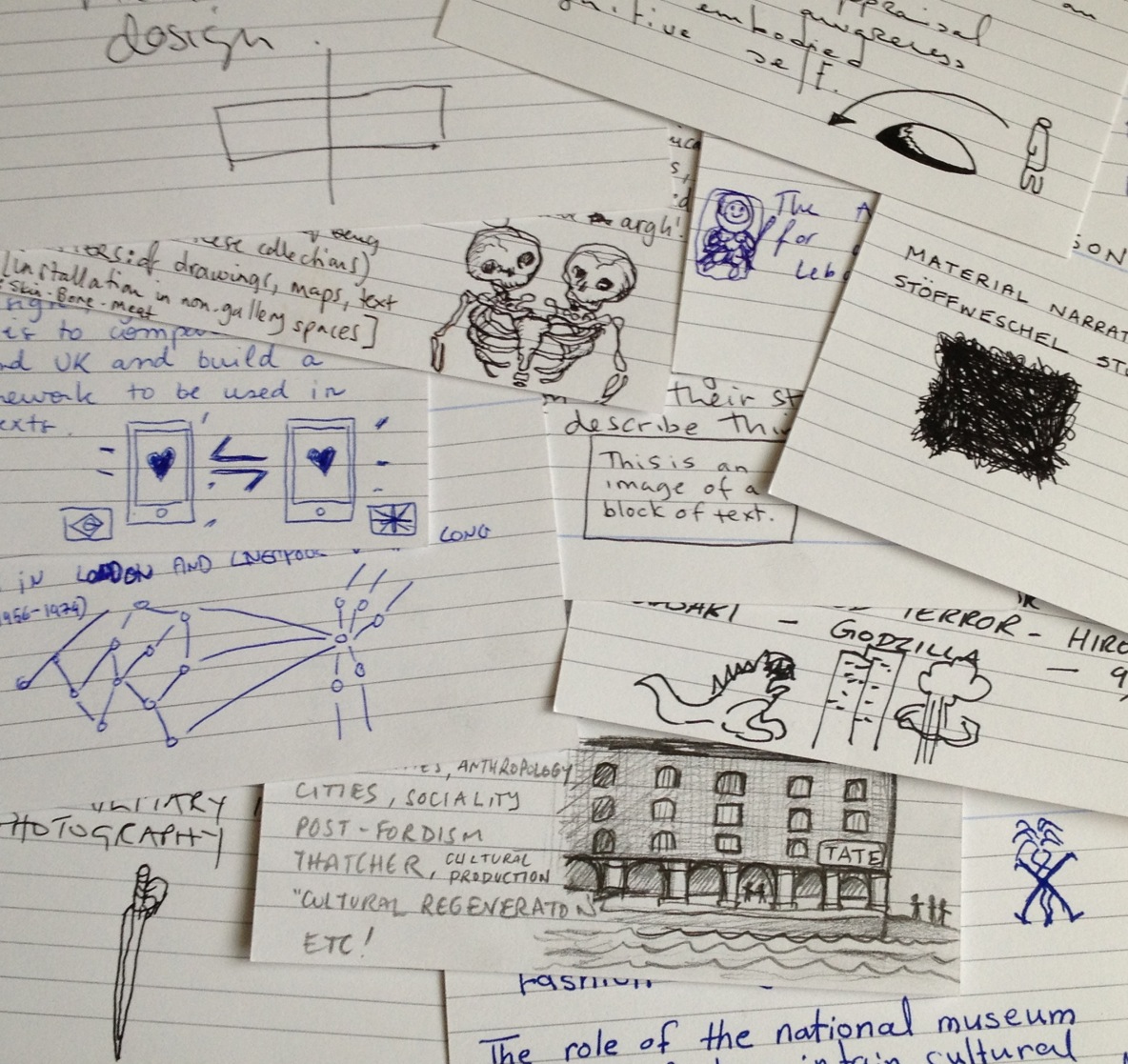
If you were asked to make a  sketch of your research interests what would you draw?

In the opening session of The Seminar, we began by first hearing each other’s research interests. We are all at different stages of our research, and inevitably there is a wide range of research projects. Interests span from material narratives (of Stöffweschel [stuff exchange]), the Arab-Muslim doll, interface designs, mapping remains, game designs, the geo-cultural mapping of cultural producers, units of description, the motif of the monster vis-a-vis incidents of terror and war, creative communities, display of traditional clothing, the changing face of masculinity, and much more besides… (it is quite a list!)

It was wonderful to hear everyone speak about their own research and subsequently to share in a debate around the nature of the PhD, and the different kinds of engagement and approaches we each reveal.  I was particularly interested to foreground the word ‘philosophy’ in the title PhD, i.e. a doctorate in philosophy. What is this ‘philosophy’ that we will all end up sharing in obtaining the PhD? It is not that we are studying the subject of philosophy (though some of us will dabble with this domain), but technically, we are all engaged in a form of philosophy, as in a mode of enquiry, investigation and contemplation.

I talked briefly about the origins of the Western philosophical tradition, which arguably still underpins institutional rhetoric today. Philosophy is the ‘love of wisdom’, and Socrates and Plato, for example, took it to be an underlying enquiry into what it is to lead a ‘good’ life. I wanted to suppose this remains a integral part of what we do when undertaking doctoral research. We’re not just interested in a singular problem (i.e. our research topic/subject matter), but a wider set of connections and relationships. We are placing our research in a communal intellectual space. It might not always feel like that when we are working alone on our writing, reading, making, thinking; indeed the PhD can be lonely at times and/or require good doses of solitude. Nonetheless, there is a continuum of intellectual practice that we are part of, which is the ‘philosophy’ named in our PhD.

Ancient Greek philosophy was interested in objects, those that remain the same (plants, animals, seasons, stars etc), and those that vary (language, customs, laws, politics). Today of course, much of what we once thought ‘remains the same’, have proved highly changeable, and we have created the means to change such objects through our investigations (for good or ill!). The physis (nature, that which is fixed) has proved just as complex and changeable as nomos (culture), but we could never have known these things without some kind of investigation and experimentation. Aristotle adopts the terms theoria (theory, contemplation) and praxis (practice) to evoke the idea: (1) of the intellects ability to ‘take hold of’ and categorise the world around us, and to articulate ideas about it; and (2) voluntary human activity, whereby we choose to alter what can be changed. Today, we can all too often hear of a divide between theory and practice, yet this would hardly seem to pertain to the curiosity and inventiveness of those early days of philosophy.

The reading I gave for this first session was the introductory chapter of Woodhouse’s ‘A Preface to Philosophy’, which is a slim ‘textbook’ for someone taking a philosophy degree. It struck me this prompted some useful debate. On the opening page, Woodhouse asks the question, ‘What is it that makes a certain question or claim philosophical?’. As he adds, this is not an easy question to answer. I think, however, it is a useful question to have in your research toolkit. What is it that makes your work ‘philosophical’? By which I mean, what is it that makes your work questioning, critical and reflective? Woodhouse offers his own definition: ‘Philosophical problems involve questions about the meaning, truth, and logical connections of fundamental ideas that resist solution by the empirical sciences’. This was inevitably – and rightly – met with quite a bit of challenge among those in the room.  I think we are all attuned to countering the very notion of fundamental ideas. But what are the galvanising Ideas that we rest our work upon? What happens if we seek to challenge these ideas?  Perhaps your work needs to be sustained by certain key – if not fundamental – ideas. For example, what do we each take to mean as ‘society’ and the ‘individual’, or the notion of ‘experience’? Psychoanalysis pertains to specific notions of the individual in a way that is very different to Marxism. When these combine, particularly in the work of the Frankfurt School (in the early twentieth century), we get further configurations and complexities. Perhaps you might be working between such terms. You need to think about what this might mean and where it takes you in your thinking; equally we need to consider how we can suitably present our ideas to account for such collisions and reconfigurations. Of course, it might be in challenging certain ‘fundamental ideas’ in our own research that we find things become unstable, unworkable even! …this can be disconcerting, yet it can also be the opening towards a whole new depth and breadth to the work.

A further problem arising from Woodhouse’s definition was the positioning against ’empirical science’. I think there is something attractive for the areas of art and design that philosophy is somehow seeking to go beyond the immediate, the visible, the uniformly testable. But, I think we were in danger at times in our conversation to allow an unnecessary division between art and science. We did discuss this directly, which helped us keep on track, but it raises an important point about the way in which ‘knowledge’ has been turned into specific discourses of knowledge. The chapter by Woodhouse might feel to many of us as too prescriptive, too logical. Yet, I hope it served to keep alive certain ways of understanding how we approach ‘philosophical’, or research problems. It is useful to define how different ideas, elements, and engagements do or do not bear equivalence. Woodhouse talks in terms of ‘assumptions’ and ‘consequences’, for example. How might we understand the logical or ‘argued for’ distinctions between various assumptions and consequences in our own field of study? At the end of the chapter, Woodhouse provides a little ‘shopping list’ of the divisions of philosophy, which include: logic, ethics, metaphysics, epistemology, aesthetics, politics, religion, science and history. These are rather ‘big’ terms, and I’m sure we’ll touch upon many of them in subsequent seminars, but for now it is perhaps worth keeping some of these terms to mind, to ask ourselves, not only what our research is about (and/or what it hopes to be about), but what kind of philosophy we bring to it, claim for it, and take from it…