Below you will find our schedule for the Winchester School of Art PhD weekly meetings, which will generally run from 2-4pm on Wednesdays, in person (PGR Office at WSA) and on MS Teams. The series consists of (guest) speakers, workshops, trainings, and other research- and practice-led events.
The working schedule will be updated here regularly.
For other Faculty and University wide events please see the central University events calendar: https://events.soton.ac.uk/
PhD Seminars will resume on 7th October 2026, but don’t forget to catch The Playful Monster conference, coordinated by WSA PGR Ruikang Wu, which will run in person and online Thursday 24 September and Friday 25 September 2026.
TUE
WED
THU
October
7 October 14:00-16:00 PhDSocial and Town Hall – discussing important business for the coming year [hybrid], PGR Meeting Room (East 3024) and online.
INDUCTION AND CAMPUS TOUR FOR NEW PGRs IMMEDIATELY BEFOREHAND.
14 October 14:00-16:00 Radical Friendship Reading Group / Workshop with Marie Theresa, Mara González González and Marina Castledine, building on from Japan partnership activities in 2025-26 [hybrid], PGR Meeting Room (East 3024) and online.
Tuesday 20 October PhD Crit (TBC)
21 October 14:00-16:00, The Great PhD Infrastructure Troubleshoot 2026 (talking about and taking questions on university systems from Pure to PGR Manager) with Megen de Bruin-Molé [hybrid], PGR Meeting Room (East 3024) and online.
28 October 14:00-16:00, WEDNESDAY MAKING / NO FORMAL SESSION
November
4 November 14:00-16:00, Life After the PhD: Joint Session with Early Career Colleagues [hybrid], PGR Meeting Room (East 3024) and online.
11 November 14:00-16:00, Progression Review Preparation with Megen de Bruin-Molé [hybrid], PGR Meeting Room (East 3024) and online.
Tuesday 17 November PhD Crit (TBC)
18 November 14:00-16:00, WEDNESDAY MAKING / NO FORMAL SESSION
25 November 14:00-16:00, WEDNESDAY MAKING / NO FORMAL SESSION
December
2 December, Potential PhD Symposium day
PhD Crit (TBC)
9 December, Potential PhD Symposium day
Winter graduation will take place between Tuesday 15 – Thursday 17 December 2026. After graduation we traditionally have a PhD social. This TBC pending the exact date and location of WSA graduation ceremony.
The winter closure period will be 24 December 2026 to Sunday 3 January 2027 (teaching and some university services will be suspended).
PhD Seminars will resume in late January or early February 2027.
As part of the PhD Seminar Series we will be joined on 14 October 2026 by the Radical Friendship and Listening and Reading Group, run by a group of doctoral researchers from other national and international institutions. Details of the session they will host for us below.
Anchored in the methodology collectively forged in the Radical Friendship and Listening and Reading Group, this session invites students to enter into a friendship with the group itself, thinking and working alongside it. The session creates conditions for students to assemble as peers and comrades, engaging with one another, with non-human relations, and with artworks and texts in ways that are responsive and experimental.
Drawing on Sara Ahmed’s scholarship into how bodies and spaces leave lasting impressions, the listening and reading group approaches friendship as a material, atmospheric, and political practice. Students are invited to consider how relations endure, shift, or dissolve, how connections persist beyond immediate encounters, and what traces remain – imprinted memories that linger from exhibitions, collaborative work, and shared durational processes.
Our practice is guided by:
The exploration of what makes a friendship radical – whether with each other, non-human relations, artworks, texts, across geographic and cultural boundaries, or through ethical, emotional, and political engagement
Staying in relation across difference – we do not seek consensus or sameness; we practice staying-with the complexities, uneven histories, and political ruptures that shape our interactions
Listening as praxis – emphasising listening as a political act that respects opacity and withholding, countering the demand for immediate resolution
Assembling a practice of solidarity – cultivating collective care and action within the contemporary, polarised conditions we find ourselves
Objectives of the session:
To explore how alternative ways of gathering can reshape how we relate to other subjects and non-humans opening up more reciprocal and productive ways of collaboration
To identify the political and ethical possibilities of friendship, including the conditions that enable its radical potential and its role as a site of solidarity, and collective care
To understand the temporality and spatiality of friendship, specifically how unexpected encounters and shared spaces allow for moments of radicality
To articulate a practice of radical friendship in contemporary contexts, including how it can be mobilized both as a form of care and as a political tool of exclusion
To understand affect as politically charged, identifying alternative or overlooked affects that are not only produced by social relations but also help shape them
Suggested readings for the session:
Hesse, Hermann. 1919. “Prologue” and “Chapter II: Cain.” In Demian: The story of Emil Sinclair’s youth.
Haraway, Donna J. (2016), ‘The Camille Stories: Children of Compost’, in Staying with the Trouble: Making Kin in the Chthulucene. Durham, NC: Duke University Press, pp. 134–168. For this session, please read pp. 149–150.
Methodology
The workshops draw from:
Transnational feminist and decolonial approaches to care and relation
Socially engaged art practice
Embodied, affect-based, and memory-informed methodologies
Collective reading, listening, and thinking together
Durational and iterative engagement, allowing practices to unfold across time
Collaborative and relational pedagogy, fostering dialogue across difference
Sessions will move through:
Reflective prompts
Open discussion
Listening practices
Embodied exercises
Accessibility Note – While the workshops are informed by philosophical, theoretical, and critical texts, no prior knowledge is required. These works act as thinking companions, sharing atmospheres that guide the group’s explorations of radical friendship and the lingering affects of the exhibition. Activities are curated to be responsive to difference, fostering brave spaces where students with diverse ways of sensing and thinking can participate, experiment, and reflect together.
Structure and approach for the session
In this session, we will work with a selection of texts, artworks, fragments, and questions that have accompanied the Radical Friendship Listening and Reading Group across its 2026 series. Thus, we will be responding to an unfolding archive, approaching them as traces of an ongoing collective process: materials that have gathered associations, disagreements, memories, and new questions through being encountered together.
Introduction
The session will begin by introducing the Radical Friendship group and sharing elements of its developing archive and mappings. Opening questions might include:
What might make a friendship radical?
What happens to our understanding of friendship when we think beyond the human?
How much do we need to know another being in order to move alongside them well?
Does friendship require mutual recognition or reciprocity?
How might friendship hold irreducible difference without attempting to overcome it?
What forms of attention are involved in learning another being’s ordinary?
What material practices – routines, spaces, infrastructures, gestures of care – allow relations to endure?
What remains when a relationship is temporary, interrupted, or changed by distance?
Activity 1: Citation Circle
Students engage with a small selection of quotes and moving images specifically from or in dialogue with the novel Demian (1919) by Herman Hesse. The novel follows the main character Emil Sinclair, a young boy raised in what is described as a Scheinwelt, a composite word meaning “world of illusion.” So he struggles to exist between two worlds: the show world of good and the world of evil. The story’s turning point occurs when he meets Max Demian. Demian reinterprets the biblical story of Cain and Abel in a completely new way.
The group is invited to:
Read aloud excerpts slowly, noticing what resonates or lingers
Trace atmospheres, tensions, and relational dynamics emerging from the material
Observe how citations enter into relation with each other and with their own embodied experience – forming unexpected alignments, frictions, and openings
Selected excerpts
“Yes. I believe, then,” he continued, “‘that this story of Cain can be interpreted differently. Most of the stories we are taught are valid. and authentic but it is possible to see them from another angle than that of the teachers’ and it gives them much more sense. You can’t feel satisfied with this Cain for example and with the mark on his forehead as they explain it to us. Don’t you agree? Someone may certainly kill his own brother in a quarrel, and he may panic afterwards and eat humble pie. But that he should be marked with a special “sign’ for his cowardice that acts as a kind of protection and inspires fear in everybody else is strange indeed.” (Chapter 2, 34).
“These thoughts went round and round in my head. It was a stone dropped to a well, and the well was my youthful soul. And for a long time this matter of Cain, the murder and the ‘sign’ formed an outlet for my attempts at recognition, my doubts and criticism.” (Chapter 2, 35).
“Now, I am fond of you or interested in you and I would like to discover what it’s like inside you. To do this I have already taken the initial step. I frightened you. You are therefore in a nervous state. How has that come about? You don’t need to be afraid of anybody.” (Chapter 2, 42)
“All I could do was to nod. It was like a voice which could only emanate from myself. A voice, indeed, that knew everything better and more clearly than myself.” (Chapter 2, 43)
Activity 2: Close Reading and Listening
From here, participants will be invited into a shared practice of close listening and reading. This activity will stay particularly close to two texts that open questions of friendship with the non-human: Marie Theresa’s experimental, poetic storytelling piece Dear Salvador and Donna Haraway’s Children of Compost.
Dear Salvador, written as a letter to a twenty-two-year-old cat cared for temporarily in Canada, considers companionship, care, leaving, memory, and the ways relations with animals gather people, places, routines, and forms of belonging around them. Haraway’s speculative writing extends questions of friendship and kinship beyond the human, asking what it might mean to make kin across profound difference and describing friendship and play as practices through which relations are continually formed.
Participants will spend time with particular passages, listening deeply to words, images, rhythms, hesitations, resonances, and points of friction between the texts. Alongside close reading, there will be an invitation to notice how the texts are encountered bodily: where attention gathers, where something catches or resists, how a sentence changes the atmosphere of the room, and what it might mean to listen to how a text breathes alongside the bodies present.
Participants may respond through discussion, silence, non-verbal responses, listening, writing, drawing, movement or simply spending time with a passage. They are welcome to pause, step out, return, or withhold a response. The emphasis is on creating conditions in which different modes of attention and participation can coexist, allowing affects to gather slowly rather than requiring consensus, resolution or immediate legibility.
Activity 3: Leaving & Listening Practice
Ending with a short grounding exercise (feet on floor, breath, posture). A brief excerpt is read aloud, and students are invited to share three words or phrases that linger. This reinforces listening and solidarity as ongoing, shared and embodied practices, extending beyond the workshop and the exhibition.
An open invitation
These same materials – “Dear Salvador” and “Children of Compost” – will also form the basis of the October 2026 online meeting of the Radical Friendship Listening and Reading Group, which will take place after the PhD session. While these two texts provide a focus for this particular encounter, the group’s wider practice is always relational, with multiple texts, artworks, fragments, and questions continuing to gather around one another across different sessions.
PhD students will be invited to join the October online gathering if they wish. Those who would like to become more actively involved will also be invited to co-facilitate the session alongside Marie Theresa, carrying questions and resonances from the PhD workshop into the wider Radical Friendship group.
The invitation also extends beyond this particular gathering. Participants who are interested in continuing with the group may join future online sessions and, if they wish, host a gathering themselves, bringing a text, artwork, fragment, question, or other material they would like others to think with, in relation to radical friendship. In this way, the PhD session becomes not only an introduction to the group, but a possible entry point into its ongoing collectively shaped practice.
Background of Current Radical Friendship Listening and Reading Group
The Radical Friendship Listening and Reading Group meets monthly online, bringing together participants from across the world. Each session is assembled around a text, artwork, fragment, or other resonant material shared by the host. Encounters are open-ended: participants may join or leave as they wish, and there is no expectation to contribute at any particular moment. Over time, the group has begun building an archive of the shared texts, and visual fragments, preserving the “threads” and “textures” that arise in each gathering.
The group was formed to hold and cultivate connections emerging from academic, artistic, and everyday encounters – often unexpected, fleeting, yet deeply generative. Drawing on transnational feminist practices and the work of Stefano Harney and Fred Moten, the group approaches friendship not as a fixed or harmonious state, but as something continually made and remade through collective attention and care.
For Harney and Moten, study names what we do with one another in and against the structures of the university: lingering in conversation, thinking and feeling together without the demand for immediate productivity, measurable outcomes, or legibility. The group treats radical friendship as a fugitive form of study – a way of gathering that does not aim to consolidate a “we” or resolve differences, but to remain in relation across uncertainty, discomfort, and uneven histories.
Radical friendship, in this context, is a practice of staying alongside one another while allowing space for opacity, silence, and partiality. It is a listening without extracting, spending durational time with texts, artworks, and fragments, and attending to the subtle resonances they generate. In the atmospheres of increasingly polarised and hostile environments – both within academia and on the world stage – the group asks how we might remain in relation differently, cultivating small undercommons of attention, care, and shared air that endure without requiring resolution.
Facilitation
The workshops have been structured by three members of the Radical Friendship Listening and Reading Group, while remaining deeply collaborative, drawing on the group’s participants from across the works – including Canada, South America, Central America, Europe – and from a wide range of disciplines, academic contexts, and artistic practices. The workshops mirror the exhibition’s collaborative ethos, reflecting the diverse perspectives and collective creativity that shape the MA Digital Media projects across their specialised strands.
Marie Theresa CrickMarie Theresa Crick is a Visiting Lecturer, interdisciplinary artist, and PhD candidate in Visual Cultures at Goldsmiths, University of London, currently based in Ireland. Her practice explores breath, memory, and relationality through transnational feminist and embodied methodologies, working across film, sound, philosophy, and socially engaged workshops. Her research focuses on Irish Catholic maternal shame, migration, and transgenerational trauma, developing breath-led approaches attentive to silence, rupture, and ethical relation. https://www.mtcdigitalcreative.co.uk/
Her work has been presented across academic, artistic, and community contexts in Europe and Canada, including Western University’s Centre for the Study of Theory and Criticism. She presented at the 10th Annual Memory Studies Association Conference (2026, Buenos Aires). Her sound work for Radio Elsewheres (re.03) was recently exhibited at Art Windsor-Essex (2025). She is contributing as an artist to one funded project in Germany, the 2026-27 Kreuzungen- Intersections festival.
Mara González González is a doctoral candidate at the Centre for Theory and Criticism at Western University. She graduated with honors from Universidad de Monterrey (UDEM) with a Bachelor’s in Philosophy in 2020. Her research engages with Memory Studies, Trauma Studies, and Critical Beauty Studies. In November 2021, a sample of her poems was published by Los Libros del Perro in the anthology Novísimas II: Reunión de poetas mexicanas.
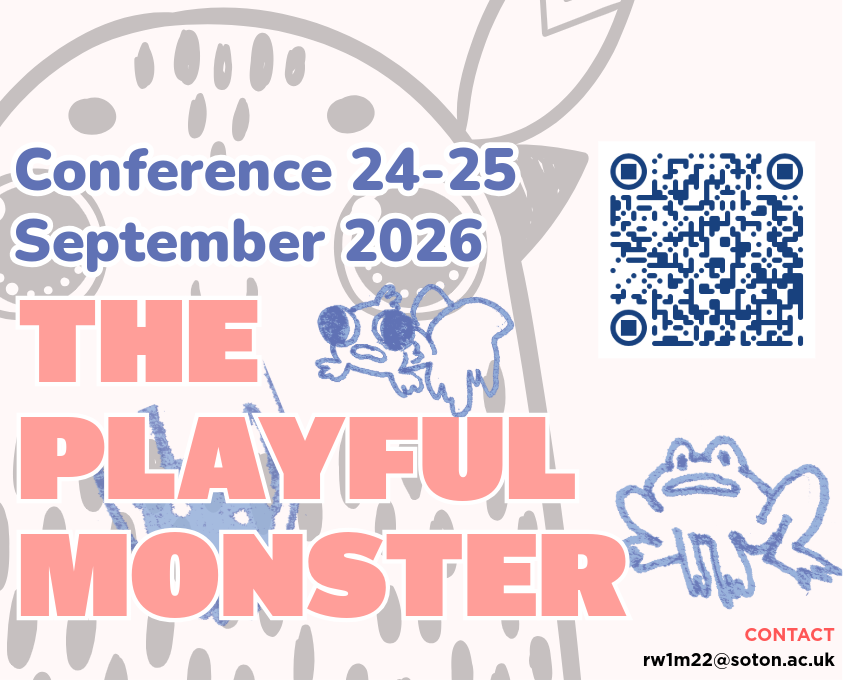
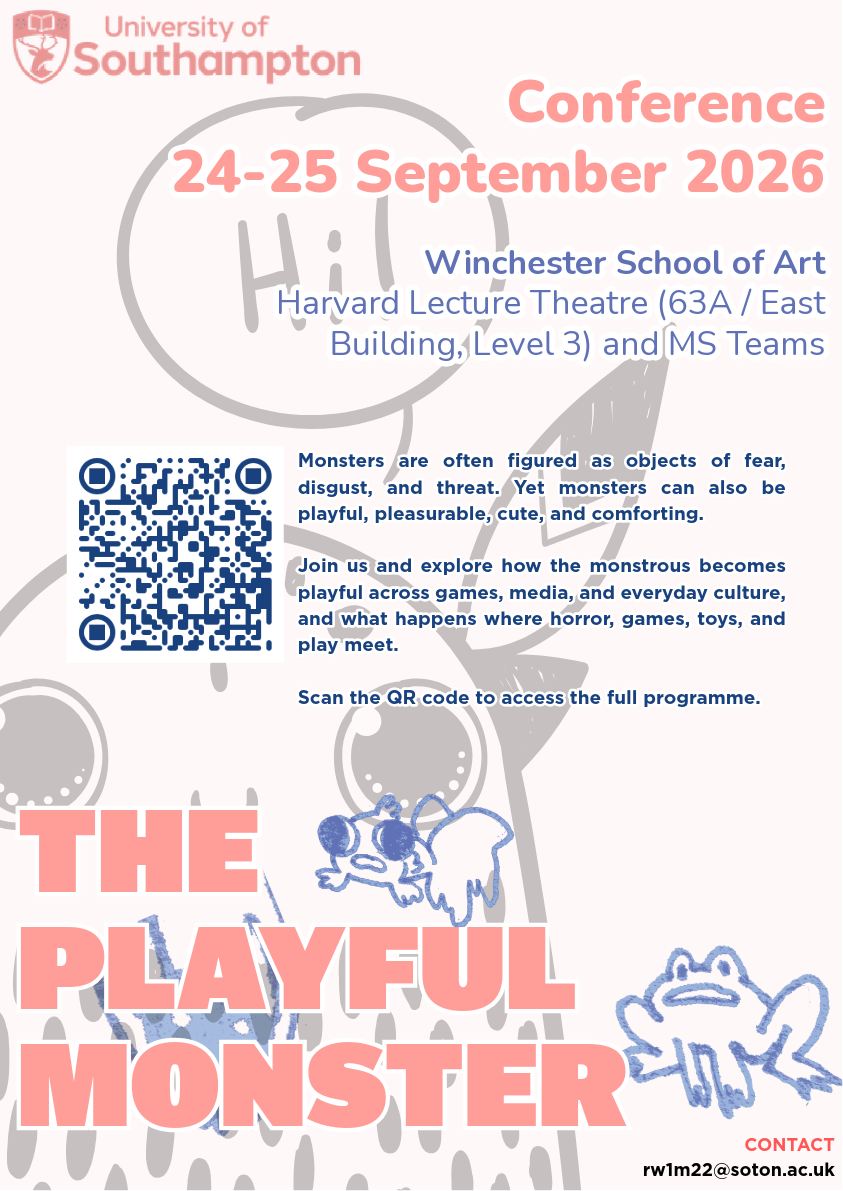
Monsters are often figured as objects of fear, disgust, and threat. Yet monsters can also be playful, pleasurable, cute, and comforting. Join us and explore how the monstrous becomes playful across games, media, and everyday culture, and what happens where horror, games, toys, and
play meet!
Thursday 24 and Friday 25 September 2026 British Summer Time (BST, UTC+1)
Winchester School of Art, Harvard Lecture Theatre (63A / East Building, Level 3) and MS Teams. Full programme below.
Thursday 24 September — Harvard Lecture Theatre (WSA 63A / East Building, Level 3) and Online
09:30–10:00 Welcome and opening
10:00–11:00 Keynote Address
Ewan Kirkland
Monstrosity and Modernity: Contained, Categorised and Captured Monsters in Video Games
09:30–11:00 Monstrous Bodies, Childhood and Material Culture
09:30–09:45 Jacinta Dietrich and Tess Ezzy — Monstrous Children: The Monster as Neuronormative Transgression
09:45–10:00 Tianni Xu — Topophilia, Topophobia, and Monstrous Embodiment: The Kowloon Walled City in Paranormal HK
10:00–10:15 Ece Arıhan and Balım İslamoğlu — Cute Has Teeth: Fugglers and the Semiotics of Kimo-Kawaii
10:15–10:30 Dalia Mostafa Abdulrahman — Playable Death: Mummies, Safe Corpses, and Children’s Literature
10:30–11:00 Panel discussion and audience Q&A
11:00–11:15 Tea break
11:15–12:30 Game Systems, Miniatures and Playable Monstrosity
11:15–11:30 Wenqing Nan (Selina) — Growing Decay in Your Palm: Playing with Nurgle Monsters from Warhammer 40,000
11:30–11:45 Yaraslau I. Kot — Interactive Exorcism: The Grotesque Transformation of Aggressors into Playful Monsters and Monster Metaphors as Trauma Processing in Ukrainian Wartime Games
11:45–12:00 Thomas Apperley, Will Hill, Ville Kankainen, Jukka Särkijärvi and Ian Sturrock — The Art of the Monstrous: The Divided Visual Cultures of Early Tabletop Role-Playing Games
12:00–12:30 Panel discussion and audience Q&A
12:30–13:30 Lunch
13:30–15:00 Digital Horror, Intimacy and the Uncanny
13:30–13:45 Jiang Luyin — Why We Need the Monster at Arm’s Length: Playful Intimacy and the Afterlife of Horror
13:45–14:00 Christina Fawcett — Cozy Horror and Playing the Uncanny
14:00–14:15 Gregory Blomquist — Confronting the Unknowable: The Reapers and Sublime Monstrosity in Mass Effect
14:15–14:30 Elena Martín-Gil — Enemies to Lovers: Evolution of Vampire Tropes and Emergence of the Charismatic Vampire
14:30–15:00 Panel discussion and audience Q&A
15:00–15:15 Tea break
15:15–16:45 Domestic Monsters: Family, Desire and Affect
15:15–15:30 Kristine Ask and collaborators — Fear, Thirst, and Fan Culture: The Erotic Appeal of Game Monsters
15:30–15:45 Scott Ennis — From Closure to Play: The Emergence of the Playful Monster in Modern Children’s Literature
15:45–16:00 Noah Borgen — Playing Angry Dad: Dysregulated Fatherhood, Safe Fear, and the Family Practice of Declawed Reactivity
16:00–16:15 Phoebe Santillan — When Monsters Become Desirable: Erotic Attraction and the Pleasures of the Monstrous
16:15–16:45 Panel discussion and audience Q&A
Please contact conference organiser Ruikang Wu with any questions: rw1m22@soton.ac.uk
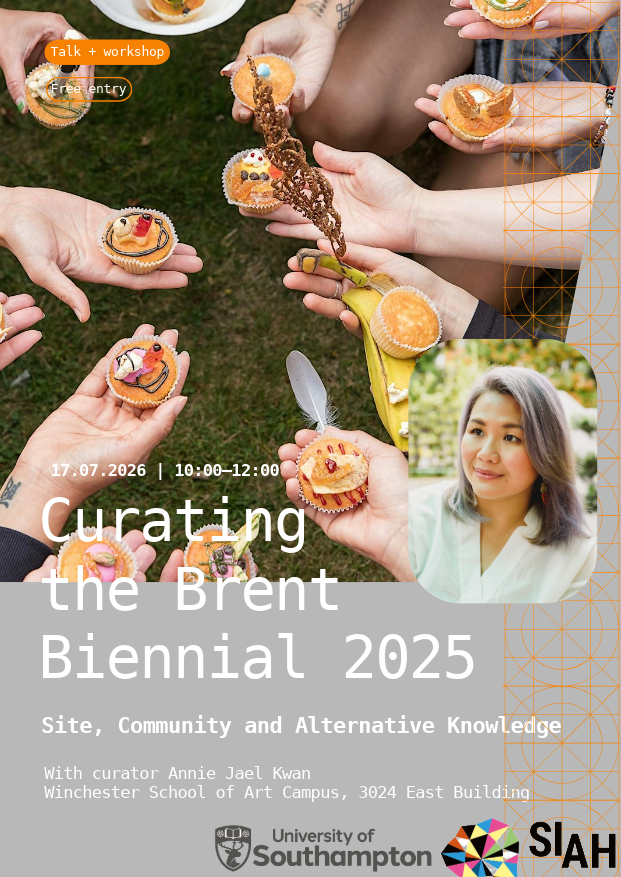
The Southampton Institute for Arts and Humanities, together with Winchester School of Art’s PhD Programmes, is excited to present ‘Curating the Brent Biennial 2025: Site, Community and Alternative Knowledge’, a talk with independent curator and visiting PhD researcher Annie Jael Kwan.
This talk will take place on Friday, 17th July from 10:00-12:00 in the WSA PGR Room (East 3024) and on MS Teams, in hybrid format. All welcome.
This lecture offers an in-depth account of the curatorial methodology underpinning the Brent Biennial 2025, examining how a commitment to place, process and collective imagination can shape an alternative model of biennial-making. Responding to specific sites across the London Borough of Brent, the curatorial framework draws on the four classical elements — earth, water, fire and air — as generative lenses for exploring material, metaphor and methodology, and for centring plural and non-Western knowledge systems.
Central to this approach is a two-stage structure: Divinations, a relational pre-programme phase that develops trust and shared vision with local organisations and communities, and Rituals, a public-facing series of live events, assemblies and collaborative encounters. The lecture critically reflects on how this model resists the logic of spectacle in favour of gathering and exchange, and considers the practical and ethical dimensions of fundraising across local and international contexts.
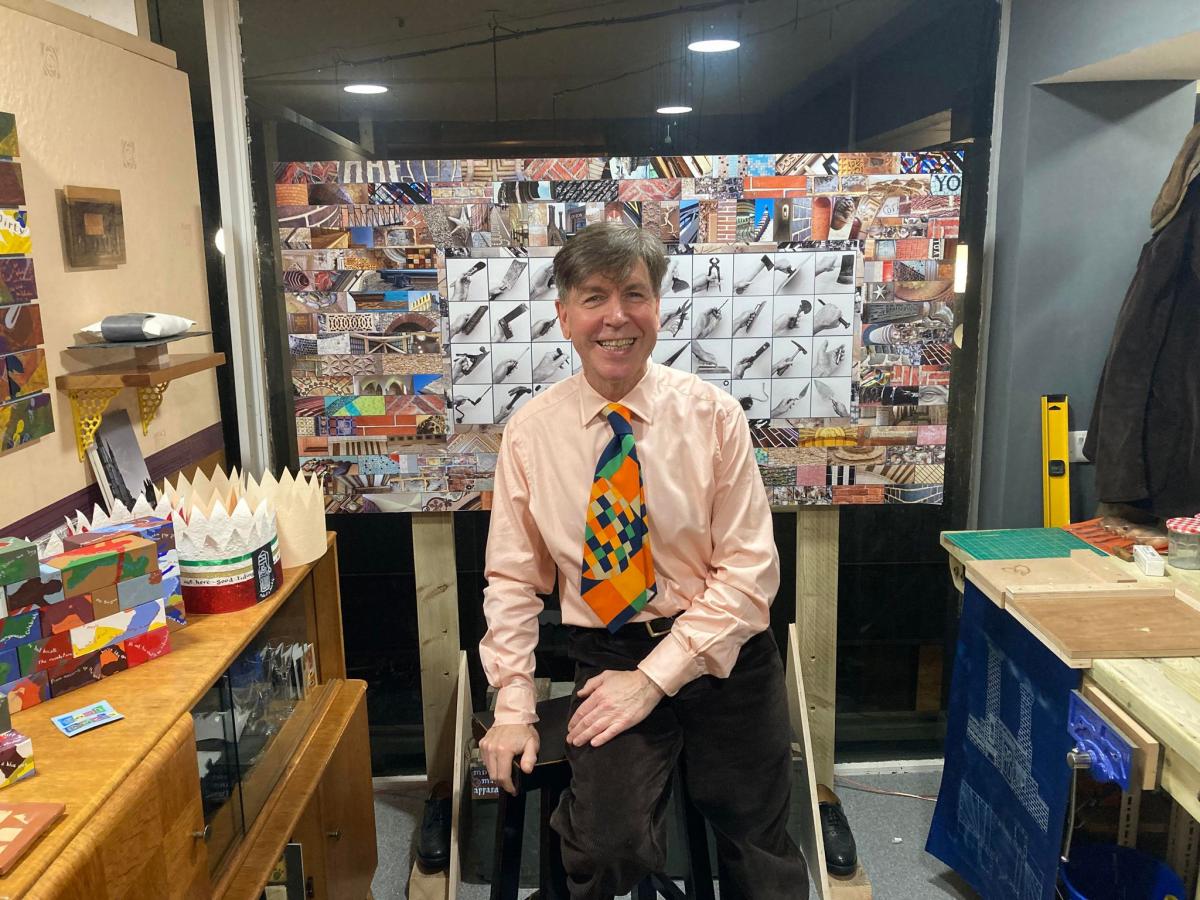
Annie Jael Kwan is an independent curator, researcher and educator whose exhibition-making, programming, publication and teaching practice is located at the intersection of contemporary art, art history and cultural activism, with interest in archives, feminist, queer and alternative knowledges, collective practices, solidarity, sisterhood and spirituality. She is currently undertaking PhD research in Liverpool.
Building from the May 2025 doctoral researcher workshop on impact and engagement, this workshop will focus on understanding and positioning your research impact as part of your professional development. As the ‘engagement, influence and impact’ section of PGR Development says:
Understanding how to communicate your research clearly, collaborate with wider communities, and generate meaningful impact is an essential part of doctoral‑level development.
We will explore how to understand, identify, and narrate the impact your research might generate, and how this connects with professional development goals and frameworks (including the Vitae Researcher Development Framework). The workshop will be structured around activities enabling you to understand contemporary research contexts and environments, reflect on your research and advance your professional development goals.
For those who did not participate in the May 2025 or would benefit from a reminder, the slides are available on the WSA Impact and Engagement site.
Prof Daniel Ashton is the Professor of Cultural and Creative Industries in the Department of Art and Media Technology at Winchester School of Art at the University of Southampton. His teaching and research focus on cultural and creative industries organisations, work and policy, and digital media technologies. Research in these areas has been presented internationally, published in academic journals, and shared in online videos and articles. He is a PhD supervisor and support postgraduate researchers with their teaching professional development. He has worked in partnership with a range of organisations on public exhibitions, teaching initiatives, and research projects.
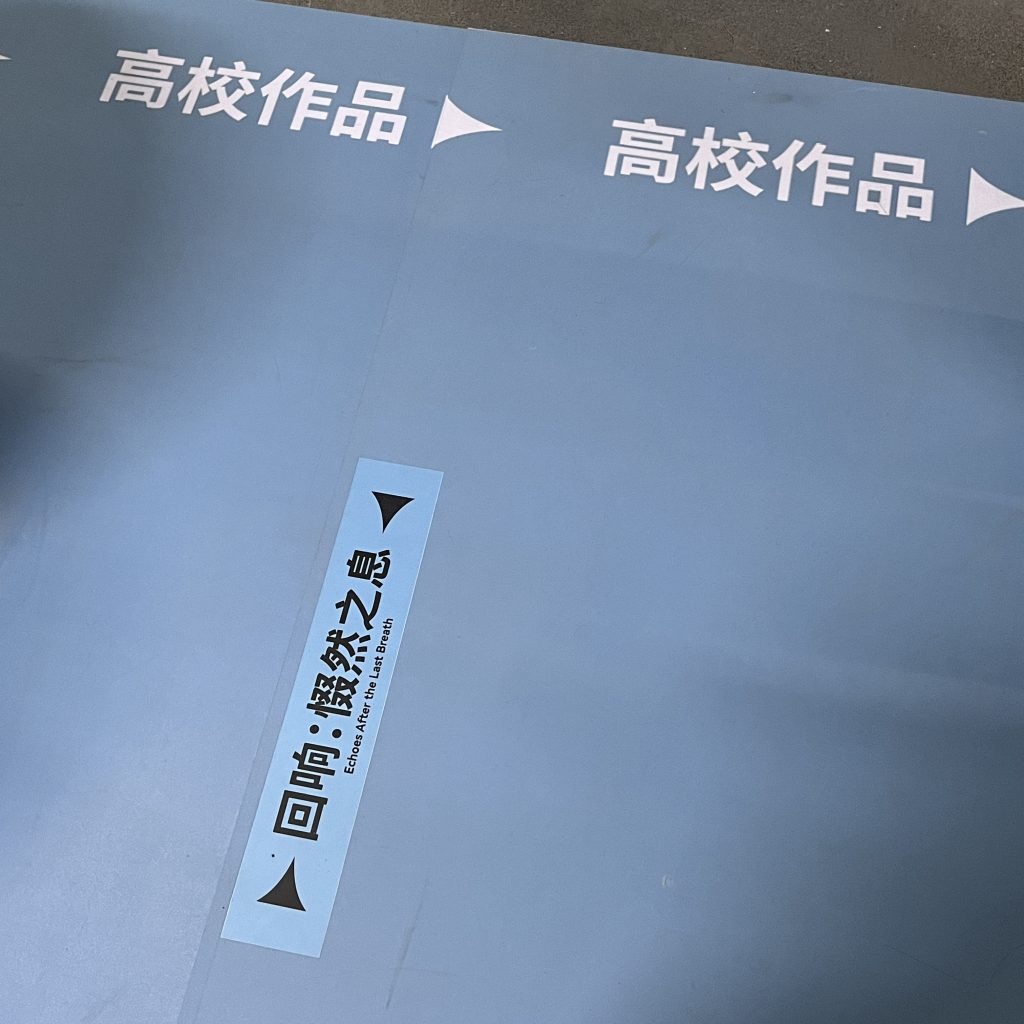
A virtual reality (VR) project developed by WSA postgraduate researchers (PGRs) has been shortlisted at the Beijing International Film Festival, one of Asia’s leading platforms for immersive media.
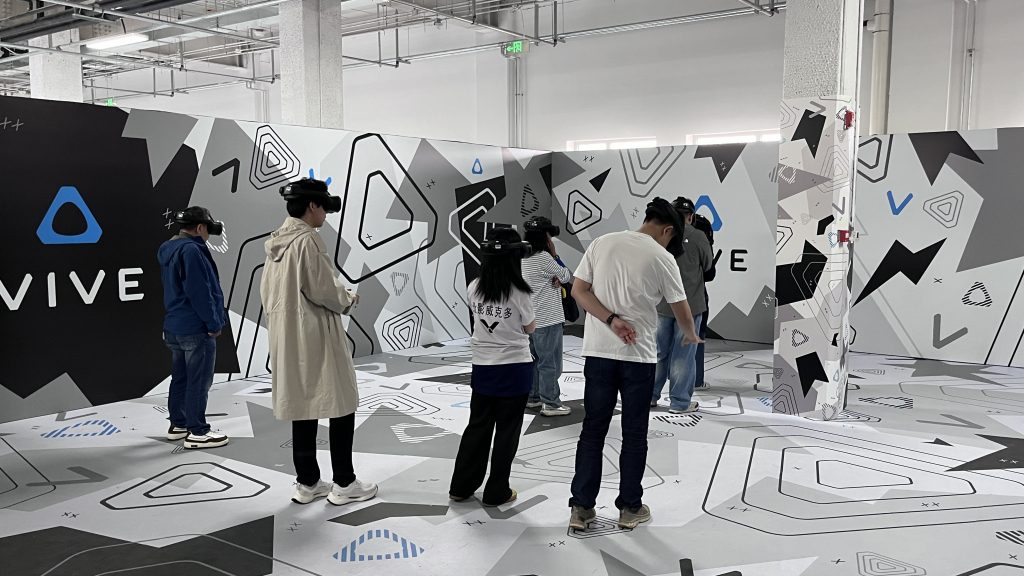
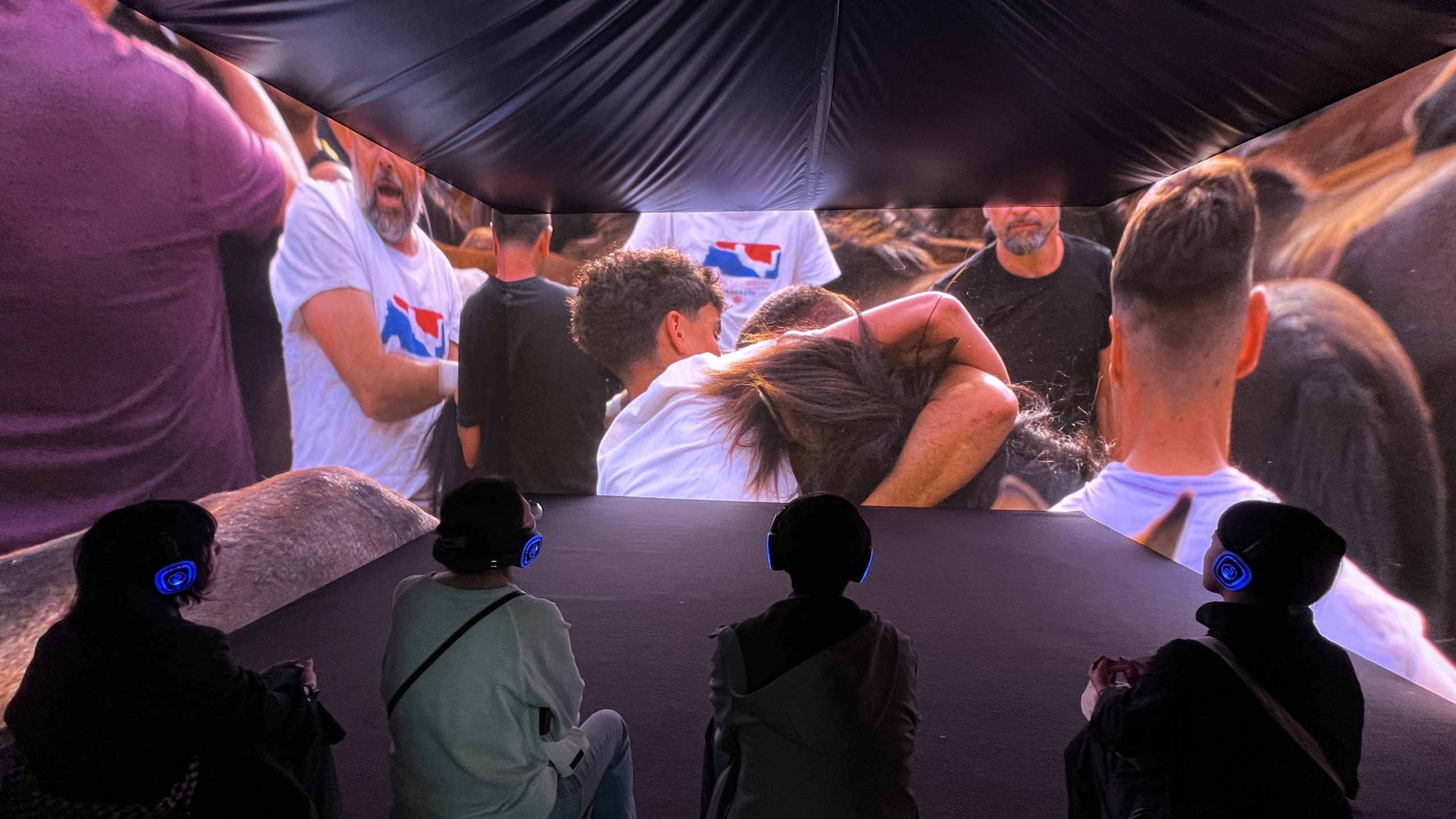
“Echoes After the Last Breath: A Gamified Gaze-Driven VR Near-Death Experience” by Yimeng Li, Weigan Zhang, and Xinyu Zhang was selected for exhibition at the 16th Beijing International Film Festival (BJIFF) “Boundless ∞ Immersive Unit.” In April 2026, Weigan and Yimeng attended the festival in Beijing, where the project was exhibited and presented to audiences alongside a wide range of international immersive works.
Yimeng Li and Weigan Zhang attending the 16th Beijing International Film Festival in Beijing.
Echoes After the Last Breath at the BJIFF Boundless ∞ Immersive Unit.
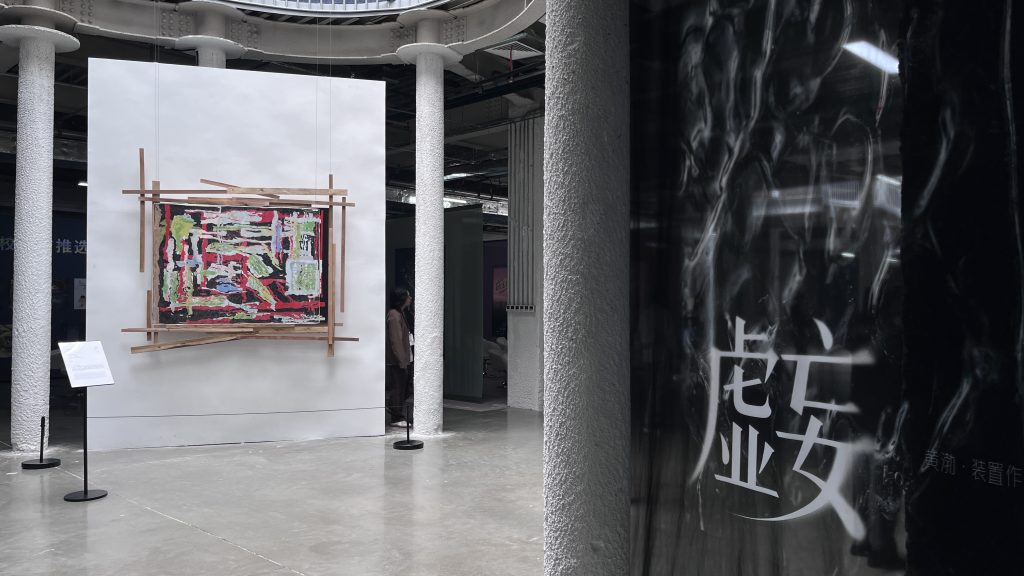
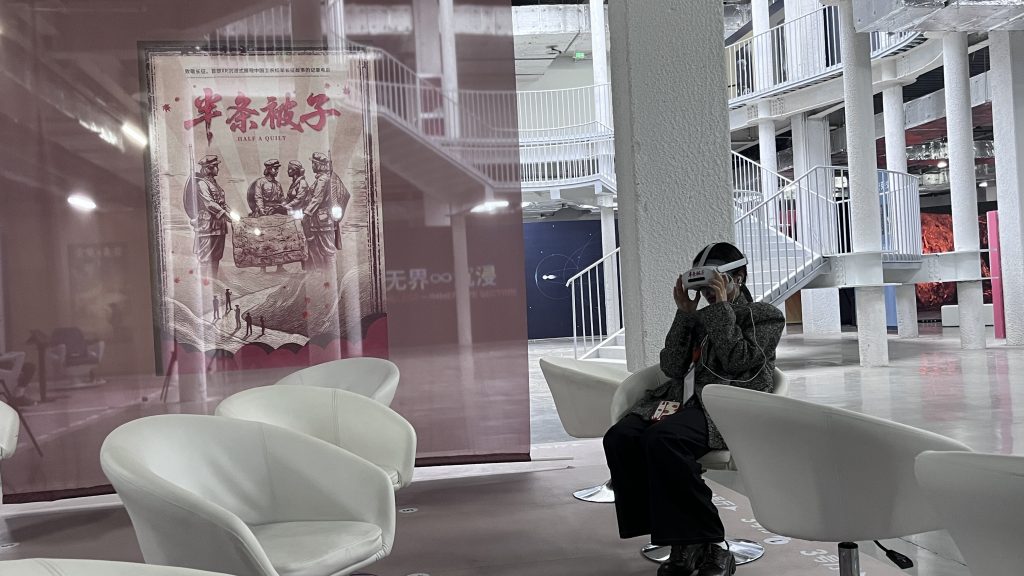
Exhibition views from the BJIFF Boundless ∞ Immersive Unit
Exhibition views from the BJIFF Boundless ∞ Immersive Unit
Exhibition views from the BJIFF Boundless ∞ Immersive Unit
“Echoes After the Last Breath: A Gamified Gaze-Driven VR Near-Death Experience” is an immersive interactive experience that explores memory and emotional resonance through spatial storytelling and sensory interaction. Presented within the context of emerging immersive cinema and interactive media, the work invited audiences to engage with the experience in a personal and reflective way.
The “Boundless ∞ Immersive Unit” is one of BJIFF’s major immersive sections, focusing on VR, AR, MR, installation art, and spatial media experiences from around the world. Under this year’s curatorial theme, “Entering Cinema Through Play”, the exhibition explored how audiences can experience storytelling beyond the traditional screen through interaction, embodiment, and participation.
Exhibition views from the BJIFF Boundless ∞ Immersive Unit
Weigan and Yimeng said: ‘During the exhibition, we had the opportunity to connect with many other immersive media creators and projects, exchanging ideas about storytelling, technology, and audience experience. We were also very happy to see so many visitors engage with our project. The audience shared a great deal of thoughtful feedback, encouraging responses, and useful suggestions for future improvements, which were incredibly valuable for us as creators and researchers. This experience was a wonderful opportunity for our team, and we are especially proud that the work of PhD students from the University of Southampton could be presented to a wider international audience through the Beijing International Film Festival.’
Below you will find our schedule for the Winchester School of Art PhD weekly meetings, which will generally run from 2-4pm on Wednesdays, in person (PGR Rooms at WSA) and on MS Teams. The series consists of (guest) speakers, workshops, trainings, and other research- and practice-led events.
The working schedule will be updated here regularly.
For other Faculty and University wide events please see the central University events calendar: https://events.soton.ac.uk/
TUE
WED
THU
January
28 January 12:00-14:00 NewPhDs Induction and campus tour, followed by PhD/ECC Start of Term Social @ 14:00-16:00 [in person], PGR Meeting Room (East 3024)
February
4 February 14:00-16:00 PhDTown Hall – discussing important business for the coming year[hybrid], PGR Meeting Room (East 3024) and online
11 February 11:00-13:00 PhD Crits Rezia Wahid and Qixuan (Fay) Wu [in person], Sculpture Studio
AND
14:00-16:00 Practice-based research skills session with Prof Teresa Dillon [hybrid], PGR Meeting Room (East 3024) and online. Teresa Dillon is a self-taught artist and curator who draws on methodologies from psychology, social science and the performing arts.
18 February 14:00-16:00, PhD WriteLab [hybrid], PGR Meeting Room (East 3024) and online
25 February 14:00-16:00 Letterpress workshop with Andy Reaney in preparation for Into the Fold, WSA’s artists book and zine festival (6-7 March) [in person only, max 6 participants], Printmaking Workshop (1023 East, WSA)
March
4 March 14:00-16:00 Zine and book-making workshop with Dr Megen de Bruin-Molé in preparation for Into the Fold, WSA’s artists book and zine festival (6-7 March) [hybrid], PGR Meeting Room (East 3024) and online
17 March 14:00-16:00 PhD Crits [in person], Sculpture Studio
18 March 14:00-16:00, PhD WriteLab [hybrid], physical location TBC
25 March 14:00-16:00, Design Research Methods with Dr Daniel Cid (Head of Research Design Department) [hybrid], PGR Meeting Room (East 3024) and online. A session focused on the idea that, in a way, we all design, and this potential can be transformed as an ongoing rehearsal for what more sustainable ways of living could be.
EASTER BREAK 30 MARCH – 24 APRIL
(teaching and some university services will be suspended)
TUE
WED
THU
April
14 April 14:00-16:00 PGR Student Crit Workshop with Elissa Wang and Rui Cai [in person], Sculpture Studio (East Side). The work will remain up through Weds 15th and Thursday 16th April.
29 April 14:00-16:00, PhD WriteLab [hybrid], physical location TBC and online
May
6 May 14:00-16:00 Learning to Teach: Reports and Reflections from SoTeach3 with PhD teachers and Megen de Bruin-Molé [hybrid], PGR Meeting Room (East 3024) and online
13 May 14:00-16:00 PURE online profiles workshop with Megen de Bruin-Molé [hybrid], PGR Meeting Room (East 3024) and online.
20 May 14:00-16:00, Progression review preparation session (leader TBC) [hybrid], PGR Meeting Room (East 3024) and online
26 May 14:00-16:00 PGR Student Crit Workshop with Susan Francis and Jingnan Bian (Bianca) PGR Meeting Room (East 3024) and online
27 May 14:00-16:00, PhD WriteLab [hybrid], physical location TBC and online
June
10 June 14:00-16:00,PhD WriteLab [hybrid], physical location TBC and online
23 June 14:00-16:00 PGR Student Crit Workshop with Zhiyu Guo (Zoe) and Glauco Adorno, location at WSA TBC (please contact David Birks)
17 June 14:00-16:00, ‘Creating and narrating impact’ workshop with Dan Ashton, focus on developing PURE profiles [hybrid], PGR Meeting Room (East 3024) and online
WSA Summer Graduation will take place at 10am on Monday, 20 July 2026 in Winchester Cathedral. Following this, at around 12pm there will be a formal reception on the Cathedral grounds for staff and PGRs. There will then be a PhD celebration, lunch, and social at The Willow Tree from around 1pm. Please RSVP here.
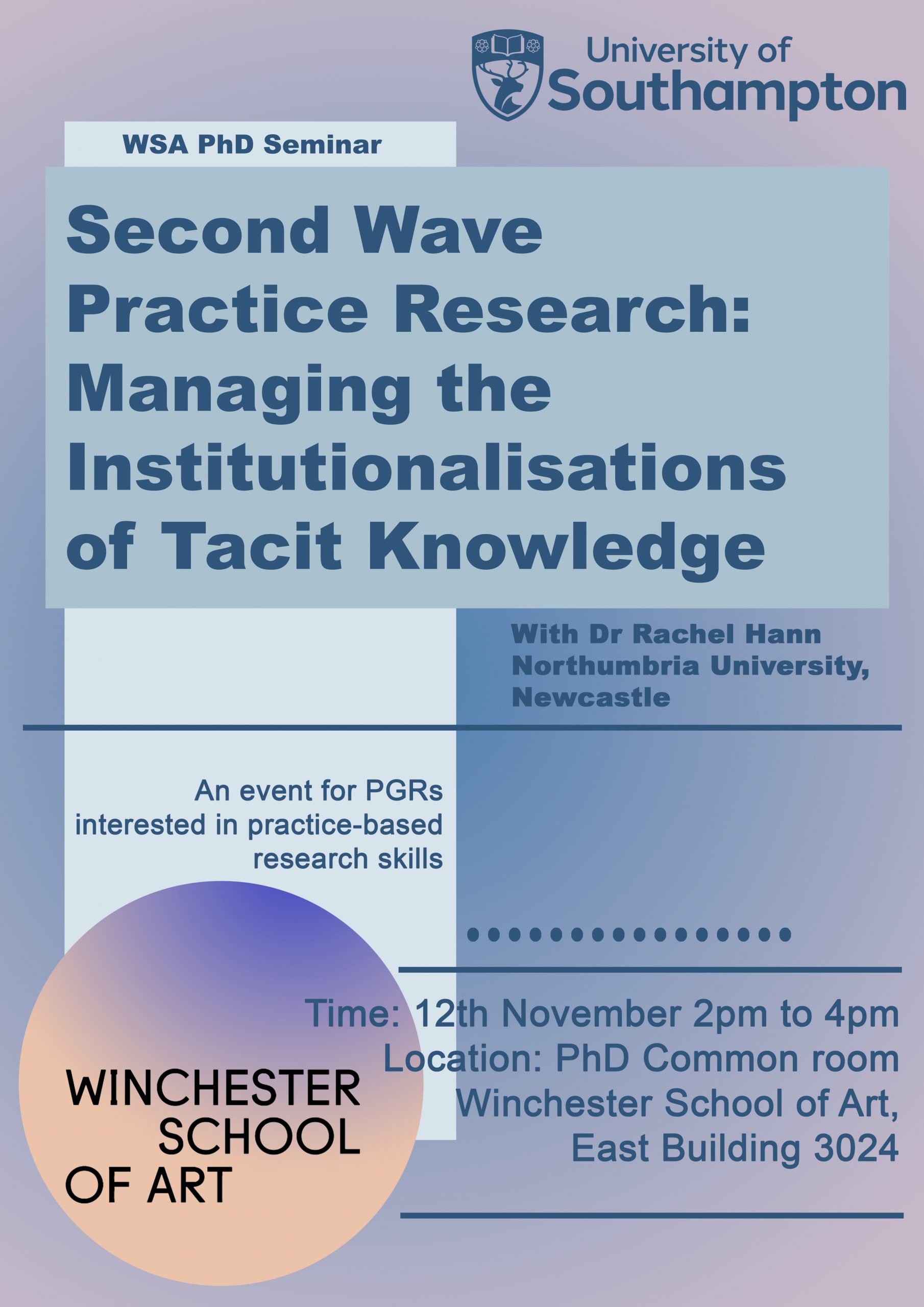
On 12 November, the WSA PhD Seminar is excited to welcome Dr Rachel Hann (Northumbria University, Newcastle), who has extensive experience with practice-based research across Fine Art, Design, and Fashion/Textiles.
Dr Hann’s talk will be on ‘Second wave practice research: managing the institutionalisations of tacit knowledge’ The main concern of what Dr Hann proposes as the ‘first wave’ of Practice Research was to win the right to conduct research through practice from the administrators (university management, HEFCE). The end game of this perspective was, she argues, that it sustains a culture where Practice Research is conducted for the purpose of administration: for evidencing an individual’s research profile to be assessed holistically, by exercises such as the REF. We now need to move beyond the administrative focus of Practice Research, however. Dr Hann is part of a movement suggesting a ‘second wave’ of arts research practice. This talk and subsequent discussion will lay out some strategies and examples for managing the institutionalisations of tacit knowledge, and skills for navigating a practice-based PhD within these institutions.
Dr. Rachel Hann is Associate Professor in Performance and Design at Northumbria University, Newcastle (UK). She researches material cultures of scenography, transness, and climate crisis. Rachel is the author of Beyond Scenography (Routledge 2019) and co-founder of the research network Critical Costume. From 2024-2025, she was PI for an AHRC Fellowship entitled Trans Performance Now. Rachel is also a former Chair of the Theatre and Performance Research Association, a member of the AHRC Peer Review College, and a curator for the Prague Quadrennial 2027. Rachel has examined 11 PhDs as external and supervised 11 to completion.
This session will take place in person in the PhD Common Room (WSA East Side 3024) and online.
It has been so wonderful to see PGRs taking the initiative to develop a more collaborative research culture at our beloved WSA. Having a safe space and the opportunity to learn from each other and explore and challenge our ideas are very valuable for developing our competencies as researchers as well as for our own research.
This time, we would like to acknowledge David Birks, who has been working very passionately to present us with PhD crits. PhD Crits is a regular (biweekly) 2-hour workshop where a practice-led and a theory-based PGR from different stages of the research process (early, mid, and final) present their art/design research process and findings to gain action-orientated feedback from fellow PGRs and experts, such as Stephen Cornford and Megen de Bruin-Molé.
The structure of the workshop is specifically designed to facilitate a positive and critical peer learning environment to help both the presenters and participants be more aware and appreciative of each other’s research, to be comfortable in raising questions and answering them, and to learn more about various research philosophies/methodologies, approaches/methods, analyses, and effective ways to present our research. To facilitate effective engagement, this workshop will be an on-site and PGR-only event.
Therefore, we would like to encourage all WSA PGRs who live in and outside of Winchester to come and attend these events in person. Furthermore, we would love to have fellow PGRs that share similar research topics or approaches with the speakers to come and actively engage in the open dialogue sessions to co-create a productive workshop.
The PhD Crits will be a valuable complement to our regular Wednesday PhD Sessions, WriteLab, Design Research Methodologies and Methods, and Interdisciplinary Collaboration Working Group.
It is with great pleasure that we invite you to attend the launch of the 1st WSA PhD Crits that will be held on:
Date : 28th October 2025
Time : 1 to 3 PM
Venue : Right-hand Installation Space (back end of the Sculpture Studio)
Introducing our speakers:
Weigan Zhang [Practice-based research]
PhD research title: “An Artistic, Practice-Based Inquiry into Digital Memorialisation:Visual Reality as an Empty Machine for Reshaping Memory and Mourning”
Supervisors: Dr Alexandra Anikina, Dr Emma Reay and Prof Seth Giddings and Dr Ruohan Tang.
Abstract:
This study explores how VR can function as an ethical and reflective medium for digital memorialisation. In response to the rise of the “digital afterlife” industry, the project proposes the concept of the Empty Machine—treating VR as an open, participatory field for co-creating meaning around loss and memory. Through research-creation and participatory co-design, I’m developing a speculative VR prototype that invites users to navigate fragmented, polyphonic memories, fostering reflection and dialogue rather than simulation.
Li Xu (Visiting Postgraduate Research Student from China) [Theory-based research]
PhD research title: “The Afterlife of Nucleic Acid Testing Booths: Assembling Post-Pandemic Urban Infrastructure”
Supervisors: Jussi Parikka and Ryan Bishop
Abstract:
This article examines the lifecycle of nucleic acid testing booths in China, a form of data infrastructure that became ubiquitous during the COVID-19 pandemic. While scholarship has addressed datafication and the politics of pandemic control, the material afterlife of such infrastructures — particularly their abandonment and reuse — remains underexplored. Drawing on fieldwork in Wuhan between December 2023 and September 2025, this study traces how these booths underwent territorialization, deterritorialization, and reterritorialization as public health policies shifted. Using assemblage theory and infrastructure studies, it conceptualizes the booths as a case of post-pandemic infrastructural adaptation that reveals the volatility and plasticity of short-cycle urban systems. Once integral to data collection and pandemic governance, the booths were rapidly decommissioned, generating both spatial friction and infrastructural waste. Yet many were reassembled into community kiosks and other shared facilities through grassroots initiatives. This reterritorialization highlights the agency of local actors who reconfigured abandoned digital infrastructures to meet evolving socio-spatial needs. The study advances urban theory by foregrounding the afterlife of temporary infrastructures, contributing to debates on urban resilience, waste politics, and community governance in post-pandemic cities.
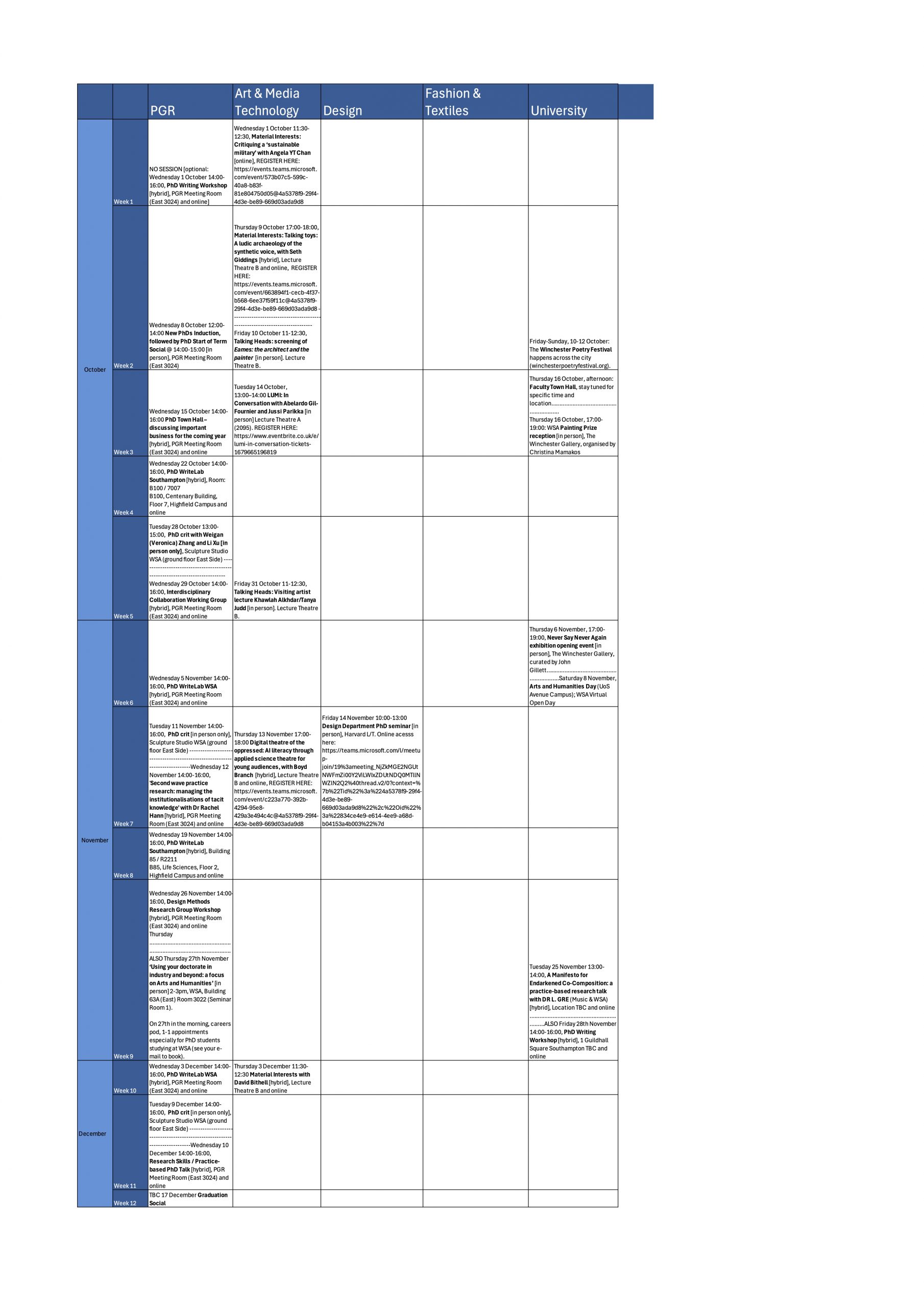
We’ll be continuing our regular Winchester School of Art PhD Seminar Series, which will generally run from 2-4pm on Wednesdays, in person (PGR Rooms at WSA) and on MS Teams. The series consists of (guest) speakers, workshops, trainings, and other research- and practice-led events.
In conversation with PhD Representatives, however, the nature of these sessions will be slightly different this term. Namely, we are trying to do fewer ‘big’ events and guest lectures (1 a month), and other events will be tailored to different subsets of our PhD community here at WSA (for instance practice-based PhDs and PhDs at specific stages of their projects).
The working schedule for the Spring 2025 term is available below (also HERE as an Excel sheet), and will be updated here with any schedule changes. Details and bios for individual sessions will be linked as they become available.
For other Faculty and University wide events please see the central University events calendar: https://events.soton.ac.uk/
 Below you will find our schedule for the Winchester School of Art PhD weekly meetings, which will generally run from 2-4pm on Wednesdays, in person (PGR Office at WSA) and on MS Teams. The series consists of (guest) speakers, workshops, trainings, and other research- and practice-led events.