Experiences of person-centred planning meetings as part of the education, health and care plan (EHCP) process: An IPA investigation.

Assignment type: Research Project (Small Scale Research Project, Year 1)
Authors: Ashleigh Shuttleworth, Anna Doedens-Plant, Helen Jones and Hanna Kovshoff
Submitted: Spring 2017

Background: Eliciting pupil and parent views and encouraging their participation in planning is considered a vital tool in pursuit of a more inclusive culture in education (Mitler, 2000). A range of tools known as person-centred planning (PCP) tools have been designed to enable this. Educational psychologists (EPs) in a local authority in the South of England have developed a format for conducting Education, Health and Care Plan (EHCP) planning meetings inspired by an established PCP format (Promoting Alternative Tomorrows of Hope [PATH]; O’Brien, Pearpoint & Kahn, 2010). Continue reading
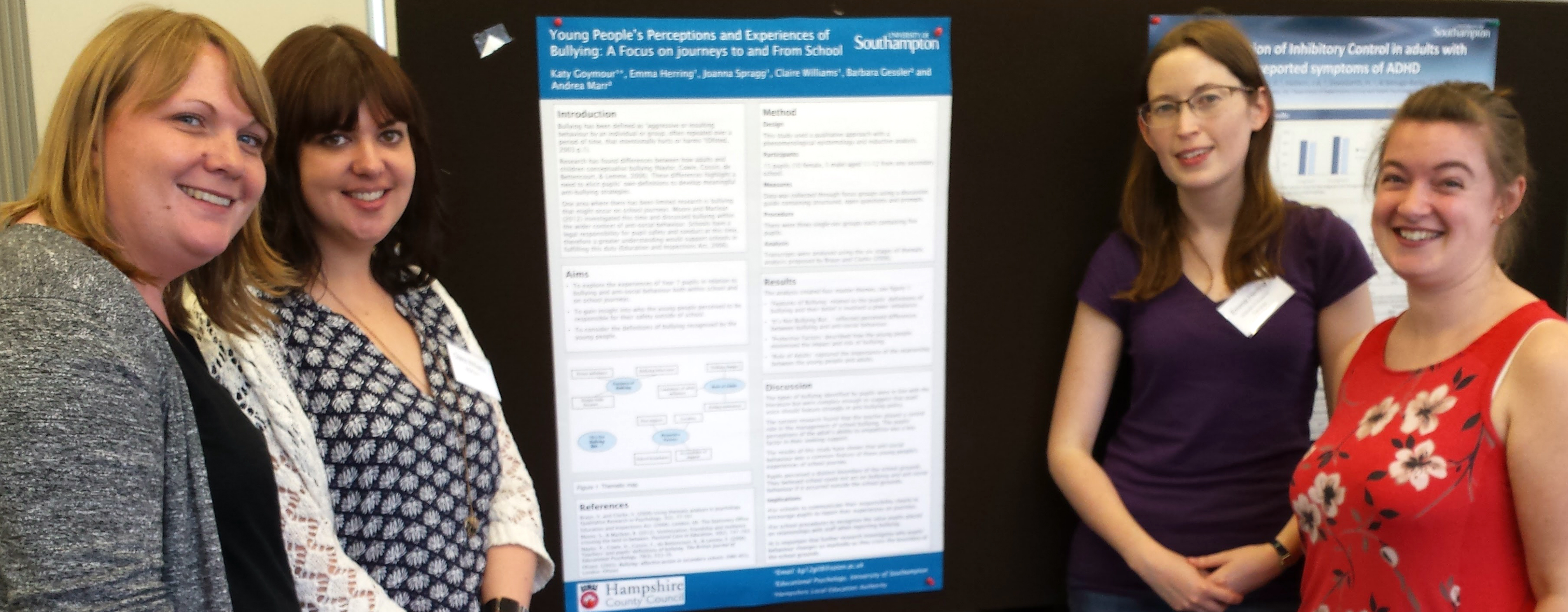
Young people’s perceptions and experiences of bullying: A focus on journeys to and from school.

Assignment type: Research Project (Small Scale Research Project, Year 1)
Authors: Katy Goymour, Emma Herring, Joanna Spragg, Claire Williams, Barbara Gessler, Andrea Marr and Hanna Kovshoff
Submitted: Spring 2016

PGR poster 1

The poster for this research study won first place at the 2016 Southampton School of Psychology Post Graduate Research Conference.

Research Summary:

Bullying appears to be an unpleasant but inevitable part of school for many pupils, and has been shown to impact on emotional well-being and academic achievement, both in the short and the long-term.

Continue reading

Establishing the effectiveness of a gratitude diary intervention on children’s sense of school belonging (2016)

Assignment type: Research Project (Applied Research Project, Year 1)
Authors: Tara Diebel, Colin Woodcock, Claire Cooper & Catherine Brignell
Submitted: 2011

Aim: The promotion of wellbeing in schools using evidence-based interventions from the field of Positive Psychology is a growing area of interest. These interventions are based on the principle that sustainable changes in wellbeing can be achieved through regularly engaging in simple and intentional activities. This study examines the effectiveness of a school-based gratitude diary intervention to promote school belonging for primary school aged pupils (age range 7-11 years). Continue reading

Out of school: a phenomenological exploration of extended non-attendance (2015)

Assignment type: Research Project (Applied Research Project, Year 2)
Authors: Matthew Baker & Felicity Bishop
Submitted: Summer 2014

The concept of ‘extended non-attendance’ (‘school phobia’ or ‘school refusal’) was distinguished from truancy by Broadwin (1932), and refers to children who fear school and avoid attending. Subsequent research has established that instances of extended non-attendance tend to be highly individual and multi-factorial in causation (Nuttall & Woods, 2013), but despite this improved understanding, outcomes for those affected are often poor and the child’s voice remains largely absent from the evidence base. The current study sought to address these shortcomings by examining the experiences of four children with extended attendance difficulties. Data consisted of semi-structured interviews conducted in the participants’ homes, and was analysed using Interpretative Phenomenological Analysis (Smith, Flowers & Larkin, 2009). Emergent themes include being disbelieved, experiencing fragmented support, and feeling blamed and punished. Various implications for practitioners are discussed, among them the importance of early intervention and the need to consider the voice of the child.

This assignment has been revised and published as an article:

Baker, M. & Bishop, F. L. (2015) Out of school: a phenomenological exploration of extended non-attendance. Educational Psychology in Practice, 31(4), 354-368. DOI:10.1080/02667363.2015.1065473

Download – pre-publication assignment (PDF)