Currently browsing tag

acrg, Page 4

Maritime Bus

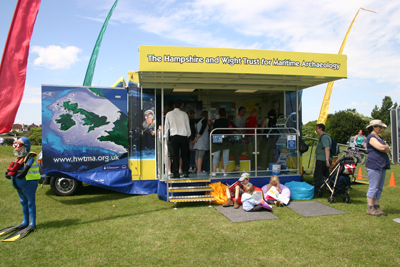
Maritime Bus Last week the Maritime Bus came to the Avenue Campus on a University Open Day to provide an insight into maritime archaeology for prospective undergraduate students, and to give current postgraduate students training and experience in outreach activities. The Maritime Bus is the only archaeology-themed exhibition of its kind in the UK. Continue reading →

Archaeological Survey at Ras Al Hadd, Oman

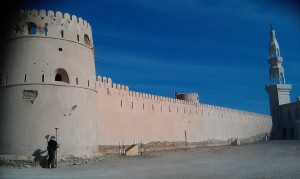
Over the last few weeks a team from the University of Southampton has been working with a team from the British Museum, surveying the archaeological site at Ras Al Hadd. The focus of the survey work was to carry out a topographic survey of the site, and to conduct magnetometer and GPR survey of areas of the occupation mound, prior to the commencement of excavation of the site. Continue reading →

Bringing the Neolithic Figurines of Koutroulou Magoula Back to Life

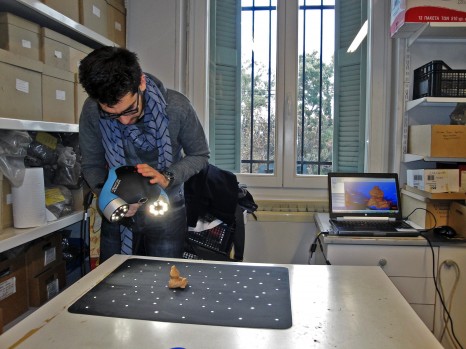
Clay Neolithic figurines are some of the most enigmatic archaeological objects, which depict in a miniature form humans, animals, other anthropomorphic or zoomorphic beings, and often hybrid or indeterminate entities. Figurines have excited scholarly and public imagination, and have given rise to diverse interpretations. The assemblage from Koutroulou Magoula, a Middle Neolithic site – 5800-5300 BC – in central Greece (excavated under the co-direction of Prof. Continue reading →

En route for Easter Island and a piece of Google’s doodle

Photogrammetry image of the statue featured in the Google doodle from 15 January 2014 (James Miles, ACRG) A century ago today, the Mana, an auxiliary schooner captained by Scoresby Routledge, stewarded by his wife Katherine and crewed by a collection of English seamen, fishermen, scientists and the odd Royal Navy lieutenant, had just been hauled up onto a floating deck in Talcahuano on the Chilean coast. They were nearly a year into their voyage. Continue reading →

Electrical Resistivity Tomography on the Isola Sacra

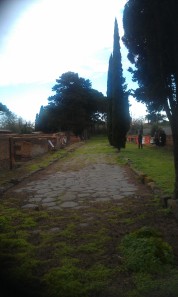
Further to my last post, the week before last was spent with a team from the British School at Rome carrying out a single Electrical Resistivity Tomography (ERT) profile across part of the Isola Sacra, designed to complement the magnetometer survey of the area, and recent coring undertaken by Ferreol Salomon. The Necropolis di Porto, showing the Via Flavia, between Portus and Ostia Antica. Continue reading →

Contemplating Data Analysis and Narrative

The lengthy period since my last blog post represents a diversion from the usual pattern of fieldwork and rapid turn-around of research reports and has provided some time for reflection on the nature of the types of data we collect as archaeologists and what we do with it. Much of the work of recent months has been related to large-scale research projects, and the analysis and interpetation of varying forms of geophysical and archaeological data to a number of different research agendas. Continue reading →