Currently browsing tag

imaging

Imaging Event/Hackathon

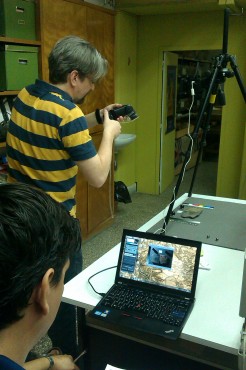
Few days to go to Rode Imaging Event where ACRG will be represent on power of three: Graeme Earl, James Miles and me. List of presenters at the seminar and workshop day include specialist with different expertise: multispectral imaging, 3D data acquisition and processing and theoretical approach. Hackathon weekend is supported by Garage48, people specialised in hackathons and helping start-ups. Continue reading →

Data mining and image processing experiments on photographs from Portus

As large-scale data processing becomes easier and more affordable to everyone, so too increases the temptation to try and use new technologies and methods to reduce the amount of manual labor that usually comes with classifying and categorising big data collections. With textual data, the techniques of extracting useful information from unstructured data have already been more or less established. Continue reading →

Icons RTI case study

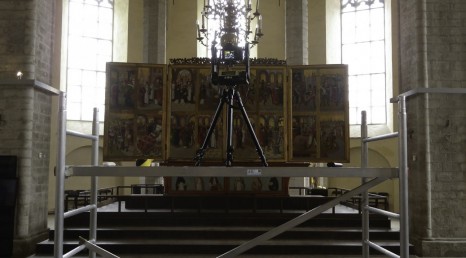
Icons: Production  techniques and examination methodology Icon or ikon from Greek eikōn is a representation of a sacred or sanctified Christian personage used in religious worship in the Russian or Greek Orthodox Church. The production of icons has been described by the monk Dionisios ek Fourna in 1728-1733. Icons are typically painted on a wooden panel with the egg tempera painting technique, over a layer of gypsum and glue (preparation layer). Continue reading →

Testing a Prototype 3D Structure Light Imaging System for Underwater Archaeology

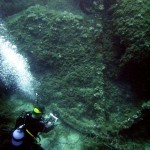
Anchor Scanning While 3D imaging has become a revolution in land archaeology, it has experienced a difficult baptism underwater. Electrical equipment and water do not mix, plus many systems do not easily transfer underwater when you add currents, visibility issues, and salt into the equation. Approaches that have been attempted include acoustics, laser-based systems, and photogrammetry with each of these having varying success depending on site conditions. Continue reading →

Seeing in a New Light – Archaeological Computing Research Group Seminar

Speaker: Sally Ford Location: Digital Archaeology Lab, Building 65a, Avenue Campus, Southampton Date: 26.10.2012, 2-3pm This Friday is the first ACRG seminar of the term, and we welcome all students and staff to attend. Seeing in a new light: How can polynomial texture mapping help record forensic investigations of cremations? Polynomial texture mapping is an image capture and processing technique used to record and represent details from a surface. Continue reading →