Archive for the ‘Uncategorized’ Category
E-business (concluding thoughts – part 1 of 2) no comments
Picking up from where I left off last week – I want to shift the focus firmly onto the impact of the Web/Internet on business competition as I move on from broad principles of management/economics to specifics. The examples used below are taken from Boddy’s ‘Management, An Introduction’.
I kick off with a consideration of Google as an illustration of the impact that the Web/Internet has had on competition between businesses. Google exemplifies a company created to use the Web/Internet – it is a pure e-business company built entirely around information technology. Since the search engine serve is free, it generates revenues by providing advertisers with the opportunity to deliver online advertising that is relevant to search results on a page. The advertisements are displayed as sponsored links, with the message appearing alongside search results for appropriate keywords. They are priced on a cost-per-impression basis, whereby advertisers pay a fixed amount each time their ad is viewed. The charge depends on what the advertiser has bid for the keywords, and the more they bid the nearer the top of the page their advertisement will be. Google has rapidly expanded the range of services it offers.
Pure e-businesses such as Google which focuses on search processes (other examples include easyGroup which exclusively sells its services online and eBay which facilitates online transactions) can be contrasted with companies existing before the Web/Internet but which use it to support many of their activities. They may still perform the same functions, but the Web/Internet often enables them to offer new services through an additional distribution channel online (such as banks).
As well as offering new ways of doing business, the Web/Internet also affects the way services are created and delivered. Examples include: delivering media content; satellite freight tracking services; and, social networking sites. Picking up on this last example in particular, social networking sites (types of community systems) enabling people to exchange information have grown very quickly. Setting up blogs is one major use, as are websites through which people with particular interests exchange information. They are significant for businesses even if they extend beyond the firm, since customers can use them to exchange positive or negative information about the company. These applications affect the strategy and competiveness of organization.
The publishing industry (compare music, film and journalism) is an example of a business model founded on information (its gathering, processing and dissemination) for whom the Web is the biggest threat. As digitisation and the Web have reduced the cost of the dissemination of information, it undermines the value proposition of those industries built on its premise.
There is also an internal business impact of the Web in terms of changing various aspects of organisational activity. Common information systems based on the Web/Internet move information between organizations, often having direct links with customers. This is part of a broader assessment of how information technology, in general, is affecting the way that business is carried out.
One way to consider the impact of the Web/Internet on business is by geographic reach. Inter-organisational information systems link organisations electronically by using networks that transcend company boundaries. They enable firms to incorporate buyers, suppliers and partners in the redesign of their key business processes, thereby enhancing productivity, quality, speed and flexibility. New distribution channels can be created and new information-based products and services can be delivered. In addition, many information systems radically alter the balance of power in buyer-supplier relationships, raise barriers to entry and exit and, in many instances, shift the competitive position of industry participants.
From an alternative perspective as an information system, the Web/Internet has had wide effects on managing data, information and knowledge. It can, for example, be used to integrate processes, from suppliers through to customer delivery. Managers must ensure that their organisation makes profitable use of the possibilities that the Web/Internet offers in a way that suits their particular business; and, not just as a technology challenge, but also as a ‘people challenge’. For example, network systems help people to communicate and interact with each other, but they do not define how they should do so (such as who should gain access to which part of the system or who is responsible for responding to customer comments on a blog – these are matters to be implemented and modified in the light of experience).
A useful distinction can be made between intranets and extranets. The former is a private computer network operating within an organisation, using Web/Internet standards and protocols and security protected. An extranet is a closed, collaborative network that uses the Web/Internet to link businesses with specified suppliers, customers or other trading partners. It can be linked to business intranets where information is accessible through a password system.
The simplest Web/Internet applications provide information, enabling customers to view products or other information on a company website; conversely, suppliers use their website to show customers what they can offer. Web/Internet marketplaces are developing in which groups of suppliers in the same industry operate a collective website, making it easier for potential customers to compare terms through a single portal. The next stage is to use the Web/Internet for interaction. Customers enter information and questions about, say, offers and prices. The system then uses the customer information, such as preferred dates and times of travel, to show availability and costs.
Another use is for transactions, when customers buy goods and services through a supplier’s website. Conversely a supplier who sees a purchasing requirement from a business (perhaps expressed as a purchase order on the website) can agree electronically to meet the order. The whole transaction, from accessing information through ordering, delivery and payment, can take place electronically.
Finally, a company achieves integration when it links its own information system to customers and suppliers: it becomes an e-business. Dell Computing is an example. Other companies use the Web/Internet to create and orchestrate active customer communications (e.g. Kraft, Intel and Apple). These communications enable companies to become closer to their customers and to learn how best to improve a product/service much more quickly than is possible through conventional market research techniques.
In conclusion, the Web/Internet is radically challenging many established ways of doing business. Combined with political change, this is creating a wider, often global, market for many goods and services.
Next week, in my final post, I will round up on the topics of e-commerce and e-business and the associated challenges faced by businesses in managing innovation and change.
Cognitive psychology, artificial intelligence, and social cognition in e-learning no comments
The following is a brief discussion of random ideas I have so far. My blogs in the next few weeks will elaborate on some of the following ideas. These ideas in their present form are by no means fully formed or coherent. Rather, there are posted here as a general guide for me to investigate further with a general sense of direction eventually leading to material suitable for our assignment.
Cognitive psychology/artificial intelligence along with constructivism in learning. Is it possible to compare constructivism with the concept of a filing system in a computer? For example where we talk about scaffolding in education, is it is similar idea to rural and a filing system in a computer? In a computer, there is a short-term memory as well as a long-term memory. RAM and ROM, and that’s what it’s all about.
Social cognition dealt with a lot on the behaviour of an individual in a social setting. It dealt with how the individual looks at oneself, how they perceive the characteristics of a group, and how they behave accordingly. Could it be that is part of this awareness is what drives the popular uptake of social networking? If this were so, how much of that can be gleaned and adopted for collaborative learning via the Internet?
Market Segmentation no comments
In marketing a key concept is market segmentation – deciding how to divide your market into individual segments so you can target your products and services, prices, advertising etc to that segment’s needs and demands.
Marketing can be conducted a different levels of segmentation:
Mass-marketing – no segmentation. This is not necessarily a bad strategy. It spreads costs across the largest possible number of customers and makes for a consistent brand image. It does however tend to lead to competing on price which may lead to low profit margins.
Segmented markets – this would be something like the over 55s – quite broad and usually with a lot of competitors – but nevertheless defining some characteristics of the market e.g. interested in holidays during the school term, not interested in low cost mortgages or nappies!
Niche marketing – quite specific groups within a market segment such as the over 55s gay and lesbian niche (yes there are companies addressing this niche). Often an unexpected group with little or no competition.
Local marketing – marketing to a specific town or even store. A supermarket chain may authorise local managers to stock and promote products specific to their store. Can be effective but have to be wary of costs and diluting brand.
Individual marketing – this has always existed at a local level. If the village shop stocks vegemite because you are the one Australian in the village who buys it – then that is individual marketing. Famously the web has enabled large companies to do mass customisation i.e. mass individual marketing. The paradigm example being Amazon.
How does this relate to my research question? The trend in science communication with the public over recent years has been to move away from science communication – which is a mass market one way process – tell them the truth which we scientists are the authorities on – to public engagement. Learn how the public uses scientific knowledge and how local knowledge can integrate with and enhance scientific knowledge. This implies segmentation – possibly down to the individual marketing level.
Business Economics Week 3 no comments
This week I start by looking at business strategy from the perspective of economics. There are basic economic principles underpinning the determination, choice and evaluation of business strategy.
As mentioned in my post on management studies from a few weeks’ back, right strategies (the ways in which organizations address their fundamental challenges over the medium to long-term) are crucial for businesses to survive and beat the competition. Strategic-minded thinking includes comprehensive consideration and reflection upon a business’ mission statement and its vision. For both economists and management theorists, therefore, the aims of a business determines its strategy. Equally relevant, however, for both disciplines are internal capabilities and industry structure/conditions.
Like management theory, economists adopt Porter’s five forces model of competition (Michael Porter, Competitive Strategy: Techniques for Analyzing Industries and Competitors, 1980) which set out to identify those factors which are likely to affect an organization’s competitiveness. These five forces are:
• The bargaining power of suppliers
• The bargaining power of buyers
• The threat of potential new entrants
• The threat of substitutes
• The extent of competitive rivalry
I will be returning to these five forces next week in the context of considering, specifically, how they apply to the effects of the Web. In the meantime, it is worth pointing out that the five forces model does have limitations. For example, it is a largely static model whereas conditions change over time requiring strategy to evolve over time. Notably, also, Porter’s model suggests that success is dependent on competition rather than the potential for collaboration and cooperation (such as with those downstream vertically from a supplier).
Value chain analysis is also closely linked to the five forces model (according to the definition of Sloman, Hinde and Garratt, value chain “shows how value is added to a product as it moves through each stage of production from the raw material stage to its purchase by the final consumer”). Analysis of the value chain involves evaluating how each of the various operations within and around an organization contributes to the competitive position of the business). Ultimately it is these value-creating activities, which can be primary or support activities, that shape a firm’s strategic capabilities.
Turning to growth strategy, it is worth making a nod here to vertical integration (this will become more relevant when considering the effects of the Web in facilitating disintermediation of value chains over the next two weeks). There are a variety of reasons why forward or backward vertical integration might lead to cost savings (such as through economies of scope and scale), including: production economies; coordination economies; managerial economies; and financial economies. The major problem with vertical integration as a form of expansion is that the security it gives the business may reduce its ability to respond to changing market demands.
Other points of comparison and dissimilarity between management and economics can start to be drawn. For example, a point of difference is economics’ focus on theories related to short-term/long-term profit maximization. There is much debate among economists about whether profit-maximizing theories of the firm are unrealistic (largely due to a lack of information or lack of motivation). This focus is where costs concepts and graphs (demand curves in particular) come in.
A more practical illustration given by Sloman, Hinde and Garratt in respect of the search for profits is the video games war where there are high costs, but also high rewards, from a long-term perspective. In considering the secret of success in the market, online gaming capability and global connectivity are significant factors. Moreover, connection to the internet has facilitated a move towards the use of consoles as ‘digital entertainment centres’, in which users can download content. These developments are likely to continue as long as broadband internet connectivity improves and remains fairly cheap to use.
Finally, in economics, there are various theories of strategic choice (such as cost leadership, differentiation and focus strategy). These strategies can be combined. For example, Amazon had a clear niche market focus strategy – to sell books at knockdown prices to online customers – and this has become a mass market with the spread of the Web and due to lower costs.
Next week, I want to move the focus firmly onto the impact of the Web on business competition as I move on from broad principles of management/economics to specifics. I will kick off with a consideration of Google’s business model.
Economics of intellectual property no comments
In my last post I talked about how economics is necessary because of the scarcity of goods. What is interesting in looking at the economics of intellectual property is that intellectual goods aren’t scarce in the way that other goods are. So does that mean we don’t actually need economics when it comes to intellectual goods?
In short, the answer is no. Even though intellectual goods aren’t scarce like land or labour, they are made artificially scarce through government policy. This creates a market for them.
To see why intellectual goods aren’t scarce, consider this quote from Benjamin Franklin (17??)
“If nature has made any one thing less susceptible than all others of exclusive property, it is the action of the thinking power called an idea, which an individual may exclusively possess as long as he keeps it to himself; but the moment it is divulged, it forces itself into the possession of everyone, and the receiver cannot dispossess himself of it.
Its peculiar character, too, is that no one possesses the less, because every other possesses the whole of it. He who receives an idea from me, receives instruction himself without lessening mine; as he who lights his taper at mine, receives light without darkening me.
That ideas should freely spread from one to another over the globe, for the moral and mutual instruction of man, and improvement of his condition, seems to have been peculiarly and benevolently designed by nature, when she made them, like fire, expansible over all space, without lessening their density in any point, and like the air in which we breathe, move, and have our physical being, incapable of confinement or exclusive appropriation. Inventions then cannot, in nature, be a subject of property.”
Thomas Jefferson, letter to Isaac McPherson, 13 August 1813
http://press-pubs.uchicago.edu/founders/documents/a1_8_8s12.html
An important difference between intellectual property and non-intellectual property (such as money, houses or land) is that the former tend to be what economists call non-rival while the latter tend to be rival. A rival good cannot be used by one without diminishing the ability of another to use it. My consumption of a pizza prevents you from consuming the same pizza. My use of an idea, a design or technique, on the other hand, does not diminish your ability to use that same idea (so long as in implementing the idea I do not use up the only resources available to implement that idea). We can both use the idea of a pizza to make our own individual pizzas without interfering with each other. Such intellectual goods are non-rival – they can be enjoyed by more than one person at the same time without losing value.
This difference is not absolute, however. Some non-intellectual goods are non-rival. Traditional public goods, such as clean air, are non-rival, but they are certainly not intellectual goods. However, most goods that are traditionally the objects of property rights, (money, houses, land) are rival. Similar qualifications apply to intellectual goods, which can sometimes be rival in certain ways. We might call them non-rival in consumption; your ability to consume an intellectual good is not affected by my consuming the same intellectual good. However, your ability to use the good in other ways may be affected by my use of it. My ability to profit from stockmarket tips (which I would classify as intellectual goods) depends on how many other people are using the same tips. My ability to profit from selling you a book depends on whether or not you have already read it. More generally, the ability to profit from an intellectual good is compromised if others are able to consume it for free. However, with these qualifications in mind, two generalisations can be made. Intellectual goods tend to be non-rival, at least in consumption. In contrast, the kind of non-intellectual goods that are typically the objects of property rights – houses, land, vegetables – are rival.
A popular defence of intellectual property takes the maximisation of innovation as the relevant end. This version is assumed in the economic literature and reflected in the wording of United States law on intellectual property:
“to Promote the Progress of Science and useful Arts, by securing for limited Times to Authors and Inventors the exclusive Right to their respective Writings and Discoveries.”
Another kind of defence takes the protection of individual creator’s rights as the most important thing an intellectual property regime exists to do. According to this view, people have the right to control the things they create with their mind. This includes preventing others from using their ideas.
Economics: the basics, and a digression no comments
I’ve been reading Samuelson’s Economics, a classic introductory textbook. So far I’ve got a better understanding of what economics is about. The essential definition according to Samuelson is that it is ‘the study of how societies use scarce resources to produce valuable commodities and distribute them among different people’. This includes, but is not limited to, the following questions:
• How the prices of labour, capital and land are set, and how they are used to allocate resources
• How the financial markets behave and how they allocate capital to the rest of the economy
• Distribution of income and how the poor might be helped without reducing growth
• Impact of government activities on growth
• Studying swings in production and unemployment and how policies can encourage growth
• International trade
• Growth in developing countries and how to encourage efficient use of resources
Returning to the above definition, we can see that without scarcity – i.e. if there were always enough goods to satisfy every person’s every desire – there would be no need for economics, because everybody could just take what they want and need without depriving anyone else. The desire for efficiency is also essential to economics; if we didn’t care about satisfying as many needs and desires as possible, then we wouldn’t need economics to tell us how to most efficiently distribute scarce resources. The economy is producing efficiently ‘when it cannot increase the economic welfare of one person without making someone else worse off’.
A QUESTION/ DIGRESSION
As an aside, I disagree with / don’t understand this definition. Imagine an economy where most of the resources are in the hands of one person (call him Bill). Imagine, reasonably, that in such an economy no-one’s economic welfare could be increased without making Bill worse off. According to Samuelson’s definition, then, this society is efficient. But surely, you want a notion of efficiency which allows decreases in welfare of one person so long as they result in proportionally greater increases in the welfare of others. If Bill’s income tax for the year is £1 million, and that revenue allows government spending, which stimulates GDP, perhaps it could make 10,000 people £20 richer – a net gain for society. Wouldn’t this be a more efficient use of resources?
From a Google search, I think the notion of ‘pareto-optimal’ captures my pre-theoretical intuition about efficiency – where a pareto-optimal situation is one in which no individual’s welfare can be improved without making another individual’s welfare proportionally even worse off. Imagine that taxing Bill £1 million makes 9,999 other people £10 richer. But this would not count as pareto-optimal, because Bill would have lost more than the combined gains of others (£1 million vs £99,990). That’s what I had imagined an economist’s notion of efficiency referred to, before reading Samuelson. But perhaps I’m jumping the gun here!
…back on topic:
Microeconomics is the study of individual entities such as markets, firms and households. It considers how individual prices are set, the determination of prices of land, labour and capital, and market efficiency.
Macroeconomics came around in the 1930’s when John Maynard Keynes decided to look at the overall performance of the economy. He analysed what causes unemployment and downturns, investment and consumption, the management of money and interest rates by central banks, and why some economies thrive and others fail. These days the distinction between the two is less important, with microeconomics being applied to studying unemployment and inflation.
Economists observe current economic phenomena as well as historic data and make theoretical predictions and broad generalisations on that basis. They also use econometrics, which is the application of statistical analysis to economic data, allowing them to identify the relationships between different factors.
The kind of economy one has depends on three things:
• What goods should be produced
• How should they be produced
• For whom will they be produced
Factors of production are things that are used to create goods and services, and come in three categories:
• Land (and other natural resources)
• Labour – human time
• Capital – goods which can be used to create new goods
Attitudes: Do I have one? no comments
I have found myself in a rather strange territory this week. Under normal circumstances, I would be very offended or at least somewhat disappointed with myself if someone says I have an attitude. Yet, what does the word “attitude” actually means?
“attitudes are defined at least implicitly as responses that locate ‘objects of thought’ on ‘dimensions of judgement’ ” (McGuire, 1985, p.239)
“an attitude is a general and enduring positive or negative feeling about some person, object or issue” (Petty and Cacipoppo, 1996, p.7)
It is interesting to see from this definition that we all have an attitude toward something. It is normal. Most importantly, having an attitude in an academic sense is not wrong. An attitude can be positive or negative. Even negative attitude is not always wrong. For example, having a negative attitude toward murder is generally socially acceptable. This concept of right and wrong, or social acceptance brings us to another closely related topic: Cognition and Behavioural relationship.
Cognition and Behavioural Relationship
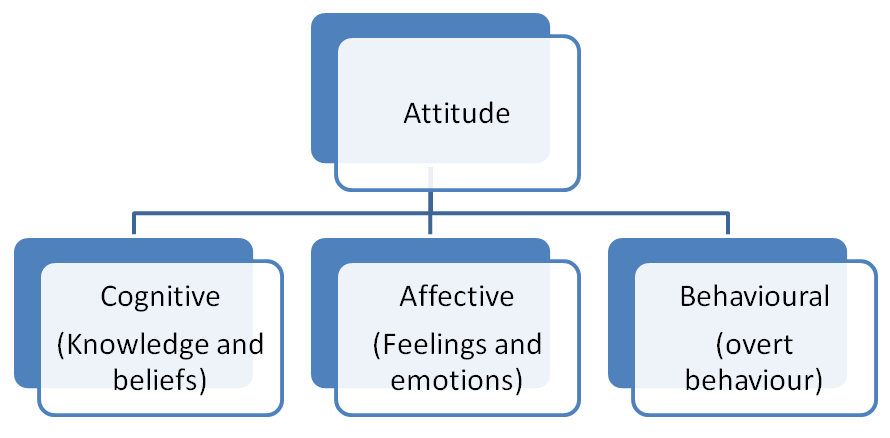
The above model is commonly known as the ABC model for obvious reason. This model was first proposed by Hilgard in 1980 and has since became the fundamental framework for further research. For instance, many have investigated the relationship between behaviour and beliefs. It has been found that behaviours are modified by the peers, identity of self with the peers and perceived social norms.
This is an interesting findings because it backs up the social concept of “peer pressure” and shed light on how these pressures function/ affect an individual. The book then went on to discussion several theories regarding the factors involved, such as: theory of reasoned action, and planned behaviour, social identity, self-categorisation, social norms, group definition and discursive theories.
Time would fail me if I was to detail all of them here. It should be sufficient to say that these theories were used to describe the results obtained from various experiments. It is particularly interesting to see how these theories interact with each other and compliments each other.
Moving On
In view of the time remaining, I will be reading up more on self and identity as I have found this topic rather interesting. That will then be my last post based on text book reading. Further posts will concentrate on multidisciplinary approach and migrate towards final report style thinking/ writing/ blogging.
Soxciology for Dummies (2) no comments
What sociologists do
1) Empirical Research: using data collected by the various methods we described before sociologists use statistical analysis to draw conclusions about social class, gender inequality etc.
2) Theorists: these sociologists try to develop an understanding and context for the empirical research. To theorise qualitative methods of research are employed and the social theorists paints a picture which explains why the world is the way it is.
3) Critics: this type of sociologist criticise common sense views of the world and carefully dissect social norms which are taken for granted.
4) Educators: they provide students, governments, corporations with information and advice about human interaction, in particular these types of sociologists are found in the media and they try to drive change.
There are several other roles which a sociologist might take and they often assume different combinations of the four roles described above.
Limitations of Sociology
Sociology is the study of human interaction and society, but human interactions and society are part of a changing evolving world. Furthermore a sociologist studies a moving target, any finding as part of some empirical research or a theory may only be relevant for a limited time.
Also, however hard they try; sociologists cannot look on the world objectively. Part of the study of the social is the study of you, thus it is hard to part with the preconceptions about society which we are born with. For example, on a very basic level, it is unlikely for a Chinese and an American sociologist to share a similar theoretical approach.
Another limitation is that social knowledge or theory is fed back into society and then will affect that society. For example, evidence that crime rates are soaring makes the population more aware of crime so they report more crimes; a recursive process.
06 – Museology no comments
Museum Studies
The museums by themselves have different processes and meanings for the population and institutions. Through these classifications of museums, we can provide a more accurate linkage in between the object of study (or exhibited) and the audience.
Cultural Theory
Through contemporary cultural theory we can incorporate all sort of art practices into the everyday life. This will create our culture. So culture is becoming something less separatist in which art or culture itself no longer belongs to the educated or rich classes. The cultural theory is now being implemented more and more within museums, specially in social history and contemporary collections (Macdondald, 2011). Contemporary cultural theory seeks to utilize culture from a pluralistic perspective.
We inhabit a culture in the sense that we share a certain amount of knowledge and understanding about our environment with others.
We have evolved into a society that shares what Stuart Hall (1997: 18) in Macdonald (2011:18) defines “cultural maps” which makes us question or make judgements the value, status and legitimacy of products or cultural practices.
Within museums we are trying to materialize values and trying to give meaning to objects. For this reason museums within cultural theory are public spaces in which their values and the culture creation is always under debate.
Main theoretical apporach
In order to give meaning to something, we depend on a social construction of a signifying system that creates a shared understanding. The semiotic research of Ferdinand de Saussure, indicates that signifiers and signifieds relate arbitrarily. This means that perhaps the meaning or classification (curation) system to an object could be completely different from the perspective of a different culture.
When an artifact is being curated, this is attached or linked to an interpretation system that could be attached to a single cultural ‘string’. Taking the post-structuralist approach, we can provide a structure of interpretation that adapts to the cultural needs of the artifact or the audience. The attempt to materialize culture and present how an object can change through time, tends to fit to the vision of the post-structuralist thinking.
For this project this could be the way in which post-structuralism becomes the main way of presenting an object of study. A multi curated object presented from different cultural backgrounds and within different cultural audiences. Although the object can be presented with several meanings, “poststructuralist theory does not automatically imply that the material world ceases to exist” (Macdonald, 2011:21), but it will be understood from different perspectives or meanings.

V&A Mark Lane Archway (Gallery 49)
The Object
Before photography, multimedia and all the new technologies, the object by itself was the way to present the culture or places which it came from. For this reason I think that the object presented should contain enough information to communicate or represent the specific qualities of a culture. When the object is unique it will be a challenge to transmit the embedded information to a replica that could be presented somewhere else. The use of modern manufacture technology and prototype making can assist with this process. But it will be the correct adaptation of the object and its environment what will be able to make the correct communication to the audience possible.
Bibliography
MACDONALD, S. 2011. A companion to museum studies, Malden, MA ; Oxford, Wiley-Blackwell.
PEARCE, S. 2001. Interpreting Objects and Collections, Andover, Routledge, 2001.
Business Economics Week 2 no comments
This week I looked at the workings of competitive markets: first in basics, before turning more specifically to my research question around how the Web has changed competition between businesses from an economic viewpoint. I continue to refer to the Sloman, Hinde and Garratt book, ‘Economics for Business’ (5th ed).
As outlined in my posts on management studies from previous weeks, firms are greatly affected by market environments (particularly when it comes to pricing strategies). The more competitive the market, the greater the domination of the market over firms (e.g. resulting in ‘price takers’ nearer the model of the ‘perfectly competitive’ market when price is entirely outside a firm’s control, rather than ‘price setters’ nearer the model of the monopolistic, ‘imperfect’ market).
Although price is often at the heart of competitive strategy, the significance of non-price factors of competition should also not be underestimated. By differentiating one firm’s products from another’s, such as through design and marketing/advertising, firms seek to influence demand. Of course, the most dramatic growth in advertising expenditure over the last decade or so is on the internet (which increased from virtually nothing in 1998 to nearly 20% of all UK total advertising expenditure in 2008 based on data in the Advertising Strategic Yearbook 2009).
The better a firm’s knowledge of a market, the better it will be able to plan its output to meet demand. In particular, knowledge related to the size and shape of current and future demand choices by consumers is critical to the investment decisions that businesses make (Philip Collins, OFT Chairman, Speech 2009). Such predictions include the strength of demand for a firm’s products followed by responsiveness to any changes in consumer tastes (particularly when the economic environment is uncertain). Collecting data on consumer behavior is therefore highly valued by businesses, assuming it can be analyzed properly so it can be used to estimate price elasticity and forecast market trends and changes in demand. Price elasticity as a concept is the measure of the responsiveness of quantity demanded to a change in price. Methods for measurement include market observations, market surveys and market experiments.
Conversely, consumers face a similar problem when they have imperfect information about, in particular complex, products/services. In finding ways for consumers to trust information provided by sellers, establishing a reputation and third parties helping firms to signal high quality can assist. For example, Sloman, Hinde and Garratt refer to the online auction site eBay providing a feedback system for buyers and sellers so they can register their happiness or otherwise with sales.
The supply side of the market is just as important as the demand side. Businesses can increase their profitability by increasing their revenue or by reducing their costs of production. Both these concepts are subject to economic theorizing to discover the particular output at which profits are maximized. The answer in any one case is heavily dependent on the amount of competition in the market which is measured, in turn, by concentration levels.
E-commerce is a force at work undermining concentration (dominance by large consumers) and bringing more competition to markets. Its effects include:
• Bringing larger numbers of new, small firms to the market (‘business to consumer’/B2C and ‘business to business’/B2B e-commerce models), which can take advantage of lower start-up and marketing costs.
• Opening up competition to global products and prices, resulting in firms’ demand curves becoming more price elastic particularly when transport costs are low.
• Adding to consumer knowledge, through greater price transparency (e.g. through price comparison websites) and online shopping agents giving greater information on product availability and quality.
• Encouraging innovation, which improves product quality and range.
On the other hand, e-commerce disadvantages still include – for example – issues around delivery (such as timing) and payment security. Furthermore, larger producers may still be able to undercut small firms based on low cost savings from economies of scale.
Sloman, Hinde and Garratt provide an interesting case study of the challenges to Microsoft by the antitrust authorities in the EU and the US – something which I am very familiar with as a former competition lawyer. This example is illustrative of the balancing exercise required when assessing the virtues of allowing very large firms to be unfettered in terms of their potential exclusionary practices, versus allowing smaller firms a more even playing field to challenge such large firms which could dampen the latter’s investment in innovation over the long-term.
Of course, new internet-only firms (such as Facebook and Google) have very different business models from that of Microsoft, including the provision of numerous free products as part of a desire to create large networks of users and heavy dependence on tailored advertising revenues.
Next week, I will look at business strategy this time from an economic (rather than management) perspective.