Archive for the ‘Uncategorized’ Category
Becoming a predictioneer no comments
In my continuing pursuit (albeit with a slow down of blog posts) I have settled on a book that has me enthralled. It is The Predictioneer’s Game: Using the Logic of Brazen Self-Interest to See and Shape the Future by Bruce Bueno de Mesquita. Featured in an article I read some time in the summer he has been using Game Theory to predict political changes for twenty five years. Most of us have heard to typical GT example of the Prisoner’s Dilemma, but Mesquita goes much further and opens the concept of Game Theory wide open way before He delves into the maths.

His opening example is on reversing the ‘game’ we play when we go to buy a car. When you sit in front of a salesperson in a car showroom they are holding all the cars, at the end of the deal they ask you how much you want to pay – which might require the salesperson to ‘go and check with the manager’ and you might think you are getting a good deal. Mesquita’s plan is about reversing the power in the game, which he, his family and his students use when buying a (new) car. First you research the car, its average value and be very specific about which model you want and what extras you want with it. Then the fun begins; call up every dealer with that car and starting with the first one you say… ‘At 5pm today i will be buying [the car], I am calling every dealer in the area and whoever gives me the cheapest price will get the check.’ Some dealers refuse to ‘play’ but most go with it, it changes the situation and requires the dealers to do what is in their own interest – offer the cheapest price without knowing what they are offering it against. A blind auction if you will, but with the essential ingredient of game theory at the centre; everyone acts in their own best interest.
Swirling around in my mind with all this my recently gained knowledge and some understanding of Actor Network Theory, also (of course) are the constant swirling thoughts of data visualisation. I am off to play with Processing and some XML stuff, having decided that Logic will be the subject of my next, imminent post.
05 – Information Systems no comments
Information Systems
O’brien (2007) defines an Information system (IS) as any kind of organized combination of people, hardware, software, communications network, data resources, and policies and procedures that stores, retrieves, transforms, and disseminates information in an organization.
The Framework.
There are 5 main areas that build the framework for the information systems. All these elements play an important role in the process of building the research project.
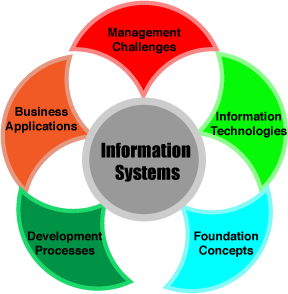
Foundation Concepts
To develop an information system, it is important to understand the behavioral, technical, business and managerial elements in order to develop the components for the Information System.
Information Technologies
In this area we will focus on the hardware, software, networks and data management that will affect the project in regard of its development, concept development and management.
Business Applications
Concepts like e-commerce can influence or provide ways of how the management can be implemented in an Information System like the one required for the Museum application.
Developments Processes
This will be focusing on the planning, development and implementation of the system(s) to meet the requirements of the problem or situation.
Management Challenges
Through this process, we will focus on delivering and managing effectively the information technologies at the end-user, business or int this case a multiuser/global institution.
Inside Management Systems
There are several types of Information Systems. They are usually classified into two different groups: Operations Support Systems and Management Support Systems.
Operation Support Systems:
- Specialized Processing Systems
- Transaction Processing Systems
- Process Control Systems
- Enterprise Collaboration Systems
Management Support Systems:
- Management Information Systems
- Decision Support Systems
- Executive Information Systems
- Specialized Processing Systems
There are five major resources focusing on the relationship with the IS and the products (O’brien, 2007)
- People Resources
- Specialists – software developers or system operators
- End Users – the person who uses the IS
- Hardware Resources
- Machines – computers, monitors, drives, printers or scanners
- Media – Storage, disks or paper forms
- Software Resources
- Programs – operating systems, editors or payroll applications
- Procedures – data entry procedures, error correction, paycheck distribution procedures
- Data Resources
- Communication media, communication processors, network access, control software
- Information Products
- Management reports, business visual display and paper forms
All these elements and areas can help us to visualize the complexity of the development of an Information System. We need to know what do we want from the organisation (system) to do? An organisation that includes people is more complex to manage than one that doesn’t (Wilson, 2001). For this, it is important to analyse the system implemented. Users or a human response will vary which will vary the judgement of the system.
To avoid judging problems we have to follow a specific methodology. We have to define a problem first of all. From here we can start gathering the appropriate techniques to solve this problem. The implementation or application of these techniques will allow us to go to the next step if effective or back to the previous one if unsuccessful. We also have to analyse the cost/effective solution. After these steps we can finally implement the solution.
So we have to solve a problem. But, who is defining the problem. What seems to be problematic for one person can not appar to be so for another one. Wilson (2001) explains that instead of focusing on a person’s problem or a problem, we have to focus on defining a situation that is problematic. I believe this will help the project not to isolate on a single person’s perspective.
Bibliography
O’BRIEN, J. A. & MARAKAS, G. M. 2007. Introduction to information systems, Boston, Mass., McGraw-Hill.
WILSON, B. B. 2001. Soft systems methodology conceptual model building and its contribution, Chichester ;, Wiley,.
Marketing Lessons for the Web no comments
I have been reading a marketing introduction (Armstrong, Kotler, Harker, & Brennan, 2009) which certainly makes for much easier reading than academic papers. These are initial notes on how marketing might throws light on the user of the web for public engagement with science.
Marketing as a discipline:
• Marketing is primarily prescriptive not descriptive. The book tells or advises people on how to do it.
• The evidence to back up the advice is almost entirely based on case studies. In this sense it does not come close to the rigour of a science or even the social sciences.
Marketing, public engagement with science, and the web
• Clearly marketing uses the web – digital marketing is a new and important branch of marketing – but the web can also use marketing. To be more precise people using the web can benefit from marketing concepts and attitudes.
• Most importantly marketing has at its heart “creating and maintaining profitable long term customer relationships”. The concepts of customer and profitable need to be expanded (you might even say twisted) beyond their normal meaning if they are to apply generally to the web – “customer” translates into “user” and “profitable” translates into something like “satisfactory”. Taking into account this translation, this is a mind-set that ought to pervade anyone trying to offer services via the web and therefore the underlying technology and standards. The big success stories Apple, Google, Facebook and Amazon are very much aware of this (Amazon is the first case study in the book). Other institutions less so. In particular scientists typically do not see the consumers of their product (research) as customers or users.
• On page 12 the book describes five different marketing orientations:
o The production concept – focuses on producing and distributing my goods and service as efficiently as possible. The vast majority of scientists see the web in this light. What an efficient way to make research available.
o The product concept – focuses on quality and innovation. Some scientists, to their credit, see the web in this light. It gives an opportunity to demonstrate or present their discoveries in imaginative or exciting ways. Science museums are particularly adept at this.
o The Selling concept – partially shifts the focus from the product to the customer – getting customers to buy the product or service – but concentrates on the short term and looks for a customer to match the product rather the reverse. Scientists probably come closest to this attitude at conferences or other events when personally presenting their research, it is hard to see its equivalent on the web. This is partly because there is no well-defined transaction to record success as there is when a commercial organisation makes a sale.
o The Marketing concept – this completes the shift to customer focus. The organisation defines itself in terms of customer needs that it has the potential to satisfy – the products and services are responses to these needs. The best way to identify and meet these needs is to develop long term relationships. This is an approach that is alien to most scientists and is likely to cause a negative response. Science should be pure and about discovering how the world is – not about meeting needs. The idea that the web would be vehicle for creating long term relationships with customers to meet their needs would be very hard to take.
o The Social Marketing concept – this goes one further than the marketing concept and takes into account not only potential customers but also social forces such as environmental considerations. Scientists are better disposed to respond to this attitude than a pure marketing approach – climate change is the obvious example. Nevertheless there is a still a presumption that society should respond to their science and the web is a tool for doing this – rather than a tool for building relationships and understanding the users’ needs and viewpoints.
04 – IT Modelling / Reporting Experiments (Statistics) no comments
Hypothesis and Experimentation
The scientific method
The hypothetico-deductive aspect of the scientific method focuses on the observation. This observation leads to a guess or logical guess called the hypothesis that tries to explain how a system works. From there, some predictions are made from this hypothesis and the experimentation or tests begin to try to prove it.
After the experimentation, the results can only be either consistent or inconsistent with the hypothesis.
These sets of experimentation will allow the hypothesis to be more consistent with the implementation of the project. But it is important to link the results properly with the hypothesis. This is where the statistics come in.
Statistics
Statistics are use in many different industries. Statistics will allow us to make decisions about large numbers of subjects which we can be able to group into some sort of systems. This way we can see patterns or data that is not visible through ‘static’ numbers.
It is extremely important to understand how statistics work. This is due to the necessity to analyse the information inside them. If we can not produce a proper statistical model, perhaps we won’t be able to make a good decision about our project. Also, if we can not understand statistics, there is no way we can see errors or disprove a theory or result.
Graphs
Once we have developed the statistical models we also have the option of visualizing this data. Or perhaps analyzing more in depth the information provided.
Mean, Error, Percent Error, and Percent Deviation
All these arithmetical/statistical tools can help us to understand our data. For example the Percent Deviation will allow us to understand or to see the whole extent of the data, not only the mean number.
| σ = |   |
|
 Percent Deviation |

All statistical models are methods of obtaining the probability of success of our experiments which will help making a decision about our hypothesis or group analysis
Reporting Experiments
Through the report is where the explanation about the study. Peter Harris (2008) points 5 elemental items for the report.
- What you did
- Why you did it
- How you did it
- What were your findings
- What do you think it shows
This can then be translated to a formal document presentation like this:
- Title
- Abstract
- Introduction
- Method
- Results
- Discussion
- References
- Appendices
So, through this report we are intended to provide the information and the appropriate material. For this we also have to consider our reader. Who is intended to see our information. This is important because perhaps we will have to give an introduction to our area of study. If we are presenting the document to Computer Scientists, perhaps we need to give and induction to Heritage or Visual Communication.
Within museums
The statistics and the report provided is also an intrinsic part of the analysis. Before even starting to provide model experimentation, it is important to provide a hypothesis. Something like:
- What are the main reasons why small museums don’t have access to big collections?
- How many visitors does each museum have per year/per day/per month?
- How many times does an expensive collection travel through different museums?
It is important to start analyzing this type of information in order to visualize the real requirements not only of the project but also of the museum. problem or situation.
Bibliography
Brookshear, J. G. (2010). Computer science an overview. (11th ed.). Addison-Wesley,.
Harris, P. (Peter R. ). (2008). Designing and reporting experiments in psychology (3rd ed., p. 284). Maidenhead :: Open University Press,
McKillup, S. (2006). Statistics explained an introductory guide for life sciences (p. 267). Cambridge :: Cambridge University Press
Introduction to Management 103 no comments
Last week I wrote about organization contexts. This week I wanted to change tack to consider business planning and marketing, and how they fit within the competitive process (in particular, in the online world). Changes in the external world create uncertainty and management planning is a systematic way to cope with that and to adapt to new conditions.
Strategic plans apply to the whole organization or business unit, setting out the long-term goals and objectives of an enterprise (effectively, where it wants to be and how to get there). It will usually combine an analysis of external environmental factors with an internal analysis of the organization’s strengths and weaknesses. This can be referred to as a SWOT assessment (bringing together reflection on internal Strengths and Weaknesses and external Opportunities and Threats). It includes drawing information as described in last week’s post as Porter’s five forces analysis of the competitive environment in which organizations are situated.
Forecasting is relevant in dynamic and complex situations but encounters problems when the sector is marked by rapidly changing trends. So-called scenario planning is an attempt to create coherent and credible alternative stories about the future. For example, consideration might be given to how the internet (as a major force in the external environment) might affect a company’s business over the next 5-10 years. According to Boddy, this process can bring together new ideas about the environment into the heads of managers, thus enabling them to recognize new and previously unthinkable possibilities. This, in turn, facilitates the development of contingency plans to cope with outcomes that depart from the most likely scenario. On the downside, the scenario planning process is time-consuming and costly.
Once a plan has been formulated, the next stage is to identify what needs to be done by whom. New technological projects often fail, for example, because planners pay too much attention to the technological aspects and too little to the human aspects of structure, culture and people. Good communication and implementation structure are therefore key.
Hand-in-hand with planning is the topic of decision-making under management theory, including the ability to recognize a problem and set objectives in trying to find a solution. A company facing rapidly changing technological and business conditions needs to be able to make decisions quickly. Boddy gives the example of managers at Microsoft being slow to realize that Linux software was a serious threat which caused a delay in competitive reaction.
There are various decision-making management models, including: computational strategy (rational model); compromise strategy (political model); judgmental strategy (incremental model); and, inspirational strategy (garbage can model). It is interesting to make comparisons between economics and the first aforementioned model which suggests that the manager’s role is to maximize economic return to the company by making decisions based on economically rational criteria. Developments in technology have encouraged some observers, says Boddy, to anticipate that computers would be able to take over certain types of decisions from managers. It is true that new applications are used in many organizational settings when decisions depend on the rapid analysis of large quantities of data with complex relationships by using rational, quantitative methods (such as in utility companies). Such automated decision-making systems “sense online data or conditions, apply codified knowledge or logic and make decisions – all with minimum amounts of human intervention” (Davenport and Harris, 2005). Of course, a behavioral theory of management decision-making – as well as economics in general – is also possible.
Understanding strategic management decisions also helps to analyze an organization’s perceived relationship with the outside world set against the particular features of the market in which it competes. In the early stages of a market’s growth, there are often few barriers to entry and establishing customer loyalty is all-important, but this changes as the market matures and customers become familiar with the products being sold. Markets also vary in their rate of technological change. At one extreme, firms experience a slow accumulation of minor changes, while at the other they face a constant stream of radical new technologies that change the basis of competition. Managers need to identify the core competences that an organization has or needs to compete effectively. Analysis of the separate activities in the value chain can assist in this respect: the firm’s cost position and its basis of differentiation from its competitors to add value being two main sources of competitive advantage.
It is a moot question to what extent strategy perspectives developed when the competitive landscape contained only offline firms are still relevant in the internet age. The Web allows firms to overcome barriers of time and distance, to serve large audiences more efficiently while also targeting groups with specific needs, and to reduce many operating costs. However, it has been argued (Kim 2004) that some things stay the same – such as the need to invest in a clear and viable strategy. On that basis, generic strategies of differentiation and cost leadership still apply to online business. Nonetheless, a focus strategy (involving targeting a narrow market segment, either by consumer group or geography) is not as relevant to online firms as it is to offline ones because the Web enables companies to reach both large and tightly defined companies very cheaply. Indeed, Kim (2004) argues that online strategies may be proposed as forming a continuum of cost leadership and differentiation as an integrated competitive strategy rather than as alternatives as they are sometimes conceived (think of how Ryanair and British Airways now compete in closer proximity to one another due to the online effect).
Marketing has been defined as a social and managerial process by which individuals and groups obtain what they want through creating and exchanging products and value with each other (Kotler and Keller 2006). Its basic function is to attract and retain customers at a profit.
In order to identify customers, and select the marketing mix that will satisfy customer demands and succeed in achieving organizational objectives, managers need information about consumer demands, competitor strategies and changes in the marketing environment. Marketing is, therefore, an information-intensive activity involving understanding buyer behavior. Aware of a need, consumers also search for information that will help them decide which product to buy.
A marketing channel decision for companies is whether to make purchases of their products available online. This channel allows easy gathering of data for marketing purposes. This decision has been embraced by many businesses such as easyjet and lastminute.com. Using electronic channels of distribution is a differentiation tool, on the grounds that consumers prefer online convenience and see this as a product feature. Indeed, for many companies, online product distribution is a complementary channel used to widen product access to geographically remote markets (e.g. supermarkets, which often offer discounts over store prices).
This point ties in more generally to issues around how existing physical businesses can take advantage of the opportunities that the Web offers. For example, Virgin managers were quick to pick up on the fact that their businesses were ideally suited to e-commerce in the early internet years. To exploit this potential, they decided to streamline their online services with a single Virgin web address. This general topic is one to which I would like to return (in particular, I have taken out a book from the library by Groucutt and Griseri entitled ‘Mastering e-business’ which I would like to work through).
However, in the interests of balance, next week I turn to my other discipline and field of interest: economics 101.
Future society II no comments
I was writing in my previous post that we don’t really realize where we are heading, but the change is already here, we are already in this cybersociety. At the London Conference on Cyberspace last Tuesday, Neelie Kroes, the European Commissioner for the Digital Agenda emphasised the social benefits of being online. She stressed that it was vital to deal with the 30% of Europeans currently not online. http://www.bbc.co.uk/news/technology-15544517
In the forward of the book Engines of Creations by K. Eric Drexler, Marvin Minsky says the following: How can we predict where science will take us? [..] It is virtually impossible to predict which alternatives will become technically feasible over any longer period of time. [..] It is equally hard to guess the character of the social changes.
Probably one of the best fortunetellers of today, Manuel Castells, Professor of Sociology at Berkley University, is widely regarded as a leading analyst of the Information Age and the Network Society. In the following blog posts we will try to pick up his main ideas by selectively reading through his famous trilogy.
Castells defines space in The Rise of the Network Society, the first volume of his trilogy, as being the material support of time-sharing social practices. Further he explains by time-sharing social practices I refer to the fact that space brings together those practices that are simultaneous in time. [..] The space of flows is the material organization of time-sharing social practices that work through flows.
- The first layer, the first material support of the space of flows is actually constituted by a circuit of electronic exchanges (micro-electronic based devices, telecommunications, computer processing)
- The second layer is constituted by its nodes and hubs. [..] A “global city” is the production site of the informational global economy
- The third layer refers to the spation organization of the dominant, managerial elites (rather than classes) e.g. Google, Facebook
In the Conclusion chapter of the book, Castells says the new economy is organized around global networks of capital management and information, whose access to technological know-how is at the roots of productivity and competitiveness. [..] Our species has reached the level of knowledge and social organization that will allow us to live in a predominanty social world. It is a beginning of a new existence, and indeed the beginning of a new age, the Information Age.
In Marketing to the Social Web, Larry Weber suggests the following methods for promoting the community that you built around your product:
- doing marketing research by following what users blog or post about your product
- minding the gap between the different ages, income or whatever might differentiate customers and focus on a target
- actually contact and offer incentives to good customers
- use search engine optimization
- promote the URL of your website through traditional or multimedia ads
- increase the benefits of your services by constantly adding new features
Social Marketing compared with traditional Marketing is personalized, more targeted and I think it is more cost effective and efficient.
In the next post, we will take a look at Castells’s second volume of his trilogy, The Power of Identity.
Game Theory and Actor Network Theory no comments
After some time looking across the surface of a few subjects; logic, statistics, game theory and the psychology of group dynamics, I have found a focus for the two subject areas of interest. Game theory is tough, very tough and the maths leaves me out of my depth in 3 out of four library loans. But I will persist with it as I am more and more convinced of its value to post-data visualisation work, which is at the centre of my studies this year. The subject which sits at the front of the workflow is becoming more clear, the concepts within statistics and logic provide a set of resources to aid in the formation and collection of data and information. This requires me to spend more and more time on Khan Academy brushing up on A-level (and post-A-level maths – ouch).
I know I shouldn’t be looking to understand these subjects completely, that would be impossible, but reaching conscious incompetence is equally challenging. I will attempt to give an overview of Game Theory on the next post.. (!)
Useful data, front and back no comments
Robert Kirkpatrick’s Strata Talk (Sept’11)
In the interests of understanding the whole process, from raw data to final (useful) output, I will need my two chosen disciplines to reflect the data-in and the data-out (post information-graphic phase).
So, the initial first choice for investigation is statistics / quality of data / epistemology and/or maybe graph theory? The second will be about the usefulness of the output visualisations which at the moment is leading me to game theory. But who knows, it was human rights, law and sociology a week ago.
03 – Museum collaboration // Collaborative Projects no comments
Collaborating with other disciplines
Starting from the essential bibliography for this research, there are some elemental concepts that the readings from Frederick Brooks (1995), Peter Harris (2008) and Brian Wilson (2001). The methodological process to undertake this project will be very important. The interdisciplinary quality will bring big challenges in the managerial aspect of the project. At this early stage, I believe the project being an intrinsic part of Web Science will invite collaborative work from Computer Science, Museology, Business Management and Visual Communication among others.
Developing Software?
I will argue that the project will contain a product similar to a computer software product. This product I believe will be develop similar to software, by this I mean a “collection of programs and the algorithms they represent” (Brookshear, 2010).
The complexity within the development of any kind of software of application requires an understanding of the methodology and the environment in which these products are created. It is also important to learn how to communicate with the team and how to make the team communicate with each other as a managerial task (Brooks, 1995). In the development of software, Brooks (1995) defines some essential tasks:
- Planning
- Coding
- Component test and early system test
- System test, all components in hand
Its about time!
It is important to know how to calculate the time needed for the development of the project and the time needed for each one of the tasks, not only for the implementation of these digital tools, but also for all the research tasks of the project. If there are some ‘hold backs’ within the project, Brooks (1995) explains that bringing more man work will not only be the solutions due to the tasks required for the development of software. Therefore it is important to analyse and understand all the different solutions applied within the Computer Science discipline and all the other disciplines involved.
It is recommended to use as little people as possible for the construction of a ‘soft system’. This is due to the managerial problems that big teams create. But sometimes small teams won’t be able to cope with the workload. Based on this, I will argue that it is also important to plan correctly the size of the teams in order for the research project to flow smoothly and with minimum communicative problems.
Assembling the team
It is my perception that is important to understand how a big system team is built in order to continue or to blend the methodological process into that work structure.
Although there are other organizational proposals, the one that seems more traditional is where we find a chief programmer defining the original program and codes and even testing the software. Followed by a co-pilot working as a second hand. There are other team members like the administrator, the editor, secretaries, program clerk, toolsmith, language lawyer and the tester (Brooks, 1995).
Problem solving
The main objective of a program or software is to solve a problem (Brooks, 1995; Wilson, 2001; Harris, 2008). For this it is essential to define the problem. What is this set of tools or applications going to solve. Wilson (2001), defines two types of problems: hard problems and soft problems. “The design of a piece of software to meet a given specification is a hard problem (as long as the specification is ‘a given’) whereas the specification of information requirements to meet business needs is a soft problem…”. The perception of what is a problems is also important. Being a multidisciplinary project means that what seems to be a problem, it could not mean anything to the person working in the museum or the audience or even the cultural heritage manager. To solve this, Wilson (2001) suggest that instead of trying to solve a problem, it would be more helpful to try to solve the situation that is creating the problem. For this he proposes the next methodology.
- Define the situation that is problematic
- Express the situation (top mapping, rich picture, etc.)
- Select concepts that may be relevant
- Assemble concepts into an intellectual structure
- Use this structure to explore the situation
- Define changes to the situation (i.e problems to be tackled)
- Implement change processes
Its all about the good manners.

Both Wilson (2001) and Brooks (1995) express the importance of the way to communicate with other team members. The ‘hierarchical’ level of communication. During the production of this research project (and any other), which I completely agree is to break the ‘tree’ system in which one person is the boss and the people below are reporting or working for this person. The responsibilities have been already defined and in the communicative structure, everybody is allowed to participate and to provide solutions to the situation problem solving.
Read the rest of this entry »
Introduction to Management 102 no comments
I pick up from where I left off last week – in particular, consideration of the field of management studies from the perspective of an organization (to be managed) as an ‘open system’. This conceptualization implies that various sub-systems should be considered from a management engagement viewpoint: the internal (towards maintenance of the system) and external (towards the competitive position of the system). One of the challenges under management theory is how to balance these competing values upon management time: in particular, how to trade-off the encouragement of flexibility and change, while still retaining control to ensure employees act appropriately.
In returning to the main research focus – how the Web/Internet is changing the nature of competition between businesses – an open system emphasizes how objectives, plans and solutions must adjust rapidly to changes in the external environment. These changes can come from a variety of sources. Boddy gives examples of the increasingly global nature of the economic system at large, deregulation in certain industries, the closer integration between many different areas of business (such as telecoms and entertainment), increasing consumer expectations and computer-based information systems. Many modern-day organizations operate in non-linear systems in which small changes are amplified through many interactions with other variables so that the eventual effect is unpredictable. In other words, management decisions should be grounded in the external context in which the organization is situated and the long-term consequences of a management decision can be majorly disrupted by circumstances in the outside world in an unforeseen manner.
Boddy goes on to introduce the idea of the competitive environment (defined as “the industry-specific environment comprising the organization’s customers, suppliers and competitors” or “micro-environment”). He distinguishes it from the “general environment (defined as the “political, economical, social, technological, (natural) environment and legal factors that affect all organizations” or “macro-environment”), as illustrated below:
Together, they make up the “external environment” or “external context”. Forces in the external environment become part of an organization’s agenda when internal or external stakeholders pay attention to them and act to place them on the management agenda. In turn, these demand a response (see next week for more on management theory related to the type of response).
In terms of analyzing the competitive environment, Porter put forward a theory of five forces which most directly affect management and the ability to earn an acceptable return. These are also found in economic theory and competition law: the ability of new competitors to enter the industry, the threat of substitutable products, the bargaining power of buyers, the bargaining power of suppliers and the rivalry amongst existing competitors. This analysis can also be applied at an industry level to determine overall profitability, being factors which influence prices, costs and investment requirements, as illustrated below:
To give one example, technological change can affect the proximity of competition between products which in turn can constrain a firm’s ability to raise price (Boddy gives the example of YouTube threatening established media companies and online recruitment threatening the revenues that newspapers receive from job advertisements).
Where management differs from economics is the nature of the response. Through analyzing the forces in the competitive environment, managers aim to seize opportunities, counter threats and generally improve their position relative to their firm’s competitors in the future. Like economics, however, management also looks at trends, such as the state of the economy which is a major influence on consumer spending and capital investment plans. Sociological trends can also be relevant. For example, many consumer businesses are changing direction from a strategy aimed at mass market towards developing much small brands directed at small, distinctive groups of consumers. This reflects the growing diversity of the population, with many personal and individual preferences more apparent (such as through the Web). Again, in turn, this shift has severe implications for media that relied on advertising from mass market advertising. There are also many examples of digital technologies affecting established markets (such as DVDs, MP3s, broadband services offering delivering online content, VoIP and digital photography).
In summary, critical reflection on business environment conditions is essential to the type of management strategy adopted. Next week I turn to theories of generic management activities of planning and decision-making, including strategy and marketing (to lead into discussions of how e-marketing has revolutionized the business world).