Archive for the ‘Uncategorized’ Category
02 – Museum collaboration (bibliography) no comments
Museum collaboration // Essential bibliography
In this post I will start to list some of the bibliography to be used to get familiarized with essential concepts and ideas that will allow the project to be carried in the most optimal manner. The bibliography was chosen from the BSc Information Technology in Organizations fron University of Southampton and readings from Museum Studies and Museology.
Due to my visual communication background the Museum Studies readings I will be focusing on the more challenging theories instead on the basic methodology. On the other hand, IT in Organizations I will be focusing on basic readings to be able to get familiarized with basic concepts.
Information Technologies in Organizations
Tools and Techniques for IT Modeling
- Peter Harris. Designing and Reporting Experiments in Psychology (2nd ed). OU Press
- Steve McKillup. Statics Explained. Cambridge
Collaborative Projects
- Brooks, FP, The Mythical Man-Month, Addison-Wesley, 1982.
- Checkland, P, and Scholes, J, Soft Systems Methodology, Wiley
Human Computer Interaction
- Dix A, Finlay J, Abowd G and Beale R, Human-Computer Interaction, 3rd Edition. Prentice Hall, 2003
- Norman DA, The Design of Everyday Things, Basic Books, 2002 new edition
Information Systems Strategy
- Bocij, P. et al. (2005) Business Information Systems Technology, Development and Management in E-business. Pearson Higher Education FT Prentice Hall.
- Turban, E., Rainer, R.K. and Potter, R.E. 3rd editon (2004) Introduction to Information Technology: John Wiley and Sons
- Brown, J.S. and Duguid, P. (2002) The Social Life of Information. Harvard Business School
- Simon, J.C. (2000) Introduction to Information Systems. New York: Wiley
Museology and Museum Studies
- Sharon Macdonald. A Companion to Museum Studies, Malden, MA ; Oxford : Blackwell Pub., 2006
- Pearce, Susan. Interpreting Objects and Collections. Andover:Routledge, 2001
- Hein, George E. Learning in the Museum (Museum Meanings) Boulder, Co. netLibrary c2001-c2003
- Poli, C. Mobility and Environment: Humanists versus Engineers in Urban Policy and Professional Education. Dordrecht; New York, Springer c2011
Introduction to Management 101 no comments
I have been reading David Boddy’s ‘Management an introduction’ (4th edition). It’s a useful introduction to the different ways in which management has emerged as a social science, including the main theoretical perspectives on management.
Interestingly, the first case study is Ryanair and how its managers were quick to spot the potential of the Web by opening www.ryanair.com as a booking site in 2000. Within a year it was selling 75% of seats online, and now sells almost all seats this way.
In considering what ‘management’ is, an important component is innovation. Computers and network (the new agents of communication) has propelled management into the new economy through innovation. To give one simple example from Boddy, the use of emails has sped up communication enabling managers to strengthen their interpersonal roles.
Thus, it seems to me that technology (including the Web) is both an external and internal force upon management: it facilitates innovation to beat the external competition; while also providing an opportunity for corporate entities to streamline themselves internally via more efficient working practices. In the nature of a double-edged sword, however, it may also be the undoing of those businesses that do not use them efficiently.
As Boddy points out, everywhere the Web is enabling great changes in how people organise economic activity, equivalent to the Industrial Revolution in the 19/20th century. This includes the challenges of coping with the transition to a world in which ever more business is done on a global scale. Those managing a globally competitive business requires flexibility, quality and low-cost production. Thus managers want production processes that help them to organise as efficiently as possible from a technical perspective.
In terms of different models of management, at a basic level we can think of management as the way in which enterprises add value to inputs. Building on this, several perspectives can be taken with no single model offering a complete solution. Models reflect their context in terms of the most pressing issues facing managers at the time. To give one example, sometimes manufacturing efficiency is necessary but not sufficient. Drucker (1954) observed that customers do not buy products, but the satisfaction of needs: what they value may be different from what producers think they are selling. Managers, Drucker argued, should develop a marketing mindset, focused on what customers want, and how much they will pay. As a consequence of business becoming more global (again partly as a consequence of the Web) managers need to react quickly to international trends of changing customer needs and how to scale up to take advantage of global opportunities.
Boddy also discusses the concept of the corporate organization from a management perspective. Just as the Web is compared to the neural functions of brains, organisms, culture, machine, so is a business.
I was also struck by the interdependent links drawn between management and technology (as mentioned above) as compared with our discussions with Cathy in relation to science and technology. For example, operational research teams set up to pool the expertise of scientific disciplines are now used to help run complex civil organisations.
But, like with the Web, technology is only part of the solution. A key plank of management is human relations. Management solutions lie in reconciling technology and social needs (i.e. appreciating that work systems are socio-technical in nature). So whereas I had previously been concentrating on the Web in its influence on external business strategies, this can only be appreciated by considering how it has also revolutionized internal operations, in addition to the links between the two and the outside world which provides inputs (what Boddy calls the ‘open models’ system conception of an organisation).
In a nutshell, I have learnt that management is about relationships between subsystems and whole systems. To what extent, I wonder, is the Web breaking down the boundaries between these and blurring the conceptualization of an internal world / external world hard-line divide in business (i.e. now that consumers can become producers of certain products/services and more flexible and freelance working practices are becoming the norm)?
Finding the core text books no comments
Anyone had any ideas on the best way to find the core text books for your disciplines? If you have a contact who has studied the discipline that seems like the obvious route, but what if you haven’t? I tried:
Go to library by subject
This is great for pointing you at databases of journals but not so hot for basic textbooks.
Search Webcat for subject + introduction
Better … . My two disciplines are marketing and either film studies or journalism. It worked quite well for marketing and film studies – only about 10 to choose from – although they were mostly on loan. Not so well for journalism – not at all obvious which were solid introductions to the subject.
Search on Amazon for subject + introduction
Again worked OK for marketing and film studies – the comments allowed me to confirm the books in the library were good choices. Journalism produced a rather long list and it was hard to tell which were good and also how to get hold of them without spending large amounts.
Looks like it is going to film studies!
Research question:
Something on the lines of:
How do scientists use the web to communicate with the public
Investigating intellectual property on the web through Economics and Law. no comments
The web has changed the way we consume content, and I want to investigate this change through the disciplines of Economics and Law. There are several related questions I hope to address.
How has the law evolved (or not) in response to the shift from print to web-based media? How and why has consumer behaviour changed with regards to content on the web? How do the two relate to each other? Is the current intellectual property regime in inevitable conflict with the economic decisions of content consumers?
I’m going to start by reading some textbooks. So far (with thanks to Alison), I have begun to leaf through Information Technology Law, by Andrew Murray (in particular, Part III: “Digital Content and Intellectual Property Rights”). I imagine that after attempting to read the whole IT law textbook I’ll end up having to get some more basic understanding of the law from additional sources. I’m also hoping to get in contact with some people who Alison recommended, namely:
- Professor Steve Saxby (head of IT law research in Southampton)
- Laura German (2nd year Phd Web Science, from a Law background)
- Dr Roksana Moore (who gives lectures on IT law this term)
As for economics, I’m going to read the straightforwardly titled Economics, by Paul Samuelson and William Nordhaus (apparently a classic introductory textbook). I also have Modern Industrial Organization, Dennis W. Carlton, Jeffrey M. Perloff, in particular, Chapter 16: “Patents and Technological Change”, again thanks to Alison.
Finally, because my interest is in consumer behaviour and economic decision-making with regards to the consumption of digital content, I would also like to look at ‘behavioural economics’. An Introduction to Behavioral Economics, by Nick Wilkinson and Matthias Klaes, will hopefully give me the relevant background. I also hope to get in contact with Professor David Gill from Southampton’s Economics department, who specialises in behavioural economics.
The Gameification of Warfare no comments
POST ONE;
Having missed the lecture it appears I am behind on my blogging. Also never having blogged before this is a new concept to me, but I shall give it my best shot!
After much deliberation and thought I decided to go along the lines of thinking that if I am going to be researching a new topic perhaps I should choose something that has always been of interest to me, but as of yet I have not had a chance to study.
On this bases, my chosen research area will be the gameification of warfare. I hope to expand on this further in later blogs.
The two topics that I have chosen will be War Studies and Physiology.
Linking these two subjects will pose an interesting challenge after doing some brief research in Physiology I believe the following schools of thought will be of particular interest to me area of research;
BEHAVIOURISM
COGNITIVISM
And perhaps;
Neuro psychology
READING LIST – Psychology
Breedlove, S.M., Watson, N.V., Rosenzweight, M.R., (2010) Biological Psychology: An Introduction to Behavioural, Cognitive, and Clinical Neuroscience, Sinauer Associates.
This book is a comprehensive survey of the bases of behaviour that is authoritative and up-to-date. It offers a very broad perspective – encompassing lucid descriptions of behaviour, evolutionary history, development, proximate mechanisms and applications.
Crisp, R.J., Turner, R.N., (2010) Essential Social Psychology, 2nd Edition, Sage Publications, London.
Essential Social Psychology gives an accessible and thorough grounding in the key concepts, the fundamentals and the essentials of social psychology, while providing a lively introduction to the major theoretical debates, new approaches, and findings in the discipline.
Eynsenck, M.W., Keane M.T., (2010) Cognitive Psychology: A Student’s Handbook, 6th Edition, Psychology Press.
Traditional approaches are combined with the cutting-edge cognitive neuroscience approach to create a comprehensive, coherent and totally up-to-date overview of all the main fields in cognitive psychology. The major topics covered include perception, attention, memory, concepts, language, problem solving, and reasoning, as well as some applied topics such as everyday memory.
Goodwin, J.C., (2011) A History of Modern Psychology, 4th Edition J. Wiley and Sons
This book explores the modern history of psychology including the fundamental bases of psychology and psychology’s advancements in the 20th century. Contains substantial information including ideas and concepts, history on the applied areas of psychology; philosophical antecedents and physiological antecedents and history in the 20th century.
Gross, R. (2010) Psychology: The Science of Mind and Behaviour, 6th Edition, Hodder Education.
All the major domains of psychology are covered in detail across 50 chapters . A final section on issues and debates casts a critical eye on the research process, explores the nature of psychology as an evolving science, and provides an understanding some of the ethical issues faced by psychologists.
Slater, A. and Bremmer, G. (2011) An Introduction to Developmental Psychology (BPS Textbooks in Psychology) 2nd Edition, J. Wiley and Son
In the first section of the book, developmental theory and methodology is discussed with special emphasis on the complex nurture–nature transactions shaping the child’s development. In a closing section educational and clinical implications of developmental research are presented. The book covers both European and American contributions to developmental science. Anecdotes about children, graphs of empirical results, pictures of experimental apparatus, and a set of discussion points at the end of each chapter facilitate the understanding of developmental achievements.
What is the web doing to our minds? no comments
My exploration stems from the question as to how the web is changing human cognition: The way we think, they way we understand, the way we learn and reason. This is primarily resulting from a very enjoyable reading of ‘The Shallows’ by Nicholas Carr, which has sparked many debates, both internally with myself and with others, sometimes beocming quite heated. It is indeed a controversial topic, with very interesting arguments being raised from numerous different perspectives.
The questions are not just the if or the how in a psychological or physical sense but also a philosophial consideration of the greater impact and entering the terriroties of cognitive extension and the web. Is this a dangerous notion or a good one and should we encourage it or discourage it? If we are truly outsourcing not just our memories but our thoughts and indeed, our thinking processes themselves, where does this leave us in ten years time? This of course leads back to the psychological concerns of what is actually happening internally within ourselves, are certain facilities for thought being replaced by others? What have we given up when we pick up a SatNav system or an iPhone to help guide us rather than a map and a compass (particularly relevant after having spent a weekend doing Duke of Edinburgh learning to navigate without such technology!) or when we let Facebook decide what it thinks is important for us and intersting to us so we don’t have to?
To begin this journey of explanation, I shall thus be diving deeper into the realms of both psychology and philosophy to explore the question – what is the web doing to our minds?
Research interest and chosen topics – Alison no comments
The Web is changing the nature of competition between businesses as new ways of delivering and marketing services and products emerge, together with new ways to innovate and organise your supply chain. My research question is around the ways in which such changes are taking places from a range of different perspectives (supply side and demand side, micro and macro) and whether they mark a materially different kind of competition from offline competition. It may naturally lead into a wider question about the potential for very distinct forms of competition/collaboration between businesses in the future using the Web and the potential benefits/risks involved matched against how the current legal/regulatory framework applies (a potential PhD topic). For the purposes of this project, however, the initial question may narrow and focus on one particular aspect – such as disintermediation in the supply chain – as my enquiry goes along for succinctness on points of comparison. My two research topics are management and economics.
Mandy’s First Post no comments
This is just a random first post which “hopefully” I will later delete. This is just to check the technology is working as expected. Readers please ignore.
Blog test no comments
Just testing the blog.
Katie Spires
01 – Museum collaboration. no comments
How can smaller museums have access to exhibition artifacts?
Main Concept
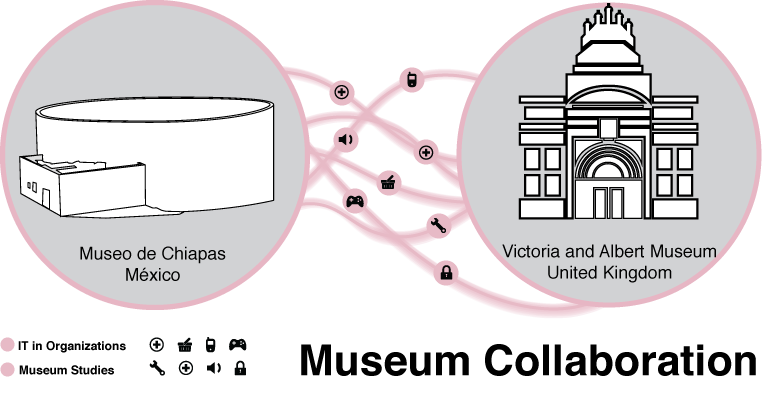
I believe that museums should be able to collaborate with other museums. Not only in their same country but also around the world. The Museums Association (MA), along with The Museums, Libraries & Archives Council (MLA) in the UK, indicates that a museum should “enable people to explore collections for inspiration, learning and enjoyment.”
This means that the cultural motivation or agenda of the museum can be manipulated by different factors like: political, economical, location, etc…
The different agenda that the museum can follow, motivates me to approach the problem from different perspectives and disciplines.
The main two disciplines
Within Web Science, my main two disciplines will be:
- Museum Studies / Museology
- Information Technology for Organizations
Museum Studies
Through the museum studies, I will be attempting to explore the different museum methodologies but focusing mainly on the purposes of the museums and how the response from people. Peter Vergo mentioned in 1989
… too much about museum methods and too little about the purpose of the museum …
(Vergo, 1989: 3)
This indicates how it is not only important the methodological approach wich is directly related to Graphic Design and Visual Communication; which is my area of expertise.
The MLA indicates a basic typology of museums that can be able to target the different approach for the museum purpose within the UK.
- National museums
- Local authority museums
- University museums
- English Heritage museums
- Independent museums
- National Trust properties
- Regimental museums and armouries
- Unoccupied royal palaces
Being a Web Science research, this typology will have to be challenged and extended in order to globalize the museum typology throughout the world.
Through my research I will attempt to develop a new approach of how museums exhibit to their public by extending their exhibition material through different collaborative processes.
Information Technology for Organizations
Within the IT for Organizations, the technology developed can be able to adapted for the requirements of the institution or organization. Through this discipline I believe I can target a different problematic of museum collaboration. Issues like: e-learning, disabled IT access, gaming, security system, etc..
A full technological approach with a sociological combination will allow the research to preview different areas of improvement. Areas in which museums, institutions and academics can be able to benefit from it.
My next step
Throughout the next days I will start to gather the essential bibliography for this research. I will start posting the main theories and methods gathered from these books and start finding people that relate or can be able to collaborate with my research. Ultimately I will like to find some institutions that are keen is promoting these kind of ideas to provide support to smaller museums that are struggling to get ‘out there’.