Archive for the ‘Sociology’ Category
What is Anthropology Part 2: Theories and Fields no comments
Eriksen, T. H., 2004. What is Anthropology. London: Pluto Press.
“The raw material of anthropology – people, societies, cultures – is constituted differently from that of the natural and quantitative sciences, and can be formalised only with great difficulty…” (Eriksen, 2004, p 77). “[Anthropology’s approach] can be summed up as an insistence on regarding social and cultural life from within, a field method largely based on interpretation, and a belief (albeit variable) in comparison as a source of theoretical understanding” (Eriksen, 2004, p 81). Theory provides criteria by which to categorise data and to judge is significance. Anthropology applies theory to social and cultural data.
Fundamental questions
1. What is it that makes people do whatever they do?
2. How are societies or cultures integrated?
3 To what extent does thought vary from society to society, and how much is similar across cultures?
Anthropological theory is deeply tied to observation. Differences in approaches by region: US researchers favour linguistics and psychology and British favour sociological explanations (via politics, kinship and law).
Theory
There are 4 main theoretical underpinnings of Anthropological theory:
1. Structural-functionalism – A R Radcliffe-Brown: Demonstrating how societies are integrated. Person as social product. Ability of norms and social structure to regulate human interaction. Social structure defined as the sum of mutually defined statuses in a society.
2. Cultural-materialism – Ruth Benedict (1887-1948): Cultures and societies have ‘personality traits’.
Dionysian = extroverted, pleasure seeking, passionate and violent;
Apollonian = introverted, peaceful and puritanical;
Paranoid = members live in fear and suspicion of each other. Culture expressed seamlessly in different contexts – from institutional to personal levels.
Margaret Mead (1901 – 1978): sought to understand cultural variations in personality. Her highly influential work on child-rearing, Coming of Age in Samoa (1928) demonstrated that personality is shaped through socialisation.
3. Agency and society
Raymond Firth: Persons act according to their own will.
Pierre Bourdieu: Interested in the power differences in society distributed opportunities for choice unequally. Knowledge management: Doxa = what is self-evident and taken for granted within a particular society; Habitus = embodied knowledge, the habits and skills of the body which are taken for granted and hard to change; Opinion = everything that is actively discussed; Structuring structures = the systems of social relations within society which reduce individual freedom of choice. Important to understanding the causes that restrict free choice.
4. Structuralism – Theory of human cognitive processes.
Lévi-Strauss: the human mind functions and understands the world through contrasts in the form of extreme opposites with an intermediate stage (‘triads’). Cross-cultural studies of myth, food, art classification and religion. Based on Jean-Jacques Rousseau’s observation in La pensée sauvage: “…in order to study Man, one must learn to look from afar; one must first observe differences in order to to discover attributes”. Post-structuralism more in favour today.
5. Primacy of the material – Strongly influenced by historical materialism (Marx). Gives primacy to material conditions of individuals above individual agency or how the mind works.
Two approaches within this area: those that favour economic conditions and those that give primacy to technological and ecological factors.
Julian Steward/Leslie White: Societies grow in complexity as a result of technological and economic change. Change happens in the ‘cultural core’ of technology, ecological adaption and property relations. The ‘rest of culture’ (e.g. religion, art, law etc) is more or less autonomous.
Gregory Bateson (Margaret Mead’s husband and one of the founders of cybernetics – i.e self-regulating systems) – all systems have properties in common: reaction to feedback (or lack of feedback) gives rise to repercussions which ensures the continuing re-imaging of the system.
6. Geertzian hermeneutics – interpretation of the world from the natives point of view.
Clifford Geertz: Thick description = a great deal of contextual description to elicit understanding of data. “…research primarily consists of penetrating, understanding and describing culture systematically the way it is experienced locally – not to explain it in terms of comparison…structuralist, materialist, or otherwise.”
Culture is expressed through shared, public symbols (communication) – so guessing the workings of the minds of those under scrutiny is unnecessary.
7. Eclecticism – a combined approach which recognises the complexity of the world and which attempts to “grasp both the acting individuals and the systemic properties constraining them”.
Fields
1. Reciprocity – the conduct of exchange, fundamental to sociality, crucial to human life.
a) Marcel Mauss – Gift-giving. The Gift (Essai sur le don, 1925). Three roles in gift-giving: obligation to give, obligation to receive and obligation to return the gift. Simplistic evolutionary view of society: i) Universal gift-giving fundamental to social integration (historical) ii) Institutions take on gift-giving role. iii) Marginal role for gift-giving in modern, alienating, capitalist societies. Exchange does not need to be economically profitable. “All economies have a local, moral, cultural element” (Eriksen, 2004, p 88). (Remnants of historical obligation are witnessed in round buying in pubs, dinner party invitations, circulation of second-hand children’s clothing among family and friends, voluntary community work, and Christmas. The potlatch institution (Boas) – where tribes seek to out-do each other in their extravagant wastefulness.
b) Karl Polanyi – Integration: reciprocity, redistribution and market principle. A radical critique of capitalism, directly relevant to ‘economic anthropology’. Rejects the view that people primarily strive to maximise utility (even if it happens at the expense of others). Psychological motivations are influenced by personal gain, consideration for others and the need to be socially acceptable. “Reciprocity is the ‘glue’ that keeps societies together” (Eriksen, 2004, p 91).
c) Marhsall Sahlins – 3 forms of reciprocity: balanced (e.g. tit-for-tat trade – close proximity ), generalised (gift-giving – family and friends), and negative (attempt to gain benefit without cost – strangers). Shows how “morality, economics and social integration are interwoven” (Eriksen, 2004, p 92).
d) Annette Weiner (Inalienable Possessions, 1992) – some things cannot be exchanged or given away as gifts, e.g. “…talismans, knowledges, [secret] rites which confirm deep-seated identities and their continuity through time” (Maurice Godlier, 1999). Cultural identity could be seen as an ‘inalienable possession’.
e) Daniel Miller (Theory of Shopping, 1998) – Sacrifice: women in buying at supermarkets purchase for others to form a relationship with them, and consider the views of others when buying for themselves.
f) Matt Ridley (The Origins of Virtue, 1996) – mathematical models show that cooperation ‘pays off’ in the long run.
2. Kinship – basis of social organisation. Not just family, but local community and work relations.
a) Lewis Henry Morgan – traditional societies thoroughly organised on kinship and descent.
b) Fortes and Evans-Pritchard – acephalous (‘headless) societies in Africa based on kinship-based social organisation. Segmentary system that expands and shrinks according to need – deeply influential in anthropology.
c) Lévi-Strauss – Alliance and reciprocity in kinship relations. Marriage in traditional societies is group-based and forms long-term reciprocity.
d) ‘Modern’ society – tension between family, kinship and personal freedom. Kinship is important in determining career opportunities
3. Nature
a) Inner nature – humans shaped by society and history, but with objective, universal human needs (Malinowski, Lévi-Strauss).
b) External nature – relationship between ecology and society, options are limited by environmental conditions, technology and population density.
c) Nature as a social construction – humans create representations of nature, which is often unspoken or not reflected upon – tacit knowledge.
d) Sociobiology – human actions cannot be be understood as pure adaption. “Research aims to establish valid generalisations about the mind as it has evolved biologically”.
4. Thought – people say what they think or express it through their acts, rituals or public performances.
a) Rationality – Evans-Pritchard’s 3 types of knowledge: i) mystical knowledge based on the belief in invisible and unverifiable forces; ii) commonsensical knowledge based on everyday experience; iii) scientific knowledge based on the tenets of logic and experimental method. Important, possibly unanswerable questions: i) is it possible to translate from one system of knowledge to another without distorting it with ‘alien’ concepts? ii) does a context-independent or neutral language exist to describe systems of knowledge? iii) do all humans reason in fundamentally the same way? Study of Technology and Science (STS) – science and technology as cultural products.
b) Classification and pollution – different people classify and subdivide them in different ways. Mary Douglas: classification of nature and the human body reflects society’s ideology about itself. What ‘pollution’, i.e. food prohibition, tells us about society.
c) Totemism – a form of classification whereby individuals or groups have special (often mythical) relationships to nature. Lévi-Strauss’ distinction between bricolage (associational, non-linear thought) and ‘engineering’ (logical thought).
d) Thought and technology
5. Identification a) The social b) Relational and situational identifications c) Imperative and chosen identities d) Degrees of identification e) Anomolies
Mind map: http://www.mindmeister.com/250242069
What is Anthropology? Part 1: Introduction no comments
Eriksen, T. H., 2004. What is Anthropology. London: Pluto Press.
Fieldwork
Although they “cast their net far and wide” (to provide context for observations), the work of the anthropologist is undertaken primarily through close interaction with individuals and the groups they live within. In-depth, structured interviews are used extensively and the key research method is ‘participant observation’ – the goal being to extensively record everyday experiences.
Concepts and theoretical approaches
Observation and reporting is influenced by the interplay between theories, concepts and methodologies.
Key concepts:
1. Language The human perception of the world is primarily shaped by language. The Sapir-Whorf hypothesis proposes that language is a strong indicator of the world view that different groups inhabit. Studying the language structure (e.g. predominant use of grammar) can provide a good understanding of a particular groups’ everyday concerns.
2. Theories of the person
a) Egocentric. Person as a unique individual, whole and indivisible; responsible for the decisions they take.
b) Sociocentric. Person as a part of a community, who is a re-creation of an earlier human entity and has a pre-ordained role as a member of a social strata within the community (caste). A persons life is decided by fate and destiny (karma and dharma).
c) Ancestor-centric. Person as a unique individual with personal responsibility, but guided by ancestral spirits.
d) Relational. Person is primarily understood through their relationship with others.
e) Gender. The social construction of male/female distinctions, often described through the idiom of female oppression. Perception of oppression is based on personal appreciation. Male domination of formal economy is prevalent, with women exerting “considerable” informal power. Societies experiencing change often demonstrate conflict and tensions through gender and generational relations.
3) Theories of society
Often related to nation state. But each state contains communities, ethnic groups, interest groups, people who work or live together for a long time and have moral relationship. This presents a tension between ‘face-to-face’ society and abstract national society, where face-to-face societies have more permeable boundaries than state, and the state may be perceived as oppressive, corrupt, or remote.
a) Henry Maine (1861):
i) Status societies. Persons have fixed relationships to each other, based on birth, background, rank and position.
ii) Contract societies. Voluntary agreements between individuals, status based on personal achievement. Perceived as more complex than status societies.
b) Ferdinand Tönnies (1887):
i) Gemeinschaft (community). People belong to group with shared experiences and traditional obligations.
ii) Gesellschaft (society). Large-scale society. Driven by utilitarian logic, where the role of family and local community has been taken over by state and other powerful institutions.
These simple dichotomies are no longer followed by anthropologists as distinct boundaries within society are mutable. Power within a state may reside in political elite, but in ethnically plural states, the ethnic leadership may hold sway, or in poorly integrated states, local and kinship grouping may hold greater power than state politicians.
When setting out a study subject, anthropologists describe the scale of the subject (e.g. web use among teenagers in urban Europe).
4) Theories of culture
Possibly the most complex area in anthropology. The classic concept of culture is based on cultural relativism, which has been discredited due to its use to promote particular group claims, discriminate against minorities and promote aggressive nationalism. The key intellectual architect of apartheid was anthropologist, Werner Eiselen (Bantu Education Act, 1953).
a) No definition that all anthropologists agree on. A L Kroeber and Clyde Kluckholn (1952) – Culture: A Critical Review of Concepts and Definitions describes and analyses 162 different definitions of culture.
The concept of ‘multicultural society’ indicates that culture has a different meaning to society – although there are similarities between them and are often used as synonyms for each other.
b) E B Tylor (1871). ‘Culture in its widest ethnographic sense, is that complex whole which includes knowledge, belief, art, morals, customs, and any other capabilities and habits acquired by man as a member of society’.
c) Clifford Geertz (1960s). Interpretive Anthropology – shared meanings through public communications.
d) Objections to concept of culture:
i) Culture as plural can be seen as something that divides humanity, as the attention shifts from uniqueness of humanity to the differences between groups. (Boas – cultural relativism, Malinowski – field methodology, focus on single societies). Expressions of culture are unique and variable – but refer to universal, shared humanity.
ii) Problem of boundaries, internal variation and change. Delineating culture is problematic as there is considerable variation – often more so within groups than between groups.
iii) Mixed cultural forms and transnational flows of culture makes it more difficult to draw boundaries between cultures. Ulf Hannerz (1992) describes culture as flowing, dynamic process rather than static entity – culture as a global web of networks with no absolute boundaries, with nodes of varying density which are more or less stable.
iv) Inaccurate and vague nature of culture. Term used glibly to mean many different things and gives the illusion of insight. To understand what goes on in the world a more nuanced, specific concept is required.
5) Problems of translation
This includes translation of acts as well as language, and is mediated by necessary forms of compression and editing, which implies subjectivity. To understand a group it is not sufficient to simply observe, the anthropologist must learn the meaning and connotations of actions and words. Understanding only comes when a phenomenon is understood and explained in terms of its full meaning and significance to the group under observation – and how it forms part of a continuous whole. The main difficulty comes in translating abstract terms.
Problems: Misrepresentation, inevitable subjectivity of researcher, standard data organisation (gender, class, ethnicity) may not correspond to life-world of observed group.
Criteria for distinguishing good from bad subjectivity:
a) High level of detail.
b) Degree of context provided.
c) Triangulation with related studies.
d) Closeness of researcher to group (e.g. homeblindness).
6) Comparison
A means to clarify the significance of findings through contrasts that reveal similarities with other societies and build on theoretical generalisations. The aim of comparison is to understand the differences as well as the similarities.
a) Translation is a form of comparison – the native language is compared to the anthropologists own.
b) Establish contrasts and similarities between groups.
c) To investigate the possible existence of human universals (e.g. shared concepts of colour) – or to disprove them (e.g male aggression).
d) Quasi-experiment – anthropologists are unable to carry out blind studies, as the results would be inauthentic. Comparisons between two or several societies with many similarities, but with clear differences can provide an understanding of these differences.
7) Holism and context
Within anthropology holism refers to how phenomena are connected to each other and institutions to create an integrated whole, not necessarily of any lasting or permanent nature. It entails identification of internal connections in a system of interaction and communication.
a) Edmund Leach (1954) shows that societies are not in integrated equilibrium, but are unstable and changeable.
b) Fredrik Barth (1960s) transactionalism – a model of analysis which puts the individual at the centre and does not assume that social integration is a necessary outcome of interaction.
Holism has fallen from favour recently as anthropologists now understand that they are studying fragmented groups that are only loosely connected. However contextualisation may have become the key methodology; that is, every phenomenon must be understood within its dynamic relationship with other phenomena. The wider context is key to understanding single phenomena. For example – an anthropologist studying the Internet will explore both the online and offline lives of individuals. The choice of relevant contexts depends on the priorities of the researchers.
Initial Thoughts – Problem and Disciplines 1 comment
I am very interested in the issues of identity within the Semantic Web and Linked Data. Moving from a web of documents to a web of data with URIs (unique resource identifiers) for every referenced object/thing/person, aims to create new links between related content. However what happens when you want to refer to a person or thing which isn’t already referenced? This new object will be assigned a URI and others will then be able to link to it. However, who will manage this data and ensure it is correct? This issue is especially significant when referring to an individual. If someone has no intention of creating an online presence or doesn’t have access to the World Wide Web, what impact will this URI about them have on their life? They might not even be aware that a whole series of connected data about them is being collated on the web for everyone else to access. I am going to look at this area from the point of view of philosophy and either sociology or anthropology.
I have started my research by looking into the recognised strands of each of these disciplines.
Philosophy contains a number of interesting areas which could be applied to this problem. Philosophy of language could look at how the use of language could affect the formation of an online network and linked data, (http://www.philosophy-index.com/philosophy/language/). The political angle of philosophy would be interested in government, law and social justice, (http://www.philosophy-index.com/philosophy/political/). But possibly the most interesting angle would be to look at the philosophy of the mind, specifically the mind body problem (http://www.philosophy-index.com/philosophy/mind/mind-body.php). This train of thought would look at the idea of mind and body being separate and a philosopher could argue that each should have their own URI?
Secondly I want to look at the idea of URIs and identity in relation to cultures and at the societal impact that online identity could have. Sociology could include the social organisation or social change (http://savior.hubpages.com/hub/Areas-of-Sociology).
Similarly to Philosophy, Anthropology could include the study of language, and how this could impact the online community. Linguistic Anthropology looks at the cultural impact on nonverbal communication (http://anthro.palomar.edu/intro/fields.htm). Cultural Anthropology:
“All of the completely isolated societies of the past have long since been drawn into the global economy and heavily influenced by the dominant cultures of the large nations. As a consequence, it is likely that 3/4 of the languages in the world today will become extinct as spoken languages by the end of the 21st century. Many other cultural traditions will be lost as well. Cultural and linguistic anthropologists have worked diligently to study and understand this diversity that is being lost.” (http://anthro.palomar.edu/intro/fields.htm).
This field might look more negatively upon the web, as a tool which is potentially destroying the traditions and cultural diversity, which makes the world so varied.
This is a very brief introduction to the problem and fields which I wish to investigate.
Social Media no comments
This week I took a step back from the disciplines I have been studying and approached some literature on social media. My intention was not to become a social media expert but instead to approach the topic from the perspective of both sociology and politics. I read from one more technical textbook which examined both the structural nature and impact of networks within society; The Network Society by van Dijk, and one more narratively structured book centring on the beginnings, development and impact of the social media giant Facebook; The Facebook Effect by Kirkpatrick. Though both disciplines have a lot to say about each of the books I felt that certain topics and certain disciplines lent themselves well to providing comment on particular issues.
Structure and Sociology
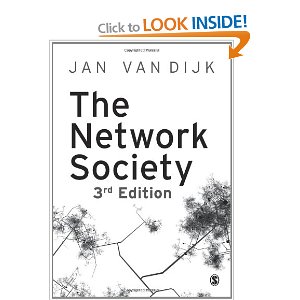
The network society starts as a technically focused book and develops into an interesting sociological account of the impact of networks on everything from economics to social policy. With particular relation to the topics of social networking are the discussions of culture and psychology.
The book outlines a variety of perspectives on the cultural impact of networks and social media. This raises a common theme from the sociological literature with regards to technological v.s. social determinism i.e. whether peoples ‘use’ or technologies ‘structure’ and ‘purpose’ (if we take it to have explicit purpose) drives network development.
Equally, further points can be made with regard to the nature of modernity and social media; each country and even culture modernising at different rates and in different ways. It is not necessarily clear from the text how these interactions of different varieties of social media and/or what we might call the interaction of more ‘developed’ systems/networks have within the context of society. There is plenty of opportunity for interdisciplinarity here with both the social and political nature of Marxism offering some critiques within this context; in particular Weberian Neo-Marxism and it’s perspectivism.
Narrative and Politics

The Facebook effect documents the history of the site and it’s now famous owners. It would be impossible not to draw similarities between the formative processes which the site underwent and politics at large. Whether it be the questionable tactics used to obtain user informations paralleled with government spying for the “greater good” or the internal struggles between the site owners paralleled with every internal political dispute ever; the story of Facebook is undoubtedly one rife with politics. As is the case within the political discipline, Kirkpatrick does a fantastic job of historically recounting these ‘political’ struggles and disagreements even without explicit intention (though perhaps a little editorialised).
But, the book highlights an important feature of social networks and of politics often ignored on both accounts: politics (and Facebook) is not just about the relationship between those at the top and those at the bottom but with every individual at each level and everyone else. This of course provides substantial room for the discussion of the sociological factors that govern such complex interpersonal relationships.
Having reached this point in my reading I feel that I have a reasonable understanding of the basics of each discipline along with the topic I have chosen. My intention for the coming week is to return to my notes first and plan some aspects of my accounts of each discipline. When this process is complete the areas I find to be lacking in depth shall be the ones that are the subject of my further reading to come.
Slowed Progress But Marxism no comments
This week’s reading was somewhat disappointing. I had intended to get through more content however I found that much of what I was reading required a much deeper level of analysis to understand. For this reason, rather than exploring social networks or globalisation; I have focused more heavily on sociology and in particular one of the most famous thinkers to have influence the field: Karl Marx.
Both for Politics and for Sociology, Marx is held in very high regard. Despite how authors feel about the validity of Marx’s views; it is quite clear that most, if not all, commenter’s extend a degree of respect for the man regarding him as a thought leader both in his own time and beyond. Whilst I would have preferred a broader week of reading, the fact that Marx and Marxist theory exists so prominently both in sociology and politics I did not begrudge the topic the extra time I afforded it. I consulted two texts in particular.
Marx, Marginalism and Modern Society

This book offered a good introduction to Marx as a whole, in terms of both his contribution to politics and sociology. The thrust of the argument presented in this text is that Marx’s key contribution was his critique of the political economy. The author presents the case that whilst this was recognised to varying extents in politics and economics; sociological perspectives took longer to entwine themselves with Marxist viewpoints.
On reason for the eventually large scale adoption of Marxist theory within sociology is suggested to pertain to Marx’s views on materialism, in particular; Historical Materialism. The perspective argued that whilst history might have previously separated notions of personhood from thingness, history rather required a deeper account of interactions. For example, dissecting the “things” called institutions into the individual “people” they were made of. This view offers significant importance for sociology allowing far deeper consideration of the people that were previously amorphous entities. Many comparisons can be drawn between these notions and social networking. Not least because of the changing relationships such sites have had with their user bases over time but also at the level of individual users with the structural changes from simple lists of activity to Facebook’s features like “Timeline”. These most certainly can be argued to personalise “events” allowing them to become related much more closely to the individual they are associated with.
Classical Sociology

This book provided a good logical point of development for explaining the development of Marxist sociological theory. In particular it dealt with the ways in which Marxist theory has been modified or adjusted in what has been argued is a necessary process of modernisation.
This notion of modernisation does not reflect technological or social advancement explicitly but rather the sociological ideas about “modernity”. As before, this is essentially the view that different cultures/societies have modernised differently leading to “multiple modernities”. The author highlights that sociologists like Anthony Giddens have argued that modernity changes the social structure and as such requires a post-modern sociology. The means that only theories that account for such changes, only post-modern theories, are sometimes argued to be the only theories relevant to assessments of the modern world. This text’s author however, believes that Marxism exploits a loophole in this argument by way of the additional work done by one Max Weber.
The author argues that Max Weber’s neo-marxism, in particular the addition of Nietzsche’s perspectivism, is the key to incorporating Marxist theory into discussions of “modern” society. Perspectivism is the theory that the acquisition of knowledge is inevitably limited by the perspective from which it is viewed. This is infact a common view within sociology and has significant relevance to the nature of accounts of social networks. Does a persons experience of myspace or facebook vary if they are a “user”, a “business”, a “celebrity”, a “moderator”, a “site owner” and so on. When considered alongside political perspectives this is of course still deeply relevant. The nature of both a person’s position/perspective, the role that position/perspective implies and the power (or lack of power) that it entails all contribute the nature of the interactions they will experience.
For my reading this coming week it is my intention to focus on texts relating to social media. In particular The Network Society.
My Week Of Very Short Introductions no comments
In the previous week I listed several books on politics I was considering as reading for introductory texts. Having looked into each of these; I found they were either very dense in their content or too specific in their details to give a broad enough introduction. Having re-examined recommended pre-reading and undergraduate introductory texts I came across the Routledge “Very Short Introductions” books and the recommendation of one university of the “Very Short Introduction to Politics”.



My initial reading of this text has prompted my decision to change my topic of discussion from “cryptography” to “citizenry on social media”. Having decided on Politics as my topic area over Politics Science; this offers the ability to make a variety of historical comparisons and contrast the developments of states and their relationships with their citizens against the development of social media sites and their relationships with users.
The book gave a relatively detailed account of the varieties of social organisation that have been implemented throughout history ranging from ancient despotism and feudalism to modern dictatorships and democracies. There are clear distinctions to be drawn between different components of these organisations and the emergence of social media. However, it is interesting how the development of end-user agreements and the rights that they hold/with-hold have mirrored some aspect of the development of many political histories.
Not wishing to miss out on a greater level of factual content I also completed readings of “Very Short Introductions” to “Democracy” and “Communism” and intend to look briefly at “Socialism”, “Human Rights” and “The United Nations” to bolster my contextual knowledge. I have also looked into the further reading of undergraduate texts on globalisation with a view to contrasting the interaction and relationships of states with the interactions between and relationships of users with different social media sites.
This week I have also completed notes on the topics of:
Jean Baudrillard
Marxist Sociology
Ethnocentrism
Emile Durkheim
The Chicago School of Sociology
Critical Theory and
Post-Structuralism
I will be looking to do some study on the nature of social media this coming week along with developing my knowledge of “modernity” in sociology with a particular focus on the nature of Post-Modernism.
My Introduction To Sociology no comments
I have chosen the topic of cryptography on the web and the disciplines of sociology and politics/political science (still undecided).
I decided the best way to start the process of research was to avoid looking at my topic in much depth and focus on grounding my knowledge in the two disciplines I’ve chosen. My reasoning was that this would better allow me to think about the cryptography within the context of my disciplines rather than read cryptography first and then need to refresh my understanding within new contexts of my chosen disciplines.
Whilst I am still undecided as to whether I will choose political science (a more theoretical approach to the nature of politics) or simply politics (closer to political history) but I am certain of my decision to examine the discipline of sociology. Having previously been heavily cognition/neurology oriented within psychology and less socially minded I felt this was a perfect opportunity for self development and so the choice of sociology was a ‘no-brainer’. Whilst psychology might be often associated with sociology, being that they are both social sciences, my particular psychological background means sociology is by all means a good distance outside my comfort zone.
I searched initially for “undergraduate sociology reading list[s]” and located an undergraduate reading list from City University London, University of Warwick and Brunel University London all of which touted Ken Plummer’s Sociology: The Basics as providing a sturdy foundation for undergraduate students. As such, this has been my first textbook on the topic of sociology.
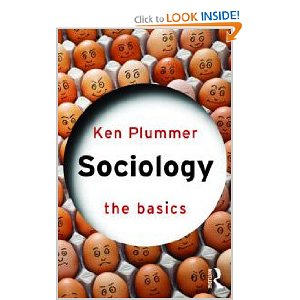 The book establishes a basic description of sociology as a lens through which to view, examine and interpret the world. It is noted that “social” in sociology can have two similar but distinct interpretations. The first interpretations is “social” meaning the social ‘entity’ or ‘agent’. The second interpretation recognises “society” as a cumulative entity comprised of multiple agents. To make an analogy; this is the difference between describing the ways in which individual birds in a flock are influenced by their surroundings and describing the seemingly single entity that all the birds, moving together, appear to form.
In this way sociology offers two key opportunities. The first is to discuss issues such as the nature of culture, religion, ethics and any facet of social life in an both an abstract and society wide sense. The second is to allow for observations to be made of the ways these abstract concepts may influence the social world of the individual agents. In this way the discipline of sociology appears to be inherently interdisciplinary in and of itself; drawing on everything from medicine to theology in order to adequately represent the complex nature of social interactions.
I have encountered several topics of interest that I will research further:
Modernity: the discussion of the sociology of “modern” societies. In particular the idea of “multiple modernities”: as societies have advanced together technologically many have diverged in their modernisations forming new cultural and societal differences. The ways in which these differences interact with differing modernisation is the subject of this specific approach.
Discourse/Discourse analysis: The approach of analysing communication. This can be done from a variety of perspective to achieve ends. These ends include making theories about the interactions of humans or to further contextualise cultural expression within a wider societal context.
I am looking into what politically oriented undergraduate text would offer the strongest foundation and have identified several potential candidates using a similar approach of consulting University undergraduate pre-/reading lists:



Future Society VII no comments
It’s great that people are becoming more aware of these problems:
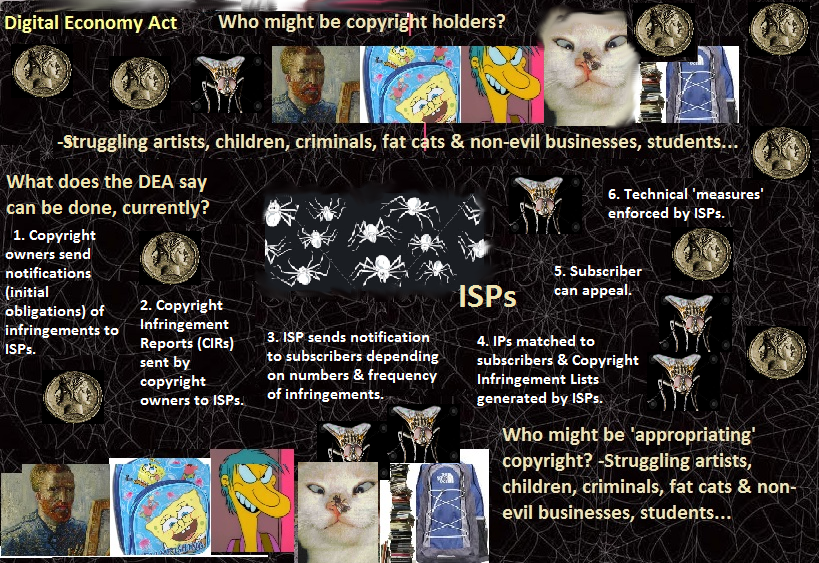
Quick Digital Economy Act Scribble no comments
Have just been reading up on the Digital Economy Act, and its various ramifications. I have created a scribble that seems to me to show one of the key points – that only jumped out at me as I was doodling – that once again, the web has made Januses of us. I think that most of us are both copyright holders and copyright ‘acquirers.’
And in this case, the ISPs aren’t necessarily bad – if you are a struggling writer, musician or artist then if they are called upon to help you protect what you would think of as yours, you’re not really going to complain. (Speaking as someone whose household gets to buy stuff from royalties coming in from the British Performing Society.) However, most struggling artists, musicians and writers are (perhaps because they’re struggling , perhaps because it’s part of the creative process), also avid ‘collectors’ of what they might not necessarily have paid for… Obviously the issue is far more complex than this.
Certainly BT and TalkTalk have requested the review because of concerns about privacy (n.b. BT and TalkTalk took up a diametrically opposite stance on this very issue when it came down to Phorm and RIPA – perhaps they are now more wary of some of these issues). It certainly brings to the fore the issue of what is property on the web, what is private property on the web, and how far a government should allow intrusion into people’s lives in order to monitor or recover what might be defined as private.
John Stuart Mill wrote:
‘The things once there…mankind, individually or collectively, can do with them as they please. They can place them at the disposal of whomsoever they please, and on whatever terms…Even what a person has produced by his individual toil, unaided by anyone, he cannot keep, unless by the permission of society. Not only can society take it from him, but individuals could and would take it from him, if society…did not…employ and pay people for the purpose of preventing him from being disturbed in his possession..’ (From Heilbroner, p.129).
Mill saw that the principle of private property had not had a fair trial, and that reform could make changes to outdated laws, without recourse to outright revolution. He feared that Communism would stifle individual thinking and feared ‘whether there would be any asylum left for individuality of character; whether public opinion would not be a tyrannical yoke; whether the absolute dependence of each on all, and the surveillance of each by all, would not grind all down into a tame uniformity of thoughts, feelings, and actions…no society in which eccentricity is a matter of reproach can be in a wholesome state.’ (Heilbroner, .p132).
The doodle is JUST a doodle, it’s not good graphic design and it’s very messy.
Future Society VI no comments
The only constant is change. Heraclitus, 500 BC
A global crisis was predicted by Prof Beddington at the Sustainable Development UK 2009 conference because of the 50% food and energy jump, rise of 30% of fresh water need and climate change by 2030 when the population will reach 8 billion. The United Nations Environment Programme predicts widespread water shortages across Africa, Europe and Asia by 2025. The amount of fresh water available per head of the population is expected to decline sharply in that time.
In the introduction of the Future Society envisioned by the Science Community report the following problems are identified: In its “Japan Vision 2050”, the Science Council of Japan (SCJ) points to “global environmental degradation”, “population growth” and “the widening North-South divide” as major global problems of the 21st century that seriously threaten the sustainability of human society. As a way of solving these global problems, the SCJ proposes that steps should be taken to achieve a “balance between environment and economy“. In recent years, the creation of innovations has been attracting interest in many countries. This is due to the expectation that breakthroughs forged by science, technology and innovation could solve these major global problems of the 21st century, and could achieve sustainability for humankind.
The ideal society envisioned in the year 2025 will be a society in which people can live in health and safety, a society in which highly advanced information technology (IT) systems are widely used, a society in which Nature has been restored and local communities revitalized, a society in which efforts are made to solve the problems of the global environment and energy, and a society in which a suitable response has been found for the problems of water and food supply. This Report highlights innovations that should be promoted with a view to realizing this vision.
The suggested solutions are presented in 2 chapters out of which we only selected some of them:
- The ideal society of the future and the innovations to be promoted
To achieve a society in which everybody can live in good health by the year 2025, society will need to be given the means to address the problems of declining birthrates, aging and population shrinkage.
Biotechnology, information technology, and others must be integrated with a view to creating innovations that offer sufficient levels of medical and health care.
Here, I must add my short article written for the Bionanotechnology lecture about this life-saving technology.
By integrating the development of artificial rainfall technology, desalination plants powered by solar batteries, water-retentive gel technology, and others, it will be possible to prevent desertification and create green areas in deserts.
By launching satellites that can convert solar energy into microwaves and transmitting those microwaves to Earth, photovoltaic power will be generated in outer space and the power used on Earth as a clean and efficient form of energy.
A voice-recognition portable automatic translation device will be developed to assist smooth communication between people from different parts of the world, greatly enhancing cross-cultural understanding.
2. Conditions, environments and systems for creating innovations
Deepening our understanding of science and technology, investigating “social
technology” and the nature of systems that allow science and technology to fully demonstrate their social character
Teachers’ ability to pass down the pleasure and fun of learning to their students should be fostered