Archive for October, 2010

The end of Week One

Friday, October 15th, 2010

It’s the end of week  1 and I’ve got this incredible feeling of being behind in blog posts already! In the past, such a feeling would cause me to write off the blog as a bad job, chastise myself for my lack of follow through and that would be the end of that. I’m going to try and keep at it for a while longer this time!

I had a mini-supervision on Monday and had my first proper, scheduled supervision today. It was good fun, but I hadn’t achieved much in the 4 days between the two meetings.

My Monday meeting left me with a stack of notes to work through. One of the most helpful things I got out of the meeting is that a PhD (mine at least, your supervisor my vary) will consist of roughly:

  • one third idea,
  • one third implementation and testing and
  • one third evaluation.

I quite like having that vague road map in my mind. It doesn’t directly relate to the time I’m going to spend on each (though a three year PhD would divide nicely into those!)

I got a few other pointers and had some questions answered. Reading (i.e. around the subject) has the potential to be a big issue for me. My third year project literature review was weak, weak, weak and it caused me a lot of stress. I’m determined to minimise any issues with it this time round. That said, I haven’t got very far! 😀 I’ve made the decision so far that I consider a paper “read” when it has been logged in JabRef and I have written a little review. So far, I have started reading two papers…. hmm

When it came down to what I should be doing for this first week, I was delighted that my tentative suggestion that I might be allowed to try making a competence structure (the topic of my PhD) was enthusiastically embraced, rather than shot down as I had been expecting. I’m also heading off to a workshop in Telford about competence structures and ePortfolios, so I sorted that out.

Tuesday and Wednesday were spent on PhD admin (more forms!) and working on my competence structure. I got kind of ill this week, coughing and sneezing and speaking with a silly voice. Damn Freshers. It mostly affected my Thursday and Friday; it’s slowing me down and clouding my thinking, so I haven’t been doing stuff that requires much brain power!

I’m looking forward to beating this cold over the weekend, going to a wedding of one of Russell’s family friends and bringing our beautiful new kitten home with us on Sunday!
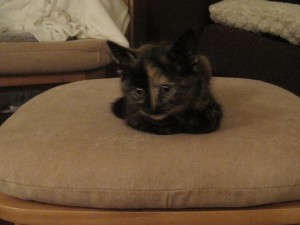
Our new kitten

Our new kitten

http://en.wikipedia.org/wiki/Elevator_pitch

Emerging from the whirlwind

Thursday, October 14th, 2010

I’m officially on Day 4 of my PhD! Woo!

The last 7 days or so have been a bit of a whirlwind of activity. I’ve been inducted, properly started my PhD, had one proper supervision and several strange conversations. I’ve filled in forms and signed up for courses. I’m still filling in other forms. I’m sorting out attending my first PhD-related workshop, I’ve marked one set of the Comp1004 Labs, and have met my liaison group of masters students. I’ve been to 5 or so sessions of Kempo and have been trying to keep on top of house work and shopping. The icing on the cake is I have caught something nasty from the freshers. Phew!

Bibliography and Word Processing

Saturday, October 9th, 2010

As I understand it, a big part of a PhD is getting to grips with the surrounding literature. I want to share my initial set up for my bibliography and reference management, and then keep you posted as it changes over the course of the PhD.

Note: This isn’t a full discussion of all the options available, it just introduces the ones I’ve selected (LaTeX and JabRef). Please comment and let us know what you are using and how it is working out for you.

We can’t discuss reference management unless we also discuss what we are managing the references for. I’m thinking a little more detailed than “For my write up”. Let’s think word processing software.

The big word processing contenders for me (on my Windows 7 box) are Word 2008/2010 and LaTeX. If you haven’t come across LaTeX and you are doing a scientific PhD, then you will meet it. I shan’t introduce LaTeX here; I don’t really know much about it, and there are much better guides on the Internet. I’m probably going to use LaTeX, to start off with anyway, and see how it goes.

Using LaTeX implies that I’ll be using BibTeX to store my references. I asked around in the lab and Charlie Hargood explained that he uses JabRef to organise his. After a few searches and research, I decided to give JabRef a try too.

The first thing Charlie warned me about was what fields can show up when you import your references to your paper. So, check out below:The fields shown for a JabRef InProceedings entry

See that nice looking notes field at the bottom? Doesn’t it look like just the right place to put your notes as you read the paper? Don’t do it! Apparently some styles in LaTeX use the BibTex notes field and you may find your scruffy, scandalous notes in your paper 😀 Save it for the Review tab further along that tab menu.

JabRef allows you go link to the source of the paper, i.e. a file on the www or on your hard disc. I’ve got quite a few papers on my machine now. Rather than try and structure them in folders within folders, I’ve got them all in one folder and am simply linking JabRef to them. If I want to reread them, I’ll find them via JabRef rather than some weird structuring rules of my own.

Please write in and tell me what you are using for both your word processing and for your reference management. DB has been using a mac program called “Papers” and gets a lot out of it. Any other contenders for your attention?

Shorinji Kempo, first session

Wednesday, October 6th, 2010

During my undergraduate career I found, for various reasons, that I was unwilling/unable to take up some of the clubs etc that I wanted to. Now that I am in my postgraduate years (that still sounds weird!) I am looking forward to persuing a Martial Art, something I have wanted to do for a long time. I’ve chosen to attend Shorinji Kempo.

I went to my first session last Thursday after looking them up online. Turns out they weren’t expecting freshers to that session, so I was the only newbie there. As it happens, I am very grateful for that circumstance. I got to meet the current students for longer and in more depth than I would have if my first session had been with the freshers. I especially liked meeting two of the other existing female members – one finishing her PhD and one starting. It was nice to have something in common.

I then attended the first official session with the rest of the beginners. It was really fun and I’m looking forward to persuing this through my degree 🙂

How do I actually read a paper?

Saturday, October 2nd, 2010

Perhaps I’m over-complicating the issue, but I’m finding it really hard to sit down and read papers. I feel like I want to be able to read, take notes, make a mind-map, evaluate and summerise the source all at once. Clearly, not going to happen.

The process of iteration in programming has always come naturally and seemed logical to me. The process of iteration in real life and project managment has not. Design (of a coding project) as an iterative step never really made sense to me until my third-year project ended up being a pile of poo halfway through. Iterative design and coding really made my summer project much smoother and enjoyable. Iterative house cleaning (a la flylady-style ) keeps our home from being a sty with not too much concentrated hard-graft.

I need to translate those iterative skills I developed to the process of reading academic papers.

This resouce sums it up nicely:

…the contents of an academic article cannot be grasped by a single reading. You have to engage with it several times – but in different ways.” (from http://www.lenmholmes.org.uk/students/how2read/how2read_b.htm <- Good resouce, a bit too indepth but I’d  recommend for ESL students)

Engaging with it several times == iteration.

So, right now I am going to hop in the bath with my eReader (I’ll be careful 😉 ) and do a first pass over a few papers. I’m not going to do any reviews or make any/many notes. I’ll do that on another pass.

Do you have a method or a process that you follow for reading academic stuff? Or are you as lost and resistant as me? Fill up the comments and share where you’re at! 🙂

Oh, the negatives

Friday, October 1st, 2010

I like doing pre-task research, it is fun busy-work that gives me the illusion of being productive 😉

So, for the past while I’ve been prepping for PhDness with google searches, reading other blogs and personal admin like clearing off the archivable undergrad stuff from my machine and setting up my bibliography software.

I’m covering some of the results of my searches here. And my word, some of them are just mightily depressing.

Should I go to graduate school?

Short answer: no.

Long answer: maybe, but only if you have some glimmering of what you are about to do to yourself.

So sayith http://www.swarthmore.edu/SocSci/tburke1/gradschool.html

Or how about:

I started to feel that I was never going to be able to produce work that I was going to be happy with – that I was never going to find the answers that I was looking for. Then followed a few months of highly self-destructive behaviour when I felt that I was starting to fail, followed by a few months of anti-depressants and then the final realisation that if I was going to complete my work it would take me years of penury and misery and that I was likely to have problems finding any kind of employment afterwards. And then the realisation that I no longer had faith that the work I was producing would have any kind of impact or be taken in any way seriously. And that’s when I decided to quit.

from http://www.plasticbag.org/archives/2004/07/what_you_should_know_before_starting_a_doctorate/

Or indeed:

Why? Completing a Ph.D. is a long, hard road with many potholes and washed out bridges along the way. You may run over some land mines and have to stop and turn around and explore other routes. If the goal is important enough to you, then these obstacles will not prevent you from completing your journey. But if you don’t know why you are on this road, then you will get discouraged and will probably leave without finishing, having wasted years of your life.

which is quoted from http://www.cs.unc.edu/~azuma/hitch4.html which ends pro-PhD and any new PhD students should go read it. Now. But come back afterwards.

Wasting years of life for nothing. Hating the job you get up to do each morning. Losing touch with friends and neglecting your family. Loneliness. Complete loss of motivation. Isolation. Loneliness. Feeling left behind your peers as they spend their parallel years climbing ladders, earning wages or setting up their own businesses. Graduating and then being overqualified for jobs.

Ugh, the list goes on, and it is a doleful selection. But I think it is really important to know the downsides of a PhD before starting, so you can mitigate and/or accept them. The ones I am particularly struggling with:

  • A PhD is unlikely to get me much more money long term than a Masters. The three years of stipend compared to peers’ wages sets me back a long way at the start, and I’m unlikely to ever really catch up. If Russell does the PhD  too, then neither of us are going to be earning much anytime soon. I envisage us starting a family after PhDs, so that will then knockout my earning power for a while too.
  • A PhD is not a toolbox degree like a BSc or a MSc, i.e. one you use to get on in life and get “any” job. A PhD is a career choice. Starting a PhD is saying “I want a career in academia”. A BSc will open doors, a PhD open a few obscure, interesting doors but will close most of the ones opened by B/MSc.
  • I am comforted by the fact that I can stop after my mini thesis and graduate with a MPhil. I would not enter a PhD programme if the MPhil was not an option I could take.
  • Isolation and Loneliness scare me, and if I were to predict the main challenge that I am going to face, loneliness will be it. I don’t know how to deal with it yet and that terrifies me. I hope to learn and share ideas in the future.

So, there are lots of downsides to be aware of, but being aware of them is the first step to dealing with them. Knowing your own answer to the Big Question, “Why do you want to do a PhD?” will help.

What are, or, have been, your biggest challenges in your PhD? How did you cope? What other downsides should people be aware of? Let me know in the comments.

Registration. As exciting as it sounds

Friday, October 1st, 2010

We were asked to attend registration today. I wasn’t expecting much, but I found it was even less of an event than my modest presumptions. We turned up individually, throughout the day, waited at a table til we were called forward, confirmed our name and were given a little satchel of freebies (a mug, a post-it note stack and a pen. I returned the mug; we own several already). We were also given a file of information, forms to fill in, and a booklet of guidance dated 09/10.

The information within the file mostly pertained to the “Postgraduate Induction Fest”, a two-day event at the end of next week. This will include, amongst other events, a tour of the campus, an introduction to ECS and a presentation on Library facilities.

While I recognise the importance of this for new-to-Southampton students, I can’t stop the sinking feeling that parts of this “Fest” will be numbingly boring. However, I am a strong believer in a situation being as good (or bad) as you make it and I look forward to the chance to meet new people starting out on this journey.  I am looking forward to Rikki Prince‘s talk “Welcome to your studies” and to the “Supervisors Panel”.

I’m kind of frustrated at the very slow pace of starting. Freshers week started Monday and we heard nothing new from admissions. We turn up today and find out the action doesn’t start for a week. I am well aware that I can be getting on with reading and reviewing literature, and I am, sort of (not really *blush*). I long for a bit more input, an official nod to start the race. I desperately want to meet my peers, but without email lists or any idea of the “who”, I’m not well placed to arrange any “when” and “where”s! Anyone else feeling this? 😀

However, I did see both #1 and #2 supervisors today and had forms filled in and signed with intentions to submit them tomorrow. That was reassuring and catching up with them was fun. My supervisions have been arranged for Friday at 11am, which means Friday afternoons will be devoid of work 😉 I will have to find something non-intellectual, fun and productive to occupy that time – I’ll keep you posted on that! 😀

Joes Leaving Do

Friday, October 1st, 2010

One of the fantastic things about LSL is the sense of community. Today we lost (to the voluntary severance program) the Web Designer for ECS. Joe Price is a fantastic chap, set up this blog for me, (fixed it when I broke it) and is generally an all round nice guy. We wish him success.

In honour of the (5) years of service that Joe has giving LSL, the customary “Coffee and Cakes” event was put on. Whenever anyone is leaving the lab, a card is circulated in advance, with or without a whip-round envelope. People sign the card and optionally pop a pound or so in the envelope. A well-meaning associate is tasked with purchasing a gift. On a convenient day, the lab gathers in a pleasant public area, adjacent to the lab, known as the “Airport Lounge”. There the grateful recipient is informally toasted, presented with gift and card, everyone claps and we all eat cake. It’s a small break from the day, but it invokes a strong sense of community amongst those who value it.

A publicly known birthday is also celebrated with a card, but culminates in a flashmob descending upon the aging recipient, singing “Happy Birthday” in various keys and with myriad tempos. The Birthday Girl/Boy (delete as appropriate) makes a small speech, often no more than a squeaked “Thank you” and reads their card, taking care to exclaim on the thoughtfulness of the picture on the front. Everybody claps and laments the lack of cake.

Such little demonstrations of community and care, (though described in a cynical tone by me; I’m tired, shoot me) are one of the wonderful things about being a part of LSL. There are many others I may expand on in other posts: the willingness to help one another, LSL lunch, the high quality banter, international diversity, student seminars, the Head of Group’s expertise in wines and his willingness to share…

Joe’s leaving do today inspired me to share about the customs used to give him a good send off. All the best Joe!