Archive for the ‘Uncategorized’ Category
Anthropology 101 – Definitions and a brief history of the discipline no comments
This week I have looked at the discipline of anthropology. In order to get a good introduction I still found is useful to read a few different introductory texts as each presents the discipline in slightly different ways. Here is what I found about anthropology as a discipline.
“The most scientific of the humanities, the most humanist of sciences”
Eric Wolf (in Erisken 2010, p. 1)
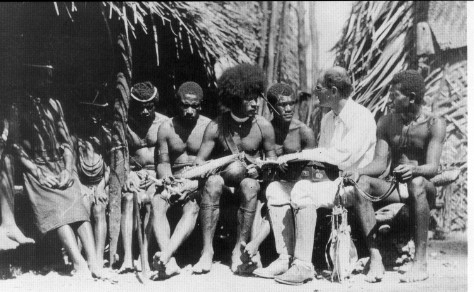
Source: http://markandrews.edublogs.org/page/2/
All the authors reviewed place anthropology at the intersection of social sciences and humanities. Peoples and Bailey outline 5 subfields of the discipline: physical/biological anthropology, archaeology, cultural anthropology, anthropological linguistics and applied anthropology. For the rest of this project, I will equate anthropology with the cultural anthropology subfield, which is also sometimes known as cultural and social anthropology (to satisfy both the American and British strands which emphasise culture and society respectively (Monaghan & Just, p. 12)). Eriksen defines anthropology as ‘the comparative study of cultural and social life’, with a focus on the ‘whole of human society’. He states that the discipline is about ‘how different people can be, but it also tries to find out in what sense it can be said that all humans have something in common’ (Eriksen 2010, pp. 1-4). This latter aspect of the discipline is highlighted in all three readings as something deeply fundamental.
Before proceeding to consider the approaches and methodologies of the field, I thought it would be useful to go through a brief history of anthropology, to emphasise preconceptions and misperceptions. Eriksen (2010, p. 10) notes its recent origins as an academic discipline during the late nineteenth and early twentieth century. All the authors reviewed recognise that there is a romanticised version of the anthropologist as the intrepid explorer, out to discover and study ‘unspoilt’ societies. This, they agree, might have been true until the 1970s when all of this changed (Peoples & Bailey 2000, p. 6). The traditional focus of anthropological research on, small, non-Western, ‘exotic’ societies (to demarcate it from the discipline of sociology which traditionally focused on large, Western ones) was abandoned and topics such as American bodybuilders, the decline of the middle class and family life at Silicon Valley now form part of contemporary anthropological research projects (Peoples & Bailey, p. 6). This, coupled with the fact that anthropology is no longer the prerogative of Western scholars, is important to note in our study of the discipline itself, but also of its perspective on the topic of the global digital divide.
Next week I will present the various approaches and methodologies prevalent in the field.
References
Eriksen, T. H. (2010) Small Places, Large Issues: An Introduction to Social and Cultural Anthropology 3rd edition, New York: Pluto Press
Monaghan, J. and Just, P. (2000) Social and Cultural Anthropology: A Very Short Introduction, Oxford: Oxford University Press
Peoples, J. and Bailey, G. (2000) Humanity: An Introduction to Cultural Anthropology, 5th ed., Belmont: Wadsworth/Thomson Learning
Moral Philosophy and Politics: An Oblique Perspective of E-Mail Hacking no comments
With an initial plan to scour the world for an insight into email hacking from the viewpoint of economists and psychologists, it suddenly came to me that I would be playing too safe a game. With Marketing being a subject so diverse and multi-disciplined, that encompassed areas of psychology in buyer behaviour and economics in statistics analysis, it seemed I had bound myself to a study area that appears difficult to steer away from wholly.
As our world is overrun by hackers and a growing abundance of readily made hacking software and programmers keen to get their hands on whatever they seek it seems bizarre that we still are ready to advertise ourselves on the likes of Facebook, Twitter and many other ‘self-branded’ web sources. The web is such an intrinsic part of our everyday life that we become so wound up in its beauty that we are unaware of any imminent attacks on our personal data.
From e-mail to database systems, from banking to business data, we are inundated with those who wish to hack into our lives for every penny and every piece of information that we hold dear. From recent personal experience, I had been faced with the dilemma of attempting to redeem my own personal e-mail account from those who ‘hacked’ it. I believed this to be an arduous task that is morally, socially and, potentially, financially unacceptable. After this event, I felt that I would like to pursue an understanding of it from a different perspective and realised that this would be the perfect opportunity to do so.
I have now chosen two very different subjects: moral philosophy and politics. From my initial understanding of moral philosophy is an ethical analysis of the self, and the awareness of ethical (mis)representations of action or communication. From further reading, it is believed that moral philosophy is dependant on a number of different issues including cultural values, heritage, environment and obligation (Schneewind, 1992). The cultural values specifically interest me as it is not without doubt that the varying cultures will determine various perceptions of what is morally acceptable.
My second subject is in politics, which a subject that can both be the cause and consequence of societal change in any nation. This subject helps to define our understanding of culture, psychology, finance and communications and reveals itself as a tug-of-war between power and peace (Morgenthau, 1993), greed and ethics. Furthermore, it can help to define a nation and its outlook on the rest the world through the ideologies of various political leaders whether in a dictated land or otherwise.
It appears that subjects would have, although different, solid perspectives on communications hacking and extenuate the need for this issue to subside. I will follow up my research by looking into how moral philosophy develops according to nation, race and culture. I will also seek further knowledge of political advances on e-mail hacking, whether they use it for unfair advantage or whether it is heavily moderated.
Guyer, P. (1992). The Cambridge Companion to Kant. Cambridge: Cambridge University Press
Morgenthau, H.J. (1993). Politics Among Nations: The Struggle for Power and Peace. Boston:McGraw-Hill
Psychological Astronomy related to the web no comments
Originally I was going to learn about Psychology and Geography and see if I could combine these disciplines to the Arab Springs or the Dark web. At first it was going well and I learnt about psychology and developed my understanding about the subject as a “science that seeks to understand the behaviour and mental processes and, to apply that understanding in the service of human welfare” (Bernstein and Nash, 2002, p. 3). Within the textbooks I found there were a number of interesting sub topics that I thought could be related to my ideas. Specifically:
“Engineering Psychologists who study and try to improve, the relationships between human beings and the computers and other machines they use” (Bernstein and Nash, 2002, p. 6).
However I thought that this was already specific enough for the study of web science and wouldn’t offer much scope to creatively combine relatively new disciplines. I was nevertheless occupied with the idea of cognition within Psychology, which “emphasizes mechanisms through which people receive, store, retrieve, and otherwise process information” (Bernstein and Nash, 2002, p. 17). Carlson et al. (2007, p.7) elaborates on the idea of the cognitive psychologist: “the events that cause behaviour consist of functions of the human brain that occur in response to environmental events”. This idea of behaviour being affected by the way that the human brain responds to information to do with the environment is particularly interesting. Furthermore, social cognition “involves our perception and interpretation of information about our social environment and our behaviour I response to that environment.
Already my study of psychology has led towards an environmental concern and obviously there are obvious overlaps with the discipline of Geography. For example, “humanistic geographers were concerned with the meaning that a place conveyed o an individual or, as it has been called, ‘a sense of place’” (Bradford and Kent, 1993, p. 9). Thus I decided to drop Geography and choose Astronomy instead.
“Astronomy is the only one of the sciences which gives man some knowledge of the entire visible universe” (Fath, 1955, p. 1) and is thus an interesting subject to combine with psychology. Since the Web is considered a virtual world which is invisible it is interesting to use an astronomical approach to explore the Web. Astronomers use light “to understand what is happening in the rest of the universe” (Holliday, 1998, p.1). Astronomers use light and similarly, web users use code.
The dominant research approach in Astronomy is through observations. Since the internet cannot be seen directly this mode of approach is problematic. In the following weeks I will explore how the web can be seen as a psychological world by which astronomy can be used to see the ‘real’ effects of this world.
EWI: Philosophy and Law no comments
So I had a bit of a read this week around some of the philosophy texts. There are a number of different ways of interpreting or describing how philosophy is divided up into a discipline. This is, I suppose, a consequence of what philosophy is like in general. Philosophers hardly ever agree on anything, even when it comes to describing what it is that they do. Some people think that all of philosophy can be divided into two basic categories: realism, and the rest. Realism is the view that there is stuff that is real. The rest is, well, lots of other things. However this way of dividing up philosophy is controversial. The Cambridge philosopher Siumon Blackburn for instance in his book ‘Think’ suggests that it is perhaps not very helpful to divide up philosophy as a disicipline into these neat little categories. It is rather too dependent on the ability to taxonomise the arguments that are actually made. But there is no objectively correct way to do this that everyone can agree on. A philosopher’s job is to think about stuff. No wonder they can never agree on anything, including their own job description!
An alternative way of dividing up philosophy is to describe the different kinds of subjects that philosophers look at. This taxonomical approach has the advantage that it does not try to divide up philosophical approaches according to the arguments that are made: it is merely divided up by subject, not by the views taken on that subject. For instance, we might say that there are philosophers interested in questions of epistemology (knowledge), logic, politics, aesthetics, metaphysics, morality, and so on. This way of dividing it up does not say anything about what views the philosophers are taking on these different questions. So you could have the realists and the non-realists all lumped together into one category: the question of logic, say. However there are also problems with this way of describing philosophy as a discipline. Many of these areas overlap into each other, and there doesn’t seem to be any particularly objective reason, other than the causal whim of the observer, why we would divide these categories up in this particular way rather than any other.
From a personal perspective, I am inclined to describe the subject of philosophy in the way that it is often divided up in the university faculties, and the way that it is often divided up in the textbooks. You have things like philosophy of religion, philosophy of science, philosophy of language, philosophy of politics, philosophy of history, and so on. The discipline doesn’t have to be divided up this way necessarily; it just happens to be that it often is.
The particular area of philosophy that I am really interested in for this course is philosophy of law, and especially how this speaks to the internet. To some extent internet is still in its formative period. This is a time when internet legislative and constitutional precedent does not yet exist for the most part. So now is our opportunity to try to make decisions about what these precedents should look like. This is an area that I have never studied before and while there is a large amount of literature of philosophers commenting on law and legal procedures (sometimes known as jurisprudence) I do not know whether there is any substantial commentary by philosophers on internet law specifically. I did find one book by the philosopher Gordan Graham, ‘The Internet: A Philosophical Enquiry’. The book is quite out of date unfortunately (1999) but it is the only text I have been able to find so far on this subject. In general I liked the book and would recommend it. It is reasonably well written, though it is very wide-ranging and swings from one thing to another. But I think this is OK. Graham talks a little about the history of the internet, some of the technical aspects (not so relevant now perhaps) and puts this in the context of the history of technological development generally. Then he really lets it rip and has lots of fun talking about obscure and pretty much unrelated things like democracy and the internet (offering a dashing sweeping critique of democracy along the way), the nature of reality (is the internet a new form of ‘the real’?) and questions of the changing human experience (what has internet done to human individuality and community?). While this does seem a little bit all over the place, I think there are many really interesting ideas in here. The main point I take away from the book is the question of: to what extent should law on the web be different from law in the ‘real’ world (by which I mean the world off the web)? I mean, laws in the non-webby world are supposed to legislate over non-webby things, right. But the question is, how great is the disparity between webby stuff and non-webby stuff? And how great is the disparity between webby law and non-webby law? At this early stage, I am inclined towards the view that perhaps the disparity is a very big one indeed, much bigger than we had thought. This is something that we should probably find quite disconcerting. Do we need a set of laws for the ‘real’ world, and another set of laws for the virtual world that we have created?
AI: Notes to week 1 no comments
Artificial Intelligence from the point of view of philosophy and compsci: Initial Reading/Findings
René Descartes – Discourse on Method and the Meditations
Computer Science: An Overview 11th Edition – Glenn Brookshear
Philosophy and Computing: An Introduction – Luciano Floridi
Started off by reading Brookshear, which was pretty clear and basic. Also looked into the Descartes, which is fairly basic philosophy and might be a little too general, but has some good points about reason and the mind. Philosophy and computing has a chapter on AI (hard and soft), and is more advanced/specified.
Notes on Brookshear –
So you get an agent, which needs to respond to environmental stimulus. Some of this is easier than other to programme, and how much of it actually indicates ‘intelligence?’ Like a plant grows towards light as a response to stimulus but that hardly makes it intelligent or aware. That said, human behaviour could also be a collection of stimulus responses that have evolved (respond correctly = survive to reproduce (1) respond incorrectly = die (0))
The Turing Test has, by now, pretty much been passed. What does this indicate?
There are some things which computers find really hard to create an appropriate response to; things which are super easy for humans, for example interpreting visual information and also double meanings in sentences. There are various ways to try to get around this, such as semantics webs constructing context in order to generate appropriate ‘understanding’.
Some people argue that computers will never be properly intelligent in the way that humans are, but others argue that the brain is just lots of different components performing different tasks, which a computer kinda is.
Also Strong AI and Weak AI are different. Should probably concentrate on just one as I only got 2500 words here.
It’s hard to get agents to reason. You can give them a goal though.
Inference Rules allow new statements to be made from old ones p475
And then there’s Heuristics (getting something/someone to learn for itself/themself)
“Another approach to developing better knowledge extraction systems has been to insert various forms of reasoning into the extraction process, resulting in what is called meta-reasoning – meaning reasoning about reasoning. An example, originally used in the context of database searches, is to apply the closed-world assumption, which is the assumption that a statement is false unless it can be explicitly derived from the information available.”
E-democracy: what political scientists and computer scientists can do no comments
The increasing presence of the Web in society has put forward the possibility of new models of democracy that can overcome certain pitfalls of the existing ones. These imperfections range from a lack of engagement of the population to a lack of popular power of decision. Using ICTs for an electronic voting system could become an inexpensive and effective way of enacting a more representative democracy in which a wider range of the population can take part in the political life of a state. Therefore, a thorough analysis of the feasibility of this alternative should be conducted from both socio-political and technological perspectives.
Some limitations of this alternative such as cyber-security issues that could facilitate electoral fraud or issues of competence of the population in certain ‘sensitive’ decisions have been put forward in several debates on this topic.
This essay will attempt to explain how the collaboration of two different academic disciplines, namely Political Sciences and Electronic and Computer Sciences can address two issues on which the essay will be focused. One is an alleged ‘digital divide’ that could leave apart certain sectors of the population that cannot access a connected computer or do not have the skills to vote electronically. The other one has to do with the above-mentioned technical problems related with security that can arise from the use of this voting system.
To do this, I will start looking at how political scientists analyse public participation in democratic systems by reading a textbook on democracy and a report for an independent enquiry institution.
The book is titled Models of Democracy, written by David Held (2006). It is a suggested reading for a unit in the Politics and International Relations degree in this university, called Democracy and the Modern State. I expect find there what methods of enquiry are the most commonly used in this discipline.
I am also reading a report for the Power Enquiry by Graham Smith, the title of which is Beyond the Ballot: 57 Democratic Innovations from Around the World (2005), where I also expect to find out how this discipline analyses current political phenomena and tackles the questions raised in the assignment.
The ‘technological side’ of the issue will be looked at a few weeks later.
The intention in the assignment is not to ‘answer the questions’, but to show how these two disciplines can work together towards it. Therefore, special emphasis will be put on the research methods that both of them use in order to find solutions to the problems they encounter.
The digital divide through an anthropological and management lens no comments
With a background in international relations, I came to Web Science with an initial interest in communication and communication technologies, and how those impact on post-conflict reconstruction and development efforts. At the time I came to identify this interest I was working for a Social Brand consultancy, helping organisations to recognise the transformational effect of social media on businesses and how to adapt to it. My first project there was to develop a ranking of Social Brands, the Social Brands 100. So while everyone around me seemed to be raving about the power of the Web and social media, I started thinking of those who don’t have access to it.
 On 11 March 2011, coincidentally the launch day of the Social Brands 100, an earthquake struck Japan with devastating consequences. During the earthquake and in its aftermath, my Japanese friend was stuck in her office building for a few days, regularly posting Facebook updates to reassure friends and family that she was alright.
The possibilities for using social media in times of crisis seemed great. There were already forays into the idea with platforms like Ushahidi which enables crowdsourcing of information during crises via various channels (another 2011 Social Brands 100 nominee!)… But all this got me thinking that those whom such platforms or ideas could help the most were often those without access to the Internet of the Web.
Now the purpose of this assignment is to focus on particular disciplines and the approach each would take to evaluate the issue rather than on the issue itself, but we still need to define what we will look at through the disciplinary lenses. I have chosen to examine the disciplines of management and anthropology, and over the course of the next few weeks will attempt to get an idea of their epistemologies and ontologies, the basic theories that underpin them and see whether it is helpful or beneficial to combine them to understand some of the issues around the digital divide. For Chen and Wellman (2004, p. 40) ‘the digital divide involves the gap between individuals (and societies) that have the resources to participate in the information era and those that do not’. It is a complex problem characterised by wide ranging aspects – socioeconomic, technological, linguistic factors, social status, gender, life stage and geography (Chen and Wellman 2004, pp. 39-42). Going into too much detail at this stage is not necessary, as the relevant issues to be examined will be framed through each discipline, but it provides a useful starting point.
So next week I will start with Thomas Hylland Eriksen’s Small Places, Large Issues: An Introduction to Social and Cultural Anthropology (3rd Edition) Pluto Press, for Anthropology and for management, David Boddy’s (2008) Management: An Introduction, 4th ed., Prentice Hall.
Reference
Chen, W. and Wellman, B. (2004) ‘The Global Digital Divide – Within and Between countries’ in IT & Society Vol.1(7), pp. 39-42.
Happy web science Christmas no comments
Shop shelves loaded with specially packaged items signal the advent of Christmas in mid October. What do we become involved in at Christmas? What is the meaning of our engagement? What are we doing in group behavioral terms? How is giving at the heart of what we do? The academic discipline which can give us significant answers is not Philosophy or Theology or consumer research within the study of Marketing
What helps us understand our gift-giving tradition is Anthropology. It studies group behaviours in communities and has an extensive body of theory derived from ranging fieldwork across the globe in the 19th, 20th and 21st centuries. An important base of theory is focused on systems of exchange and their significance. The sociologist-anthropologist Marcel Mauss analyses gift-giving systems in his work An essay on the gift: the form and reason of exchange in archaic societies1. He demonstrates that early exchange systems are based on reciprocity in order to build social connections between groups. A classic example of reciprocity is the exchange of sisters in marriage that took place in e.g. the Bambuti society in the Congo. Or another, the Kula ceremonial exchange system in the Trobiand Islands which created social cohesion and was distinctly different from their commodity exchange approach.
Now the web science question which is begged is can we apply these theories to online user behaviors outside of the Christmas context? What is happening in the online communities within and around internet services deploying the Free business models coined and analysed by Chris Addison2? Is there evidence of the classic anthropological gift-giving system between users and entrepreneurs?
Find out more in my next instalment!
1 In L’Année Sociologique, 1925.
E-business (concluding thoughts – part 2 of 2) no comments
Finishing off my posts on this blog, I conclude with some final thoughts about e-business / e-commerce and the associated challenges faced by businesses in managing innovation and change in the context of the impact of Web/Internet on business competition. These bring together various topic strands from previous weeks.
For completeness sake:
• E-business refers to the integration, through the Web/Internet, of all an organization’s processes from its suppliers through to its customers. For example, a company may use a website to manage information about sales, capacity, inventory, payment and so on – and to exchange that information with their suppliers or business customers. In other words, they use the internet to connect all the links in their supply chain, so creating an integrated process (what is termed “Management in Practice’).
• E-commerce refers to the activity of selling goods or services over the Web.
As discussed last week, networked information systems enable companies to coordinate joint processes with other organizations across great distances. Transactions such as payments and orders can be exchanged electronically, thereby reducing the cost of obtaining products and services. Many such systems use Web/Internet technology, with labels such as extra-organizational systems, e-commerce, e-business systems and supply chain management systems (collectively, inter-organizational systems).
The relationship between a company and its channel partners can be fundamentally shifted by the Web/Internet (or by other applications of inter-organizational systems). They can create new relationships between an organization, its customers, suppliers and business partners, redefining organizational boundaries. Firms are using these systems to work jointly with suppliers and other business partners on product design and development and to schedule work in manufacturing, procurement and distribution.
This fact is because electronic networks can help to bypass channel partners – so-called disintermediation. Disintermediation is when intermediaries, such as distributors or brokers (whose function is to link a company to its customers), are removed. For example, a manufacturer and a wholesaler can bypass other partners and reach customers directly. The benefits of disintermediation are that transaction costs are reduced and that it enables direct contact with customers. This also makes it possible to increase the reach of companies, e.g. from a local presence to a national or international presence.
Disintermediation can be contrasted with reintermediation (the creation of new intermediaries between customers and suppliers by providing (new) services such as supplier search and product evaluation helping customers to compare offers and link them to suppliers: examples are Yahoo and Amazon).
From a management perspective, the challenge of transforming a company into an e-business lies in reorganizing all the internal processes. A major concern of companies moving towards e-commerce or e-business has been to ensure they can handle the associated physical processes. These include handling orders, arranging shipment, receiving payment and dealing with after-sales service. This gives an advantage to traditional retailers who can support their website with existing fulfilment processes. Given the negative effects of failure once processes are supported by inter-organizational systems, it seems advisable to delay connecting existing systems to the new system until robust and repeatable processes are in place.
Kanter (2001) found that the move to e-business for established companies involves a deep change. She found that top management absence, short-sightedness of marketing people and other internal barriers are common obstacles. Based on interviews with more than 80 companies on their move to e-business, her research provides ‘deadly mistakes’ as well as some lessons, including:
• Create experiments and act simply and quickly to convert the sceptics.
• Create dedicated teams, and give them autonomy. Sponsor them from the wider organization.
• Recognize that e-business requires systemic changes in many ways of working.
Earlier, I identified the management job as being to add value through the tasks of planning, organizing, leading and controlling the use of resources. In particular:
• Planning – this deals with the overall direction of the business, and includes forecasting trends, assessing resources and developing objectives. I also introduced Porter’s five forces, widely used as a tool for identifying the competitive forces affecting a business. Information technology can become a source of competitive advantage if a company can use them to strengthen one or more of these forces. Managers also use IS to support their chosen strategy – such as a differentiation or cost leadership. IS can support a cost leadership strategy when companies substitute robotics for labour, use stock control systems to reduce inventory, use online order entry to cut processing costs, or use systems to identify faults that are about to occur to reduce downtime and scrap. A differentiation strategy tries to create uniqueness in the eyes of the customer. Managers can support this by, for example, using the flexibility of computer-aided manufacturing and inventory control systems to meet customers’ unique requirements economically.
• Organization – This is the activity of moving abstract plans closer to reality, by deciding how to allocate time and effort. It is about creating a structure to divide and coordinate work. Information systems enable changes in structure – perhaps centralizing some functions and decentralizing others. For example, Siemens have used the Internet to bring more central control.
• Leading – This is the activity of generating effort and commitment towards meeting objectives. It includes influencing and motivating other people to work in support of the plans. Computer-based IS can have significant effects on work motivation, by changing the tasks and the skills required. >>>
• Controlling – Computer-based monitoring systems can constantly check the performance of an operation, whether the factor being monitored is financial, quality, departmental output or personal performance. Being attentive to changes or trends gives the business an advantage as it can act promptly to change a plan to suit new conditions.
The Web, like other new technologies, also enable processes of international business, since firms can disperse their operations round the globe, and manage them economically from a distance. The technology enables managers to keep in close touch with dispersed operations – though at the same time raising the dilemma between central control and local autonomy. This internationalisation effect also makes possible working interdependently with other organizations: previously this was constrained by physical distances and the limited amount of information that was available about the relationship. As technology has advanced, interdependent operations become more cost effective – most obviously through outsourcing and other forms of joint ventures. Companies can routinely exchange vast amounts of information with suppliers, customers, regulators and many other elements of the value chain. This implies that managers need to develop their skills of managing these links (to foster coordination and trust between network members).
In summary, the Web enables radical changes in organizations and their management. It enables management to erode the boundaries between companies, through the use of inter-organizational systems. They can then develop systems for e-commerce and e-business, ultimately connected with all stages in their supply chain.
As well as transforming the internal context of organizations, the Web also affects the external context (hand in hand with internationalization and other factors) to transform the competitive landscape in which firms operate. The Web has enabled companies offering high-value/low-weight products to open new distribution channels and invade previously protected markets. These forces have collectively meant a shift of economic power from producers to consumers, many of whom now enjoy greater quality, choice and value. Managers wishing to retain customers need continually to seek new ways of adding value to resources if they are to retain their market position. Unless they do so, they will experience a widening performance gap (when people believe that the actual performance of a unit or business is out of line with the level they desire).
I have also considered how people introduce change to alter the context, with management attempting to change elements of its context to encourage behaviours that close the performance gap. For example, when supermarkets introduced on-line shopping, their management needed to change technology, structure, people and business processes to enable staff to deliver the new service. Thus there is an interaction between context and change: with change affecting context but also context (organisational culture) affecting change.
Game Theory 101 no comments
Two theives plan to rob a shop, as they approach they are arrested for trespassing (the story differs depending on where you get it from, but focuses on the same point). Based on the assumption the criminals were going to rob the store they put them in different rooms at he station, giving each the same choice:
‘ in exchange for your cooperation, I will dismess your tresspassing charge, and your partner will be charged to the fullest extent of the law – a twelve month jail sentence… if you both confess, your individual testimony is no longer as valuable and your jail sentence will be eight months each.’
Game theory assesses the game with a matrix, see below:
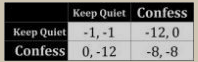
There are two rows and two columns relating to each of the two criminals. Each players ‘payoff’ is a ranking of his most preferred outcome. In this game we are to assume that the players main intention would be to reduce the time spent in jail. The core of Game Theory is the opinion that everybody is ultimately selfish and will always do what is best for them, when confronted with the option to do so. ‘ Game theory does not force players to believe that this is case, as critics frequently claim’. GT simply analyses the options and assembles the most likely strategy for each player based on the potential outcomes.
The most preferred outcome in this case is worth 0, the least is -12 and everything else is representative to the game being played. These values are irrelevant to the outcome of the game however, as they can be replaced with other sets of numbers such as 1-4 representing the most and least preferred outcomes see below:
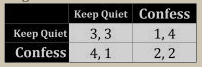
We are able to see from both tables that the preferred outcome for both players is to confess. There are more complex tree structures and matrix diagrams to go, but for now this is Game Theory 101.