Archive for the ‘Sociology’ Category
Future Society V no comments
As we pointed out in our previous post, there is an imbalance between the technological overdevelopment and the social underdevelopment in our society. As the number of young unemployed reaches a record level in the UK and as the education taxes increase, the situation is not becoming any clearer and confusion and uncertainty reigns. We are going to explore the main factors of these problems and some solutions to them in the following and next post.
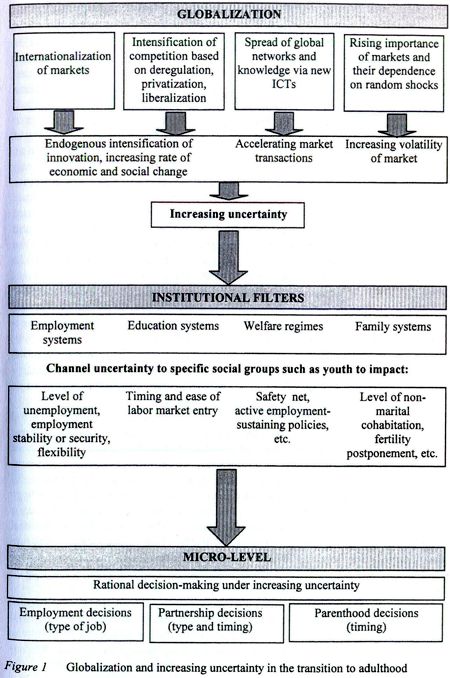
Globalization, Uncertainty and Youth in Society by Hans-Peter Blossfeld, Erik Klijzing, Melinda Mills and Karin Kurz published in 2005 seemed to predict the economical problems facing the world 3 years later. The main factors are:
- internalization of markets
- liberalization within nations
- accelerated diffusion of knowledge and the spread of global networks that are connecting all kinds of markets on the globe via new information and communication technologies
- rising importance of markets and their dependece on random shocks occuring somewhere on the globe ( e.g. major scientific discoveries, technical inventions, new consumer fashions, major politcal or economical upsets)
The authors mention that the markets are becoming more dynamic and more less predictable. The national institutions meant for reducing this uncertainty are employment, education and family systems as it can be seen in the figure below.
In the next post we will look at the 2007 Future Society envisioned by the Science Community of Japan report to find solutions to these global problems and to diminish uncertainties.
Globalisation and The Long Tail no comments
Globalisation refers to the how the world is ‘shrinking’ culturally and economically. How the world is changing from different nations managing themselves to one big world trading ideas, people, products and money. There are many global companies such as MacDonalds that exists everywhere! There are a number of advantages and disadvantages to globalisation. Sometimes it can be seen as a good thing that benefits small businesses by giving them access to a larger market, such as through the Internet. However, sometimes it can also be seen as a bad thing, for example with the outsourcing of work to poorer countries and buying materials for production in poorer countries to save money which can affect the local and national economy.
The Long Tail – Chris Anderson
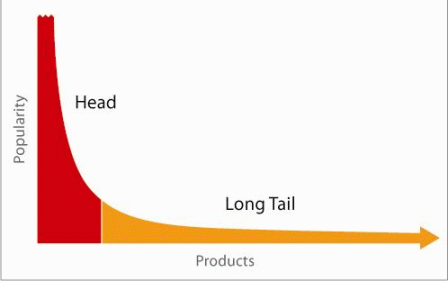
The tail refers to the long end of the curve on the graph that depicts the popularity of all products. As you can see from the image above, ‘the head’ is short and contains the most popular of products. These are things that everyone wants, think of it is the top 40 songs in the charts. ‘The tail’ is much longer and consists of every other product in existence (or every song that is not in the top 40!). These things are much less popular, but there is a lot more of them. Money can be made by just selling products from the long tails, you would sell maybe one of each product rather than millions of one product as is seen in ‘the head’.
Companies do still aim for a business model that targets ‘the head’ rather than the long tail. For example radio stations tend to play the popular music at that moment in time, but there is a suggestion from Chris Anderson that the radio is dead.
Why the radio is dead:
- Radio stations need money so they need advertising and therefore need listeners. To get the most listeners you need to appeal to the majority who like what is popular at that moment in time (‘the head’).
- The rise of technology in the form of MP3 players. You can listen to any music you want at home, on your PC, on my personal MP3 player and even take that into your car and connect it to a modern car stereo.
Chris Anderson also suggests that “The Long Tail is full of crap.” Which is it…It does contain everything! But the compelling thing about the long tail is that there is something for everybody that they would not be able to find and purchase otherwise.
The Internet and the Long Tail
The internet has given us unprecedented ability to access products never before available so quickly and easily. The Internet is the best example of how globalisation can reach everyone. Someone who makes Doggles (goggles for dogs), or other niche items, can become a millionaire.

A real shop on the high street may have trouble making money if it was taking advantage of the long tail. Not just for the reason that it cannot reach as many customers as an online shop, but for more practical reasons that it would be difficult to sort through all of the many niche products. Being able to search through the ‘crap’ and filter to get to the information you actually want is very much a benefit you can see online. Social media may also help with this, we often see suggestions for other items we might like on online shops like Amazon. Folksonomies consisting of lots of tags collaboratively created may also assist with finding things you want and things that are similar to it.
Does the Internet bring down the barriers for businesses?
Is Globalisation good for the small business?
Yes and no, it depends on what you are selling. There is the potential for more sales through having greater access to a wider market. This is especially true for niche items and products where in some situations they may sell nothing if they are not based near their market. The Internet definitely assists with globalisation based on geography. There is also the benefit that selling products online is very cheap to set up and use. Google Analytics is also a nice tool to assist with marketing and improving your own business website.
However, with the benefits of reaching more people, large businesses will also receive this benefit. Large businesses may be able to give better prices due to mass production, but this shouldn’t effect niche businesses where large businesses do not offer so many niche products.
Economics of Ontologies no comments
 Am trying to focus back in on my original assertion about what I was going to study. This was whether there are differences between subjects and their degree of separation from the www, and their primary ontologies. Although I was going to use economics and psychology or perhaps sociology and their attendant ontologies to create a spotlight with which to examine this question, this would still involve looking at the ontologies of a range of other subjects.
I was going to use economics as a focus, as I think it perhaps represents something that might be wrong with how we talk about knowledge in general and reasons for studying, working together, collaborating – ultimately: trust.
A lot of work that we do is tied into research programs that are underwritten by governments as being part of some economic promise. For example, the last Labour government’s education policy was predicated partly on the premise (stemming from research in the 1950s that re-emerged in the 1970s (need to find and cite)) that countries with a more highly educated population tend to do better economically. Thus following Tomlinson’s recommendations, the Diploma system was introduced, only partially, which in fact had the consequence of introducing a system that did the opposite of what he had intended.
This however, being loosely accepted: that the more highly educated a population is, the more wealthy their country, it would seem to follow that it makes sense to make use of emerging technologies to help to educate this population. There is a body of research on this – how technology can be ubiquitous; it can get to the places that teachers can’t, and can help to make learning something that is always ‘on’.
There are actually so many problems with these assertions that it would take a whole other blog post, or perhaps even, essay, or perhaps even, thesis to go into them – but I’m happy to accept that 1) learning is basically a Good Thing and that 2) technology can help to mediate it. I might perhaps then reluctantly accept that it’s possible that if you have a lot of learning, you might end up creating more wealth for your country, however some of the data for this is possibly correlative rather than strongly causal.
But to get back to my original question, it is whether there might be said to be an economics of ontologies? Could we find out whether there are some subjects that lend themselves, via their objects of knowledge to be shared and studied on the web? And that therefore are more accessible and therefore might end up generating more money?
It seems at first glance, that physics might be one of these subjects. Physics research can be large scale and tend to be carried out by large communities who share resources. Is there something about the nature of physics that makes people more likely to collaborate? Are they perhaps true seekers after knowledge who are less motivated by economics / reward than say, chemists? (Apologies to all you pioneering, truth-seeking chemists out there.) Would this then mean that by the very nature of a subject, if it attracts more people who care more about discovery, or truth, then they may well as a result, collaborate more, and could easily use technology in order to do this, but they care less about creating wealth, so that all web-based subjects that can easily or practically use the web to be studied are never going to be worth funding by governments who only care about short-term goals?
This seems on the face of it, rather facile, but it does intersect with another debate about why there still seem to be less girls studying physics, and in general, science subjects. (This debate appears worldwide, but I shall for now confine myself to the UK.) There was recently some speculation about whether the Big Bang Theory was attracting more people to the subject, but this generated some scathing responses from researchers who had determined that take up of physics was in fact governed by early influences.
Future Society IV no comments
This is indeed a time of change, regardless of how we time it. In the last quarter of this fading century, a technological revolution centered around information, has transformed the way we think, we produce, we consume, we trade, we manage, we communicate, we live, we die, we make war, and we make love. Castells, End of Millenium
In Castells‘ last volume of his trilogy, End of Millenium, the author begins with examining the Soviet Union collapse, then discusses the problems faced by Africa and the so called rise of the fourth world as a result of social exclusion. Africa is presented as the exponent for the Fourth World which consists in millions of homeless, incarcerated, prostituted, criminalized, brutalized, stigmatized, sick, and illiterate persons. [..] But, everywhere they are growing in number, and increasing in visibility, as the selective triage of the information capitalism, and the political breakdown of the welfare state, intensify social exclusion. In the current historical context, the rise of the Fourth World is inseparable from the rise of informational, global capitalism. Probably, some good examples in the western world would be the French riots in 2005 or UK riots of this year.
On the other side is the example of Japan where the income inequality is one of the lowest levels in the world. Although the social landscape was transformed by modernizing without Westernizing, Japan’s cultural identity was preserved. We discussed the importance of cultural attibutes of the information society in our previous post about The Power of Identity.
The most fundamental political liberation is for people to free themselves from uncritical adherence to theoretical or ideological schemes, to construct their practice on the basis of their experience, while using whatever information or analysis is available to them, from a variety of sources. [..] The dream of Enlightenment, that reason and science would solve the problems of humankind, is within reach. Yet there is an extraordinary gap between our technological overdevelopment and our social underdevelopment. Our economy, society, and culture are built on interests, values , institutions, and systems of representation that, by and large, limit collective creativity, confiscate the harvest of information technology and deviate our energy into self-destructive confrontation. [..] There is nothing that cannot be changed by conscious, purpseive social action, provided with information, and supported by legitimacy. If people are informed, active, and communicate throughout the world; if business assumes its social responsability; if the media become the messengers, rather than the message; if political actors react agains cynicism, and resoter belief in democracy; if culture is reconstructed from experience; if humankind feels the solidarity of the species thoughout the globe [..] maybe then, we may, at last, be able to live and let live, love and be loved.
We explored Castells views, the marxist leading analyst of the Information Age and the Network Society. In the following posts we will look into a more scientific book called Globalization, Uncertainty and Youth in Society by Hans-Peter Blossfeld, Erik Klijzing, Melinda Mills and Karin Kurz, in order to identify some key problems of our current society and find solutions to them.
Basic concepts: Sociology no comments
Sociology is ‘the systematic, sceptical and critical study of the social. It studies the way people do things together.’ There are many different perspectives and it encompasses the widest global issues right down to the individual and their inner world.
Methodology
Although sociology is also a social science similar to my other subject choice of economics they work in different ways. Economics uses data to predict future spending etc, but sociologists are researchers and theorists. There is a degree of overlap, but the range of sociology is much wider and so sociology methods are more varied. Researchers find data, from experiments or data from everyday life (such as population statistics or Census data), and use is to draw conclusions about the world and society, Theorists go further and want to understand how this data fits into ‘the grand scheme of things’ and want deeper understanding of what is going on. Data alone cannot speak for itself and a wider understanding is necessary to gain real insight from the data. Theorists in sociology develop these wider ideas and help develop theoretical explanations for the data and how it fits in the world.
Although there can be some problems with the way sociology is studied. Firstly they are part of a changing world, one finding may be true one day, but not the next. Secondly, sociologists are part of society so it is difficult to remove oneself from what you are studying. Lastly, sociology knowledge becomes parts of society as it is known and therefore changes society. This cycle of knowledge has an impact of society itself.
Origins of Sociology
The Enlightenment caused a change in society. There was a move to rational thinking, empiricism and science and there was more focus on the individual.
Auguste Comte wanted to understand the ‘human drama’ of his time. He believed that if people had the knowledge of how society operates they would be able to build a better future. He divided his new discipline into two parts: how society is held together; and how society changes. From the Latin ‘to study society’ Comte descried his study as sociology.
Previous to Comte philosophers had been imagining the ideal society, not measuring and analysing society as it was. Comte wanted to develop a scientific approach to study society, thus he was proponent of Positism – to understand the world based on science.
Society is always changing and there have been many great leaps in society and how we look at it, for example during the Industrial revolutions. However, there is a more recent change that is of current interest to my research question: The Cyber Revolution. The Cyber Revolution is linked to the development of digital technology and the spread of information technologies that affect how we communicate and how it has become mainstream. The World Wide Web is a great example of this, launching recently in 1991 it is already embedded in all of our lives and is considered an international technology. This changes surrounding this digital age is a rapid change with large effects on society. The textbook tries to break down these changes:
The Digital Age: The shift of computerisation of life. The way there are computers is most everyday things.
The Cyborg Age: The way humans are becoming more adapted to using these technologies.
The Information Age: The rapid growth of production and availability of information and data.
The Network Society: The change in the way we are networked together through mobile phone and the internet.
The Virtual Age: The mediated nature of reality. We live in a world that is increasingly less direct and instead of face-to-face we communicate through computers and phones.
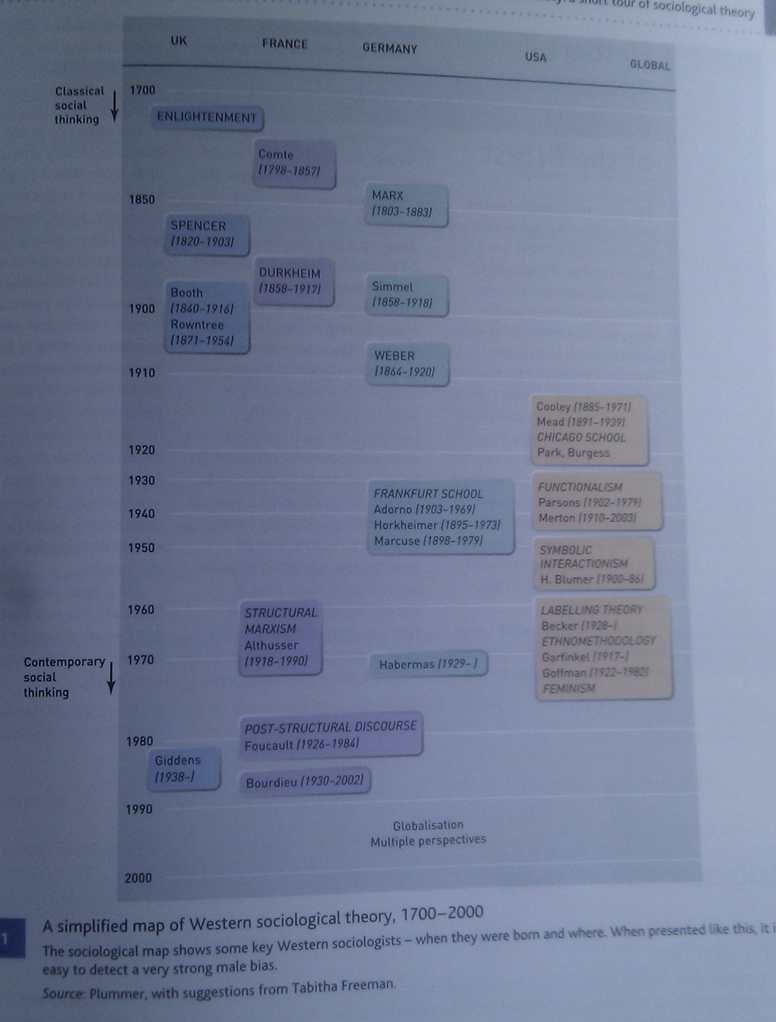
Another large aspect of sociology is that there are different theoretical perspectives of looking at things which guides thinking and research. Below is a simplified map of Western sociological theory, 1700-2000.
Classical/Traditional Perspectives of Sociology
Functionalism
‘Functionalism is a framework for building theory that sees society as a complex system those parts work together and interconnect.’ This perspective looks as social structure (finding stable patterns of human behaviour) and social function (all social structures have a function in society, either it be a handshake of family life). Merton also speaks of social dysfunctions, which cover any social patterns that have undesirable consequences for the operation of society. The critique for this perspective is that although this perspective was dominant until recently it presumes that society is stable and orderly. It also does not take into consideration inequality, such as class/gender/ethnicity issues.
Conflict perspective
‘The conflict perspective is a framework for building theory that sees society as an arena of differences and inequalities that generate conflict and change.’ This perspective complements Functionalism as it focuses on division and inequality. The critique of this perspective is basically the opposite of the Functionalism critique. The Conflict perspective glosses over the shared values and interdependence in society and focuses on the conflict and inequality. Both the Conflict and the Functionalist perspectives could also be criticised for being too broad and glossing over the smaller factors that make differences in society such as family and class.
Social action perspective
Contrary to the broad views of society seen in both Functionalist and Conflict perspective, the Social action perspective focuses on the smaller factors. One founder of social action theory is Max Weber who emphasised looking at a setting from the point of view of the people in it. His approach emphasised how human meaning and action shape society. A critique for this perspective is that this perspective helps us understand how people experience society and how they do things together. But by focusing on these smaller details broader social structures may be missed.
There are also contemporary perspectives such as feminism (looking as gender difference), Anti-racism (looking at race differences), postmodernism (looking at differences and complexities) and globalisation (looking at the larger world and how societies fit in it). The next post will further explore globalisation because I believe it is an important in relation to my research question. The globalisation of industry and society may lend some answers to why independent music can survive if the music industry has been made global.
Information and graphs summarised from:
Macionis, J.J. & Plummer, K. (2008). Sociology. A global introduction. Essex, England: Pearson Education Limited.
Sociology for Dummies (1) no comments
The main reference for this blog post is Sociology A global Introduction 5th edition (2012) by John Macionis and Ken Plummer.
Macionis is a professor of sociology and a Prentice Hall distinguished scholar and works at Kenyon College in Ohio and is considered one of the most prestigious liberal arts colleges in the U.S. Professor Ken Plummer works at the University of Essex.
Sociology is the study of the forces of social integration and how they change in space and time. According to Macionis and Plummer sociology is
“the systematic, sceptical and critical study of the social.”
So it challenges preconceived ideas about the world like any decent science but what is the social? For example we mostly think of ourselves as individuals who make our own decisions whereas many sociologists, such as Durkheim (1858-1917), believe that many of the decisions we make are contingent on social factors. Durkenheim noticed a correlation between the less socially integrated (single people, men, the rich) and higher suicide rates. He argued that people would have made different decisions had they been born a different gender, social class, in another time or another space.
Sociologists are interested in the way that different groups (ages, gender, racial etc.) are affected by society as a whole. In particular, the definition of gender or age or race differs depending on location in space and time. For example in the Victorian era in Britain, women were expected to dress much more conservatively than they are today. Maconis and Plummer sum this up succinctly,
“At the broadest level, sociology sets out to show the patterns and processes by which society shapes what we do.”
I think that the word “show” here is very important, it deftly avoids the question, as a sociologist, am I required changing the world or just observe it? Or are critical observations enough to change it?
Methodology
Sociologists claim some statement and then build up an argument which supports this statement. To build an effective argument sociologists use a variety of methods such as case studies, statistical analysis, questionnaires and interviews. For example Durkenheim (above) used statistics to back up his claim that individual decisions are often not that individual and are contingent upon society
Future society III no comments
In my first blog post called Self and business in social networks, I was refering to the concept of self and four methods through wich self-consciousness is achieved. In his first trilogy volume called The Rise of the Network Society, in the chapter Prologue: the Net and the Self, Castells explains that the first step in an informational society is the organization by recognition of itself based on cultural attributes. This was the fourth method of self identification described in my post: 4. cultural perspectives – depending on the origin of the individual. In the second volume The Power of Identity, Castells defines identity as a source for the meaning and experience, distinguishing between three forms and origins of identity building:
- Legimitizing identity – introduced by dominant institutions e.g. nationalism
- Resistance identity – generated by the dominated minorities opposed to the institutions of the society
- Project identity – based on some cultural values, a new identity is built
e.g. feminism challanging patriarhal family, reproduction, sexuality and personality on which societies have been historially based
e.g. green culture, smart meters, preserving nature
In the final chapter called Conclusion: Social Change in the Network Society, Castells sees the information networks we presented in our previous post as the organizers of activity and sharing information, as producers and distributors of cultural codes.
I see a similarity between Castells’s forms of building identities and Nietzsche’s history types:
- Monumental history – study of nation’s heroes conducted in order to invoke them in all their greatness [1]
- Antiquarian history – local history of specific social and civic communities [2], history as consolation and reassurance, as the positive continuity that provides a people with its identity [1]
- Critical history – the sort of history one utilizes when the monumental structures fail to inspire and when antiquarian musings become mired in unproductive thoughts and a conservative motionlessness [2]
Wikipedia differentiates identity as personal and social, where social identity is defined as a person’s conception and expression of their individuality or group affiliations (such as national identity and cultural identity).
In our next post we will look into Castell‘s last trilogy volume End of Millennium.
References
[1] F. Nietzsche, Untimely meditations
[2] Blogpost, Nietzsche’s Three Types of History in Literature: Stephan Heym’s THE KING DAVID REPORT
Interdisciplinarity no comments
Just reading Repko’s book on Interdisciplinary Research. Very interesting to consider that,’ Interdisciplinary research is a decision-making process that is heuristic, iterative, and reflexive. Each of these terms – decision-making, process, heuristic, iterative, and reflexive-requires explanation.’
I’m finding this very intriguing, especially in relation to one of our courseworks that involves outlining the process involved in searching for and (hopefully) finding material on a randomly selected question that has something to do with the web at its heart. It is interesting that although we think of searching as ‘seeking’ there is sometimes an element of filtering or of looking for material that might reinforce one’s original ideas.
Have also been reading on economics in Afghanistan, Intelligent Agents (not secret ones), hypermedia, (just discovered The Humument – an old favourite of mine is about to be released as an app) bots (including narrative bots and social bots – here’s one I made earlier) and privacy. At present these don’t strictly appear to be to do with my original question, but some of the topics keep re-presenting themselves to me and so I’m keeping an eye on them, to see if they might develop into a personal theme. Have also been reading on spimes, hyperreality and skeuomorphs, and came across this blog from Matt Jones on The Internet of Things.
Have a good introduction to Sociology (Giddens) but need to also check to see what isn’t in it, as it’s quite an old copy.
Future society II no comments
I was writing in my previous post that we don’t really realize where we are heading, but the change is already here, we are already in this cybersociety. At the London Conference on Cyberspace last Tuesday, Neelie Kroes, the European Commissioner for the Digital Agenda emphasised the social benefits of being online. She stressed that it was vital to deal with the 30% of Europeans currently not online. http://www.bbc.co.uk/news/technology-15544517
In the forward of the book Engines of Creations by K. Eric Drexler, Marvin Minsky says the following: How can we predict where science will take us? [..] It is virtually impossible to predict which alternatives will become technically feasible over any longer period of time. [..] It is equally hard to guess the character of the social changes.
Probably one of the best fortunetellers of today, Manuel Castells, Professor of Sociology at Berkley University, is widely regarded as a leading analyst of the Information Age and the Network Society. In the following blog posts we will try to pick up his main ideas by selectively reading through his famous trilogy.
Castells defines space in The Rise of the Network Society, the first volume of his trilogy, as being the material support of time-sharing social practices. Further he explains by time-sharing social practices I refer to the fact that space brings together those practices that are simultaneous in time. [..] The space of flows is the material organization of time-sharing social practices that work through flows.
- The first layer, the first material support of the space of flows is actually constituted by a circuit of electronic exchanges (micro-electronic based devices, telecommunications, computer processing)
- The second layer is constituted by its nodes and hubs. [..] A “global city” is the production site of the informational global economy
- The third layer refers to the spation organization of the dominant, managerial elites (rather than classes) e.g. Google, Facebook
In the Conclusion chapter of the book, Castells says the new economy is organized around global networks of capital management and information, whose access to technological know-how is at the roots of productivity and competitiveness. [..] Our species has reached the level of knowledge and social organization that will allow us to live in a predominanty social world. It is a beginning of a new existence, and indeed the beginning of a new age, the Information Age.
In Marketing to the Social Web, Larry Weber suggests the following methods for promoting the community that you built around your product:
- doing marketing research by following what users blog or post about your product
- minding the gap between the different ages, income or whatever might differentiate customers and focus on a target
- actually contact and offer incentives to good customers
- use search engine optimization
- promote the URL of your website through traditional or multimedia ads
- increase the benefits of your services by constantly adding new features
Social Marketing compared with traditional Marketing is personalized, more targeted and I think it is more cost effective and efficient.
In the next post, we will take a look at Castells’s second volume of his trilogy, The Power of Identity.
Future society I no comments
What is sociology? Sociology is the systematic, sceptical and critical study of the social. It studies the way people do things together. [..] it becomes a form of consciousness, a way of thinking, a critical way of seeing the social. Sociology, a global introduction, Macionis and Plummer. As I was reading Chapter 6. Groups, organisations and the rise of the network society, Manuel Castells‘s ideas about the network society and the Information Age (this is the name of his 3 books on this topic) were described: people, cities, businesses and states are nodes in networks through which information, money and people flow. These flows make time become a perpetual present and space becomes global, being everywhere at the same time. A guide to this trilogy is David Bell’s Cyberculture Theorists which discusses the ideas of Castells and Haraway.
Haraway, the other theorist besides Castell discussed by Bell, is a professor at the University of California in the History of Consciousness. She published in 1985 a cyborg manifesto suggesting enhancing our human bodies to transgress the boundaries of nature. She is recently interested in the links between humans and animals.
A quick browsing through the Cyberculture Theorists google book http://goo.gl/yS4n1 brought me to Carl Popper‘s World 3 about which I read last year. Popper’s elegant philosophy explains the world on 3 levels:
World 1: the world of physical things
World 2: the world of mental events and objects
World 3: the world of abstract objects produced by the mind such as scientific theories
Bell states that world 3 is sometimes referred to when cyberspace is discussed. Cyberspace is a term coined by William Gibson in his novel Neuromancer. In this novel cyberspace is entered as disembodied consciousness by joining the network which is the battleground over ownership and access to data, much like today’s internet where Google, Facebook and other players are crunching user data to provide the best sponsored ads.
People like to spread information and social networks, microblogging helps them do that easily through webpages like Twitter or status updates on Facebook. For example, 100 billion updates are processed each day on Facebook. People care what others think, more than what Google thinks. This is why rating appeared recently on Wikipedia and that is what the Facebook Like button is all about. Socialnomics, Erik Qualman
The Zeitgeist, the spirit of the age, our common consciousness is the one leading us in this connected, common, social direction.
By selectively reading through these books, I think that the most comprehensive is the Sociology book. I was particularly interested in the chapters about the future of society and the internet. It contains valuable information regarding these topics. I have the feeling they are all predicting the future. We don’t really realize where we are heading, but the change is already here, we are already this cybersociety.
I also read 3 chapters on Social Marketing (Marketing to the Social Web – Larry Weber), but I couldn’t find some valuable information, something that Qualman didn’t mention in his book – the main idea emphasized is what I already mentioned in my previous post – that the new marketer’s perspective should take into account the customer, he should be an aggregator and not a broadcaster.
I will keep on reading about Social Marketing and Sociology.