
How did enslaved people create communities in the Caribbean? How did they resist slavery?
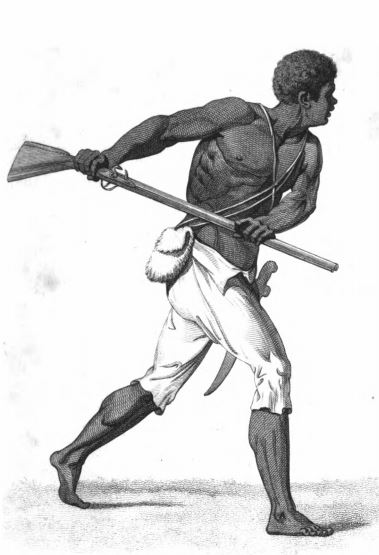
‘Leonard Parkinson, a Captain of the Maroons’, frontispiece to The Proceedings of the Governor and Assembly of Jamaica in regard to the Maroon Negroes (1796).
(Who was Parkinson, and to what extent was he a ‘typical’ resister of slavery, do you think?)
We will look at how enslaved people experienced and tried to survive the institution of slavery, and at how they fought back. Our work on this during the seminar will set up things that we will return to throughout the module. These include examining the ways that slaves tried to make ‘lives of their own’ within the confines of slavery (see the item by Beckles in the recommended section) and the various activities that historians have interpreted as types of slave resistance.
What were the main features of the slaves’ communities on the plantations? What was resistance? What sorts of differences do we see even within one kind of activity (e.g. running away, studied by Heuman, below)? Did some slaves ‘collaborate’ with slaveholders? Should we define a distinction between ‘opposition’ and ‘resistance’?
Some suggested reading:
Beckles, H. ‘Black Female Slaves and White Households in Barbados’, in Gaspar and Hine (eds), More Than Chattel: Black Women and Slavery in the Americas (1996).
Burnard, T. Mastery, Tyranny and Desire: Thomas Thistlewood and his Slaves in the Anglo-Jamaican World (2004) (especially chapter 5).
Heuman, G. ‘Runaway Slaves in Nineteenth Century Barbados’, in Heuman, G. (ed) Out of the House of Bondage (1986).
Roberts, J. ‘The “Better Sort” and the “Poorer Sort”: Wealth Inequalities, Family Formation and the Economy of Energy on British Caribbean Sugar Plantations, 1750–1800’, Slavery and Abolition 35/3 (2014).