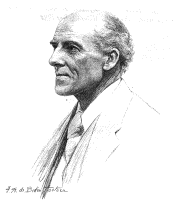
Pearson’s name appears in statistics textbooks in connection with chi-squared, correlation, goodness of fit, method of moments and the Pearson system of curves. However these books rarely contain much information about the man or about the context of his work.
There is a good account of Pearson’s earliest statistical work in chapters 8 and 9 of Porter (2004). Another useful account containing much biographical information is
M. Eileen Magnello (2005) Karl Pearson and the Origins of Modern Statistics: An Elastician becomes a Statistician, Rutherford Journal, 1 (1) here
For accounts on Pearson’s place in the history of statistics see (besides MacKenzie (1981))
H. M. Walker (1929) Studies in the History of Statistical Method, Baltimore: Williams & Wilkins.
V. L. Hilts (1967) Statist and Statistician: Three Studies in the History of Nineteenth Century English Statistical Thought. Thesis, Harvard University, Cambridge MA. Reprinted by Arno Press, New York 1981.
J. W. Tankard (1984) The Statistical Pioneers, Cambridge, MA: Schenkman.
T. M. Porter (1986) The Rise of Statistical Thinking 1820-1900, Princeton: Princeton University Press.
S. M. Stigler (1986) The History of Statistics: The Measurement of Uncertainty before 1900. Cambridge MA: Harvard University Press.
A. Hald (1998) A History of Mathematical Statistics from 1750 to 1930. New York: Wiley.
Walker’s history looks back from the Pearsonian present of 1929. Hilts presents a rounded picture of “the first mathematical statistician in England”. Tankard’s introductory textbook has a chapter on Pearson plus ones on Galton, Gosset and Fisher. Porter has written a wide-ranging essay in the history of ideas. Hald and Stigler have written complementary works on ‘technical’ statistics: Hald emphasises the mathematical theory while Stigler is as concerned with the use of the theory. Apart from Hald the coverage tends to stop at 1900. By that date Pearson had done his most influential work but he still had hundreds of works in front of him.
The International Statistical Review has marked the Pearson sesquicentenary with a special issue. Appropriately enough, the articles emphasise Pearson’s international influence.
E. Seneta, I. H. Stamhuis (2009) Preface to Karl Pearson Issue, International Statistical Review, 77, 1-2.
M. E. Magnello Karl Pearson and the Establishment of Mathematical Statistics, International Statistical Review, 77, 3-29.
H. A. David (2009) Karl Pearson—The Scientific Life in a Statistical Age by Theodore M. Porter: A Review, International Statistical Review, 77, 30-39.
A. M. Fiori andM. Zenga (2009) Karl Pearson and the Origin of Kurtosis, International Statistical Review, 77, 40-50.
D R. Bellhouse (2009) Karl Pearson’s Influence in the United States, International Statistical Review, 77, 51-63.
P Guttorp and G. Lindgren (2009) Karl Pearson and the Scandinavian School of Statistics, International Statistical Review, 77, 64-71.
T. K. Nayak (2009) Impact of Karl Pearson’s Work on Statistical Developments in India, International Statistical Review, 77, 72-80.
C. G. Borroni (2009) Understanding Karl Pearson’s Influence on Italian Statistics in the Early 20th Century International Statistical Review, 77, 81-95.
I. H. Stamhuis and E. Seneta (2009) Pearson’s Statistics in the Netherlands and the Astronomer Kapteyn, International Statistical Review, 77, 96-117.
E. Seneta (2009) Karl Pearson in Russian Contexts International Statistical Review, 77, 118-146.
The issue has no paper on Pearson’s influence in France. Pearson’s influence there was limited but Lucien March felt it.
M. Armatte (2005) Lucien March (1859-1933): Une statistique mathématique sans probabilité? Journal Electronique d’Histoire des Probabilités et de la Statistique, 1, (1), pp. 19.
Hald’s book has a comprehensive bibliography. A few items from it are worth highlighting: E. S. Pearson on the interaction of Pearson, Galton, Weldon, Edgeworth, ‘Student’ and Fisher and Plackett on Pearson (1900)
E. S. Pearson (1965) Some Incidents in the Early History of Biometry and Statistics 1890-94, Biometrika, 52, 3-18. JSTOR
E. S. Pearson (1967) Some Reflections on Continuity in the Development of Mathematical Statistics 1885-1920, Biometrika, 54, 341-355. JSTOR
E. S. Pearson (1968) Some Early Correspondence Between W. S. Gosset, R. A. Fisher and Karl Pearson, with Notes and Comments, Biometrika, 55, 445-457. JSTOR.
R. L. Plackett (1983) Karl Pearson and the Chi-squared Test, International Statistical Review, 51, 59-72.
More recent papers include
S. M. Stigler (1999) Karl Pearson and Degrees of Freedom. In the collection of essays, S. M. Stigler, Statistics on the Table, Cambridge, Harvard University Press.
Eileen Magnello, Karl Pearson, Paper on the Chi-Squared Goodness of Fit Test. In Ivor Grattan-Guinness (ed.) Landmark Writings in Western Mathematics: Case Studies, 1640-1940, pp. 724-731, Amsterdam: Elsevier, 2005.
S. M. Stigler (2008) Karl Pearson’s Theoretical Errors and the Advances They Inspired, Statistical Science, 23 (2), 261-271. Euclid.
Lancaster and Dale treat more specialised theoretical topics
H. O. Lancaster (1969) The Chi-squared Distribution, New York: Wiley.
A. I. Dale (1999) A History of Inverse Probability from Thomas Bayes to Karl Pearson, second edition, New York: Springer-Verlag.
There is a volume marking the centenary of Pearson’s chi-squared paper
C. Huber-Caro, N. Balakrishnan, M. Nikulin, M. Mesbah (Eds.) (2002) Goodness-of-Fit Tests and Model Validity, Boston: Birkhäuser. This includes a chapter by D. R. Cox on “Karl Pearson and the Chi-squared Test.”
Pearson’s time series analysis as well as other aspects of his work are discussed by
J. L. Klein (1997) Statistical Visions in Time: A History of Time Series Analysis, 1662-1938, New York: Cambridge University Press.
Pearson’s disagreements with Yule on time series analysis—as well as on other aspects of correlation—are discussed by Aldrich (1995).
Among the other distinguished statisticians who worked for KP were F. N. David, J. O. Irwin, H. E. Soper (see M. Greenwood, Journal of the Royal Statistical Society, 94, (1931), 135-141 JSTOR) and J. Wishart.
Pearson’s relations with Gosset (‘Student’) are covered by
E. S. Pearson (1990) ‘Student’, A Statistical Biography of William Sealy Gosset, Edited and Augmented by R. L. Plackett with the Assistance of G. A. Barnard, Oxford: University Press.
The origins of Fisher’s quarrel with Pearson (see above) are described in
E. S. Pearson (1968) Some Early Correspondence between W. S. Gosset, R. A. Fisher and Karl Pearson, with Notes and Comments, Biometrika, 55, 445-457. JSTOR
There were many areas of disagreement. Besides Hald and Lancaster see
S. E. Fienberg (1980) Fisher’s Contribution to Categorical Data, pp. 75-84 of Fienberg, S. E. & D. V. Hinkley (1980) (eds.) R. A. Fisher: An Appreciation, New York, Springer.
R. Mensch (1980) Fisher and the Method of Moments, pp. 67-74, of Fienberg & Hinkley.
D. Baird (1983) The Fisher/Pearson Chi-Squared Controversy: A Turning Point for Inductive Inference, British Journal for the Philosophy of Science, 34, 105-118. JSTOR
H. F. Inman (1994) Karl Pearson and R. A. Fisher on Statistical Tests: A 1935 Exchange from Nature, American Statistician, 48, 2-11. JSTOR
J. Aldrich (1997) R. A. Fisher and the Making of Maximum Likelihood 1912-22, Statistical Science, 12, 162-176. Project Euclid.
S. M. Stigler (2005) Fisher in 1921, Statistical Science, 20, 32-49. Project Euclid.
J. Aldrich (2005) Fisher and Regression, Statistical Science, 20, 401-417. pdf.
The relevant papers by Fisher are available from the University of Adelaide as is the useful biography
Yates, F. & K. Mather (1963) Ronald Aylmer Fisher 1890-1962, Biographical Memoirs of Fellows of the Royal Society, 9, 91-120.
For more on Fisher see A Guide to R. A. Fisher.
Pearson did not only apply statistics to biometrics; for his work in medical statistics see
J. Rosser Matthews (1995) Quantification and the Quest for Medical Certainty, Princeton, Princeton University Press.
M. E. Magnello (2002) The Introduction of Mathematical Statistics into Medical Research: The Roles of Karl Pearson, Major Greenwood and Austin Bradford Hill, in Eileen Magnello and Anne Hardy (ed.) The Road to Medical Statistics, Amsterdam: Rodopi.
A. Hardy and M. E. Magnello (2002) Statistical methods in Epidemiology: Karl Pearson, Ronald Ross, Major Greenwood and Austin Bradford Hill, 1900-1945, Soz.- Präventivmed. 47, 80–89. here
K. O’Rourke (2006). Reducing the Play of Chance using Meta-analysis. James Lind Library. This refers to the following
K. Pearson (1904) Report on Certain Enteric Fever Inoculation Statistics. British Medical Journal, 3, 1243-1246. here
The medical statistician Major Greenwood was strongly influenced by Pearson. Austin Bradford Hill attended Pearson’s lectures but was not so strongly influenced.
Pearson’s research into the effects of parental alcoholism was criticised by doctors and by the economists J. M. Keynes, Alfred Marshall and A. C. Pigou. The controversy is discussed in the standard biographies of Keynes (by Harrod, Skidelsky and Moggridge) and in accounts of Keynes’s attitude towards statistics: see e.g.
R. M. O’Donnell (1989) Keynes: Philosophy, Economics and Politics, London: Macmillan.
B. W. Bateman (1990) Keynes, Induction and Econometrics, History of Political Economy, 22, 359-379.
The most thorough treatment of the statistical issues involved is
S. M. Stigler (1999) Karl Pearson and the Cambridge Economists. In the collection of essays, S. M. Stigler Statistics on the Table, Cambridge: Harvard University Press.
Pearson’s more positive relationships with the American statistical economists H. L. Moore and Irving Fisher are discussed in
J. Aldrich (2010) The Econometricians’ Statisticians 1895-1945, History of Political Economy, 42, 111-154.
Biometrika celebrated its centenary in 2001 and several of the articles in the commemorative issue (February 2001) discuss Pearson’s contributions to the journal. The material is available in book form as Biometrika: One Hundred Years edited by
D. M. Titterington & D. R. Cox. Amazon.
Pearson changed the language of Statistics and contributed many technical terms as can be seen from
J. Aldrich (2003) The Language of the English Biometric School, International Statistical Review, 71, 109-131. pdf
H. A. David, First (?) Occurrence of Common Terms in Statistics and Probability, Appendix B and pp. 219-228 of H. A. David & A. W. F. Edwards (ed.) (2001) Annotated Readings in the History of Statistics, Springer New York. (updating articles in 1995 and 1998 in American Statistician, 49, 121-133 and 52, 36-40.)
or by searching for Pearson in Jeff Miller’s Earliest known uses of some of the words of mathematics.