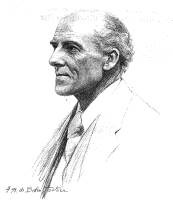
Karl Pearson was a great teacher. For fifty years he taught at University College; his subjects were applied mathematics, astronomy and statistics. For nearly forty years he almost monopolised the teaching of statistics in Britain and many prominent statisticians studied with him. Some went as undergraduates, some as fledgling members of staff and some as visitors; the modern PhD system was established only towards the end of Pearson’s career and he was never part of it. The following were among those who studied with him—the reference, unless otherwise stated, is to an obituary in the Journal of the Royal Statistical Society or, after 1948, to Series A of that journal: Florence Nightingale David, 157 (1994), 299-301 JSTOR; William Palin Elderton, 125, (1962), 669-673 JSTOR; Edgar Charles Fieller, 124, (1961), 275-277 JSTOR; William Sealy Gosset, 101, (1938), 248-251 JSTOR; Major Greenwood, 112, (1949), 247-249 JSTOR; J. Arthur Harris, Biometrika, 28, (1936), p. 444 JSTOR; David Heron, 133, (1970), 276-279 JSTOR; Austin Bradford Hill, 154, (1991), 482-484 JSTOR; Joseph Oscar Irwin, 145, (1982), 526-528 JSTOR; Leon Isserlis, 129, (1966), 612-616 JSTOR; Henry Ludwell Moore Econometrica, 30, (1962), 1-21 JSTOR; Ethel May Newbold, 96, (1933), 354-357 JSTOR; Jerzy Neyman, 145, (1982), 523-524 JSTOR; Raymond Pearl, Ecology, 22, (1941), 408, JSTOR; Egon Sharpe Pearson, 144, (1981), 270-271 JSTOR; Edmund Cecil Rhodes, 128, (1965), (4), 615-616 JSTOR; Henry Schultz, Econometrica, 7, (1939), 97-103. JSTOR; Ernest Snow, 123, (1960), 355-356 JSTOR; Herbert Edward Soper, 94, (1931), 135-141 JSTOR; Samuel Stouffer, American Statistician, 14, (1960), 36 JSTOR; L. H. C. Tippett, 149, (1986), 44 JSTOR; John Wishart, 119, (1956), 270-271 JSTOR; George Udny Yule, 115, (1952), 156-161 JSTOR.
Some of Pearson’s students wrote about him after he died. Pearson generated strong reactions: “the man is a liar” wrote J. M. Keynes to W. Bateson in 1910 (Bateson Letters, John Innes Archives). On Pearson’s death in 1936 and his centenary in 1957 the survivors reflected on him and his work.
The Times obituary is available on the MacTutor Pearson page. Also available is an obituary for the Royal Society of Edinburgh by G. H. T. (presumably Godfrey Hilton Thomson (1881-1955) the statistical psychologist).
E. S. Pearson (1895-1980), Pearson’s son and his successor as head of the Department of Applied Statistics University College, London (UCL) and editor of Biometrika, wrote a full biography soon after his father’s death
Egon S. Pearson (1936/8) Karl Pearson: An Appreciation of Some Aspects of his Life and Work, In Two Parts, Biometrika, 28, 193-257, 29, 161-247. JSTOR, JSTOR
This appeared as a book with the same title, published by Cambridge University Press, in 1938.
George Udny Yule (1871-1951) was a student and eventually an assistant professor in Pearson’s department. Later he went his own way he and Pearson came to disagree about association, time series correlation, …. The Royal Society obituary also has a contribution from L. N. G. Filon, Pearson’s student and eventually his successor in the Goldsmid chair in Applied Mathematics
G. Udny Yule & L. N. G. Filon (1936) Karl Pearson, Obituary Notices of Fellows of the Royal Society of London, 2, 74-110.
Raymond Pearl (1879-1940) attended Pearson’s lectures in 1905-6 and was once a co-editor of Biometrika. See Matthews (1995) for his fluctuating relations with Pearson. From 1919 Pearl was a professor at Johns Hopkins. In his obituary he wrote warmly of Pearson’s influence on his generation.
Raymond Pearl (1936) Karl Pearson, 1857-1936, Journal of the American Statistical Association, 31, 653-664. JSTOR
William Palin Elderton (1877-1962) was a distinguished actuary. He first met Pearson in 1900 when he was training to be an actuary and was drawn into the University College statistical group. Elderton computed the first chi-square tables and in 1907 published an account of the Pearson curves (see below). His sister Ethel M. Elderton worked for Pearson for many years. In his obituary Elderton gave a balanced account of Pearson’s achievement and personality.
W. P. Elderton (1937) Professor Karl Pearson, Journal of the Institute of Actuaries, 68, 183-185. here
E. S. Pearson recalls Elderton’s relations with Pearson in the obituary, William Palin Elderton (1877-1962), Biometrika, 49, (1962), 297-303. JSTOR
R. A. Fisher (1890-1962), Pearson’s greatest successor and his bitterest critic, wrote an article for the Dictionary of National Biography but it was not accepted. Edwards published the article and tells the story in
A.W. F. Edwards (1994) R. A. Fisher on Karl Pearson, Notes and Records of the Royal Society of London, 48, 97-106. JSTOR
Pearson emerges without glory from Fisher’s sketch of the history of statistics (available from the University of Adelaide in pdf format)
Statistics from Scientific Thought in the Twentieth Century, (ed. A. E. Heath), pp. 31-55. London: Watts, 1951.
An anonymous reviewer of Fisher’s Statistical Methods for Research Workers (1925) used a quotation from Macaulay to describe Fisher’s attitude to Pearson: “just so we have heard a baby, mounted on the shoulders of its father, cry out, ‘how much taller I am than Papa!’” The reviewer could well have been Major Greenwood
Major Greenwood (1880-1948) wrote the article that appeared in the DNB. Greenwood was an early follower of Pearson and became professor of medical statistics at the London School of Hygiene & Tropical Medicine: see Matthews (1995) for his relations with Pearson. In 1928 Greenwood wrote a memorandum on the state of medical statistics in which Pearson is compared with Newton but, as with Newton and the calculus, the Continentals had the better system! Greenwood expressed his feelings towards Pearson in the opening paragraphs of his Presidential Address to the Statistical Society given a few months after Pearson’s death.
M. Greenwood (1949) Pearson, Karl, The Dictionary of National Biography, 1931-40, ed. L. G. Wickham Legg, pp. 681-684, Oxford University Press.
V. Farewell, T. Johnson & P. Armitage (2006) ‘A Memorandum on the Present Position and Prospects of Medical Statistics and Epidemiology’ by Major Greenwood, Statistics in Medicine, 25, 2167-2177.
J. B. S. Haldane (1892-1964), at UCL from 1933 first as professor of genetics then of biometry, compared Pearson to Columbus: following a false theory of heredity he discovered methods that proved indispensable for the study of evolution.
J. B. S. Haldane (1957) Karl Pearson, 1857-1957. A Centenary Lecture delivered at University College London, Biometrika, 44, 303-313. JSTOR
H. M. Walker (1891-1983), pioneer historian of statistics, produced a centenary piece on a man “to whom no smaller word than titan is appropriate”
Helen M. Walker (1958) The Contributions of Karl Pearson, Journal of the American Statistical Association, 53, 11-22. JSTOR
S. A. Stouffer (1900-1960) pioneer quantitative sociologist studied with Pearson in the 1930s.
Samuel A. Stouffer (1958) Karl Pearson—An Appreciation on the 100th Anniversary of his Birth, Journal of the American Statistical Association, 53, 23-27. JSTOR
2007 was the Karl Pearson sesquicentenary (or sesquicentennial) and this was marked in various ways. There was a Karl Pearson sesquicentenary conference in London in March and a session (“Karl Pearson’s 150th birthday,” IPM78) at the conference of the International Statistical Institute in Lisbon in August; see below.