Photos of KP in 1882 1890 1910 with Galton of Weldon Bateson Fisher
Karl Pearson was born in London on March 27th 1857 into an upper-middle class family, his father a barrister. He read mathematics at Cambridge University, where Maxwell, Cayley and Stokes were the luminaries. He had the best of coaches, Routh, and came through the examinations as third wrangler. This brought him a fellowship and, for some years, financial freedom to travel and to pursue very diverse interests. He qualified as a barrister and studied social, philosophical, literary and historical questions, turning himself into a German Late Romantic. Pearson developed his own view of man’s place in a post-Christian world, expressing his ideas in a novel and play as well as in essays—some of these appeared in the Ethic of Freethought (1888) and the Chances of Death and Other Studies of Evolution (1897). Pearson founded the Men and Women’s Club and in 1890 married a fellow-member Maria Sharpe. They had three children; the son Egon Sharpe Pearson also became an important statistician.
In 1884 Pearson became Professor of Applied Mathematics and Mechanics at University College London (UCL). Mechanics and the theory of elasticity—and later biometry—eventually crowded out other pursuits. Pearson took on the task of completing Todhunter’s History of the Theory of Elasticity and Clifford’s Common Sense of the Exact Sciences. The Elasticity is a very detailed internal history of Pearson’s own specialism. The book by Clifford, the first holder of the UCL chair, explains the basic principles of mathematics in a non-technical way. Pearson not only edited what Clifford had written but contributed about a third of the final text Pearson’s ideas for the reform of mechanics were close to those of Mach and he developed them further in the Grammar of Science (1892). This presented the scientific method as “the orderly classification of facts followed by the recognition of their relationship and recurring sequences.” His achievements as an applied mathematician were recognised when he was elected to the Royal Society in 1896.
Between 1891 and -94 Pearson gave four series of lectures at Gresham College. The first series provided the basis for the Grammar. The later lectures treated statistics. Pearson had developed a new interest to which he would devote his greatest efforts. With W. F. R. Weldon, professor of zoology at UCL, he founded biometry. Weldon had come to the view that “the problem of animal evolution is essentially a statistical problem” and was applying Francis Galton’s (1822-1911) statistical methods, including correlation. Pearson joined in, developing new techniques and eventually a new theory of statistics. Over the next ten years Pearson made his most important contributions to statistics, including the method of moments, the Pearson system of curves, correlation and the chi-squared test. Pearson realised that the methods he had devised for biometry had other uses and he and his collaborators applied them to all manner of subjects. The most important of the early collaborators was G. Udny Yule, whose applied interests were in social policy and medicine. By the end of the nineteenth century there was an embryonic mathematical statistics community extending to non-biometricians such as F. Y. Edgeworth and W. F. Sheppard.
In 1901 Pearson, Weldon and Galton founded Biometrika, a “Journal for the Statistical Study of Biological Problems”. The mission was controversial. Following the “rediscovery” of Mendel, William Bateson (1861-1926) argued that the statistical study was pointless while Pearson thought Mendel’s account covered only a few special cases. In 1903 Pearson established the Biometric Laboratory. This drew visitors from all over, including W. S. Gosset (‘Student’) from Guinness in Dublin and the biologist Raymond Pearl and the economist H. L. Moore from the United States. (American economists, like Moore and Irving Fisher, thought more of Pearson than their British counterparts—see below) As well as research in theoretical and applied statistics, much effort went into constructing statistical tables. In 1907 Pearson took over a research unit founded by Galton and reconstituted it as the Francis Galton Laboratory of National Eugenics. The laboratory researched human pedigrees but it also produced controversial reports on the role of inherited and environmental factors in tuberculosis, alcoholism and insanity. Pearson saw his role in eugenics as providing the scientific foundations and he addressed other experts rather than the public directly.
In 1911 a bequest from Galton led to the establishing of a chair of Eugenics and a Department of Applied Statistics at University College. Pearson was no longer responsible for applied mathematics. After the 1914-18 war statistics continued to flourish and the department went on attracting talents, such as Neyman and Wishart, but Pearson was no longer producing influential new ideas. By the later 20s R. A. Fisher was replacing him as the dominant influence on the subject. Some of Fisher’s most important contributions were corrections to Pearson’s work and relations between the men were bad from around 1917. Pearson retired in 1933 but he continued to write and, with his son E. S. Pearson, to edit Biometrika. He died on April 27th 1936.
Sources E. S. Pearson’s biography is the major source. It is thorough and fair-minded, though inevitably dated. For the early Pearson it has now been surpassed by Porter (2004). This new biography focuses on the making of the statistician and does not try to cover in the same detail what Pearson did when his career was under way.
Sources of pictures
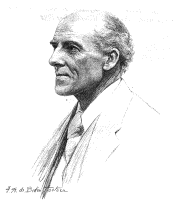
The sketch over the menu is from Peter Lee’s portraits of statisticians
http://www.york.ac.uk/depts/maths/histstat/welcome.htm
KP 1882 1890 & 1910 from E. S. Pearson’s Biometrika biography
Weldon from KP’s Biometrika memoir
KP with Galton from the Galton website http://www.mugu.com/galton/:
Bateson from the Bateson website http://post.queensu.ca/~forsdyke/bateson1.htm
Fisher from J. H. Bennett (1971) Collected Papers of R. A. Fisher volume 1, Adelaide: Adelaide University Press.
Additional photographs
The UCL Special Collections digital archive has some nice family photographs. Maria and baby Egon can be seen on Science, Technology and Engineering, p. 5 and Karl and Maria with pram and with grown-up children on Science, Technology and Engineering, p. 6.
There is a wealth of photographs of places associated with the Pearson family on John Bibby’s From Crambe to chi-squared.
There are photographs of the Pearson family home at Karl Pearson’s Hampstead home.