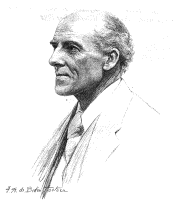
Pearson’s technical publications usually involve unfamiliar mathematics and unfamiliar science and, while his volumes of essays were addressed to the educated reader, both the issues and the way they are treated are now remote.
Pearson did not make a book out of his Gresham lectures on statistics and probability but the following general essay on probability was published after his death
The Laws of Chance, in Relation to Thought and Conduct: Introductory, Definitions and Fundamental Conceptions Being: the First of a Series of Lectures Delivered by Karl Pearson at Gresham College in 1892, Biometrika, 32, (1941), 89-100. JSTOR
Two papers of considerable autobiographical interest should be mentioned. The memoir Pearson wrote on the death of Weldon, his friend and most important colleague, recalls the beginnings of biometry
Karl Pearson (1906) Walter Frank Raphael Weldon.1860-1906, Biometrika, 5,1-52. JSTOR
In old age Pearson wrote affectionately of his student days in the 1870s
Karl Pearson (1936) Old Tripos Days at Cambridge, as Seen from Another Viewpoint, Mathematical Gazette, 20, 27-36. here
In fact, his experience at the time, as described in Andrew Warwick’s Masters of Theory: Cambridge and the Rise of Mathematical Physics, Chicago UP (2003) and based on letters to his family, seems to have been rather unhappy.
Two anthologies of “fin de siècle” writing have snippets of Pearson: Ledger & Luckhurst have extracts from National Life and the Grammar of Science, Jay & Neve have extracts from National Life and the Scope and The Importance to the State of the Science of National Eugenics (1907).
Sally Ledger and Roger Luckhurst (editors) (2000) Fin de Siècle A Reader in Cultural History, C. 1880-1900, Cambridge, Cambridge University Press.
Mike Jay and Michael Neve (editors) (2000) 1900: A Fin-De-Siècle Reader, Harmondsworth, Penguin.
These volumes treat themes developed more fully in the secondary literature listed under Eugenics, feminism & socialism and Physics & philosophy.
Much of Pearson’s most important statistical work appeared in conjunction with biological ideas which are now obsolete—e.g. his fundamental work on correlation is in the 1896 paper on “Regression, Heredity and Panmixia”. However his first chi-squared paper, Pearson (1900), does not contain difficult biological matter. It appears with notes by G. A. Barnard in
S. Kotz & N. L. Johnson (ed.) (1992) Breakthroughs in Statistics Volume 1, New York, Springer-Verlag.
Pearson wrote no textbook but the chapters on evolution in the 2nd edition (1900) of the Grammar of Science make a good introduction to his way of doing statistics. A “statistical methods for research workers” could be compiled from the introductions he wrote for his books of tables. Elderton’s Pearsonian textbook covers fitting the Pearson curves and correlation:
W. P. Elderton (1906) Frequency-Curves and Correlation. London: Layton.