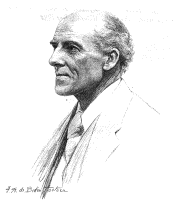
Pearson is perhaps most familiar to the general reader as an advocate of eugenics. For an introduction and guide to this literature see MacKenzie and
G. R. Searle (1976) Eugenics and Politics in Britain 1900-1914. Leyden: Noordhoff.
D. J. Kevles (1985) In the Name of Eugenics: Genetics and the Use of Human Heredity, New York: Knopf.
P. M. H. Mazumdar (1992) Eugenics, Human Genetics and Human Failings. London: Routledge.
Kevles has a valuable bibliographical essay.
There are 2 short extracts from Pearson’s writings on eugenics in
Lucy Bland & Laura Doan (eds) (1998) Sexology Uncensored: The Documents of Sexual Science, Chicago: Chicago University Press. (Table of contents)
There is an essay
Carolyn Burdett “From the New Werther to Numbers and Arguments: Karl Pearson’s Eugenics” in Roger Luckhurst & Josephine McDonagh (eds) (2002) Transactions and Encounters: Science and Culture in the Nineteenth Century, Manchester: Manchester University Press.
Pearson’s participation in the Men and Women’s Club (in existence from 1885 to 1889) and his marriage to Maria Sharpe are discussed by Porter (2004) and by
L. Bland (1995) Banishing the Beast: English Feminism and Sexual Morality 1885-1914, London: Penguin.
The Club is also discussed in
Judith R. Walkowitz, (1986) Science, Feminism and Romance: The Men and Women’s Club, 1885-1889, History Workshop, no. 21 (Spring), 37-59.
Judith R. Walkowitz (1992) City of Dreadful Delight: Narratives of Sexual Danger in Late-Victorian London, London: Virago. (review by Lesley A. Hall)
Elaine Showalter (1990) Sexual Anarchy: Gender and Culture at the Fin-de-Siecle, New York: Viking.
Olive Schreiner (Burdett) was the Club’s best-known woman member. There are accounts of her relationship with Pearson in
Ruth First & Ann Scott (1980) Olive Schreiner, London: Deutsch.
Carolyn Burdett (2001) Olive Schreiner and the Progress of Feminism: Evolution, Gender, Empire, Basingstoke: Palgrave.
The biography of another novelist, Amy Levy, discusses her relationship with Pearson
Christine Pullen (2010) The Woman Who Dared: A Biography of Amy Levy, Kingston University Press.
The careers of two of KP’s female colleagues are described by
R. Love (1979) Alice in Eugenics Land: Feminism and Eugenics in the Scientific Careers of Alice Lee and Ethel Elderton, Annals of Science, 36, 145-158.
Semmel pioneered the study of Pearson’s social ideology in its historical context
B. Semmel (1960) Imperialism and Social Reform: English Social-Imperial Thought 1895-1914, London: George Allen & Unwin.
There are later references in Olby. See also MacKenzie and Porter (1994 and –99).
Pearson also appears in Jones’s more sociologically oriented study
Greta Jones (1980) Social Darwinism and English Thought: the Interaction between Biological and Social Theory, Brighton, Sussex, Harvester Press.